
My dad, uncle and I hiked down, and then back up the Grand Canyon in the middle of summer. We were told it would take around 5 hours to hike back up, but after 4 hours I saw the top, maybe just 10 more minutes away, and I was impressed by our hiking. I was wrong. At 5 hours, we were all pretty exhausted, and I finally saw the peak closing in. I was wrong again. After observing one group of hikers having to get helicoptered out due to exhaustion, and giving one of our canteens to another group, we had another couple discouraging times of thinking we reached the top, and were wrong.
The Grand Canyon is so long and deep, making our view so restricted, many areas looked like the canyon peak, but were just local high points, with much further trail continuing beyond. Finally, after around 8 hours, we reached the actual top of the canyon.
The vast majority of questions or challenges audiences have asked me about the Bible, were coming from someone who thought they were at a high point of understanding, but it was easy to see they were only standing on a foothill, ignoring the mountain before them.
- The Bible is just a bunch of ancient ideas, now we have science.
- The Bible includes miracles and the supernatural, so I cannot trust it.
- Didn’t Emperor Constantine just decide what books were put in the Bible and which were left out?
- We cannot know what was originally written in the Bible.
- What’s with all the different translations, we cannot know which to trust?
- There are so many errors in the Bible, thousands of copy mistakes, so we cannot know what is trustworthy and what was simply added.
These sound like good challenges, at first, until you think or research further, which opens your limited view to see the immense mountain of evidence looking down on you.
What is the PRIMARY question to ask?
All of the questions mentioned above are very secondary questions, the primary question to ask is: Is there a God behind the Bible. The answer to this question is so towering because its significance overshadows every other question that can be asked about the Bible.
Think: If there is a God behind the Bible, all supposed problems are very secondary to the need to take this communication as serious as it gets. What you do not like in the Bible, or do not currently understand is walking in the foothills of the mountain of significance before you.
If you disagree – Why would you believe as you do? Are you claiming you know enough to discount a source of information from the Creator of the universe, a source in a position to know and ensure their purpose, on a level no other source remotely approaches? What reasons or evidence support your belief? If you realize the overarching importance of the primary question, then we need to ask …
How could you know if a God was behind something?
Answer: It at least needs to do something beyond human capacity? This is how you would establish yourself as an authority beyond all others.
I have read the Koran, Vedas, Bible, Book of Mormon, atheist books, and other sources of information people claim has a God behind it, or supposedly have the answers to life’s biggest questions. It is a fairly simple process to determine which sources of information are simply written by people with nothing more behind them than any other book, and which establishes itself on a whole other level of authority.
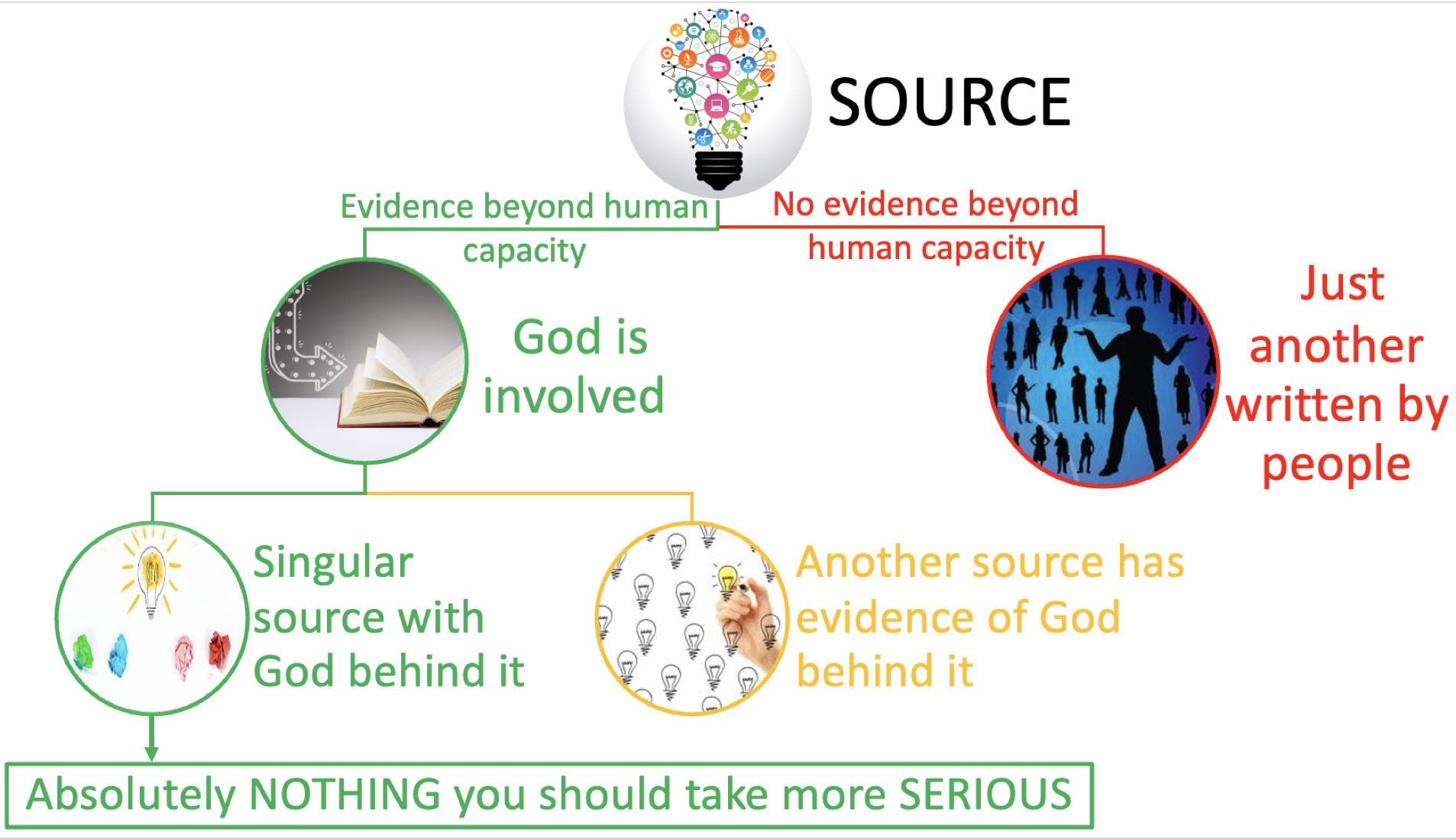
The Bible stands absolutely alone in verified authority
While there may be some impressive ideas, insights, wisdom, etc., in any of the sources mentioned, the Bible is absolutely alone in validating its authority as beyond human capability to produce. This was covered in blogs concerning astronomical discoveries (The BIG BEGINNING and The BIGGER CAUSE, and others in the works) and predictions concerning Jesus (1 in 100 Billion Pick). One of the best-known ways to test the validity of something is if the source provides new information, no one would have known otherwise, and the Bible’s claims about the beginning and cause of the universe went against every other religion, common sense experience, and science, all the way to around Einstein’s time, when modern science reached the same understanding biblical scholars had for millennia.
Nothing by man has ever come close; nothing by man has such verification of authority beyond human limits. If you think something is comparable, like Nostradamus, what’s your evidence? There are standard tests for the validity of a claim or model about reality, including: how well a model explains what we find, how much it explains, are the predictions accurate and difficult to match.
The biblical model reaches a level of validation in these tests no other competing claim is able to reach. One cannot rationally walk past this point, unless other examples show the Bible is not entirely alone in this. Many more reasons can be given to support there is something well beyond humanity’s ability in the Bible, but those will be covered in later blogs.
Brett Kunkle, Sean McDowell, and J. Warner Wallace brought a group of students, and invited me along, to the University of California in Berkeley to interact with undergraduate and graduate student and professor atheist groups. When the question-and-answer period began, I briefly gave a sample of the multiple, clear, specific predictions of the Bible, and asked the hundreds of people in the crowd, including the atheist debaters and professors: “If you think the Bible is only a product of humans, then name other books, or anything ever produced by humans, matching the number and level of clear, specific, accurate predictions, given so far in advance of scientific recognition? No person could have known what the Bible provided.”
Silence, until the lead graduate debater on the atheist panel said, “But there are errors in the Bible.” I noted as a debater he knows better than to go off topic (using the red herring fallacy). Even if there was something entirely false in the Bible, such as claiming UC Berkeley actually had a good football team – so what? Does that mean you don’t have to take the Bible seriously? We just covered incomparable evidence there is a God behind the Bible! So, even if we found errors, which I can argue against later, you still have to take the Bible as seriously as it gets because it is a source of information dwarfing the importance of all others.
I asked the question again, “If you think the Bible is just the product of people, then all the people in all of history would produce other works that can compare, what are they?” Silence. Someone tried to break the silence by going off on another topic, but I told them I was not going to let them illogically avoid the question. I asked the question again. Silence. I let the silence drag on a really awkward amount of time, then concluded with:
“Your silence speaks very loudly, doesn’t it.”
I waited, silence followed, I sat down. During this awkward silence, hopefully the audience started to glimpse the biblical mountain of significance overshadowing the small things they did not like or did not understand about the Bible.