The Treaty that Led to a War
David S. Symington, PhD
The War of 1812 has been referred to by historians as “The Forgotten War” and “Mr. Madison’s War,” but the most descriptive name was the “Second War of American Independence.” This is because it was fought largely over issues resulting from the Revolutionary War. Despite the 1783 peace treaty ending the American Revolutionary War, a “Cold War” persisted between the United States and the British Empire.
Although there were numerous outside reasons having a profound effect on the causes of the War of 1812, like the rise of Napoleon, and the poor communication systems of the time, the main cause of the war was the resentment between the United States and England since the Revolutionary War. The reasons for this resentment included:
- the Indian uprisings in the West, which were encouraged and supported by the British;
- the desire of land by both sides;
- the issue of “freedom of the seas”;
- the failure of political compromise;
- and national pride.
The Treaty of Ghent, signed on December 24, 1814, which ended the War of 1812, did not address the major causes of the war, but did refer some of the issues to joint commissions for future settlement. In submitting the treaty to the United States Senate for ratification, President Madison claimed no victory. John Adams described the document as being nothing – nothing was adjusted, nothing was settled – nothing in substance, but an indefinite suspension of hostilities.”[1]
A close examination of the main provisions of the Treaty of Ghent reveals the War of 1812 was a draw for both sides. Nevertheless, most Americans look back at the war of 1812 with both pride and satisfaction because of the results of the final battle of the war, which was actually fought for two weeks after the Treaty of Ghent officially ended the conflict.[2]
[1] John Blum, et al. The National Experience: A History of the United States (New York: Oxford, 1963) 181.
[2] Hämäläinen Murrin et al. Liberty, Equality, Power, A History of the American People, Volume I: to 1877. 275.
Not Going Well for the Americans
The first year of the War of 1812 did not go well for the Americans as they attempted the “three-pronged drive” into Canada. This attack was directed at Detroit, Canada’s capital city of York (later named Toronto), and Montreal. One result was the Americans lost Detroit. British General Isaac, who knew the American General Hull was afraid of Indians, sent a note into the fort telling Hull that “The numerous body of Indians who have attached themselves to my troops will be beyond my control the moment the contest commences.”[1] Brock also paraded his entire force on the other side of the Detroit River, and in a circle so Hull thought he was facing a much larger force. Worried about what would happen to the women and children in a full-scale Indian attack, Hull surrendered his entire command of 2,000 militia without a single shot being fired. The Americans also lost the garrison at Fort Dearborn (Chicago), and sacked Fort Mackinac in the northern Michigan Territory.
The American invasion of Canada from the east also resulted in frustration and defeat. The plan called for an American force of 6,000 regular troops and local militiamen to cross the Niagara River separating Ontario from western New York, and face the 2,000 British and Indians on the other side of the river. The regular American army troops successfully crossed the river and established a camp at Queenston Heights, but the New York militiamen refused to cross the river to reinforce the regulars because they did not believe it was their duty to invade other countries. The British regrouped and slaughtered the outnumbered, exhausted American regulars. This happened with other militia groups throughout the War of 1812, and proved that the citizen-soldiers could not be trusted or expected to extend an invasion into other countries.
The tide of the war shifted in 1813 with the British military deploying their best resources to the defeat of Napoleon. A more experienced American army returned to Canada and raided the Canadian capital at York (Toronto), and against orders, burned the city. Further, although an autumn offensive against Montreal failed, the Americans had better luck on Lake Erie.
[1] Murrin 286.
Providential Winds
With the barrier of Niagara Falls keeping Britain’s saltwater fleet out of the upper Great Lakes, the British and Americans engaged in an ambitious shipbuilding contest on Lake Erie. By September, Commander Oliver Hazard Perry was ready for a major engagement with Captain Robert Barclay and the British fleet at Put-In-Bay. Captain Barkley, who had lost an arm at the Battle of Trafalgar, was an experienced naval officer with six ships at his command. The two fleets were just about equal with Barclay having more guns, 63 compared to Perry’s 54, but with three less ships.[1]
On the morning of the battle, Commander Perry ran up his battle flag with the inscribed words, “Don’t Give Up the Ship”[2], which were the last words of his friend, Captain James Lawrence, who lost his life in a naval battle earlier in the war. Just as the two fleets came into range, the wind shifted in favor of the Americans, and Captain Barkley had to change direction to a less favorable position.
After two and a half hours, Commander Perry had to abandon his flagship Lawrence, due to damage, but another change in the wind enabled four additional American schooners to arrive and join the battle. Within an hour, the British ships lowered their colors and surrendered. Oliver Perry declined to accept the tendered swords, and only asked about Captain Barclay, whom he learned earlier had been wounded. Being informed he had survived the battle (Perry and Barclay would become lifelong friends), Perry would then write his famous report to General Harrison, “Dear General, we have met the enemy, and they are ours. Two ships, two brigs, one schooner and one shoop. Yours with great respect and esteem, O.H. Perry”[3]
Commander Perry’s naval victory at Put-In-Bay is one of the most important events of the War of 1812 because it forced the British to abandon Lake Erie, and the entire Northwest Territories. It was also the first time in the war that a Providential wind, in two pivotal occasions, had changed the course of a battle in favor of the Americans.
With the naval defeat at Put-In-Bay, the British lost control of the Great Lakes and had to depend on their land forces, which included over 3,500 native warriors who were under the influence of the brilliant Shawnee Chief Tecumseh. Although Tecumseh’s village was destroyed by General William Henry Harrison’s army, Tecumseh was away recruiting additional tribes to join his Indian Confederation. After the battle of Tippecanoe, he left with his brother, the “Prophet”, for Canada to join with the British fighting the Americans.
Tecumseh was the greatest threat to the frontier territories because of his intelligence in combining the gifts of both the warrior and the statesman. His diplomatic abilities in forming an Indian Confederation from tribes that have been traditional enemies was an amazing accomplishment. He was charismatic, a natural leader, skilled orator, and a brave and respected warrior, who had a clear vision of uniting the different tribes into a Pan-Indian confederacy that would spread from Canada to the Gulf of Mexico.
Tecumseh joined the British forces under the command of General Proctor. The control of Lake Erie enabled the United States to cut off supplies to the British in Canada. General Harrison, aware of this fact, attacked the combined force of General Proctor and Tecumseh at the Battle of the Thames River.
Tecumseh had doubts about the fighting ability of the British soldiers, and had a premonition of his own death before the battle. The night before the battle, Tecumseh was deeply pessimistic. He confided to his chiefs, “When General Brock was in command, he used to say, ‘Tecumseh, come and fight the Americans’, but General Proctor always says, ‘Tecumseh, go fight the Americans’ … Brothers, we are about to enter an engagement from which I will never return. My body will remain on the field of battle.”[4] Tecumseh’s concerns about the British soldiers and General Proctor’s leadership as a warrior proved correct.
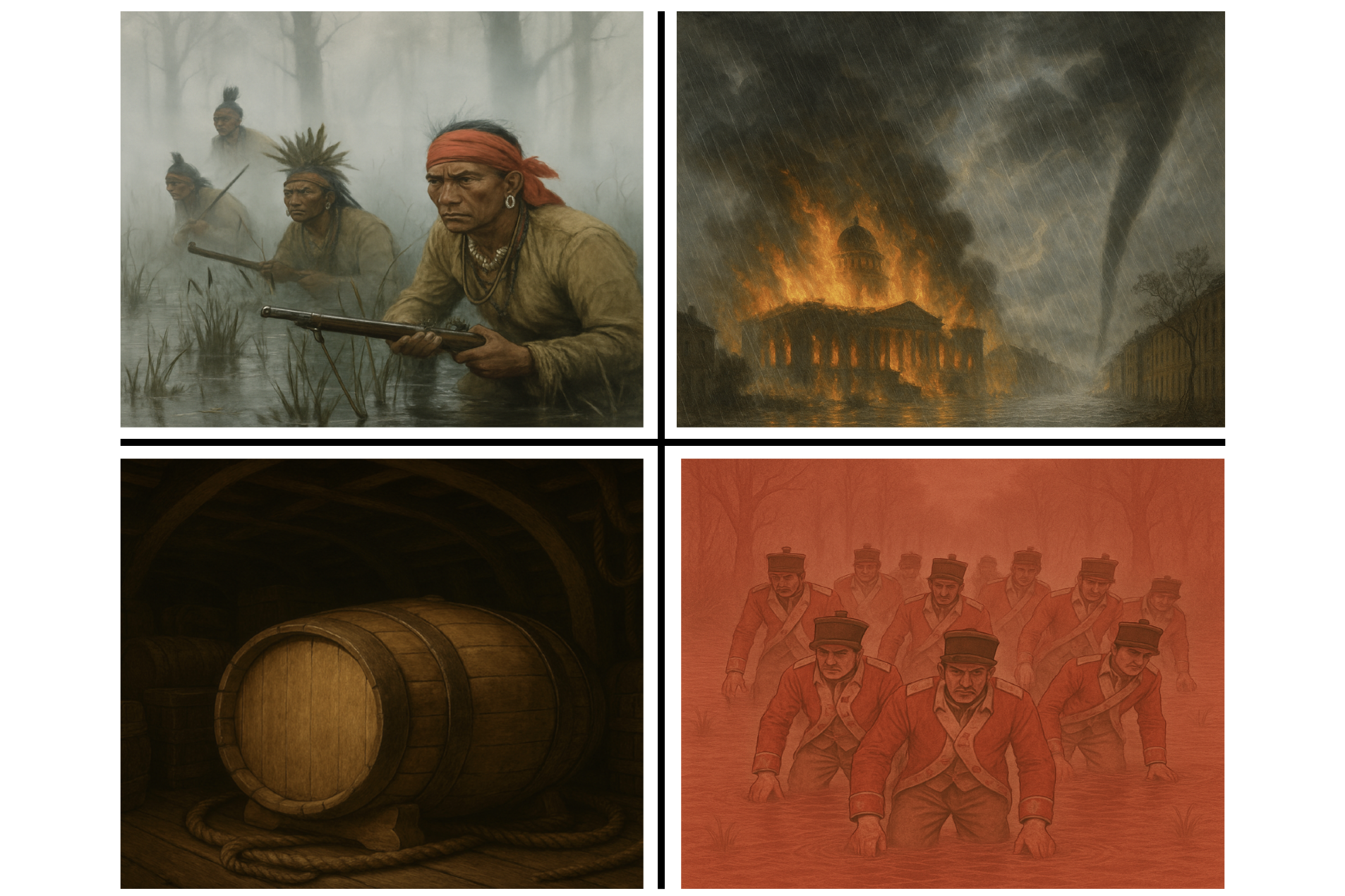
The plan was for the British line to push General Harrison’s troops into the swamp area, where the Indians were waiting in ambush. However, it had taken only a few minutes for the Americans to crash through and flank the British line. After a meager attempt to rally his men, General Proctor fled the field, leaving Tecumseh to face the Americans alone. This would not have been a problem because a heavy fog covered Tecumseh and his 1,000 Indian followers, who were hidden in a perfect ambush position under heavy undergrowth by the side of the swamp.
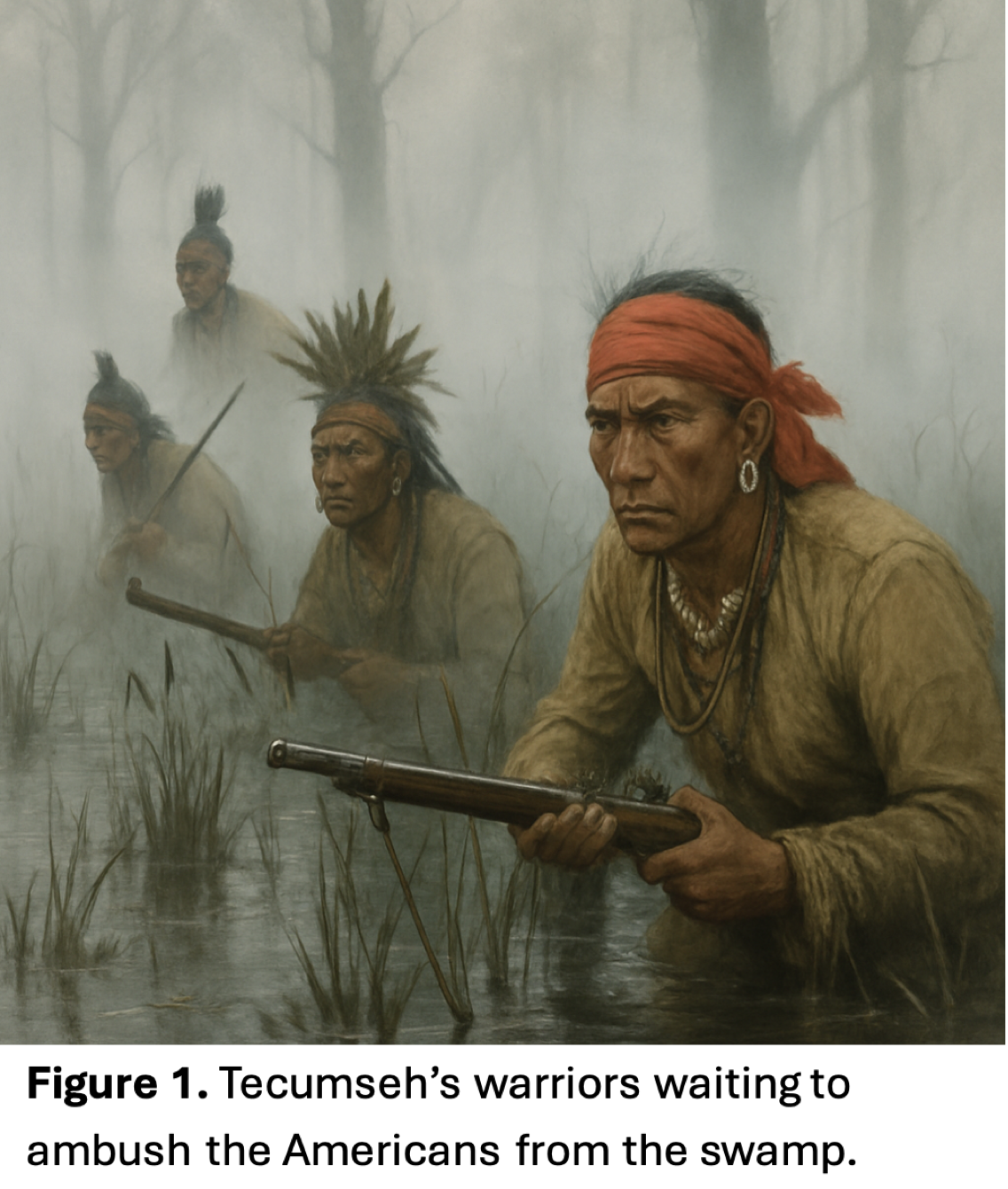 The Americans were about to charge into this fatal trap, when destiny, in the form of yet another providential wind, lifted the fog that had settled only around the swamp. With Tecumseh’s warriors’ positions now uncovered, the outcome of the battle was determined. After a frightening period of deadly hand-to-hand combat, Tecumseh was killed, and the Indians lost their will to continue the fight. The providential wind removing the fog at just the right time was a decisive element in the American victory. General Harrison had lost only 15 men slain or mortally wounded, and a similar number injured. The British and Indians suffered severely, losing 634 men killed or captured.[5]
Although the one-sided loss by the British at the Battle of the Thames was difficult to comprehend, their greatest loss was with the death of Tecumseh. With his death lay the end of the British-Indian alliance, along with the dream of a Pan-Indian Confederacy. The events that led to the victory on the battlefield made General Harrison, like General Andrew Jackson after the Battle of New Orleans, a believer in George Washington’s “Doctrine of Providence”. After the Battle of Monmouth, Washington wrote: “… the hand of Providence has been so conspicuous in all this that he must be worst than an infidel that lacks faith, and more than wicked that has not gratitude enough to acknowledge his obligations.”[6]
[1] Hubbard Cobb. American Battlefields (Simon & Schuster MacMillian Company, 1995) 106-7.
[2] Hubbard Cobb 105.
[3] Hubbard Cobb 108.
[4] Peter Marshall and David B. Manuel Jr. From Sea to Shining Sea (Grand Rapids, Michigan: Revell Publishing Company, 2009) 151-152.
[5] Holt and Company 374.
[6] Michael Medved. The American Miracle (New York: Crown Publishing Group – Penguin House LLC, 2016) 86-87.