
Whether you study the Quran and Muhammad, the Talmud and Rashi, Tao Te Ching, the Bhagavad Gita, Buddha, the Book of Mormon and Jospeh Smith, The Grand Design and Stephen Hawking, or others, these are all the same: lofty claims absent the evidence to keep those claims aloft. There is a lot of good thinking and accurate claims in there, those people involved were intelligent and/or creative, but as far as providing definitive answers to the big questions and evidence of that singular communication from the personal Creator the first three smooth stones led us to—nothing.
In previous blogs we discussed unprecedented aspects of the Bible requiring input from God, and there are other examples beyond human capability, one of these is consistent predictions and markers, written even hundreds of years before Jesus, picking out Jesus precisely from the collection of any person to have ever existed on Earth.
Think about that. Try to come up with numerous predictions about a single person, who would impact the world probably more than any other, and simultaneously expect other people in different times and locations across hundreds of years would combine their predictions with yours, and these predictions were so precise as to pinpoint a single person in all time who would go on to match these predictions and change the world. People can not do this, which makes this a good test for truth.
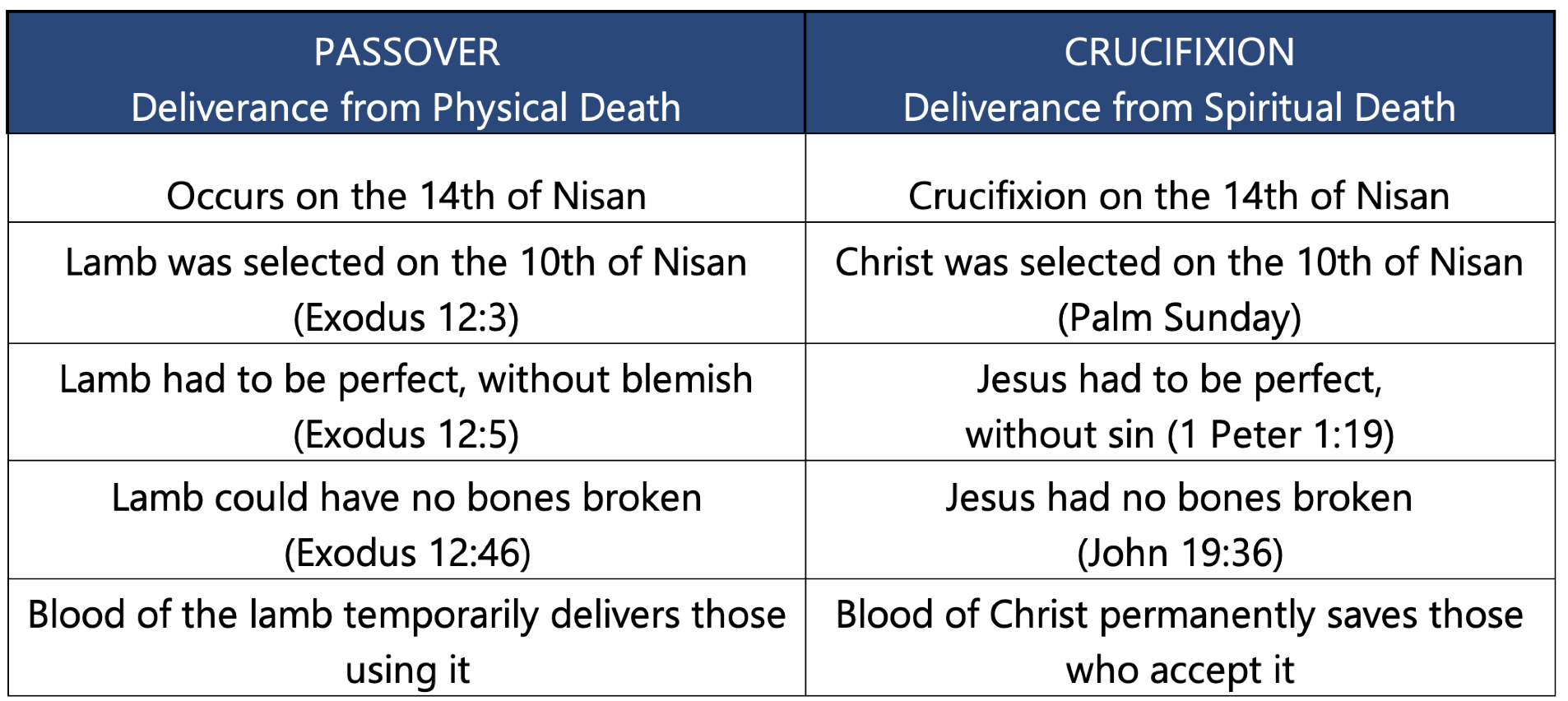
Certain figures, events, or objects in the Old Testament (OT) are understood as a foreshadowing of Christ and his work. This is a form of predicting what will happen in the future with knowledge beyond human capability. This tremendously broad typology study is interesting to investigate, but even brief coverage makes the point more than noteworthy, and necessary to account for. For example, the major Jewish holiday of Passover can be compared directly to Jesus’ crucifixion.
This next example I researched because the Old Testament (OT) account of Isaac was troubling to me. Reading Genesis 22 we are told how people were engaging in pagan religions, which among other things, required human sacrifice, especially children. Archeology has found bones of children in piles, and discovered repulsive details of the sacrificial practices. The Bible gives God’s thoughts and actions against the practice, for example, Jeremiah 19:5, Deuteronomy 12:31, 18:9-12. The Bible makes it clear, God does not accept the excuse “everybody is doing it”, but instead makes clear, all other gods are “not like us”. While Kendrick Lamar used this line to musically “diss” certain people, I couldn’t resist using the line as it fits. God is symbolically exposing the other supposed gods, noting these degenerates are nothing like us (God the Father, Son, Holy Spirit).
Therefore, when the account states God asked Abraham to offer up his son as a sacrifice, I was very confused. Of course, I hadn’t applied the rest of the biblical context, or really looked further into the issue as I did not know how to find an answer. Later, when I did, it became clear God was pointing towards the coming Messiah, and at the same time flipped the common non-biblical beliefs on their head.
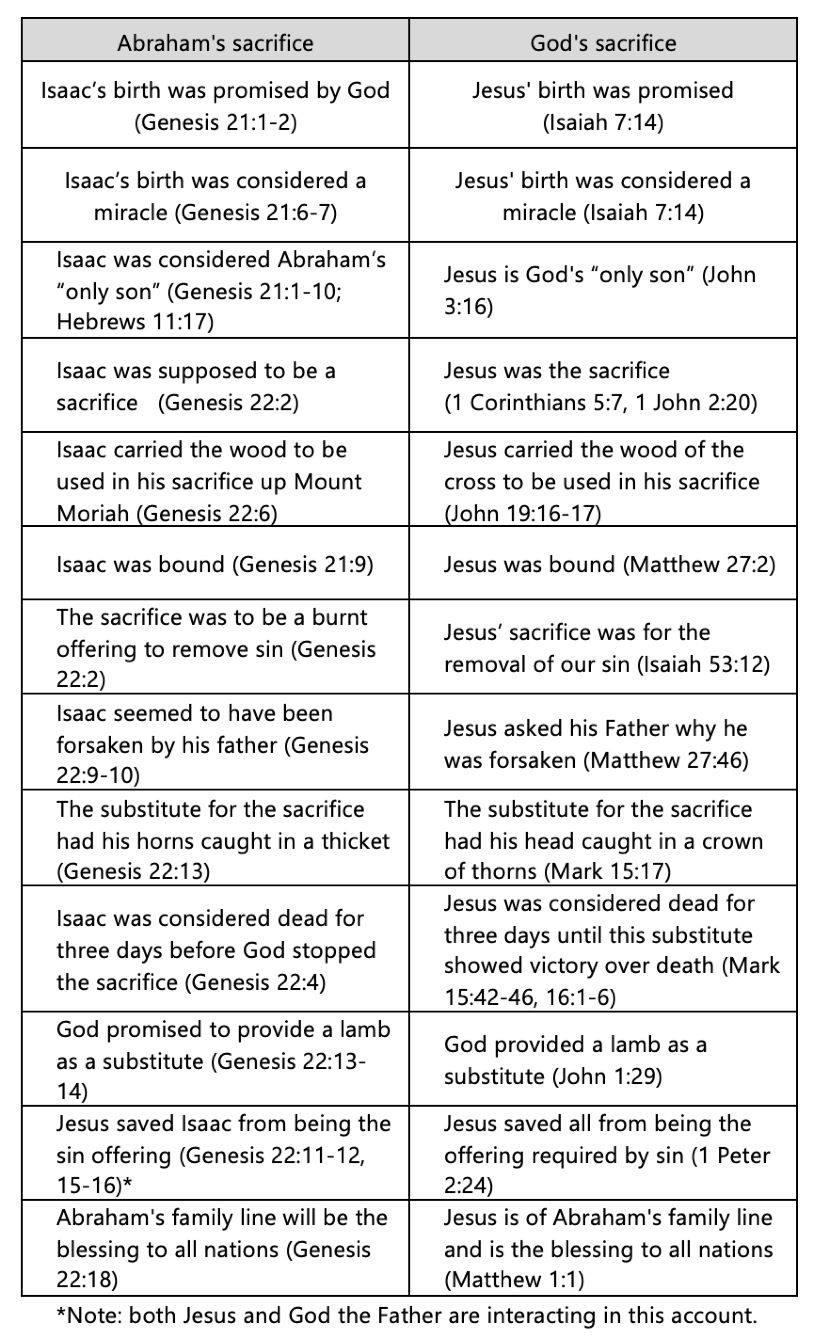 While the other belief systems required you to sacrifice your child to the gods, God asked Abraham to sacrifice “his only son” to demonstrate[1] (whether to Abraham himself, or to others) this follower of God loves God as much as those who worship pagan gods, but the biblical God completely flipped this practice, by doing what none of the supposed gods were willing to do, by instead sacrificing “his only Son” (John 3:16) for us.
Abraham knew God had earlier promised to create a nation from Abraham’s son Isaac, so, he believed God would have to bring his son back to life as he knew he could trust God’s promises (Hebrews 11:17-19), but the story was much deeper than Abraham, and even readers today, have grasped. There is a two-thousand-year string of connections between this account and the account in the New Testament (NT) about Jesus.
The birth of Isaac was predicted by God to be a miraculous act, and Isaac was considered Abraham’s “only son” (Genesis 21:1-10). Genesis 22:1-18 gives a number of other details, including: Isaac was supposed to be a sacrifice and carried the wood to be used in his sacrifice up Mount Moriah, which would result in a burnt offering to remove sin. Isaac was seemingly forsaken by his father. After, stopping the sacrifice, God promised to provide a lamb as a substitute for Isaac, which was three days after his request for the sacrifice. Instead of a lamb, a ram with his horns caught in a thicket was used. I remember thinking, wait, a ram is not a lamb, and looking at pictures of them they cannot be considered the same. A ram would serve as a burnt offering for what Abraham needed, but God still owed him a lamb. When you see all the connections, you will understand the lamb was provided over two-thousand years later (John 1:29).
[1] I would not be surprised if there is some other goal or reason God utilized this situation to achieve. While the Bible does clearly and redundantly cover some topics, God does not always care when or if we understand everything he does, as Jesus makes clear in John 6: 30-66, or Matthew 13: 1-23, and a number of other examples.
The Greatest Bulls-eye in History
If these two examples of symbolic ties to Jesus were all there was, then maybe you could write it off as coincidence, but these symbolic ties or foreshadowing are found throughout the OT. And further, these markers for the Messiah are supplemented with direct predictions (known as prophecies) given in the Old Testament. The biblical God demonstrated a pattern of validating those people used to communicate new knowledge from God (called prophets) with miracles and/or accuracy in predictions unmatched by humanity otherwise, and if you do a biblical study of miracles and prophecies, you will see them clustered around these individuals.
What do you think the probability would be of predicting, or guessing, numerous defining characteristics and future experiences of a person who will impact the world, and so specifically and accurately only one person in all history will fit? I do not think it is humanly possible, otherwise we would have had numerous examples of this throughout all of history, and many, many others able to come convincingly close. Where are those examples?
The OT is the only source I have found providing such verification of its authority and ultimate authorship. We only need to look at a few here as they are enough to show how each prophecy about the Messiah (Savior or Christ) brings in the restrictions of who can fit more and more, until eventually only one person is left within the confines prescribed by the prophecies. This is illustrated below by each prophecy having a circle of people who could potentially fit within its requirement, and as each prophecy is added, the circle of possible candidates on the target gets smaller and smaller, until eventually reaching a bullseye where only one person can be found.
If these two examples of symbolic ties to Jesus were all there was, then maybe you could write it off as coincidence, but these symbolic ties or foreshadowing are found throughout the OT. And further, these markers for the Messiah are supplemented with direct predictions (known as prophecies) given in the OT and NT. The biblical God demonstrated a pattern of validating those people used to communicate new knowledge from God (called prophets) with miracles and/or accuracy in predictions unmatched by humanity otherwise, and if you do a biblical study of miracles and prophecies, you will see them clustered around these individuals.
What do you think the probability would be of predicting, or guessing, numerous defining characteristics and future experiences of a person who will impact the world the way Jesus did, and so specifically and accurately only one person in all history will fit? I do not think it is humanly possible, otherwise we would have had numerous examples of this throughout all of history, and many, many others able to come convincingly close. Where are those examples?
The Bible is the only source I have found providing such verification of its authority and ultimate authorship. We only need to look at a few here as they are enough to show how each prophecy about the Messiah (Savior or Christ) brings in the restrictions of who can fit more and more, until eventually only one person is left within the confines prescribed by the prophecies. This is illustrated below by each prophecy having a circle of people who could potentially fit within its requirement, and as each prophecy is added, the circle of possible candidates on the target gets smaller and smaller, until eventually reaching a bullseye where only one person can be found.
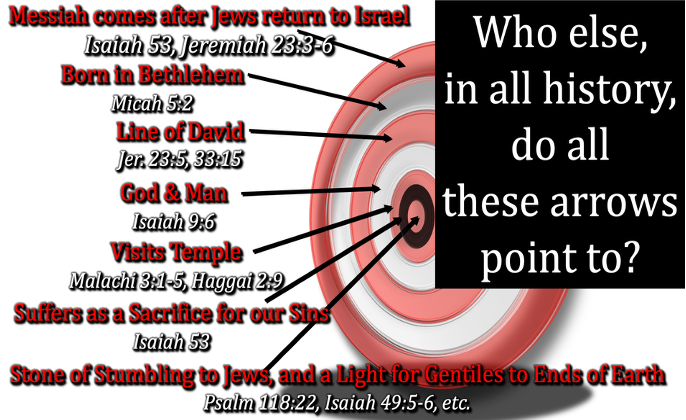
- The Messiah (Christ is the Greek word for Messiah, which means “annointed one”) will not come to do his work until the Jewish people come back together to the land of Israel, as a nation, and rebuild the First Temple (also known as Solomon’s Temple or Bayit Rishon), after first being destroyed, dispersed, and with large percentages being held captive in other nations (Jeremiah 23:3-6).
This was written over 600 years before Jesus’ time and such a return of the Jewish people back to rule over their land was far from likely at that point in time. Yes, I know, religious-sounding words like “prophecies” may seem uncomfortable, they definitely did for me, until I saw the evidence. This topic is covered in another blog on the website, but think on the following example. The Jewish people were decimated by the Assyrians and the Babylonians, the temple they built for God was destroyed, and they were taken captive by the greatest empire to have existed by that time, Babylon. The prophet Isaiah in chapter 44 and 45 (Isaiah 44:28; 45:1) observes how Israel is God’s chosen people to show the word what happens when a people follows God, or decides to go their own way. Israel had decided to go their own way, and even followed other gods. Therefore, consequences were soon to follow, which included destruction, dispersal and captivity. That’s the bad news.
However, Isaiah also says there is good news, hope. Amazingly, Isaiah states by name the person God will use in the future to conquer the greatest empire of that time, release the Jewish captives, and even allow them to rebuild the temple. Isaiah’s book, provided this exact name, Cyrus, and is known to have been written over 100 years before Cyrus the Great was born. The Jewish people returned and built the Second Temple around 500 BC. Therefore, only people born after that time are in the running to be the Messiah.
- The Messiah will be born in Bethlehem Ephrathah (Micah 5:2).
Now the circle containing all the possible candidates for the Messiah is significantly smaller, only allowing anyone born in this specific ancient village. Given 700 years before Jesus’ birth, Micah was very specific noting not the city of Bethlehem, the large walled-in area where the wealthy lived, but Bethlehem Ephrathah, a farming village Micah noted was seemingly unimportant.
The symbolism here is maybe as stunning as the prediction. This humble farming village was the birthplace of King David, and was also known for providing spice and other needs for the priestly functions in the bigger city, even the Passover lambs sacrificed for the people’s sins came from Bethlehem Ephrathah.
- The Messiah will come from the family line of David (noted in several places, including Jeremiah 33:15).
The genealogies are used in the Bible to make this clear for Jesus, as Mary is a descendant of King David’s son Nathan. Again, the possible candidates for the coming Messiah are further constricted.
- This Savior will be both God and man as Isaiah 9:6 gives attributes of both natures, God and man, to this child to be born.
Isaiah was a big-time prophet, and he added a big-time claim. In fact, his words are often heard every year in Christmas plays to celebrate Jesus’ birth:
For to us a child is born,
to us a son is given,
and the government will be on his shoulders.
And he will be called
Wonderful Counselor, Mighty God,
Everlasting Father, Prince of Peace.
Many think this was written in the NT Gospels, Nope. This was provided 700 years before Christ was born to let people know this was God disclosing himself personally on Earth.
- This Christ will visit the Second Temple (Haggai 2:9, Malachi 3:1-5).
When the Jewish people returned from exile to a desolate land, with the heart of the former nation, Solomon’s Temple, destroyed, they were despairing of what was lost as they felt the destroyed First Temple would never be equalled. But God raised their spirits by letting them know he will fill the Second Temple even further with his glory. When God says he will fill the temple with glory, he is speaking about the “glory of his name”, which was used in the OT and meant his presence, which in the First Temple was displayed as a pillar of smoke or fire. So how can his glory, his presence, be greater than it was in the first Temple? The pillar of fire was not seen again, but only if the Messiah comes personally to visit. And a later prophet, Malachi, added the Lord will come to his temple and purify some and bring judgement to others, and used the Hebrew term which always refers to God himself doing the work. This ties poignantly to the scene of Jesus displaying his unique role and authority against the religious practice allowing money changers at the Second Temple.
Since this Second Temple was in use between 516 BC and its destruction by Rome in 70 AD, what Jewish person personally visited the temple before it was destroyed in 70 AD, who also fit the other qualifications? Can you see the circle of possible candidates getting very small? The destruction of the Second Temple not only ended the annual practice of giving sacrifices for Israel’s sins, but also the time frame when the Messiah would come.
- The Messiah will suffer as a sacrifice for our sins (Isaiah 53, and numerous other passages).
Now read Isaiah 53, and ask yourself, who is this talking about? Remember Isaiah wrote this description seven centuries before Jesus was born.
Imagine guessing accurately a number of aspects of a person, who the calendar pivots upon (B.C. to A.D., or BCE to CE for those who get sensitive bringing Jesus into it). Isaiah 53 was uncomfortable and a problem many Jewish people of the time could not abide, as they were suffering under Roman rule and were hyper-focused on the conquering aspects of the coming Messiah. King David was a conqueror, and the Messiah would be greater by far, and while many passages speak of the pain and suffering of the Messiah as well, the people of that time either did not believe in a resurrection (Sadducees), or believed all would be resurrected at the final judgement (Pharisees). The idea of a Messiah being killed and rising to accomplish a greater goal than conquering Israel’s foes on Earth was not part of what the people were being taught or expected.
- The Messiah would be a stone of stumbling to Jews, and a light for Gentiles to the ends of the earth (Psalm 118:22, Isaiah 49:5-6, and other passages).
This Savior would not be accepted well by his own people, how embarrassing (but true of Jesus), and, on the other hand, would be accepted and bring salvation to others who are not Jewish, and all across the world. What Jewish person fits this qualification? Ruth Bader Ginsberg, or maybe Steven Spielberg? Out of the 100 billion or more people to have ever lived, only one I know of, and probably only one you know of, fits in the circumscribed space provided by just the predictions covered above.
There are many more arrows shot across the centuries to pinpoint the Savior the OT predicted was coming. Who else in all human history fits even these seven identifiers, aside from Christ Jesus?
I do not think it is humanly possible to have a group of people, separated by time, culture, and location, predict a future world impactor like this. Otherwise, if this were within natural capacity, we would have had numerous examples of this throughout all of history, and many, many others coming close. Where are those examples?
For those who don’t like symbols and are not comfortable with prophecies, usually mathematics is acceptable. But it is mathematics that verifies the validity and unequalled nature of the symbols and prophecies. Come up with your own odds on the likelihood of any group of people achieving this predictive accuracy, with all those diverse predictions, when only one person out of the over 100 billion others in all history will fit, and Jesus fits precisely. Mathematics does not worry itself about what people are comfortable with, only usage to provide facts about reality. The Bible is the only source I have found providing such verification of its authority and ultimate authorship. And it points directly and solely to Jesus, and does not stop there.
The next blog will give a quick way to approach all the possible options about what happened to Jesus: Five-Minute-Fact-Run.