Unexpected Intervention Came from the Skies
David S. Symington, PhD
In the winter of 1813-14, Napoleon’s situation steadily declined. Unable to defend France’s borders against a combined European military force, Napoleon was removed from his throne and exiled to the island of Elba. This enabled the British to now devote their full attention to the war in America. Although Wellington could not be persuaded to assume command of the war effort, the English Empire was able to send their elite army of Wellington’s Heroes that defeated Napoleon, along with a navy of over 900 ships that outnumbered the American fleet of just 10 ships.
There were a few notable victories by the American Navy, like the Constitution (“Old Ironsides”) versus the British frigate Guerriere, but most of the naval battles fought by the United States involved privateers.[1] These privateers carried enough guns to fight, but their primary tactic was to evade any ships-of-the-line, which were British warships with crews of 600-800 men, and attack merchant ships for their cargo. The only difference between a pirate and a privateer was the latter was recognized by a country and shared in the captured cargo.
With this type of military advantage, the British developed their own “Three-Pronged Attack.” This plan would concentrate on a blockade of the East Coast, New York area, capture of the Washington, D.C. and Baltimore area, and control of New Orleans in the South. They planned to punish the Americans for the results of the Revolutionary War. The blockade formed their main element of punishment, and it was very successful in crippling the maritime industry of New England. The Americans were unable to resist England’s powerful saltwater fleet, and without what President Madison referred to as “Providential Intervention”, they were also at the mercy of Britain’s powerful army, who had Washington, D.C. as its main target.
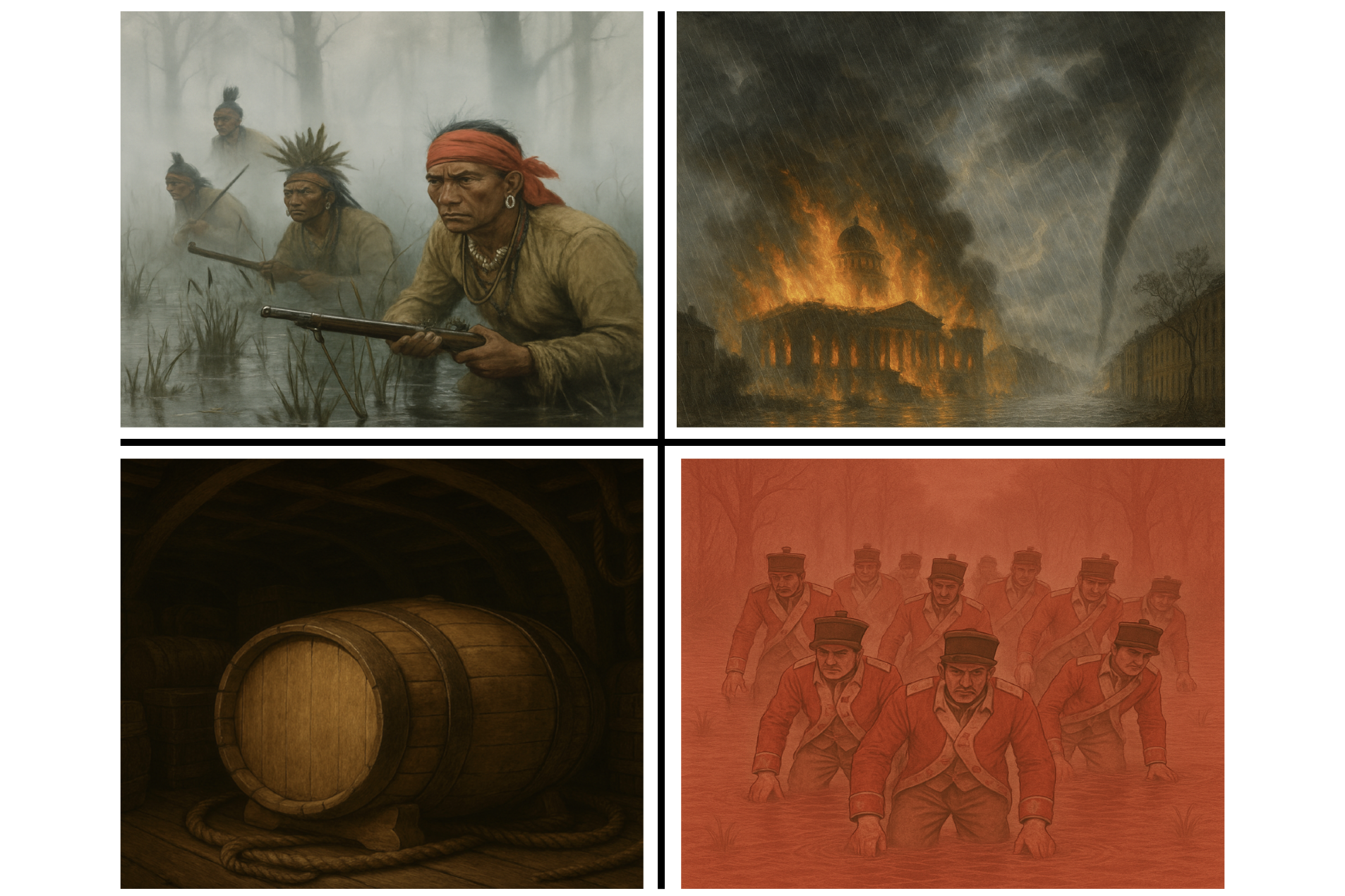
The British force of over 10,000 regular troops, encountered little resistance on their path to Washington, D.C. The worst example of American resistance came at Bladensburg, Maryland, where the British Army, under General Robert Ross, forced the Americans to flee the battlefield in such chaos that the battle became known as “The Bladensburg Races”. With the American forces scattered, the British marched unopposed into Washington, D.C., where the English officers ate a meal in the White House intended for President and Mrs. Madison.
Dolley Madison gained fame for refusing to leave the White House before she saved the portrait of President Washington, but it was a narrow escape, as within an hour, the British had begun to burn all the government buildings in the nation’s Capitol, except the patent office. The interior of the White House was totally destroyed by the fire in retaliation for the American destruction of the Canadian Capitol of York earlier in the war.
The British had complete control of Washington, D.C., and continued their destruction until the afternoon of December 25, 1814, when the area was hit by a historic rainstorm. Torrential downpours, violent lightning and tornadoes on Capitol Hill, where The British had their forward camp, killed more British soldiers than the Americans did, and doused the fires that were burning out of control. To Captain Harry Smith, the storm seemed to be of biblical proportions: “I never witnessed such a scene as I saw for a few minutes. It resembled the storm in Belshazzar’s Feast.”[2] It was reported that:
An unexpected intervention came from the skies. At midday, an immense storm struck a turn of weather that some in the city saw as God’s wrath. As the sky grew suddenly dark, a prodigious wind blew men off their horses, ripped the roofs off houses, and dumped a great volume of rain, all in what seemed like an instant. Trees were broken and dismembered, chimneys blown down … in the hurricane force winds.[3]
In parts of the city, every house was damaged. One British soldier, George Robert Gleig, wrote in his memoir “… of the prodigious force of the wind it is impossible for you to form any conception. Roofs of houses were torn off by it and whisked into the air like paper, while the rain which accompanied it resembled the rushing of a mighty cataract”.[4] The severe weather lasted for two hours with torrential rain and wind, uprooting trees, houses picked up and landing back on their foundation, and tossing cannons into the air.
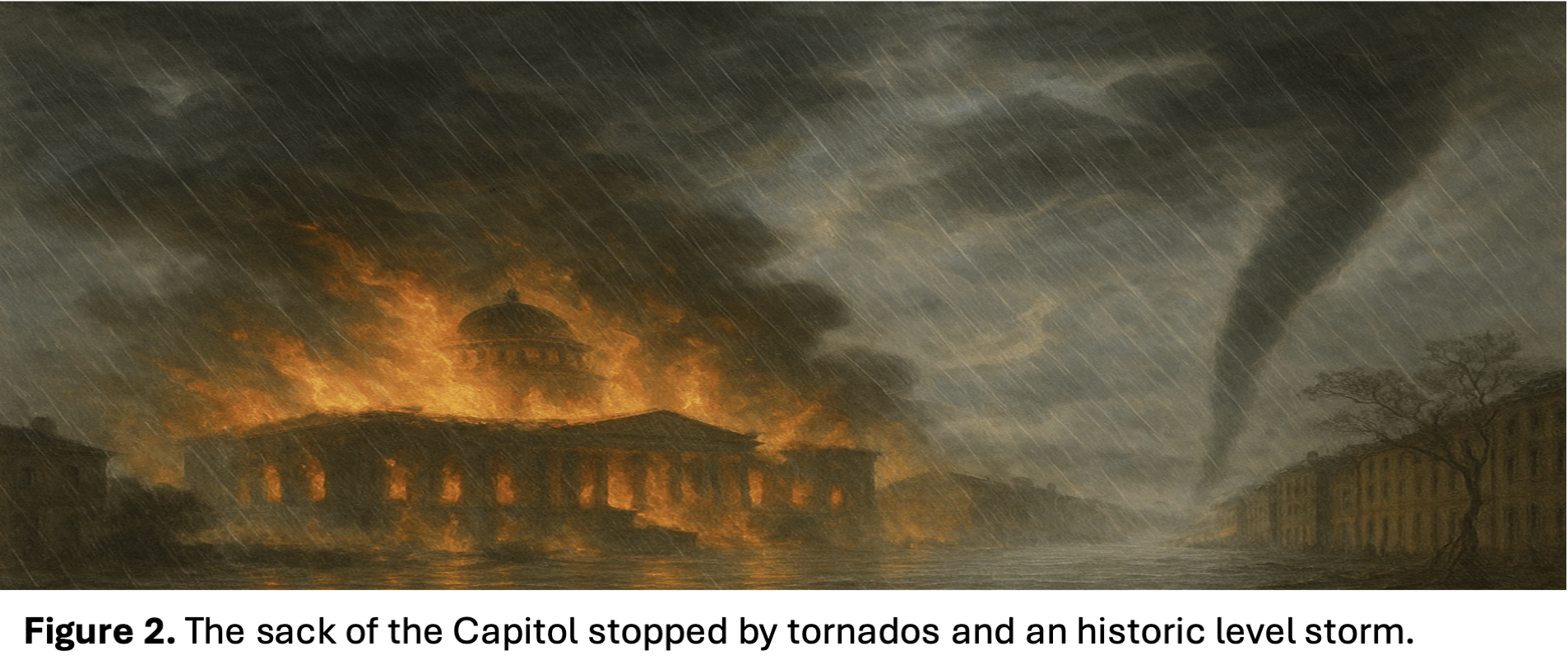
This fierce storm also doused the fires set by the British and doused their spirits. Quickly deciding to withdraw, the stunned British force limped out of the city, back to their ships, only to find them also damaged by the raging storm. That night as they abandoned the city, British Rear Admiral Sir George Cockburn stopped at a house to request some water from their pump. During this brief encounter, he asked the woman who was passing out the water, “Good God, Madam! Is this the kind of storm to which you are accustomed in this infernal country?” The woman replied, “No sir. This is a special Interposition of Providence to drive our enemies from our city.”[1]
[1] Jane Hampton Cook. The Burning of the White House: James and Dolly Madison and the War of 1812 (Washington, D.C.: Regnery History Publishing, 2016) 259.
[1] Richard C. Wade, Louise C. Wade, and Howard B. Wilder. A History of the United States (New York: Houghton Mufflin Company, 1971) 296.
[2] Steve Vogal. Through the Perilous Fight (New York: Random House, 2013) 201.
[3] Hugh Howard. Mr. and Mrs. Madison’s War: America’s First Couple and the Second War for Independence (New York: Bloomsbury Press, 2012) 208.
[4] Robert S. Quinby. The U.S. Army in the War of 1812: An Operational and Command Study (East Lansing, Michigan: Michigan State University Press, 1977) 695.
“I’ll eat in Baltimore tonight – or in Hell.”
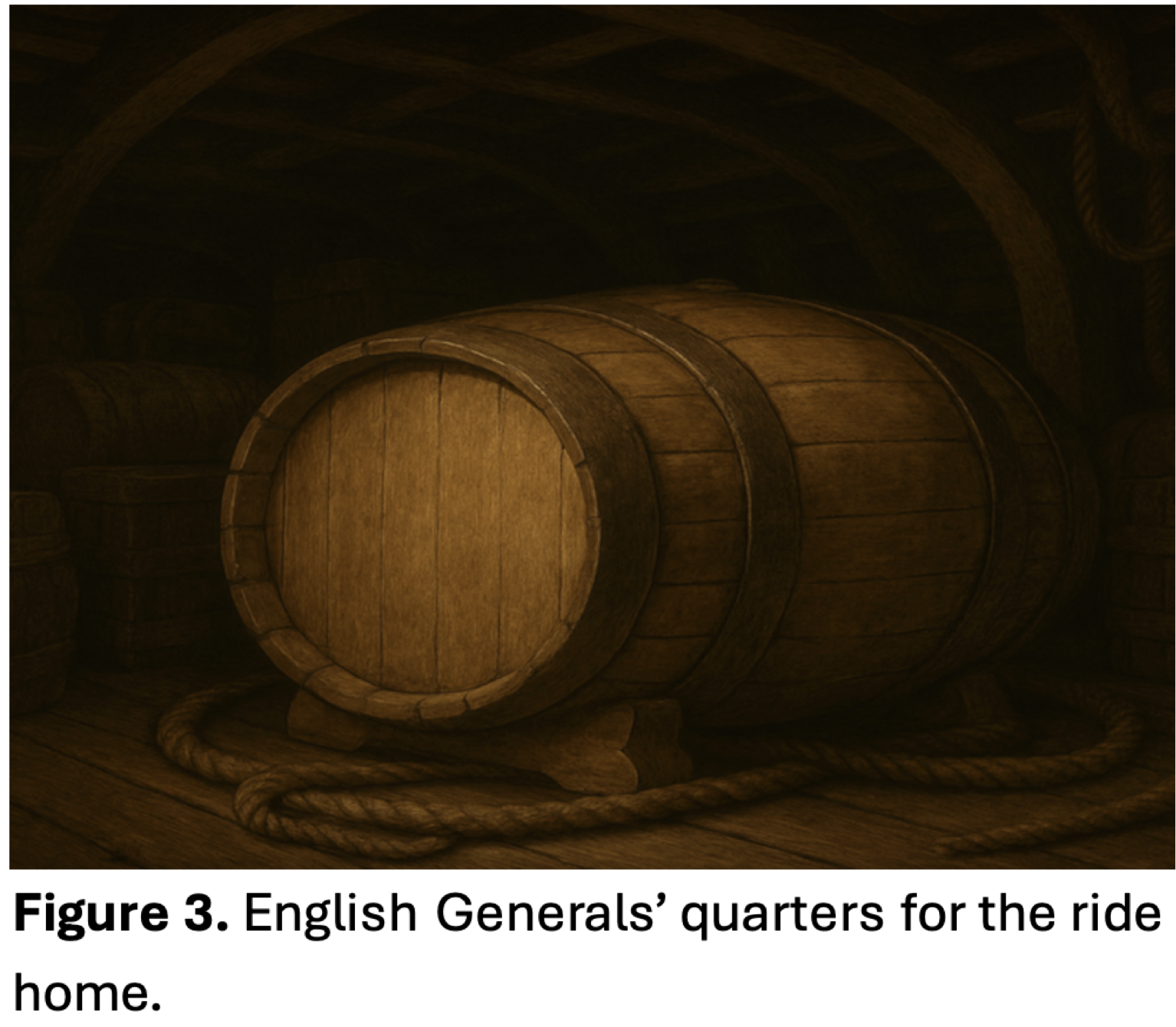 After the violent storm forced the British to leave Washington, D.C. in the middle of the night, their next target was Baltimore. The Port of Baltimore was a much bigger prize than Washington, D.C., because it was the fourth largest city in the US, and was also the home port for the for many of the American privateers. The advanced British force, which was extremely confident that they would capture Baltimore, was led by General Ross and stopped at a farmhouse they commandeered for a relaxed breakfast, while they waited for the main body of the army to arrive. When asked if they would need to be served dinner that evening, Ross replied with a smile, “I’ll eat in Baltimore tonight—or in Hell.”[1]
It was not recorded where General Ross ate dinner that night, but it was not in Baltimore. Later that day, two American sharp shooters fired at the on the advancing British column, mortally wounding General Ross, who was replaced by Admiral Cockburn. The British decided not to advance after stiff resistance on the part of the American militia. In order to get the needed reinforcements and moral support, the British needed to capture Fort McHenry, which guarded the entrance to Baltimore harbor.
[1] William J. Bennett. America: The Last Best Hope, Vol. 1 (Nashville, Tennessee: Nelson Communications \, Inc., 2006) 206.
The Story of “The Star-Spangled Banner”
In the Battle of Fort McHenry, the Americans hosted the largest United States flag ever made up to that time. The British brought the largest concentration of firepower that had ever been leveled upon one place in the United States. The British launched their attack with 35 Men-of-War, including the flagship Tonnant, which mounted a record 90 guns (America’s largest ship, the Constitution, carried only 44). There were also five of the Royal Navy’s new bomb vessels that lofted aerial bombs, which exploded directly over the heads of the defenders, instantly filling the air with flying shrapnel. These shells struck terror into the defenders of the fort. For the next 25 hours, Fort McHenry was pounded by bombs and rockets. Major General Armistead, Commander of Fort McHenry, estimated the British fleet had fired 1500 to 1800 cannon and rocket shots at the fort.[1] If you were a religious man, you would have “… you thanked God for the rain that had turned the ground inside the fort into a quagmire that simply absorbed many of the shells and rendered the earthen works outside like a sponge. You also thanked Him for the banty rooster that came out of nowhere, mounted a parapet and hurled defiance at the British to the cheers of the exhausted defenders. But most of all, you thanked Him for such obvious interventions as the mortar that landed directly on top of the powder magazine and dented in its roof, but did not explode. And you thanked Him that after a whole day in this living Inferno, you and most of your comrades were still alive.”[2]
Throughout the attack on Fort McHenry, the Americans suffered only two killed and several injured.[3] With the failure of the English to capture Baltimore, they sailed back to Chesapeake Bay, carrying General Ross’s body preserved in a barrel of rum. It is well-known that soldiers, who died in combat during that time in history, were buried on the field of battle, but English tradition called for the bodies of fallen Generals to be transported back to Britain for a proper burial. The British defeat at Fort McHenry resulted in the English representatives negotiating the Treaty of Ghent to allow the Americans to eliminate most of the sections of the peace treaty they found objectionable. This led to a ratification of the treaty, officially ending the war of 1812.
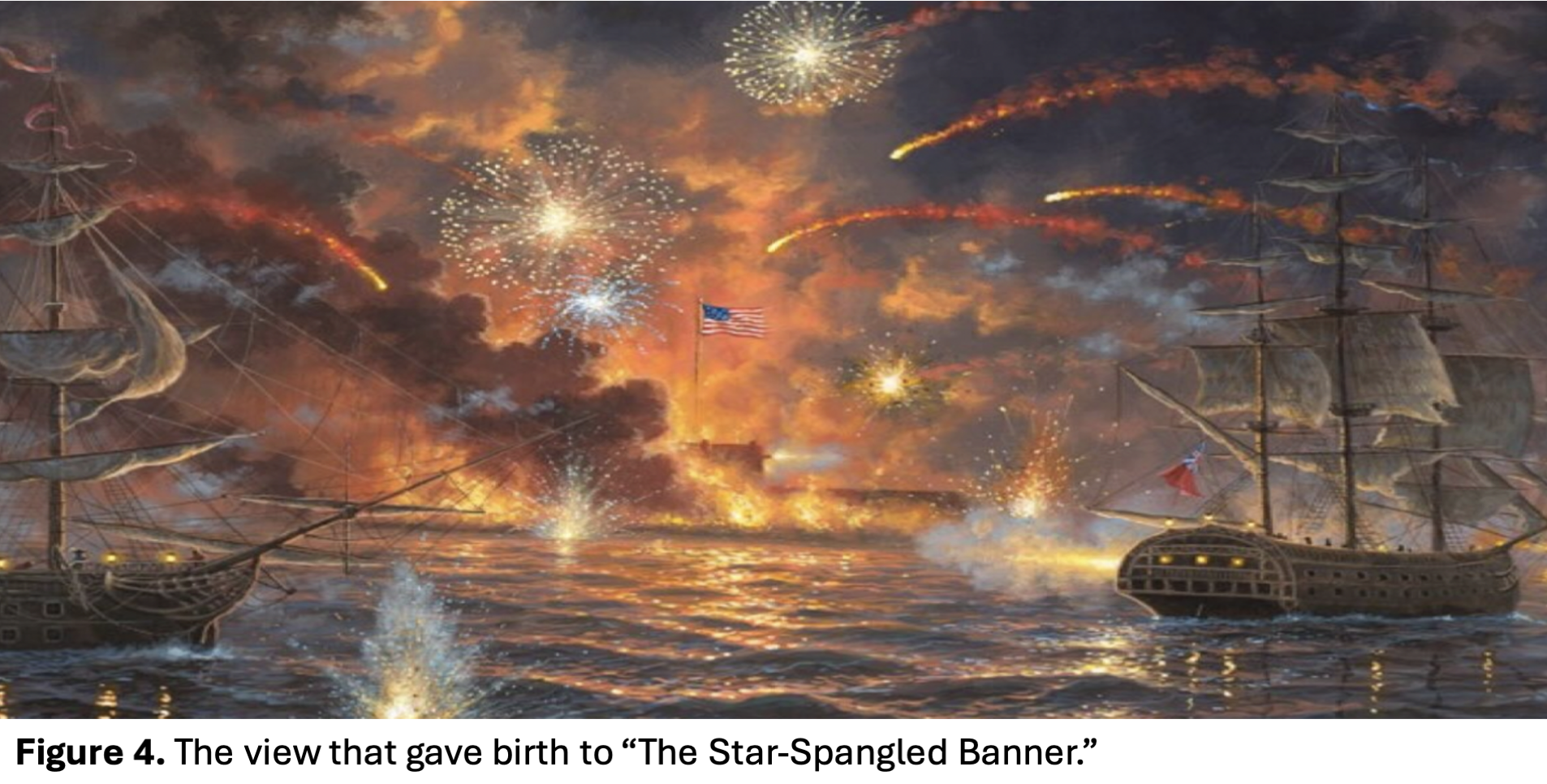
The battle also gave the Americans their future national anthem, “The Star-Spangled Banner.” Francis Scott Key rewrote the words to an old English drinking song called “To Anacreon in Heaven”, while he was stranded on a British warship during the attack on Fort McHenry. He wrote of “the rockets’ red glare” and “the bombs bursting in air”, which “gave proof through the night, that our flag was still there.” Most Americans today are familiar with the first stanza containing these notable phrases, but do not even realize there is a fourth stanza that declares:
Then conquer we must
when our cause it is just,
and this is our motto –
in God is our trust.
[1] Cobb 114.
[2] Marshall 163.
[3] Cobb 115.