Treaty … What Treaty?
David S. Symington, PhD
The British began the final part of their “Three-Pronged-Attack” without any knowledge of the progress of the negotiations in Ghent Belgium. Because of the time delay of six to eight weeks for information to travel from Europe to America, both sides fought the Battle of New Orleans two weeks after the war was actually over. This fact had no effect on the battle itself, but with the news of the Treaty of Ghent published immediately after the American victory at New Orleans, it gave the impression the English ended the war because of their loss, and that the Americans won not only the battle, but also the war. In reality, the War of 1812 has historically been considered a tie militarily. This was an amazing result considering the strength of the British military.
At the time of the Battle of New Orleans, Britain was a formidable military power. With the defeat of Napoleon, England was the most powerful nation in the entire world. With over 500 warships, she had long dominated the oceans and was considered “The Mistress of the Seas”. The English also had a veteran army of over 250,000 battle-tested troops. With the fall of Napoleon and his abdication, the English had been able to shift their military resources to America.
The British attack on New Orleans was led by Major General Edward Michael Pakenham. He was a very popular, experienced and respected officer. He was also the brother-in-law of the Duke of Wellington. He fought in the Napoleonic Wars, the Irish Rebellion, and was wounded several times. He led an army of 10,000 experienced soldiers, which included many of “Wellington’s Heroes”, who were instrumental in the defeat of Napoleon.
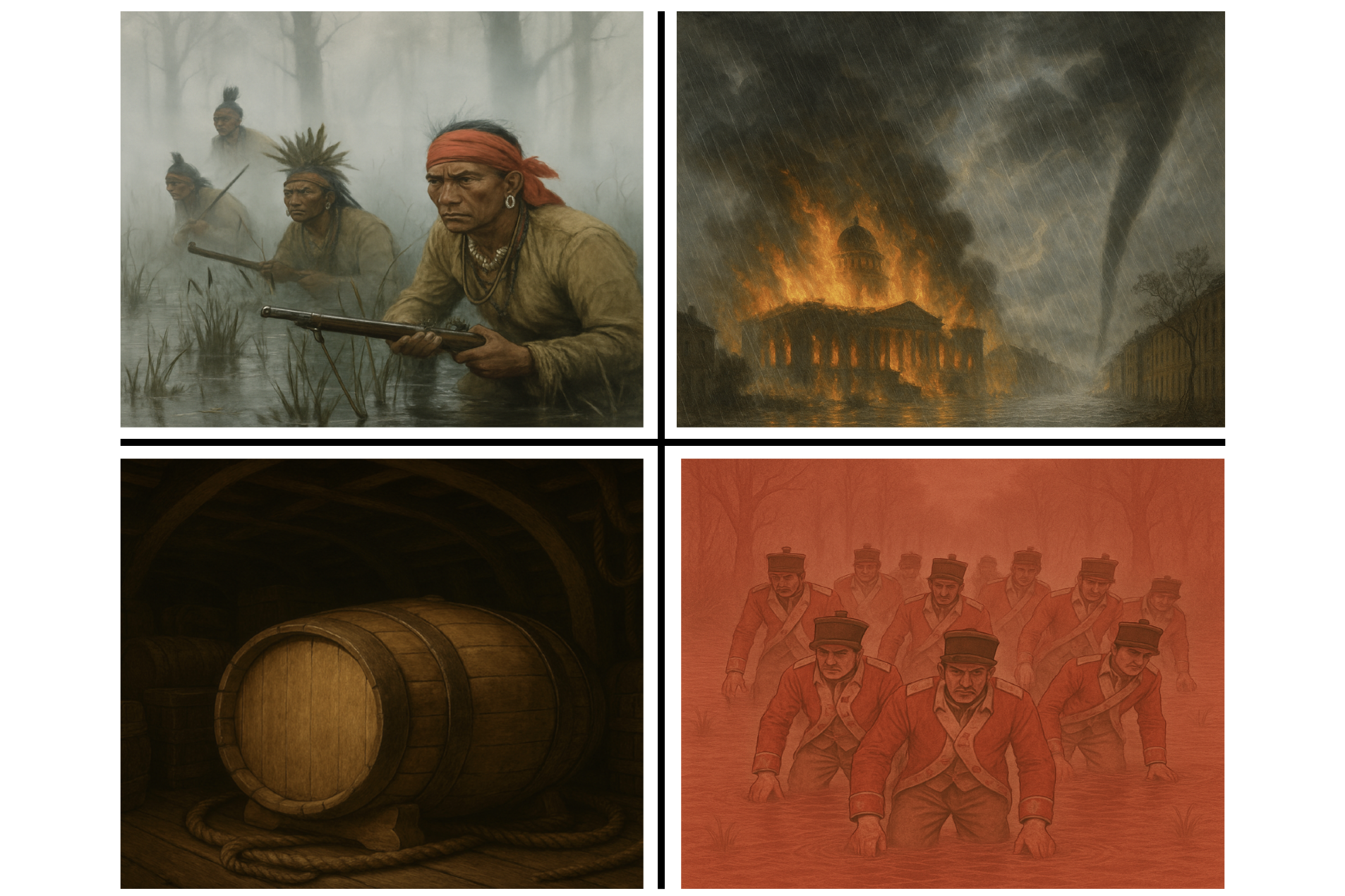
Facing this tremendous force was Andrew Jackson’s diverse group of defenders, which included Kentucky and Tennessee militiamen, farmers, clerks, free blacks, pirates, a few U.S. regulars, ordinary working men and backwoods men from the surrounding area. They were referred to as “Dirty Shirts”, due to their less than sanitary appearance. With less than 4000 men, they were at a real disadvantage.
General Pakenham’s battle plan was simple, but called for complex timing and coordination. The American battle line was located between New Orleans and the British army. It extended from the east bank of the Mississippi River to a large, impassable swamp. It also extended in the opposite direction to the other side of the river, which was done in order to prevent the British from outflanking their defensive position.
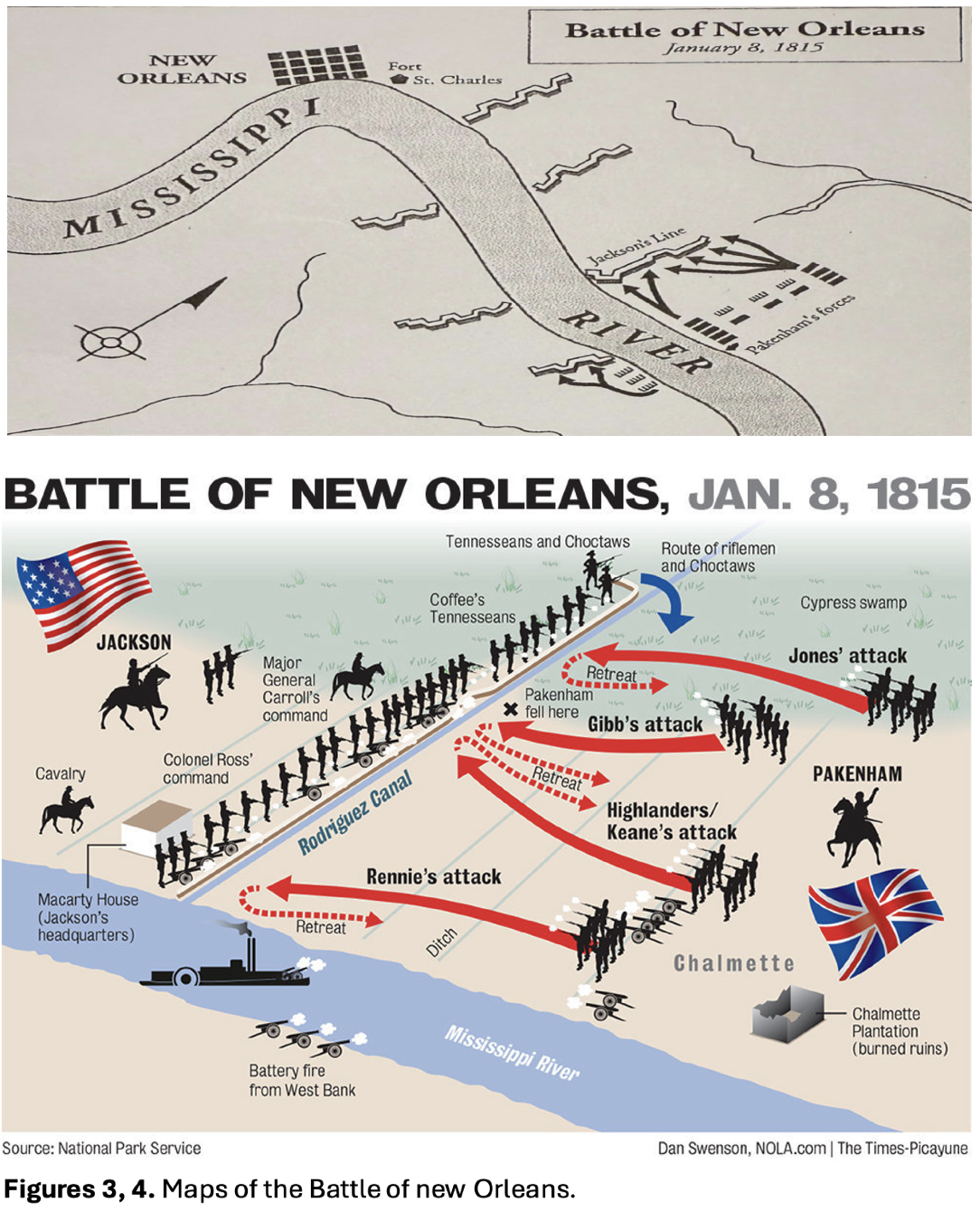 Because of the location of the Americans, General Pakenham’s plan called for a direct assault on the firing line of Jackson, with the main assault on both flanks of their defensive position. If Pakenham’s troops could capture either of the flanks, then the Americans would be open to a deadly crossfire and be forced to flee or surrender the field. This was exactly the type of attack these battle-hardened veterans of the Napoleonic Wars achieved such success with in Europe.
The individual responsible for attempting to prevent this plan from succeeding was General Andrew Jackson. Besides being a great leader and very patriotic, Jackson also had a deep, long-standing hatred of the British army. This hostility towards the English began during the Revolutionary War, when his eldest brother died campaigning against them with a local patriot group. After the British attacked his hometown in Waxhaws, North Carolina, Andrew and his only remaining brother were taken prisoner. During the time when they were first taken prisoner, a British Dragoon officer ordered Andrew to clean his boots. When he refused, the officer raised his saber and slashed at his head. “The sword point reached my head and has left a mark there as durable as the skull, as well as on the fingers.”[1] Andrew as his brother both contracted smallpox while in prison. The disease spread quickly among the prisoners due to the unsanitary conditions, and a total lack of care. Andrew Jackson’s brother did not survive the ordeal, and his mother also died from cholera that she contracted while nursing local Waxhaws men held in British prison ships in Charleston Harbor. In Jackson’s view, the British had killed his mother and brothers and left him without an immediate family. The scar left on his face from the Dragoon officer’s sword was a continuous and permanent reminder of the loss of his family at the hands of the English.
It is easy to discern the influence of destiny, or divine direction on sweeping significant events. However, divine providence can also play an equally important role in obscure individual events, the lifting of a fog at a specific time, the changing of the wind current, or the tide, can all make a significant impact on a specific event. In the case of the Battle of New Orleans, the outcome of the conflict should never have been in doubt, because the English invaders enjoyed an enormous advantage over the Americans, not just in the quantity of their troops, but also in the quality.
“These veterans, including some of the most storied regiments of the British Empire, had fought with the Duke of Wellington in the peninsular campaign in Spain, defeating Napoleonic armies reputed to be the best In the world. In their expedition to America, the soldiers reveled in their well-earned designation as ‘Wellington’s Heroes’, and took special pride in their daring, battle-scarred commander, General Pakenham, who Wellington referred to as “One of the best we have!”[2]
Although Jackson’s “Dirty Shirts” were at a distinct disadvantage in facing such a powerful force, they did have the prayers of the Ursuline nuns and the fighting skills of the Baratarian Bay Pirates, who were under the leadership of Jean and Pierre Lafitte.
The Ursuline nuns of New Orleans established their headquarters in the French Quarter in 1751, and built the first convent in the United States, along with the first girl’s school in the country. Their buildings were saved in an apparent miracle when a raging fire swept through the city. The sisters carried a recently arrived statue of the Blessed Virgin to a front window and prayed. The wind shifted immediately, and the convent was saved from the flames that destroyed much of the surrounding area. The Ursuline nuns sided with the Americans because they feared an English victory would destroy the city and end their mission. The nuns placed the same statue, now known as “Our Lady of Prompt Succor”, on an altar and prayed throughout the battle for divine intervention in order to rescue the outnumbered Americans.
[1] John Buchannan. Jackson’s Way: Andrew Jackson and the People of the Western Waters (New Jersey: John Wiley and Sons, Inc., 2001) 4-5.
[2] Medved 161.
How Does this Happen—Ask the Ones Who Were There
Whether it was the prayers of the Ursaline nuns or “Providential Intervention”, General Pakenham’s battle plan proved fatal, when the fog that kept the American sharpshooters from taking aim at the approaching British troops suddenly lifted at a time of no return, as “… a stiff breeze arose from nowhere and promptly blew the thick fog into rapidly dissolving patches that revealed the enemy at precisely the right moment counted as one of those fortunate occurrences on the battlefield that struck participants as supernatural.”[1]
With the British forces confined to the narrow strip of land between the Mississippi River and the swamp, they became easy targets for the Kentucky and Tennessee riflemen. “Fire from the batteries became increasingly effective as the British got nearer to the American line and the fog began to dissipate.”[2] The Americans quickly took advantage of this opportunity. The cannon and rifle fire devastated the advancing of British troops.
The Battle of New Orleans was the largest and bloodiest engagement of the War of 1812. One American observer said the battlefield was a terrible sight with the dead and wounded all laying in heaps in every possible position, “Some had their heads shot off, some their legs, some their arms. Some were crying, some groaning, and some screaming.”[3] A British officer who toured the field, was stunned by what he saw: “Of all the sites I ever witnessed, that which met me there was beyond comparison the most shocking and most humiliating. Within the narrow compass of a few hundred yards were gathered together nearly a thousand bodies, all of them arrayed in British uniforms.”[4]
Just about everyone was shocked by the disparity in casualties. On the British side, of the 3000 soldiers that began the attack, over 2000 were dead, wounded or missing. When the shooting stopped, over 400 British soldiers stood up from the ground in the field of battle and surrendered. Many of those captured had taken refuge under the American earthen wall, or hit the ground to escape the murderous American fire. Escape was not attempted because as one British soldier stated, “… these damn Yankee riflemen can pick a squirrel’s eye out as far as they can see.”[5] According to one British veteran of the Napoleonic Wars, it was, “the most murderous fire I ever beheld before or since.”[6] The American losses, by contrast, were modest, with only 13 killed, 39 wounded and 19 missing.[7]
Three generals, seven colonels and most of the officer corps of the British were dead. This included General Pakenham, whose body was preserved in a rum barrel, and the rum barrel was misplaced for a brief time on its journey back to England. There is little research to prove what actually happened to the missing rum barrel, but one account holds that the ship’s Captain had to put into a port for repairs after being hit by a strong Caribbean storm. In order to pay for the needed repairs, the Captain had to barter some of the ship’s cargo. The barrel of rum containing General Pakenham was mishandled and included with the regular barrels of rum in a sale to a local bar. The patrons of the bar thought that the rum was rancid until breaking the barrel open in their anger, and watching the General’s body flow out onto the floor. His body was later packed in a fresh rum cask, and sent back to England for a proper burial.
The heavy losses that the British suffered on the battlefield were also the result of a couple of errors, which seemed beyond belief for such an elite professional army that had humbled Napoleon. The first was that although the British were famous for their thoroughness in preparation before battle, they failed to check-out the landscape to make sure that their troops could cross the Mississippi River in a timely manner to outflank the American line. As a result, they got stuck in the mud on the riverbank, and when they were finally able to free themselves from the mud, they were then swept off course further down the river by the heavy current. This put them so far behind time they were never able to support the main attack with their planned flanking movement. This allowed the Americans to concentrate their full firepower on the British troops attempting to scale the earthen works in a frontal assault.
The second mistake was even more unbelievable, because it involved the celebrated 44th Irish Regiment. This battle-tested infantry unit was charged with the vital task of throwing over three-hundred sugar cane stalks into the ditch in front of the Jackson’s line, and then placing the scaling ladders up against the earthen works. This was both a dangerous and vital assignment for the success of the British attack. It was because of its importance it was assigned to the crack 44th infantry. With their reputation of bravery and determination it would normally seem to be a wise decision. However, this must not have been a normal situation, because at the beginning of the battle—they forgot to bring the ladders!
How professional soldiers in the most elite army in the world could forget their primary assignment was beyond reality. The results of this blunder would be reflected in the death toll of the men who were trapped in the open field without the ladders needed to scale the American earthen works. With their casualties mounting “… some of the veteran British troops turned and fled to the rear in panic. Others began falling to the ground, lying down beside their dead or wounded colleagues, in hopes of avoiding the lethal, ceaseless waves of American fire.”[8] A lieutenant, who had fought “For King and Country” around the world, remembered: “Never before had British veterans quailed. But it would be silly to deny that they did so now. … That leaden torrent, no man on earth could face. I had seen battlefields in Spain and in the east … but nowhere such a scene as this.”[9]
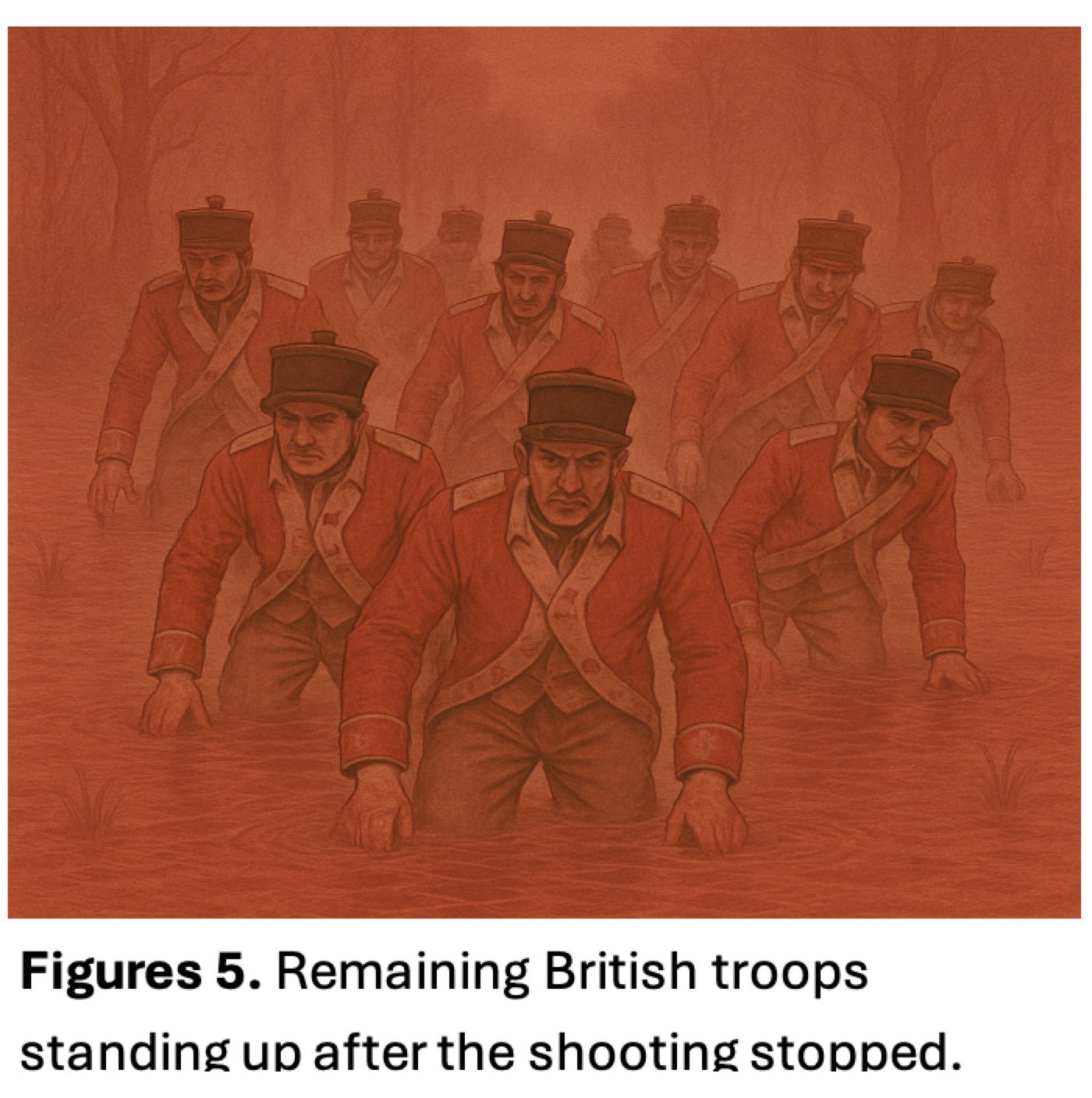 The unimaginable nature of the outcome, and the sense of unreality was evident on both sides. The British Captain Henry Cook noted that it seemed “more like a dream, or some enchantment, than reality.”[10] Major General John Lambert, who was the highest-ranking British officer to escape death or surgery, requested a cease-fire in order to care for the fallen troops. The Americans who wandered out over the fields of slaughtered described an unending, “sea of red”, not because of the bloodshed, but because of the scarlet coats of the fallen British soldiers lay so thick upon the ground, often piled two or three deep, so that for hundreds of yards there was no bare ground that could be seen between them. General Jackson surveyed the scene and reported: “I never had so grand and awful an idea of the resurrection as … when I saw more than five hundred Britons emerging from the heaps of their dead comrades, all over the plain rising up and … coming forward as prisoners.”[11]
In the weeks following the Battle of New Orleans, Andrew Jackson publicly acknowledged his belief that the American victory was due to Providential intervention:
“I was sure of success for I knew that God would not give me previsions of disaster, but signs of victory … It appears that the unerring Hand of Providence shielded my men from the show of balls, bombs, and rockets, when every ball from our guns carried with them a mission of death.”[12] Secretary of War James Monroe agreed stating, “Heaven to be sure has interposed most wonderfully in our behalf, and I am filled with gratitude when I look back to what we have escaped.”[13]
It has been noted that the British did suffer from a number of logistical blunders, the famous lost ladders, the boats that had to be dragged through the mud to reach the river bank, and not considering the powerful Mississippi river current that would carry them miles off course and too late to flank the American line. But these were well-trained, battle-hardened veterans who prided themselves as “Wellington’s Heroes” and should have still been able to defeat the poorly equipped and badly outnumbered “Dirty Shirts” that faced them. However, it should be emphasized that “a pattern of consistent good fortune, or ceaseless bad luck, nonetheless indicates a discernible design.”[14]
Perhaps Abbé Guillaume Duboug, the administrator of the Diocese of Louisiana, said it best when asked by General Jackson to conduct a “service of public thanksgiving in token of the great assistance we have received from the ruler of all events, and our humble sense of it for the signal interposition of Heaven in giving success to our arms.”[15] Abbé Duboug welcomed Jackson and congratulated him for, “proving a worthy instrument of Heaven’s merciful designs”, and then continued by denouncing the idea that either good luck or coincidence could account for the tremendous victory: “Let the infactuated votary of blind chance deride our credulous simplicity: let the cold-hearted atheist look up for the explanation of such important events to the mere concatenation of human causes; to us the whole universe is loud in proclaiming a Supreme Ruler, who as he holds the hearts of man in his hands, holds also the thread of all contingent occurrences… . Immortal thanks be to His supreme majesty, for sending us such a gift of his bountiful designs.”[16]
This same feeling was also expressed over a half-century later by Ralph Waldo Emerson in his “Oration on the Death of Lincoln”:
There is a serene Providence which rules the fate of nations… . It makes its own instruments, create the man for the time, trains him in poverty, inspires his genius, and arms him for the task.”
[1] Donald R. Hickey. Glorious Victory: Andrew Jackson and the Battle of New Orleans (Baltimore, Maryland: John Hopkins University Press, 2015) 171-172.
[2] Hickey 108.
[3] Hickey 112.
[4] Hickey 112.
[5] Hickey 113.
[6] Hickey 109.
[7] Paul S. Vickery, PhD. Jackson: The Iron-Willed Commander (Thomas Nelson Press, Inc., 2012) 154.
[8] American Miracle 173.
[9] Medved 173.
[10] Medved 173.
[11] Medved 174.
[12] William J. Federee. America’s God and Country (Dallas, Texas: AGC Inc., 1996) 307.
[13] Federee 307.
[14] Medved 181.
[15] Medved 176.
[16] Medved 176.
Conclusion: “From Sea to Shining Sea”
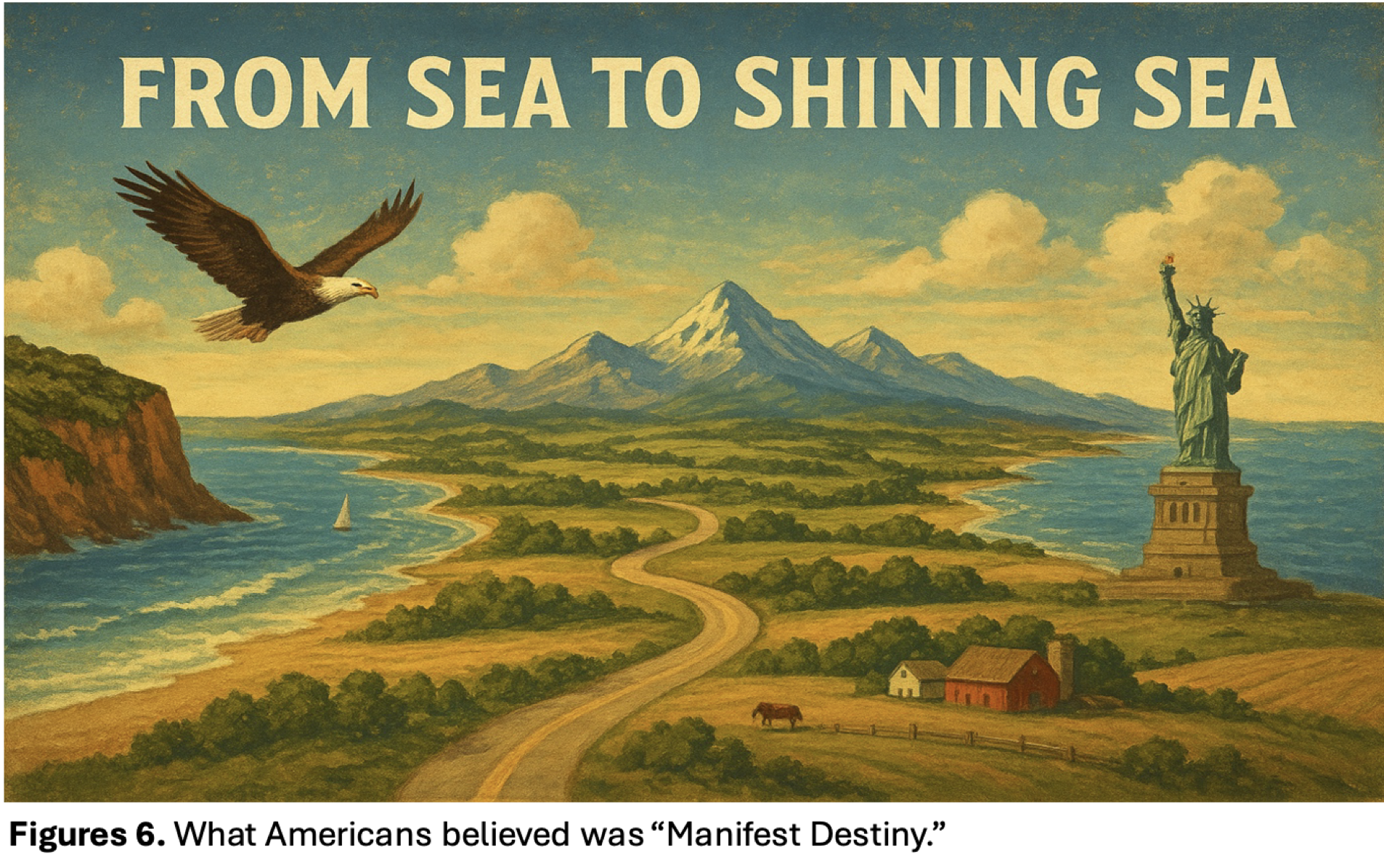 The War of 1812 has been referred to as “The Forgotten War” because the Treaty of Ghent, which ended the American War of Independence, just dismissed or allowed the return of the same issues that led to the war and to the status quo. However, “The Second War of American Independence” is a more appropriate title because the results had a significant effect on the future of the United States.
Besides the public acknowledgement of Providential intervention, some of the most important results of the war of 1812 were:
- There was a tremendous rise in feelings of patriotism throughout the country. It was an enormous psychological victory for the Americans.
As historian Robert V. Remini stated: “To the modern world it is virtually impossible to convey what this victory meant to contemporary Americans. Never again—ever—did they feel compelled to prove to themselves or anyone else the worth of their unique experiments in liberty and constitutional government.”[1]
- With the defeat of the British armed forces there was a new respect for the military power of the United States. This would lead to the “Era of Good Feelings” under President Monroe, where other countries would attempt to avoid conflicts with the United States. Examples resulting from this new respect for the military power of America include: the Adams-Onis Treaty, in which Spain ceded Florida to the United States to avoid an armed conflict Spain was certain to lose; the end of the Barbary Pirate’s attacks on American ships; and the Rush-Bagot Pact, where England settled border issues with the United States, instead of facing a third war. Historian Page Smith noted the War of 1812 ratified the Revolutionary War due to the new respect for America’s ability to protect their territory.
- Andrew Jackson would be elected the seventh President of the United States (1829-1837), and had such a powerful impact on the future course of the country it is referred to historically as “The Age of Jackson.”
- The War of 1812 ended Tecumseh’s dream of an Indian confederation, which would have stopped American expansion in the West and the goal of Manifest Destiny.
- The end of the influence and power of the Federalist Party, due to the Hartford Convention and their opposition to the War of 1812.
- Perhaps the most important result of the War of 1812 was given by new evidence discovered in 2015 on the 200th anniversary of Jackson’s victory. It was found that if the British won the Battle of New Orleans, they intended to seize New Orleans, nullify the Louisiana Purchase, and colonize the entire Mississippi Valley.
Michael Medved said it best in his book The American Miracle, when he explains the geopolitical importance of the Battle of New Orleans:
Military historian Ronald Drez of the University of New Orleans made a major discovery among British war records: a set of secret orders issued in October 1814, instructing Pakenham to continue with the invasion and occupation of New Orleans regardless of any peace agreement with the Americans [emphasis mine]. Drez found the papers among military records in the National Archives at Kev in London. “It truly is the smoking gun,” Drez told the Associated Press. “They say to Pakenham: ‘If you hear of a peace treaty, pay no attention, continue to fight.’” To realize their long-term goals, Britain secretly inserted government officials and experienced bureaucrats within military units in order to immediately establish administrative control once General Pakenham, the designated governor, had completed his conquest.
Though they had negotiated an agreement in which both sides would return to the boundaries they had accepted before the war, the British had never accepted America’s purchase of Louisiana. They challenged Napolean’s seizure of the territory from Spain and his right to sell it to the Americans. In his book The War of 1812, Conflict and Deception: The British Attempt to Seize new Orleans and Nullify the Louisiana Purchase, Drez makes clear the English plan to conquer and colonize the entire Mississippi Valley as a key addition to their territory in Canada and as a means of limiting the growth and power of the United States. In spite of the ironic timing that saw the Treaty of Ghent signed before the Battle of the Bayous, Jackson’s miraculous victory played an absolutely essential role in allowing the United States to build a continental nation “From Sea To Shining Sea.”[2]
[1] Medved 178.
[2] Medved 179.