
Objective vs. Subjective
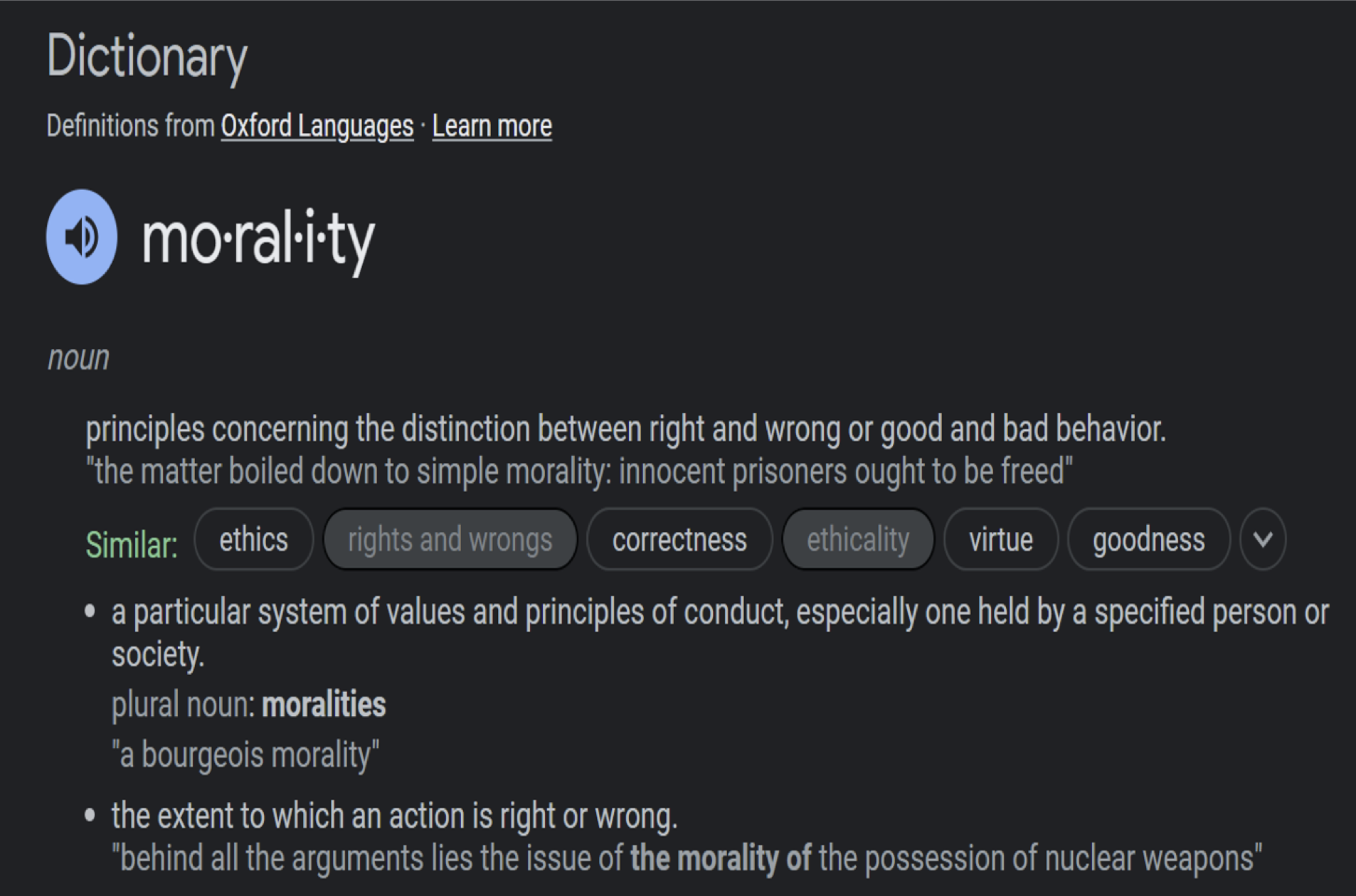 Definitions are important so people clearly understand what is meant by what is said. When “morality” is used in this discussion, I refer to “the distinction between right and wrong or good and bad behavior.” Notice, this definition is assuming there is a way to judge whether something is truly good or bad. If there is no way to judge or make a distinction between ideas, thoughts, and actions, then the words good/bad, right/wrong, justice/injustice are nonsense because these words will have lost all their meaning, everything could only be morally neutral, neither and never universally good nor bad.
Our culture today has shifted much deeper into the belief in “subjective morality” or “relativism,” “You can’t judge me or anyone else” is a mantra preached in endless books or movies, and chanted recurrently in peoples’ statements and actions. While at the same time, our culture has a penchant for judging others; examples can be observed in social media feeding frenzies on the latest “bad” person or “bad” act. The same culture saying you have your truth and I have mine, were all struck by the same condemning Kendrick chord, “Hey Drake, I hear you like em young.”[1]
[1] Kendrick Lamar, “Not Like Us”, May 4, 2024. https://www.youtube.com/watch?v=T6eK-2OQtew
We all slip into this hypocrisy, even judging judging. I definitely sympathize with having problems with authority, with someone telling me how it ought to be, while at the same time I was judging and telling authorities how it ought to be. Having been fully punched in the head by two teachers and a principal on separate occasions, engaged in very public denunciations and confrontations against top executives at two organizations, and even mocking a power-abusing judge in his court and taunting his bully bailiff to join me later if his courage matched his tough talk. I have definitely judged others while being judged. Not a good picture of my past, if there is such a thing as “good.”
Do those authorities, or me, or you and all the people you run into have the obligation, right, or even the logical capability to judge anything as right or wrong? It depends on what is true regarding morality.
In other blogs the difference between objective and subjective truth was covered, and this understanding is the same for objective and subjective morality. Here is a quick review using chili peppers.
Objective claim – something is objective if it is (a) either true or false for all people, in all places, and in all times, meaning it is universal or absolute, and (b) depends on the facts about the object.
Subjective claim or opinion – a subjective claim has an answer not depending on the facts about the object, but instead on differences in the subject having the opinion (personal preferences, genetics, personal experiences, backgrounds, etc.). There is no such thing as subjective truth, only subjective opinion.
A close friend produced a documentary on chili peppers around the world, Crazyhot, and hopefully will provide a memorable example to use with a college group I will be teaching. Let’s say Eric comes to our class and splits a Moruga scorpion pepper between Caleb and Kristin. Caleb takes a bite, waits, then his face and choked words exclaim the pepper is hotter than a thousand suns, while Kristin says it is only mildly hot. The juice from the pepper is chemically measured and found to be 1.2 million Scoville Heat Units (SHU).
Now, if anyone coming in for the next class asks, “Is the Moruga scorpion crazy hot?” There are both truths and opinions involved.
What are the objective truths?
- How Caleb felt, the pepper was way too hot, is true about Caleb (Caleb is the object here).
- How Cariana felt is true about
- The pepper was 1.2 million SHU.
These statements are either true or false, and depend on facts about the object of the claim. And these facts are true for all people, places and times, in case someone from China in 2050 was researching hot pepper situations.
What are the subjective opinions?
- “YES” from Caleb, and “Mildly” from Cariana.
The claims about the pepper are subjective, because they differ depending on the subject’s (Caleb or Cariana’s) personal or subjective responses to the peppers.

Are the claims below objective or subjective?
- That shirt is red.
- Red is the most beautiful color.
- 2 + 2 = 4.
- This room is way too cold.
- Tropical island vacations are the best kind.
- An atom of oxygen contains protons, neutrons, and electrons.
- Darren and Juanita can sit on this table and Mr. Symington can lift them all over his head.
- God exists.
- There is no objective truth.
- Premarital sex is immoral.
This is tricky as most of our education has neglected proper instruction in logic, so you should not feel bad if getting more wrong than you would expect. Answers: #2, 4, and 5 are subjective, the rest are objective. #7 is an objective truth claim, even though definitely false. The last three are also objective truth claims, either true or false universally depending on the facts of reality. The last one especially seems to be a personal preference, but it is an objective claim, the object (premarital sex) being morally wrong, is either true or false, depending if there is what philosophers call “grounding” for such a proscription (we will cover “grounding” later).
People tend to think all things in their private, personal lives, including beliefs about God, relationship choices, or morality are all subjective and without real answers and consequences—this is dangerously inaccurate and leads to harmful results if objective truth exists—and we will consider that now.
Can you feel your feelings, biases, desires kicking in, if so, kick them down as your heart brings great feelings in life, but your head is what keeps you safe enough in your decisions to allow a reliable foundation for your heart to operate.
- Subjective Morality: the idea there is no absolute or universal good and bad in morals, instead, each person or group (the subject) has their own opinion on things being either what they prefer or do not prefer, and would call right/wrong, good/bad only relative to other things they themselves judge. Simply put, nothing is objectively, universally, unchangeably, or truly good or bad, just viewed as good or bad by different people or groups.
This idea is also referred to as “moral relativism,” claiming morals are not absolute, only right or wrong relative to the traditions, culture, or other factors of a person or group.
- Objective Morality: the idea there is absolute or universal good and bad, right and wrong, factually. Therefore, there are some moral values and duties true for all people, places and times, and certain thoughts or acts themselves (the object of our judgment) can be judged truly good or bad.
While there are moral values and duties placed on us through opinions of culture, politics, parents, etc., the question is: Is there an unchanging moral law or standard of right and wrong, by which behavior can be judged against as truly right or wrong, or even better or worse?
Here is the most important point:
While moral values and duties may be placed on us through opinions of culture, politics, parents, genetics, God, etc., the question is: Is there an unchanging moral law or standard of right and wrong by which behavior can be judged against as truly right or wrong, or even better or worse? The only way use of words like good/bad, justice/injustice or progress are not nonsense.
What do you think?
Now we come to your choice: what do you think? Does objective morality exist, or is it all subjective? If there is one example of a moral value or duty true for all people, places, and times, then objective morality exists. Here is a way for you to come to your own answer: Do you think there is any act wrong or bad for all people, places, and times?
Going to an extreme example is a quick way to check if objective morality exists. Although initially I questioned the need for an extreme example given by a philosopher and speaker friend, Frank Turek, it does make the point simpler to grasp. Pick any behavior and add “just for the fun of it” to show there is no objective moral justification needed for your claim. Is it ever right or good morally to torture a child for the fun of it? If your answer is “no,” then you believe objective morality exists. If you answer “yes,” then seek help, there are special hospitals and rooms for people like you. Is there anything you have seen or had done to you, which you know is always immoral, regardless of time, culture, genetics, or opinions? If you answer “yes,” then you believe in objective morality.
In fact, just going through daily life you observe examples all the time you automatically judge and respond to as right, and others you just know are wrong, and often long to see justice done. Hollywood relies on this general understanding to carry audiences through a story. And it is not just you, those same intuitions are found throughout the world and history. Hollywood relies on this general understanding to carry audiences through a story. Stories depict actions or events expecting every audience member to experience the same inner pressure this is wrong and in need of justice, or revenge. Later today I will be watching Denzel Washington in Othello, and soon will desperately be desiring Iago’s brutal end.
Belief in the existence of true or objective morality is what philosophers call a “properly basic belief.”[1] Such beliefs do not depend on justification of other beliefs, but are reasonable to hold either being self-evident or evident by the senses in the absence of a defeater (something disproving the belief). Examples include memory, testimony, sensory experience. A properly basic belief may be false, but can still be properly basic and reasonable to hold until it is defeated with greater evidence.
For example, when a small bump showed up on my leg after a mountain biking ride, and my wife said it had signs of a serious spider bite, I held my properly basic belief it wasn’t and would go away on its own because none of my senses, specifically sense of touch or pain, registered anything while biking, all previous spider bites looked the same and just went away, and a group of local bikers said no dangerous spiders were in this forest. I held my belief for two weeks, until the necrotic skin and other defeaters of my belief came in, with urgent care confirming a brown recluse had bitten me.
Another properly basic belief is our universe and ourselves really exist, and we are not just a brain in a bath of chemicals and electrodes being stimulated to imagine it all, as displayed in The Matrix. There is no way to prove we aren’t in such a simulation, but in the absence of a defeater, we are perfectly rational to believe what our sensory experience is telling us about a real world around us. Similarly, if moral values and duties are self-evidently objective or universal, then in the absence of defeaters, we are reasonable to hold child trafficking as objectively, truly, always wrong.
Some have argued because some cultures and times show differences, it means objective morality does not exist. For example, while cowardice, selfishness, being unfaithful or cruel are viewed almost unanimously as wrong across cultures, you may find some accept or even praise some unfaithful or cruel behavior, after all they may have observed these behaviors leading to some benefits in life, or something in the background of the culture created an odd tradition. Nevertheless, this does not mean objective morality does not exist, or these cultures did not have these moral values innately, it simply means they choose not to follow certain moral values.
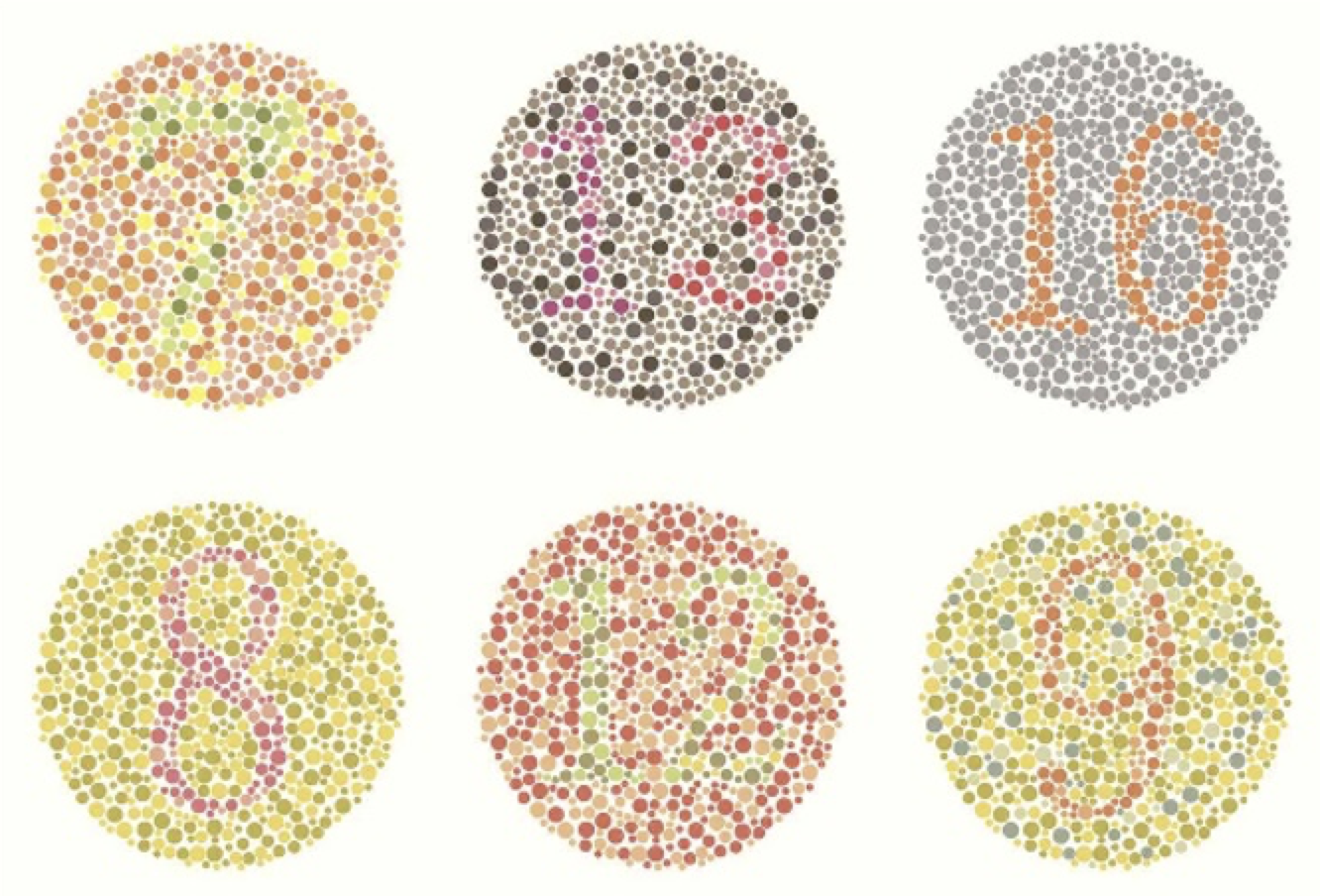 Just as a person with color-blindness cannot see the numbers within the circles in the image, a person’s inability to see the evil within their acts gives us no reason to think morals are not objective, or fail to prosecute those not accepting objective morality. Uday Hussein, being the son of an absolute ruler in Iraq, may or may not have seen or accepted the evil in his acts of rape and murder, but the families of his victims and international watch groups clearly recognized the need for justice. One must present a defeater, greater evidential reasons, to make belief in objective morality unreasonable and not a properly basic belief. What are these defeaters?
You can go anywhere or anytime in our history, and an innate understanding can be observed in people there are some truly good things, but also this world is not exactly as it should be, as some truly wrong things exist and need to be eliminated. You will witness things and may experience a deep touch inside of you when truly good or truly bad things occur.
A homicide detective I know, who has been on Dateline repeatedly after solving a number of high-profile cases, once related an interesting observation regarding lie detectors. He said even when they tell a person on a detector to lie on purpose, giving permission to lie without consequence, they see the same reading on the detector as people have when lying on their own. There is something innate in us registering behaviors we know are right or wrong.
There are differences between people and cultures, of course, yet as C. S. Lewis notes:
There have been differences between their moralities, but these have never amounted to anything like a total difference. If anyone will take the trouble to compare the moral teaching, of, say, the ancient Egyptians, Babylonians, Hindus, Chinese, Greeks, and Romans, what will really strike him will be how very like they are to each other and to our own. Some of the evidence for this I have put together in the appendix of another book called The Abolition of Man; but for our present purpose, I need only ask the reader to think what a totally different morality would mean. Think of a country where people were admired for running away in battle, or where a man felt proud of double-crossing all the people who had been kindest to him. You might just as well try to imagine a country where two and two made five. … Whenever you find a man who says he does not believe in a real Right and Wrong, you will find the same man going back on this a moment later.[2]
Even studies of the German soldiers in WWII, who agreed with and were immersed in culture espousing the complete lack of value in certain people groups, still suffered from terrible nightmares betraying inherent knowledge their acts against those targeted groups were truly wrong.
What must I believe if objective morality does not exist? Wow, really!
Consider the alternative, if you believe objective morality does not exist, there is no absolute standard so all morality can only be subjective, and a number of things naturally follow.
- Do you live your life accepting there is not one single thought or action truly good or truly bad?
- Nothing displayed in history or in any story can ever be truly and always wrong.
- Without a standard of good/bad to compare with, the words good, bad, right, wrong, good, evil, etc., have no meaning beyond saying: the opinion of a person or group is currently for or against a thought or action.
Therefore, it was really just King George and England’s opinion against the American colonies, or the Nazi’s subjective morality against Nuremberg’s trial against them, nothing universally wrong.
Additionally, morality changes through time. Anything you react against as wrong or bad today, such as racism, discrimination, genocide, lying, intolerance, or cutting you off in traffic really only goes against your own, or a group’s preference or opinion, and in another place or time is possible to be accepted as good.
You are speaking nonsense anytime you claim any person’s choices or actions are truly wrong or bad beyond simply going against the changeable preference of you, a culture, or some other factor.
If this is true, then social justice warriors (SJWs) are not fighting for something truly right, something we can assure will never change from being the correct end goal; they are warring for the social flavor of the month. A more accurate label is social opinion whiners (SOWs). There is no such thing as absolute justice with subjective morality, which relegates whatever they war against as only different opinions, none of which can be judged better or worse, more right or wrong than the other as there is no standard above human opinion. Atheists, of course, have attempted to create a standard, these attempts will be explained in the next chapter, but every attempt inevitably deconstructs into another subjective standard, incapable of providing logical grounding for true, absolute, objective good, bad, or even better or worse.
Disagreements about morality are nonsense as there is no answer of right and wrong, no end goal to strive for, or standard to compare against. Most of us are not interested in having opinions shoved down our throat in the media, politics, and pocketbook. If there is no truly good cause to fight for, then warriors become whiners.
Whether I support or reject specific SJW causes, if objective morality exists, there is an absolute standard of right and wrong, therefore, some causes are truly good and worth warring for. A current example was portrayed in the Sound of Freedom movie, covering Operation Underground Railroad’s work in rescuing children from the horrific global sex trafficking and organ harvesting business.
A well-documented historic example tested the validity of subjective morality or moral relativism directly. When the German soldiers, who had committed atrocities against Jews and other groups of people in WWII prison camps, were facing criminal charges at the Nuremberg trials, the lawyers for the German officers claimed these men could not be judged for actions morally acceptable in the nation of Germany during the time of the war. Both their leaders and society encouraged the behavior; it was the “shared morality” they lived under. If you believe in subjective morality, then you must cast your vote with those lawyers and exonerate the German soldiers as their acts were not truly atrocities, bad, or wrong.
History records the lawyers gave the full argument for subjective morality, and it was flatly rejected as false. The German soldiers were condemned as prosecutors appealed to an objective moral law standard, what Supreme Court Justice and prosecutor at Nuremberg, Robert Jackson called “a law above the law,” a transcendent moral law which is the standard of objective morality we all are beholden to, regardless of opinions, culture, circumstances, etc.
Evidence throughout history and our daily life display our recognition of objective morality. It seems we know moral law exists innately. We may not always follow this standard in how we treat others, but almost always use this standard to judge how others should treat us. When we feel obliged to make excuses for our behavior, we are acknowledging we violated something; is the violation just against opinion, or is it something deeper, more absolute?
Only an absolute moral law can be the unchanging standard by which we can truly judge right and wrong and reach justice. It is the basis of human rights. In stating, “We hold these Truths to be self-evident, that all Men are created equal, that they are endowed by their Creator with certain unalienable Rights,” the founding fathers of the United States recognized if not endowed by a Creator, then it is just King George’s opinion against the colonialists’ on what is right, with no standard of “rights” or what is truly right or wrong. We will discuss shortly whether a Creator or some other source is able to ground a moral standard. Without an absolute standard, no action can be truly good or bad, we would be incapable of distinguishing between moral positions, other than saying right here, and right now, this act is not preferred or not liked by this person or group, but may someday be viewed as good.
I encourage you to listen to people who argue morality is subjective, not only because it is best to hear both sides of the issue, but also for the interesting contradictory behavior between moral relativists claims and how they react to real life situations.
The above paragraph or two was paraphrased from a talk by Dr. Turek, during which an atheist member of the audience, who necessarily accepted and argued morality was subjective, later in the discussion gave his reasons for being atheist, including a laundry list of why God or Christianity is bad: God being evil in having the Israelites commit genocide, the crusades, Christians being hypocrites and treating LGBTQIA+ people wrong. How does a person claim no true right and wrong exists, and shortly after goes on to make a bunch of moral judgements as though an absolute morality exists and we should all recognize and agree with? Confusing, of course, moral relativism swims in confusion and contradictions when applied to life.
Philosopher William Lane Craig recounts a story of a philosophy professor friend of his, who had a student in class arguing through the year for subjective morality, and made this the topic of his final written exam. The intelligent student spent significant time on his argument, including all the biology, psychology, philosophy, and sociology observations of experts proving evolution, society or other natural means are incapable of producing objective morality, and therefore, the student rejected the existence or true right or wrong.
The professor wrote the student’s grade at the top of the submitted work, “F”. The irate student came to the professor’s office, daring the professor to justify his grading, and the professor said something to the effect, “I was turned off by the style of the binder and how the paper looked.” The flabbergasted student was barely holding in his outrage, while formulating a response. The professor asked, “Do you think how I chose to grade was wrong?” Then, both a smile and a realization dawned on the student, after all his research and certainty objective right and wrong did not exist, he actually did believe in right and wrong. The professor rewarded the student’s realization and excellent paper, even with the exposed thesis, with an “A”.
As a summary, is there anything you have seen or had done to you, which you know is always immoral, regardless of time, culture, or opinions? If you answer “yes,” then you believe in objective morality. Do you live your life believing true right and wrong, human rights, and justice exist, or do you believe the Nuremberg trials got it wrong, the German soldiers did nothing truly wrong and should be exonerated? If the former, then you believe in objective morality. Do your thoughts and actions fit your belief subjective morality is true? If you are faithful, but your spouse cheated on you with your best friend, are you okay with this if your spouse and best friend have a different morality than you? Do you have a defeater, any evidence determining objective morality does not exist? If not, the belief in objective, true morality is properly basic.
The only way subjective morality can be proven requires two proofs:
- Establish there is no natural or human way for objective morality to exist. I think this part think can be demonstrated; I will even do some of the work and demonstrate this in the next section. But, this first part must be accompanied by the second part …
- Establish no God(s) beyond human opinion authenticated a moral standard. This is where the endeavor flounders, as it requires evidence a personal God(s) does not exist, and we already have significant and unmatched evidence for such a personal authority, and more evidence is coming as more topics are examined.
If there is better evidence against the existence of a personal God, what is it? If there is proof a moral standard cannot possibly come from such an authority, what is it? The Euthyphro dilemma was an intelligent attempt, but has been invalidated long ago, even if not filtering through our general education and being taught properly as both philosophy and God have lost appropriate footing in our education system.
Bottom-line: objective morality exists. Let’s look again at the moral argument for God’s existence:
Premise 1: If God does not exist, objective moral values & duties do not exist.
Premise 2: Objective moral values & duties do exist.
Conclusion: Therefore, God exists.
If you accept the existence of objective morality, you already accept premise two as true. If you accept premise two and want to argue against premise one, you will do so against the scholarship and comprehensive case of evidence convincing the scholarship of the accuracy of premise one.
Next, we will look into premise one, and why objective morality cannot exist without God. Interestingly, most scientists and philosophers who write on morality recognize there can be no objective morality without God because nothing else can provide an absolute moral standard. Therefore, those who do not accept the conclusion of God’s existence must attempt to argue against premise two which, as should be obvious after reading through the previous pages, requires walking like a contortionist through an intellectual and common-sense minefield.
As a reminder, you are encouraged not to just accept what a professor, parent, preacher, media, your mom or myself tells you about morality and your choices, take in all the information available and decide for yourself, as you will experience the consequences of your choices, right or wrong. Reality is a good but harsh instructor, and you will hear screeching cognitive dissonance like fingernails on the chalkboard if trying to live life consistently as a non-believer of objective morality. It is safest and best for you to look around and resolve the dissonance.
[1] https://en.wikipedia.org/wiki/Basic_belief.
[2] C. S. Lewis, Mere Christianity, pp. 4-5.