
My cancer test
When I was in my mid-twenties, I visited a physician after some symptoms persisted. After a physical exam and other tests, the physician told me I most likely have cancer.
I asked, “How likely? 90%, 51%?” He said he couldn’t tell me. I responded, “What doo you mean you cannot tell me! I’m the patient in question.” After pushing him for more information, he made a quick exit, and left me to wonder for almost a month before a conclusive test could be given.
On my drive home I thought how cancer at this age probably meant fast progression and may not have more than a year. Then I prayed I wouldn’t waste my month in worry as I was teaching middle school at the time, and had little time for anxiety. When I was done praying, I remember thinking, “I had a real good run. If this is it, I’m fine with it.” And no exaggeration, for the next month I hardly thought about it, in fact, I do remember thinking a number of times, “Whoa, I may actually have terminal cancer right now, and can’t believe I am not anxious, even forgetting to think about it!”
Turns out I did not have cancer. But would have been nice if the physician gave me more to go with. Below we will discuss an excellent tool for assessing new evidence, and also explain why getting a positive result on a 99% accurate test for disease may not be as assured as it seems.
Bayes’ probability theorem
When you have big decisions to make among alternatives, so often we feel like everything is too unsure, unclear, and unable to provide reliable footing to step forward in the right direction.
There is a tool from probability theory that can provide some guidance and sometimes reliable numbers to showing how likely an option is based on new evidence.
a. What Bayes’ theorem is (in plain language)
Bayes’ Theorem is a rule for updating what you believe when you get new evidence. It tells you how confident you should be in a hypothesis after seeing new evidence, or what is the probability the hypothesis or claim or belief is true, based on:
- how plausible the hypothesis was before the evidence (known as Prior Probability), and
- how well the evidence fits that hypothesis versus other alternative hypotheses (known as the Likelihood Ratio).
b. The equation
Bayes’ theorem: 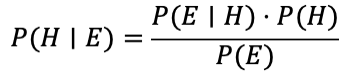
Posterior Probability P(H|E):
- The probability that the hypothesis (H) is true after considering the evidence (E).
- This is what you’re trying to calculate.
Prior P(H):
- How likely the hypothesis was before you looked at the evidence.
- This represents background knowledge or baseline expectations.
Likelihood P(E|H):
- How well the hypothesis predicts the evidence
- This will be changed to the likelihood ratio in the Bayes’ theorem (odds form), which makes the equation easier to understand
Evidence P(E):
- The overall probability of observing the evidence under all possible explanations.
- This acts as a normalizing factor so probabilities add up correctly.
- This also will be changed when moving to the likelihood ratio
The equation can be rearranged and written in the Bayes’ theorem (odds form), which is easier to use for our application:
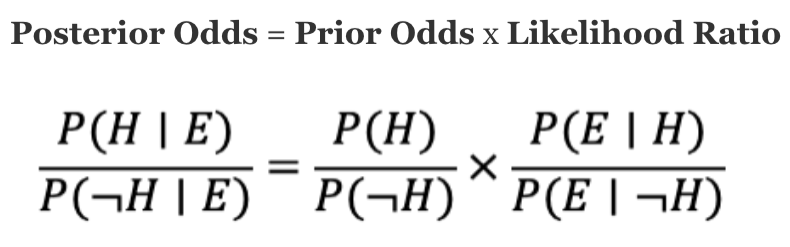
For those who do not like the philosophical form of the equation, what this equation is saying is:
Posterior Odds = Prior Odds x Likelihood Ratio (or Bayes Factor)
In other words, your posterior odds or new probability the miracle claim is true equals the odds of the claim being true based on the background knowledge we already have, multiplied by the impact of the new evidence, which is quantified by the Bayes factor.
Likelihood Ratio (Bayes Factor): 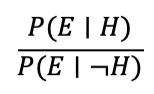
- The numerator is the likelihood we would have the evidence we do if the resurrection did occur.
- The denominator is the likelihood we would have the evidence we do if the resurrection did not occur.
The likelihood ratio (LR) quantifies the strength of the evidence in favor of the hypothesis that the miracle claim is true over how likely it would be to have the evidence we have if the hypothesis were false. This multiplier factor updates the prior odds of the claim being true to the new odds after the evidence is taken into account.
Because Posterior Probability = Prior Odds x Likelihood Ratio (LR), every piece of evidence has to be judged with a LR to judge evidential strength on likelihood of evidence if claim is true versus likelihood of evidence is claim is not true.
Therefore, Posterior Probability = Prior Odds x LR1 x LR2 x LR3 … In other words, single pieces of evidence become multiplicative when there is a cumulative case of evidence.
This powerful formula can be applied to our most serious decisions. We will now do sample calculations on two such examples.
c. Bayes’ probability theorem applied to a positive test result for a sarcoma cancer
Working at a radiation treatment center for cancer, I recognize the destructive nature of a type of cancer called sarcomas. If you came to me and said you tested positive for a specific form of sarcoma on a 99% accurate test, I would be concerned, but not as much as you’d think.
Step 1. Use the “odds form” of Bayes’ theorem
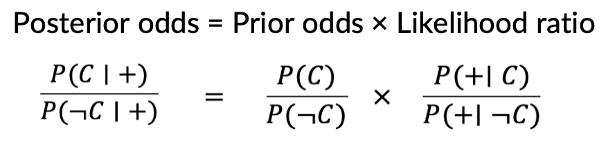
Where:
- C = you have cancer
- + = test is positive
- Prior Odds = prevalence of that cancer, or the odds that you are one of the 6 people per 100,000 that have this specific cancer you tested positive for
- = sensitivity (true positive rate), or the accuracy of the test
- = false positive rate, or how many people out of 100 get an incorrect positive result
- = likelihood ratio
Step 2. What are the value you will put in the equation?
Test is “99% accurate” (interpreted as 99% sensitivity and 99% specificity)
Assume:
- Sensitivity = P(+|C) = 0.99
- Specificity = P(-|not-C) = 0.99
so false positive rate = P(+|not-C) = 0.01
So: the Likelihood Ratio = 0.99 / 0.01 = 99
Now assume the cancer is rare: prevalence P(C) = 0.006% = 0.00006
A certain soft tissue sarcoma 6 per 100,000 = 0.00006
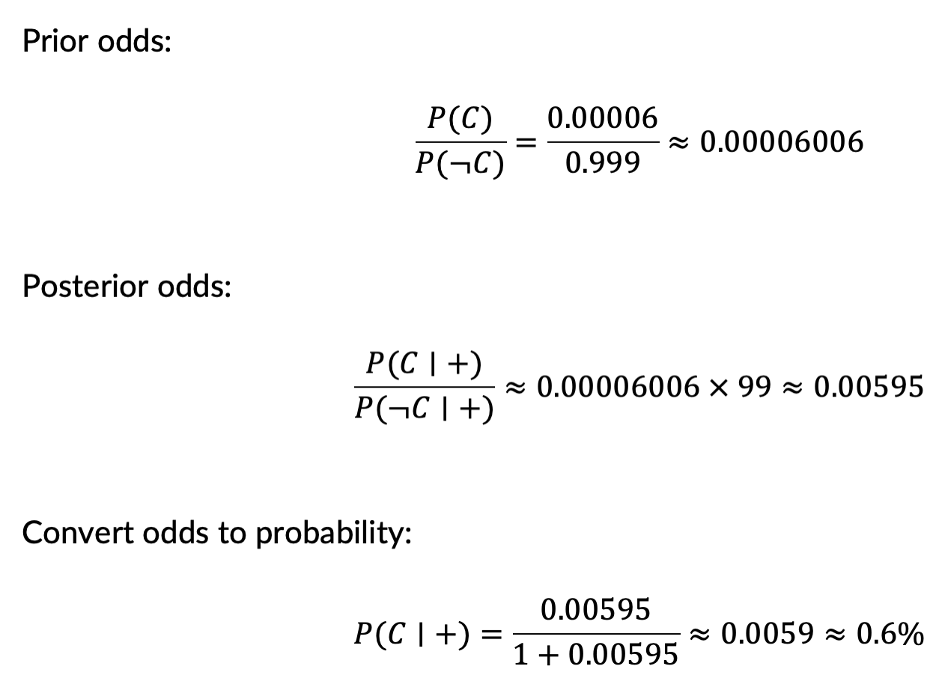
Step 3. Result
Even with a “99% accurate” test, if prevalence is 0.006%, a positive result implies about a 0.6% chance of actually having cancer — not 99%.
Why this happens: When the disease is rare, there are many more healthy people than sick people. So, when a test falsely claims a positive result for that cancer in 1% of (1 out of 100) patients, then applied to a huge healthy population, where only 6 of 100,000 actually have the disease, that test will generate a lot of false positive results.
d. Bayes’ probability theorem applied to Jesus’ resurrection
Step 1. Start with choosing your values for the Prior Odds
Based on all you know so far, what odds would you place on God performing the resurrection miracle?
Be careful. Many just say it is basically impossible and assign an extremely low value. If you are 99.9999999999% certain there is no God performing that miracle, then the prior odds you would input into the equation would be 0.000000000001 or 10-12.
BUT, this would only be valid if the hypothesis was asking if Jesus was raised from the dead naturally. HOWEVER, the hypothesis is not asking that, but instead asks if Jesus was raised from the dead supernaturally. This changes everything. If the biblical God exists, then what reason do you provide to make it improbable that God performed the miracle? Surely, God would be capable of a miracle. So, if you had to bet all you have, how certain are you God does not exist?
Your prior odds have to also account for the evidence for the existence of the supernatural biblical God.
Based on all the evidence you currently have regarding the biblical God, how certain are you no such God exists to perform the miracle?
- If you are absolutely certain there is no God …
That would make your prior odds value 0.0, the result of the equation could never be anything but 0.0 for your posterior belief odds.
This means absolutely no evidence will ever be able to change your mind. You are exposed as an unreasonable person, no reasons will ever change your thinking, which violates science and logic.
- If you are a bit more reasonable about your belief …
Let’s say you are 70% certain there is no God? Then your prior odds that the resurrection did occur would be 0.3. If you were only 55% certain no God performed the resurrection, then your prior odds would be 0.45.
- If you are a Bible believer, how strong do you believe your evidence is supporting God’s existence and authentication in the resurrection miracle?
If you are 98% sure the resurrection occurred, then your prior odds would be 0.98. If only 55% certain, then your prior odds value is 0.55.
We will begin our first calculation with the skeptic’s extremely low prior odds:
Prior odds: 0.000000000001 or 10-12
This means you are 99.9999999999% certain there is no God performing that miracle. I think we can show this value is extremely and demonstrably inaccurate, but will use it now to show the power of evidence.
Key concept: This is one place where skeptics input a faulty value leading to a faulty belief about miracles.
Step 2. Now choose your value for the Likelihood Ratio
Likelihood Ratio: P(E|H) / P(E|not-H)
P(E|H) = 0.7 = likelihood we would have the evidence we do if the resurrection did occur.
Considering the pattern of the biblical God was to establish authority by miracles unable to be matched by others, and the Bible even predicted the resurrection hundreds of years prior to Jesus’ birth, it would be more likely than not that we would have such evidence. Philosophers such as Richard Swinburne and Timothy McGrew have written on prior historical considerations also impacting the values in Bayes’ equation.
The evidence fits the resurrection very well, and should likely be higher than the 0.7 value.
Look again at just some of the evidence and decide how likely this evidence fits if the resurrection miracle did occur:
- prophecies and symbols throughout the Old Testament specifically picking out only one person, who will ever live, that be the Messiah. Jesus is the only one who fits within all the prescriptions (explained in 1 in 100,000,000,000 Pick).
- Jesus and his disciple’s moral teachings and life, adn their claims to Jesus’ deity
- an empty tomb admitted by even enemies of Jesus
- the disciples and other early followers sincerely believed their claim in Jesus being risen and making numerous post-crucifixion appearances
- evidence of close followers, like the disciples or Paul, willing to sacrifice everything for a God they knew for fact had power over death or not
- immediate changes in skeptics, like Paul and James
- sudden changes in millennia-old sacred traditions because Jesus validated his place in the traditions
- all natural cause options have been thoroughly refuted and rejected by the scholarship
- plus, much more evidence in the comprehensive case
Here are some reasons why the evidence fits the miracle. God would ensure the Messiah would be able to be predicted, or picked out from every other person who would ever live, to provide grounds to establish Jesus. The people who knew the facts of the situation, the disciples and others like James and Paul, would show sudden and dramatic life change. The evidence, if available, would survive the finest scrutiny through history if God used it for validation. All of the evidence makes sense in the context and purpose of the biblical God.
Therefore, it is reasonable to assume a high likelihood for the evidence matching the event, and 70% likelihood or 0.7 is conservative.
P(E|not-H) = 0.0000000000001 = 10-13 = likelihood we would have the evidence we do if the resurrection did not occur.
Key concept: This is another value skeptics do not do due diligence upon and arrive at a reasonable value.
The value I chose is still conservative, let me explain why I think so, and maybe you can refute the logic and let me know what better value you came up with.
Consider just the brief list of evidence provided earlier surrounding the biblical God and the resurrection:
- The symbols, tradition, and prophecies, all of which have been established as being written typically hundreds of years before Jesus’ birth, eliminate as a possibility for the Messiah every single person who have ever lived on earth—except one—Jesus.
This is impossible without a miracle, but if you want a conservative estimate: there have been around 100 billion people who have ever lived, and the odds of picking out one specific person would be 1 in 100,000,000 = 0.00000000001 = 10-11
- Having evidence of multiple eyewitnesses, who knew for fact if their claims about Jesus’ resurrection and following appearances were true or not, sincerely believe in the resurrection to the point of willingness to sacrifice all they had. And further, for the evidence supporting this to survive through history to the point the scholarship accepts this as fact.
There is no other belief system or acclaimed God or prophet—none—that make a testable claim like being able to rise from death to verify their authority, place this claim on the examination table, and come away with the evidential validation of the claim.
In addition, critics routinely complain there are thousands of religions, and if this is true, then considering the resurrection is on a level of evidential support no other religious claim can reach, then conservatively, we could place the odds of having such evidence of the eyewitnesses, which also included skeptics, to be 1 in 1000 = 10-3.
- Having millennia old traditions change suddenly, timed with the same resurrection event. This occurred with the Jewish followers of Jesus, including: changing the Sabbath focus from legalistic work restriction to a day of spiritual rest, with some even observing it on Sunday (“The Lords Day”), shift from sacrificial system to Jesus being the completed sacrifice for sin, and inclusion of Gentiles in worship and in the family of God.
I do not know how many times or chances this had to occur in history, so 1 in 100 (10-2) odds seems conservative.
We could go on, but this is more than enough to make the point. These separate supportive evidences have to be multiplied together to get the final likelihood that you would see this evidence bundle if the resurrection had not occurred.
10-11 x 10-3 x 10-3 = 10-17, but instead I used a much more conservative 10-13 in the equation, which is 1000x more favorable to those who do not want to believe in the resurrection.
Therefore, the likelihood ratio or Bayes factor = P(E|H) divided by P(E|not-H) = 0.7 / 0.0000000000001 = 7,000,000,000,000
Interpretation: The evidence is 7 trillion times more expected if the miracle occurred than if it did not occur.
Step 3. Your Turn:
Bayesian Evidence Worksheet
Short list:
Prior Odds: _________________________________
P(E | M): ___________________________________
P(E | ¬M): __________________________________
Likelihood Ratio: ____________________________
Posterior Odds: ______________________________
Posterior Probability: ________________________
Or, you can use this more detailed list:
Step 1 — Prior Belief (P(H)/P(¬H))
Prior Odds: _______________________
Step 2 — Evidence Likelihoods
P(E | M): _________________________
P(E | ¬M): ________________________
Step 3 — Calculate the Likelihood Ratio
Likelihood Ratio = P(E | M) ÷ P(E | ¬M)
Likelihood Ratio: __________________
Step 4 — Update the Odds
Posterior Odds = Prior Odds × Likelihood Ratio
Posterior Odds: ____________________
Step 5 — Convert Odds to Probability
Posterior Probability = Posterior Odds / (1 + Posterior Odds)
Posterior Probability: ______________
Reflection:
How strongly does this evidence support the hypothesis?
Does the evidence:
☐ Strongly favor the hypothesis
☐ Moderately favor the hypothesis
☐ Provide weak support
☐ Not change the belief much
☐ Count against the hypothesis
Notes:
________________________________________________
________________________________________________
Step 4. Conclusion:
Posterior Odds is the new probability the resurrection occurred based on your Prior Odds being updated by the evidence for the resurrection, which is evaluated using the Likelihood Ratio (Bayes Factor).
Posterior Odds = 0.000000000001 x 7,000,000,000,000 = 7
Posterior Odds of 7 means: 7:1 or it is seven times more likely the resurrection occurred than not.
What does “odds” actually mean? Odds are not probability. Odds are a ratio of success to failure.
So when we got posterior odds of 7, that means: P(M|E) / P(not-M|E) = 7 / 1 = 7.0
In plain English: For every 7 chances it is miracle, there is 1 chance it is not miracle. So the ratio is: 7:1
And to turn odds into total probability, there is a simple process. Probability must live in the range 0–1 and represent the fraction of the total. But odds only give a ratio, not the total. If the odds are: 7:1, then the total parts are: 7 + 1 = 8.
We have to extract the portion of the total, so the miracle probability is the fraction of the total belonging to the miracle side: P(M|E) = 7 / 8 = 0.875.
If you know the odds, then the probability = odds / 1 + odds. And to get the probability as a percentage of how likely the miracle occurred based on the new evidence, then 0.875 = 87.5%
Posterior Probability:
Therefore, the probability the resurrection miracle occurred P(H|E) = 7 / (1+7) = 0.875 = 87.5%
This means your new probability that the resurrection did occur has now changed from your prior odds based on the evidence, and being at such a high value near 90%, if you want to bet your life against the God who accomplished the resurrection, the odds are 7 to 1 against you. And luck will not save you from the consequences.
Key insight:
Even with an extremely skeptical prior odds, if the evidence is vastly more expected under the miracle hypothesis than under the natural explanations, the posterior probability can become very high and make it unreasonable not to believe in the resurrection.
e. What-Ifs
- What if we replaced the unreasonable Prior Odds of being 99.99999999% certain God does not exist or did not bring about the resurrection, to being 70% certain. Then we recalculate to find …
Posterior Probability = 99.999999999952% In other words, you’d be a fool not to believe in the resurrection, based on the evidence.
Can you see what a difference prior odds make, which are impacted by your background assumptions, confirmation bias, or awareness of the evidence available.
- What if we replaced the value I selected for the denominator of the likelihood ration which tells us the likelihood of seeing the bundle of evidence for the resurrection if the resurrection did not occur?
I showed how I got the number, and made it very much less powerful for the sake of being conservative. For example, one factor in that value was 1 in 100 billion, or 10-11. It can be shown the Old Testament’s symbols, traditions, and direct predictions were made hundreds of years prior to Jesus, yet out of the over 100 billion people to have ever lived, only Jesus fits in those fantastically prescribed predictions. This makes the likelihood of a natural explanation for these predictions 1 in 100 billion. If you can find one other person in all time who fits those prescriptions the same as Jesus, and you provide the evidence to verify, then the odds are still 2 in 100 billion.
But let’s say a skeptic, decided to input a value without much thought or verification. They failed to consider how vastly low the likelihood of a natural explanation is to explain the evidence we have. Critics have already abandoned these failed alternative explanations, backed by unmatched focus and study and over 2000 years to find even a reasonable explanation.
Ignoring all that, these skeptics hold to the examples we have of testimonies or miracles even when no miracle occurred, and examples of fraud fooling people. This is true, but failing to take into account the vast unlikelihood of natural explanations for the bundle of resurrection evidence, such as the predictions surrounding Jesus, the value they may input is fatally flawed. They may end up claiming a 20% chance of seeing such evidence even if the resurrection never occurred.
The result: the same skeptic, initially having over 99% certainty the resurrection never happened, after seeing the evidence for the resurrection, could have changed their belief as the calculation resulted in an 87.5% probability the resurrection did occur, as noted above, however, placing the faulty value of 20% likelihood of seeing the evidence even if the resurrection is false, would now calculate the following …
Posterior Probability = 3.38% And if this was the value you calculated, then it would be unreasonable to believe in the resurrection as the likelihood is under 4%. So, of course this skeptic will not consider changing their belief. Unfortunately, the value input into the equation by the skeptic to get 4% are unreasonable and lead to this faulted answer.
Therefore, the debate about miracles always comes down to:
(1) priors and
(2) how expected the evidence is under each hypothesis.
Which leads to the obvious question: What evidence is brought to the table to back up the values input into the equation?
The big takeaways
Bayes’ Theorem shows miracle debates hinge on two questions:
- Prior: How rare are miracles in your worldview?
If someone sets the prior near-zero, only a massive likelihood ratio can move them. But what validates the prior odds value? Because the claim involves the primary question of whether the miracle-worker, God, exists or not, the comprehensive case of evidence for and against God’s existence must be accounted for.
- Likelihood ratio P(E|M) / P(E|not-M): How much more likely is the evidence if a miracle happened than if it didn’t?
P(E|M) : As long as the miracle occurs in the context of a fitting theological background and purpose, then the evidence should make sense if the miracle actually occurred. Therefore, this value is usually not at an extremely high or low value, maybe between 0.5 and 1.0, and will do little to impact the calculation.
P(E|not-M): On the other hand, the likelihood of having the evidence we do if the miracle never occurred, and has to be explained by purely natural forces, especially if the evidence is rare, unique, composed of a number of separate evidences, or otherwise impressive, could drastically impact the calculation.
Consider the graph below, which shows how the final calculated value for posterior probability of the miracle being true (how likely it is the resurrection occurred based on the new evidence provided) changes depending on the P(E|not-M) value you choose.
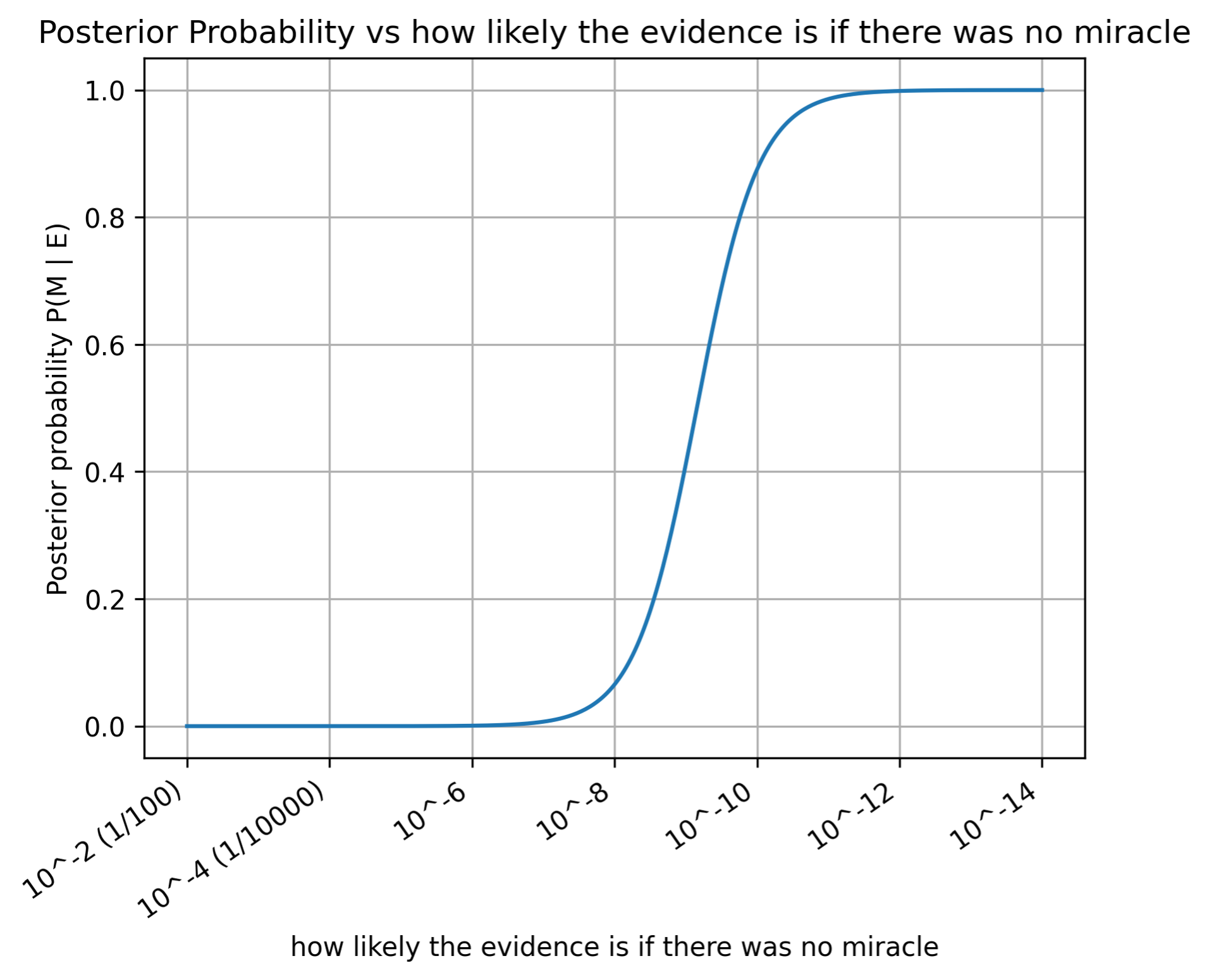
If you think all the evidence for Jesus’ resurrection can occur through natural causes given up to 1 million chances (10-6), then the final probability for Jesus’ resurrection in your mind should be near 0.0, meaning the evidence is not good enough and you would be a fool to believe in this miracle. However, you can see how quickly the posterior probability values jump up.
If you think all the evidence for Jesus’ resurrection can occur through natural causes given up to 1 billion chances (10-9), then the final probability for Jesus’ resurrection in your mind should be near 0.5 or 50%. So believing in the resurrection based on this evidence jumped up so much, you are 50-50 whether you should accept it as true or not. And since there are around 8 billion people alive today, do any of them match the specific conditions Jesus did? If not, then you should already be leaning towards a higher probability the belief in the resurrection is the accurate belief.
If you think all the evidence for Jesus’ resurrection could only occur through natural causes given up to 100 billion chances (10-11) or more, then the final probability for Jesus’ resurrection in your mind should be near 1.0, 100%, absolute certainty the resurrection occurred.
This shows the single biggest lever in miracle discussions:
How likely would we see this evidence even if no miracle occurred?
The posterior probability swings dramatically as changes. This makes it easy to show how multiple strong, unprecedented, unique, independent lines of evidence can overwhelm even extremely skeptical priors.


[…] will be fun for you. For those who don’t, it is at least interesting. Another post will explain Baye’s theorem deeper, and explain why even if an oncologist says you tested positive for cancer on a test that is […]