
Brief Answer:
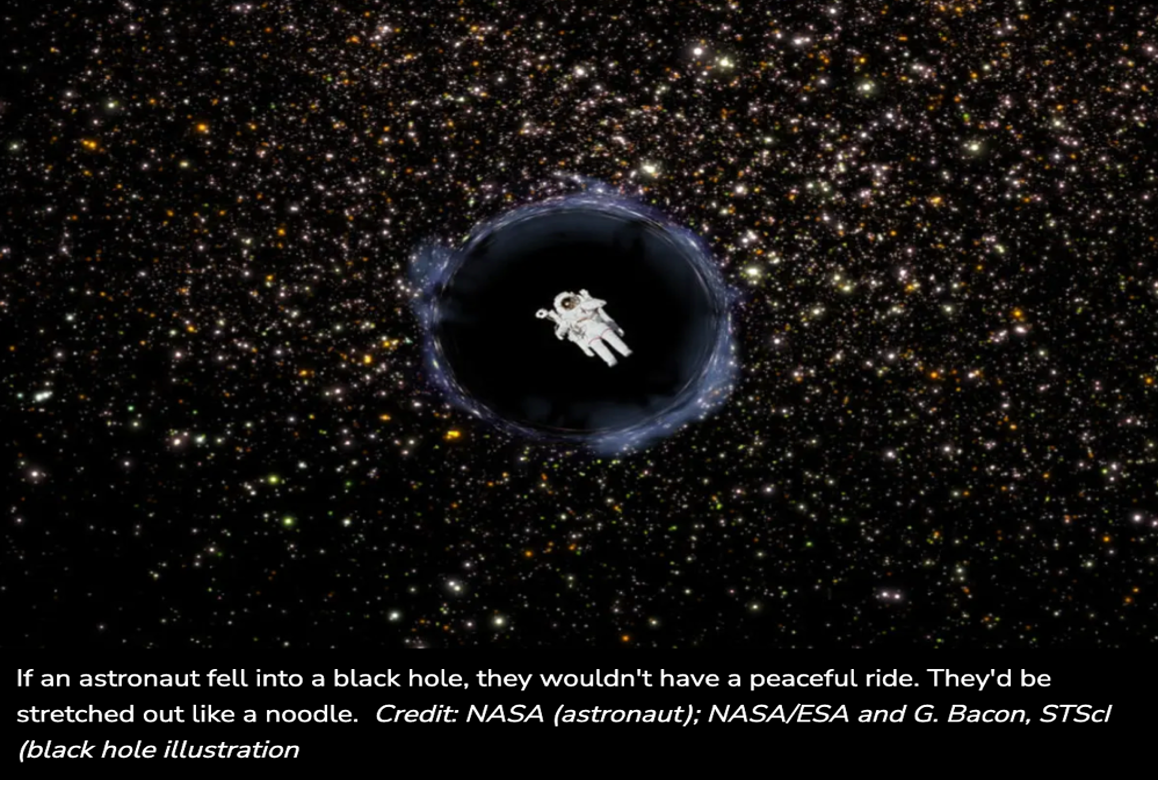
Spaghettification and crushed into extreme density.
Detailed Answer:
Science can be such a roller-coaster. Science discovers the existence of black holes, and brings science fiction writers and fans to peaks of excitement about the possibilities of what we may find entering a black hole. But, then science brings us quickly down to the reality of what actually happens when you enter.
Interstellar was so entertaining and thought-provoking as Matthew McConaughey’s character plunged into a black hole, but the reality would have been more of a horror movie.
Step-by-step: what you’d experience
- You would see light from behind the black hole bend around it (gravitational lensing). Interstellar showed this amazing visual well.
- Approaching the black hole gravity increases rapidly.
- Time for you slows relative to distant observers (time dilation). To someone far away: you appear to freeze near the edge.
- Then the horror starts, depending on what type of black hole is eating you.
Before explaining further, let’s learn a little more about this massive gravity monster.
What is a Black Hole?
Simply put, a black hole is a massive amount of mass condensed into such a relatively small place it increases gravity to the point of being so strong not even light can escape the pull of gravity, once within its grasp.
How condensed is the mass? A Black Hole the same size of our Sun has 230,000 times more mass. A 1x1x1 cubic foot block of Earth weighs around 160 pounds, but a 1x1x1 cubic foot of the black hole the size of our sun would weigh 170,000 pounds. When there is so much mass, and it is so densely packed, it creates extreme gravity.
Black holes get their name because they do not reflect light like a planet, and the gravity is so strong that no light is able to escape from it. The only way to see them is the warping of space around them causes light from behind them, which normally you could not see as it would be blocked, to bend around the black hole in a process called gravitational lensing.
Also, if a star or gas cloud gets too close to the boundary of the black hole (the event horizon), then they are ripped apart and can swirl around the event horizon, marking the black hole in the center. This accretion disc gets superheated, causing powerful jets to shoot out from the poles of the black hole. These jets are from the remains swirling around, not from inside the black hole.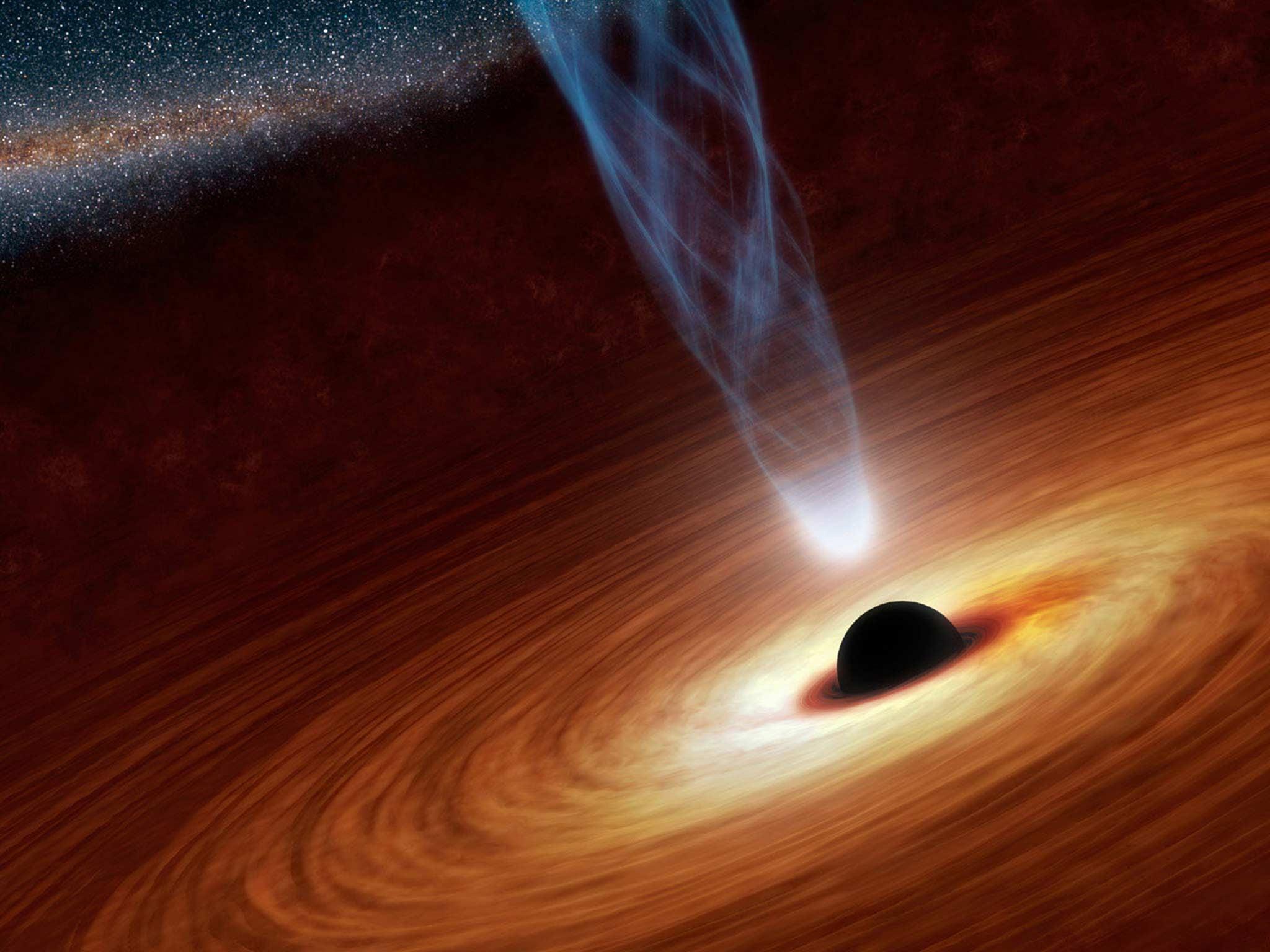
Nothing that crosses the event horizon of the black hole comes out. Stephan Hawking predicted a quantum effect of particle pairs forming near but outside the edge of the event horizon, causing one to go into the black hole, and the other to escape. But this comes not from inside, but outside the edge of the black hole.
The event horizon is not a surface. It is a boundary in spacetime where escape becomes impossible. Not even light or information can escape. So, if we sent a probe in, somehow able to survive the gravity, it would still be unable to send any information out.
Spacetime is so curved inside that all paths forward in time move toward the center of the black hole. What is at the center? We don’t know, science produced some theories, but hard to get reliable answers. The density of the mass becomes so large that it becomes infinite in the equations, what is known as a “singularity,” and the current understandings of general relativity break down, meaning our current physics theories cannot give a complete explanation. But it would not matter to you, because before you came to that center you would be dead.
As Eric Betz describes in his article in Discover,[1] at a simple level of categories, there are three kinds of black holes: stellar-mass black holes, supermassive black holes and intermediate-mass black holes. When very large stars (our Sun is not one) do not have enough fuel left to burn and keep from collapsing, they collapse into themselves and form stellar-mass black holes. Most galaxies, including our Milky Way, have supermassive black holes in the center, which grow to such incredible sizes, up to tens of billions times the mass of our Sun, by feeding on stars, dust, and merging with other black holes. There are only some suspected intermediate-mass black holes, which likely form by adding on the mass of other things they consume like the supermassive ones.
Back to what you would experience
- What you see, and what others see watching you (gravitational lensing and time dilation)
If you are in your spacesuit floating near a stellar-mass black hole, if it wasn’t pulling anything nearby into it, you may only observe the magnification or lensing of the starlight from behind the black hole.
An episode of the old television series Stargate SG-1 displayed an example of this. The closer you are to something with greater mass/energy, the greater the effect of gravity, which causes a warping of time as general relativity predicts.
You can actually calculate how much slower time runs for you near a black hole (tnear) compared to a distant observer (tfar) watching you:
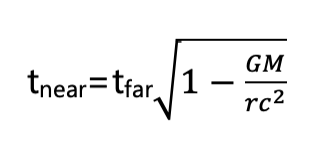
Where:
- = gravitational constant
- = mass
- = distance from center
- = speed of light
As you get closer to the black hole (smaller ) → time slows more, until eventually you appear to freeze. Time for you runs normal, but you will be stretched apart and crushed soon.
If observers watching you are far enough away, they would see you moving in incredibly slow motion, even seeming like you froze.
- What you feel (spaghettification caused by tidal forces)
As you drift closer to the edge of this bizarre sight, you would feel more and more pressure, because the gravity of the black hole compresses your body, while at the same time, stretches your body by pulling it towards the center of the black hole.
You get crushed and then stretched by tidal forces, as the article notes “like taffy,” in a process called spaghettification. If your feet were closest to the black hole, then your toes would feel a much stronger gravity pull than at your head, and every bit of your body gets elongated to literally make you resemble a strand of spaghetti.
This all happens fast for you, even before you reach the event horizon, and at that point all possible paths in spacetime lead inward. “Forward in time” = moving toward the center. You cannot: turn around, escape, avoid what’s coming.
Eventually you are crushed to extreme density as you near the center.
A star was actually observed experiencing this tidal pressure in 2014, when it came within the grasp of a black hole and was stretched and shredded. Some of the remains of the star were flung away, and the rest fell into the event horizon.
The situation is a little different for a supermassive or intermediate-mass black hole.
For an outside observer, you slow down, redshift, fade away. For you, you may cross the event horizon still alive, but it all happens to you quickly. Contrary to what you would expect, the spaghettification would not happen as far away from the event horizon as for the smaller stellar-size black holes. You may even cross the event horizon still alive. You may be able to see out into the space outside, but no one would be able to see you. You could try to flash lights to those outside the event horizon, but even that light would fall back into the black hole with you.
The end is the same: torn apart and crushed to extreme density by gravity.
You don’t “see the future of the universe instantly.”
You don’t “pop out somewhere else” (no evidence for wormholes).
You don’t survive the trip, and there is no escape once crossing that horizon.
[1] Eric Betz, “What Would Happen if You Fell Into a Black Hole?” Discover, July 29, 2020; What Would Happen if You Fell Into a Black Hole? | Discover Magazine
