

Brief Answer:
Yes, there are extra-biblical (outside of the NT) writings, archeology, historical studies, oral creeds, and more.
Detailed Answer:
I understand why some people ask this question, but it is also a bit frustrating.
Frustrating because most people asking this question are making the assumption the New Testament (NT) claims about Jesus are not trustworthy because the writers were biased, and this is a bad place to park your thinking.
Are the New Testament (NT) writers biased?
Everyone comes to the issue of God with a bias, the question is: does the bias make the person unreliable or not, because facts are facts and are shown by evidence, not by bias. Those who have written books calling the NT writers biased, they too have a bias, should we just disregard their books? Those who experienced the Holocaust are surely biased, does this mean their accounts are untrustworthy? These are just starting reasons why just assuming bias is a weak assertion and requires much more thinking.
If you assume the NT accounts are biased and untrustworthy, what is your evidence? What historical and logical evidence do you provide to support your belief the NT authors wrote lies or are untrustworthy? The consensus in historical scholarship accepts Jesus’ disciples and the apostle Paul sincerely believed what they recorded about Jesus was accurate.[1] So, what evidence do you bring to discount the evidence convincing the scholars? While I can understand bias, it is an unsupported leap in logic to claim the author’s biases made them untrustworthy recorders.
On the contrary, it would be much easier to show the weight of bias would be to not write the NT. The culture’s religious leadership and the governing power of Rome just showed what they thought of Jesus’ claims through crucifixion, and persecution would follow those supporting Jesus’ claims (2 Timothy 3:12, Acts 8:1-4).
Cold-case-detective J. Warner Wallace noted, in a lecture I attended, if the authors of the NT are lying about their claims, it always comes down to three possible reasons why they would lie: (1) financial greed, (2) sexual or relational lust, or (3) the pursuit of power. What evidence is there they got rich from their claims, or had many relationships with women, or gained power. Some may think they became important leaders in their religious community, but apply this to the most prolific NT author, Paul. Paul started off with significant authority and respect of his religious community, studying under one of the most famous teachers and was feared for his persecution of the early Christians. Why would he leave this? Especially considering the persecution he would endure if preaching the Gospel (2 Corinthians 11:23-28). The only records we have show Christian authors not gaining much of anything, aside from enemies, persecution, and martyrdom. The only motivation the authors claimed was to serve the One who saved them by giving them more than anything the world could offer.
If God is involved in the Bible, then outside sources become very secondary
And again, this is a secondary issue, the primary question to answer is: “Is there a God involved in the Bible, or not?” If the evidence supports there is more than it supports there is not, then outside source corroboration for Jesus is a very secondary concern.
Old Testament arrows get us to the bulls-eye
Yet, as amazing as the NT already compares against any other ancient writing, there are sources outside of the Bible adding corroboration.
While the last thing some readers will want is more writings from the Bible, before getting to the external sources, we have to take a quick look at the Old Testament (OT). Why, because the OT provides support for the accounts recorded in the NT, which are worth considering because these should shock you.
I will do a series of articles on this later, but consider this, God always sets his message apart from any other human endeavor, and wants the world to recognize the absolute uniqueness and exclusivity of Jesus.[2]
So how can you demonstrate knowledge beyond any other source throughout history, and exclusively limit our search for a Savior to only one? One way is to provide predictive arrows of this future Savior, hundreds to thousands of years before his birth, which land on the bullseye of only one person in all human history.
The OT does exactly that using symbols and predictions as guideposts to identify the one and only coming Messiah. Can you name anything else ever produced by humanity predicting a coming leader as comprehensively and detailed and predating this figure hundreds to thousands of years in advance?
If you think what the OT did in its predictions of Jesus isn’t beyond human ability and ultimately significant, then name all the other human-produced predictions that are equivalent.
There are direct, meaningful, identifying symbolic bonds between Jewish feasts and Jesus, the Tabernacle design, numerous accounts of characters in the OT, etc. These are so consistent throughout the OT there is a specific word for it, “typology”, referring to historical people, places, objects, or events that foreshadow Christ and his work. I will later do a series of articles on numerous examples of these typologies, but for now will just cover a couple examples of symbolic ties.
Consider the ties between the Jewish holiday of Passover and the crucifixion of Jesus:
|
PASSOVER delivers from physical death |
CRUCIFIXION delivers from spiritual death |
| Occurs on the 14th of Nisan | Crucifixion on the 14th of Nisan |
| Lamb selected on the 10th of Nisan (Exodus 12:3) | Christ was selected on the 10th of Nisan (Palm Sunday) |
| Lamb had to be perfect, without blemish (Exodus 12:5) | Jesus had to be perfect, without sin (1 Peter 1:19) |
| Lamb could have no bones broken (Exodus 12:46) | Jesus had no bones broken (John 19:36) |
| Blood of the lamb saves those using it | Blood of Christ saves those who accept it |
This next example I researched because the OT account of Isaac was troubling to me. Reading Genesis 22 we are told how people were engaging in pagan religions, which among other things, required human sacrifice, especially children. Archeology has found bones of children in piles, and discovered repulsive details of the sacrificial practices. The Bible gives God’s thoughts and actions against the practice, for example, Jeremiah 19:5, Deuteronomy 12:31, 18:9-12. The Bible makes it clear, God does not accept the excuse “everybody is doing it”, but instead makes clear, all other gods are “not like us”.[3]
Therefore, when the account states God asked Abraham to offer up his son as a sacrifice, I was very confused. Of course, I hadn’t applied the rest of the biblical context, or really looked further into the issue as I did not know how to find an answer. Later, when I did, it became clear how God was pointing towards the coming Messiah, and at the same time flipped the common non-biblical beliefs on their head.
While the other belief systems required you to sacrifice your child to the gods, God asked Abraham to sacrifice “his only son” to demonstrate (whether to Abraham himself, or to others) he loves God as much as those worshipping other gods, but the biblical God completely flipped this practice, by doing what none of the supposed gods were willing to do, by instead sacrificing “his only Son” (John 3:16) for us.
Abraham knew God had earlier promised to create a nation from Abraham’s son Isaac, so, he believed God would have to bring his son back to life as he knew he could trust God’s promises (Hebrews 11:17-19)[4], but the story was much deeper than Abraham, and even readers today, have grasped. There is a two-thousand-year string of connections between this account and the account in the NT about Jesus.
Isaac’s birth was predicted by God as a miracle, and Isaac was considered Abraham’s “only son” (Genesis 21:1-10). Genesis 22:1-18 gives a number of other details, including: Isaac was supposed to be a sacrifice and carried the wood to be used in his sacrifice up Mount Moriah, which would result in a burnt offering to remove sin. Isaac was seemingly forsaken by his father. After, stopping the sacrifice, God promised to provide a lamb as a substitute for Isaac, which was three days after his request for the sacrifice. Instead of a lamb, a ram with his horns caught in a thicket was used. I remember thinking, wait, a ram is not a lamb, and looking at pictures of them they cannot be considered the same. A ram would serve as a burnt offering for what Abraham needed, but God still owed him a lamb. Here is the lamb over two-thousand years later (John 1:29).
|
Abraham’s sacrifice |
God’s sacrifice |
||
|
Isaac’s birth was promised by God (Genesis 21:1-2) |
Jesus’ birth was promised (Isaiah 7:14) |
||
|
Isaac’s birth was considered a miracle (Genesis 21:6-7) |
Jesus’ birth was considered a miracle (Isaiah 7:14) |
||
| Isaac was considered Abraham’s “only son” (Genesis 21:1-10, Hebrews 11:17) | Jesus is God’s “only Son” (John 3:16) | ||
|
Isaac was supposed to be a sacrifice (Genesis 22:2) |
Jesus was the sacrifice (1 Corinthians 5:7, 1 John 2:20) |
||
|
Isaac carried the wood to be used in his sacrifice up Mount Moriah (Genesis 22:6) |
Jesus carried the wood of the cross to be used in his sacrifice (John 19:16-17) | ||
| Isaac was bound (Genesis 21:9) |
Jesus was bound (Matthew 27:2) |
||
|
The sacrifice was to be a burnt offering to remove sin (Genesis 22:2) |
Jesus’ sacrifice was for the removal of our sin (Isaiah 53:12) | ||
|
Isaac seemed to have been forsaken by his father (Genesis 22:9-10) |
Jesus asked his Father why he was forsaken (Matthew 27:46) |
||
|
The substitute for the sacrifice had his horns caught in a thicket (Genesis 22:13) |
The substitute for the sacrifice had his head caught in a crown of thorns (Mark 15:17) |
||
| Isaac was considered dead for three days before God stopped the sacrifice (Genesis 22:4) |
Jesus was considered dead for three days until this substitute showed victory over death (Mark 15:42-46, 16:1-6) |
||
|
God promised to provide a lamb as a substitute (Genesis 22:13-14) |
God provided a lamb as a substitute (John 1:29) | ||
| Jesus saved Isaac from being the sin offering (Genesis 22:11-12, 15-16)* |
Jesus saved all from being the offering required by sin (1 Peter 2:24) |
||
|
Abraham’s family line will be the blessing to all nations (Genesis 22:18) |
Jesus is of Abraham’s family line and is the blessing to all nations (Matthew 1:1) |
||
| *Note: both Jesus and God the Father are interacting in this account, “God asked Abraham to sacrifice Isaac?” | |||
If these two symbolic ties to Jesus were all there was, then maybe you could write it off as coincidence, but this is throughout Old Testament. And further, they are supplemented with corroborative prophecies beyond the ability of humanity.
What do you think the probability would be of predicting, or guessing, numerous defining characteristics and future experiences of a person who will impact the world, and so specifically and accurately that only one person in all history will fit? I do not think it is humanly possible, otherwise we would have had numerous examples of this throughout all of history, and many, many others that come close. Where are those examples?
The Bible is the only source I have found providing such verification of its authority and ultimate authorship. We only need to look at a few here as they are enough to show how each prophecy about the Messiah (Savior or Christ) brings in the restrictions of who can fit more and more, until eventually only one person is left within the confines prescribed by the prophecies. This is illustrated below by each prophecy having a circle of people who could fit within its requirement, and as each prophecy is added, the circle of possible candidates on the target gets smaller and smaller, until eventually reaching a bullseye where only one person can be found.
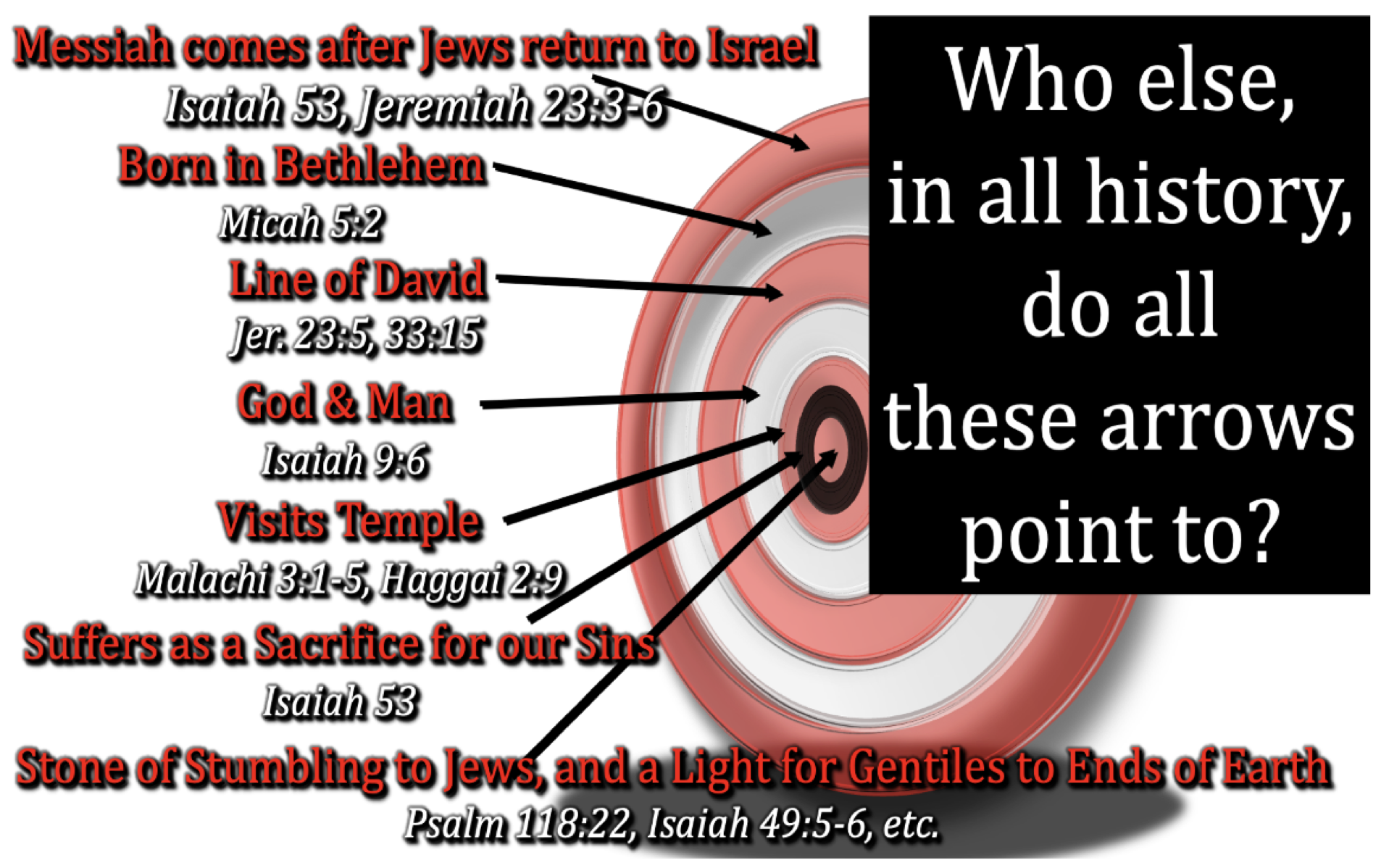
- The Messiah will not come to do his work until the Jewish people come back together to the land of Israel, as a nation, and rebuild the Temple, after first being destroyed, dispersed, and with large percentages being held captive in other nations (Jeremiah 23:3-6).
Yes, I know, religious-sounding words like “prophecies” may seem uncomfortable, they definitely did for me, until I saw the evidence. This topic is covered in another article, but think on this example. The Jewish people were decimated by the Assyrians and the Babylonians, the Temple they built for God was destroyed, and they were taken captive by the greatest empire to date, Babylon. The prophet Isaiah in chapter 44 (Isaiah 44:28; 45:1) observes how Israel is God’s chosen people to show the word what happens when a people follows God or decides to go their own way. Israel had decided to go their own way, and even follow other gods. Therefore, consequences were soon to follow, which included destruction, dispersal and captivity. That’s the bad news.
However, Isaiah also says there is good news, hope. Amazingly, Isaiah states by name the person God will use in the future to conquer the greatest empire of that time, release the Jewish captives and allow them to rebuild the Temple. Isaiah’s book, provided the exact name, Cyrus, and is known to have been written over 100 years before Cyrus the Great was born. The Jews returned and built the Second Temple around 500 BC. So only people born after that time are in the running to be the Messiah.
- The Messiah will be born in Bethlehem (Micah 5:2). And not just Bethlehem, as there was more than one Bethlehem, but specifically the smaller Bethlehem Ephrathah. Now the circle is much smaller that contains anyone capable of fitting the predicted requirements. There are only so many people who have been born in that specific ancient town.
- The Messiah will come from the family line of David (Jeremiah 33:15). The genealogies are used in the Bible to make this clear for Jesus, as Mary is a descendant of King David’s son Nathan. Joseph was a descendant of David through Solomon.
- This Savior will be both God and man as Isaiah 9:6[5] gives attributes of both nature’s, God and man to this child to be born. In fact, reading this passage in the footnotes, do you recognize it? We hear this most often at Christmas, which makes many people think this passage is from the New Testament. But no, this was provided in Isaiah over 700 years before Jesus’ birth.
- This Christ will visit the Second Temple (Haggai 2:9, Malachi 3:1-5). When God says he will fill the temple with glory, he is speaking about the “glory of his name”, which was used in the OT and meant his presence, which at that time was displayed as a pillar of smoke or fire. So how can his glory, his presence be greater than it was in the first Temple? Only if the Messiah comes personally to visit.
And since this Second Temple is the one mentioned above and was in use between 516 BC and its destruction in 70 AD, what Jewish person personally visited the temple before it was destroyed in 70 AD, who also fit the other qualifications? Can you see the circle of possible candidates getting very small?
A later prophet, Malachi, added the Lord will come to his temple and purify some and bring judgement to others, and used the Hebrew term which always refers to God himself.
- The Messiah will suffer as a sacrifice for our sins (Isaiah 53, and numerous other passages). This was uncomfortable and a problem many Jewish people of the time could not abide, as they were suffering under Roman rule and were hyper-focused on the conquering aspects of the coming Messiah. King David was a conqueror, and the Messiah would be greater by far, and while many passages speak of the pain and suffering as well, the people of that time either did not believe in a resurrection (Sadducees), or believed all would be resurrected at the final judgement (Pharisees). The idea of a Messiah being killed and rising to accomplish a greater goal than conquering Israel’s foes on earth was not part of what the people were being taught or expected.
The Messiah would be a stone of stumbling to Jews, and a light for Gentiles to the ends of the earth (Psalm 118:22, Isaiah 49:5-6, and other passages). This Savior would not be accepted well by his own people, how embarrassing (but true of Jesus), but would be accepted and bring salvation to others who are not Jewish, and all across the earth. What Jewish person fits this qualification? Steven Spielberg, or maybe Ruth Bader Ginsberg?
There are many more arrows shot across the centuries to pinpoint the Savior the OT predicted was coming. Who else in all human history fits even these seven identifiers, aside from Christ Jesus?
Sources Outside the Bible
Ancient sources outside, and hostile to, the Bible
Whenever someone asks for sources outside the Bible about Jesus, it is important to ensure they have proper understanding of a few often misunderstood points. First, the Gospels (NT books Matthew, Mark, Luke and John) are historical records, regardless of the inclusion of miraculous events and whether you or scholars accept these or not, the books are recognized and utilized as historical records by historians, archeologists, literary experts, etc.
Second, if you have a presuppositional bias (meaning you judge the biblical unreliable even before considering the facts because you do not like the supernatural aspects) this is an error in thinking, which is demonstrably exposed as science has already verified the greatest supernatural event and miracle, the bringing into existence of all nature, all the Universe, from nothing natural.
Third, how many different external sources do we typically find to verify details of an ancient claim like Jesus’? We shouldn’t expect much, if any, yet again, the Bible stands out compared to others.
Here are a dozen key facts confirmed by sources outside the Bible, and most of these sources are even hostile to Christianity:
1) Jesus lived during the time of Tiberius Caesar.
2) He lived a virtuous life.
3) He worked wonders.
4) He had a brother named James.
5) He was acclaimed to be the Messiah.
6) He was crucified under Pontius Pilate.
7) Crucified on the eve of the Jewish Passover.
8) Darkness and an earthquake occurred when he died.
9) His disciples believed he rose from the dead.
10) His disciples were willing to die for their belief.
11) Christianity spread rapidly as far as Rome.
12) His disciples denied the Roman gods and worshipped Jesus as God.
The chart below displays the sources outside the Bible and the information provided.
|
Author (all AD) |
Document |
Nature of Reference/Quote |
|
Cornelius Tacitus (55-120); Among the most trusted ancient historians |
Annals, 15:44 |
Jesus lived in Judea, was crucified under Pontius Pilatus (Pilate), had followers persecuted for their faith in Christ. |
|
Suetonius (69-140); Roman Historian; annalist to Emperor Hadrian |
Claudius, 25:4 |
Early followers of Christ were committed to their belief Jesus is God and withstood torment and punishment of the Roman Empire. Jesus had a surprising and immediate impact on his followers, to the point they were willing to die with courage for their beliefs Rome viewed as mischievous. |
|
Flavius Josephus (37-101); historian, consultant for Jewish rabbis |
Antiquities 200:9; Antiquities 18:3 |
Execution of James, “the brother of Jesus who was called the Christ”; death of John the Baptist, Jesus was wise, worker of “amazing deeds”; won over Jews and Greeks; accused by Jews, crucified under Pilate. |
|
Thallus (~50) |
Quoted by Sextus Julius Africanus (~221) in his Chronography, 18:1, and Theophilus of Antioch, Studia Patristica XXXVI, 207 f. |
Jesus was crucified, there was an earthquake and darkness at the point of his crucifixion. Although Thallus was a historian and critic of Christianity and provided natural reasons for the darkness. |
|
Pliny the Younger (61-113); Roman Author, Governor |
Written to Emperor Trajan, Letters, V. II, X:96 (circa 112) |
States Christians worship Christ as God, first Christians upheld a high moral code, and met regularly to worship Jesus. |
|
Jewish Oral Traditions (Compiled by 135, Revelation 200) |
The Babylonian Talmud, V.III, Sanhedrin 43a |
From portion of 70–200, “On the eve of the Passover Yeshu [Jesus] was hanged” the day before Passover[i.e., crucified; Galatians 3:13 equates hanging w/crucifixion]; “practiced magic and led Israel astray”; had disciples who were later martyred. |
|
Lucian of Samosata (115-120); Greek satirist |
The Death of Peregrine, 11-13 |
Jesus taught about repentance and Christians believed in eternal life, and these teachings were adopted quickly by Jesus’ followers and exhibited to the world around the followers. |
|
Phlegon (80-140); Writer and freedman of Emperor Hadrian |
Quoted by Origen of Alexandria (182-254), in Against Celsus (Book II, Chap. XIV); also by Julius Africanus (Chronography, 18:1)and Eusebius |
Jesus had the ability to accurately predict the future, was crucified during the reign of Tiberius Caesar, and demonstrated his wounds after he was resurrected. |
|
Mara Bar-Serapion (a Syrian philosopher, ~70) |
Letter from Mara to his Son Serapion, British Museum, Syriac Manuscript, Additional |
Jesus was wise and influential, died for his beliefs, his followers lived lives reflecting those beliefs, some Jews pushed for his execution, and shortly after his death Jerusalem fell. |
|
Celsus (175); Roman philosopher and opponent to Christianity |
Quoted by Origen of Alexandria (182-254), in Against Celsus |
Jesus was wise and influential, admits unusual magical powers of Jesus were generally believed at his time, died for his beliefs, his followers lived lives reflecting those beliefs, some Jews pushed for his execution, and shortly after his death Jerusalem fell. Also, alludes to 80 different biblical quotes. |
Historical and archeological research
One can further check the Bible through extensive historic and archeological study. The book is replete with historic references that can be (and have been) checked. One of the best tests for truth of an accurate source of knowledge is if it can lead to future discoveries, and the Bible is a source used more than any other for accurate guidance to historical and archeological discoveries.
Because critics expected to find constant and unavoidable errors in the biblical record (as is true with other comparable religious or ancient writings), they have poured over and exhaustively researched every minute detail. What has been found?
Wide-ranging verification, and the majority of previously held problems with the biblical claims have been turned into further evidence of accuracy. For example:
- Existence of writing during Moses’ time
- Existence of the tunnel David used
- Existence of the entire Hittite people
Scholars had claimed Moses couldn’t have written the OT books ascribed to him because the people living at that time were too primitive to record in such detail, or archeological digs in Jerusalem showed the tunnel David’s men supposedly used to invade the city did not exist, and historians claimed the entire Hittite people discussed in the Bible must be fictitious as there was no archeological or historical evidence outside of the Bible. Yet, later discoveries showed the critics wrong and the Bible accounts accurate, as there was writing prior to Moses, archeologists dug in the wrong place for the tunnel and tourists can go through the Jerusalem tunnel, and a plethora of artifacts now verify the Hittite people.
For the current topic, we will look at the book of Acts in the Bible because it not only covers the major eye-witness apostles, such as Peter and Paul, who after Jesus’ resurrection and directive to spread his Gospel, were empowered to preach all the core claims in Christianity regarding Jesus’ deity, death, and resurrection, along with recording over thirty miracles to back up their claims, but also this biblical record includes a large number of things that can be verified or rejected historically.
The author, Luke, was a physician who set out to research and document what Jesus’ disciples were claiming after the crucifixion. Acts was written as a continuation of the Gospel of Luke, with the clear purpose to attest to the veracity of Jesus’ claims:
“In my former book, Theophilus, I wrote about all that Jesus began to do and to teach until the day he was taken up to heaven, after giving instructions through the Holy Spirit to the apostles he had chosen. After his suffering, he presented himself to them and gave many convincing proofs that he was alive. He appeared to them over a period of forty days and spoke about the kingdom of God.” (Acts 1:1-3)
Therefore, either Luke was one sick liar, a lunatic, or the book is legend, or the claims are accurate. This can be tested in a number of ways, and skeptical scholars have, including one of the foremost scholars, Sir William Ramsay.
An atheist raised by atheist parents, with an outstanding academic career, being honored with doctorates from nine universities and knighted for contributions to modern scholarship, including several of his works on New Testament history being considered classics, Sir William Ramsay studied under the famous liberal German historical school, which taught the NT was not a historical document, so Ramsey devoted his archeological research to disprove the Bible, focusing on the book of Acts.
When Ramsey began his travel and research to the regions discussed by Acts, he began with a reasonable assumption. Because there was no archeological evidence supporting Luke’s records, then it couldn’t be very accurate and would be simple to disprove as just another false religious writing. After over twenty-five years of study, Ramsey found the exact opposite to be true. As has been the case with countless scholars who devoted themselves to seeking definitive evidence to disprove the Bible, Ramsey was so impressed by the honesty and accuracy of the authors and truthfulness of the information, he eventually became a Christian and wrote a number of books documenting his findings[6].
In his own words, Ramsey observes:
I may fairly claim to have entered on this investigation without any prejudice in favour of the conclusion which I shall now attempt to justify to the reader. On the contrary, I began with a mind unfavourable to it for the ingenuity and apparent completeness of the Tubingen theory had at one time quite convinced me. It did not lie then in my line of life to investigate the subject minutely but more recently I found myself often brought in contact with the book of Acts as an authority for the topography, antiquities, and society of Asia Minor. It was gradually borne in upon me that in various details the narrative showed marvellous truth.[7]
While Luke was not an eyewitness to the resurrection, he was an eyewitness to many of the NT events, was in direct contact with the apostle eyewitnesses, and demonstrated a comprehensive knowledge and accuracy of locations, names, environment, customs and contemporary situations. This was unexpected by the historians and stands out compared to comparable ancient writings. Classical scholar and historian Colin Hemer goes verse by verse to identify and test the accuracy of 84 specific facts, and the result in every case was confirmation through historical and archeological discoveries.[8]
And remember, intermixed throughout Acts are the miracles the apostles were doing to verify the authority there were speaking from. Read for yourself, Luke records the details of these the same way he does the dozens of other ordinary historical facts he covers. Luke, and the apostles he chronicles, all believe there is a supernatural Creator of the universe encouraging the spreading of the message, so the miracles they witnessed were not only possible, but came be expected.[9]
Ramsey adds, “Further study … showed that the book could bear the most minute scrutiny as an authority for the facts of the Aegean world, and that it was written with such judgment, skill, art and perception of truth as to be a model of historical statement”, also stating that one “may press the words of Luke in a degree beyond any other historian’s”.[10] Overall concluding, “Luke is a historian of the first rank; not merely are his statements of fact trustworthy” . . . this author should be placed along with the very greatest of historians . . . Luke’s history is unsurpassed in respect of its trustworthiness.”[11]
Finally, in a later book, Ramsay shocked the intellectual world by declaring he became a Christian.
Other peer-reviewed scholars have discovered the same. A.N. Sherwin-White, said: “For Acts the confirmation of historicity is overwhelming … Any attempt to reject its basic historicity must now appear absurd. Roman historians have long taken it for granted.”[12]
World renown archeologist Nelson Glueck stated:
It may be stated categorically that no archaeological discovery has ever controverted a Biblical reference. Scores of archaeological findings have been made which confirm in clear outline or exact detail historical statements in the Bible. And, by the same token, proper evaluation of Biblical descriptions has often led to amazing discoveries.[13]
Sir Frederick Kenyon, director of the British Museum and second to none in authority for issuing statements about ancient manuscripts, adds: “The Bible can do nothing but gain from an increase in knowledge”.[14]
Does this mean all challenges are answered and all claims of the Bible should just be accepted as fact? Of course not.
While providing some of the most renown scholars’ opinions does carry significance backed by expert research and peer-reviewed literature, I have not given a thorough coverage of critic’s challenges. I will do articles or FAQs later answering these challenges. However, aside from the fact most challenges have now been turned into confirmations through further discoveries and study, these are all secondary.
We will always have questions and challenges with the Bible, as well as with writings in atheism, agnosticism, and every other belief system, but only one belief system has sources, the Bible and Jesus, with evidence of God being involved.
The reason why I put so much work into this topic is because I do not want you to be one of those people, who this verifiable message from God talks about when it speaks of those who think they will do enough good or religious things to be safe, and ignore the pardon and relationship God actually offers.
[1] Habermas, G. R., Licona. M. R. (2004). The Case for the Resurrection of Jesus. Grand Rapids: Kregel
Publications. Five-Minute-Fact-Run is called The Minimal Facts approach by Habermas, there are other versions using more or less than five of the well-evidenced facts.
[2] The Gospel (meaning “good news” in Greek) is fully inclusive in its reach (it is offered to all people to be saved), but fully exclusive in its claim (there is no other name but Jesus by which you are saved; Acts 4:12).
[3] While Kendrick Lamar used this line to musically “diss” certain people, I couldn’t resist using the line as it fits. God is symbolically exposing the other supposed gods, noting these degenerates are nothing like us (God the Father, Son, Holy Spirit).
[4] 17By faith Abraham, when God tested him, offered Isaac as a sacrifice. He who had embraced the promises was about to sacrifice his one and only son, 18 even though God had said to him, “It is through Isaac that your offspring will be reckoned.”[a] 19 Abraham reasoned that God could even raise the dead, and so in a manner of speaking he did receive Isaac back from death.
[5] For to us a child is born, to us a son is given, and the government will be on his shoulders. And he will be called Wonderful Counselor, Mighty God, Everlasting Father, Prince of Peace.
[6] The Trustworthiness Of The New Testament: The Significance Of Recent Discoveries
[7] W. M. Ramsay. St. Paul the Traveller and the Roman Citizen, Chapter 1: The Acts of the Apostles, Section 1: Trustworthiness. London, England: Hodder and Stoughton, 1895. pp. 7–8. As cited in Wikipedia
[8] Norman L. Geisler and Frank Turek, I Don’t Have Enough Faith to Be an Atheist (Wheaton, Illinois: Crossway, 2004), p. 256.
[9] And for us today, what is the greatest miracle recorded in the entire Bible? I would argue the creation of the universe from nothing, which violates the natural law of conservation of matter and energy – matter and energy can neither be created nor destroyed – yet all matter/energy was created. This is the definition of a miracle, and we have scientific confirmation of this miracle. For a Creator with the authority to accomplish that, any other miracle, such as a virgin birth or raising from the dead, is child’s play.
[10] W. M. Ramsay. The Bearing of Recent Discovery (4th ed.), 1920, pp. 85. Retrieved 27 January 2024. As cited in Wikipedia: https://en.wikipedia.org/wiki/William_Mitchell_Ramsay
[11] W. M. Ramsay, The Bearing of Recent Discovery on the Trustworthiness of the New Testament (London; New York; Toronto: Hodder and Stoughton, 1915), 222.
[12] A.N. Sherwin-White. Roman Society and Roman Law in the New Testament, 1963, p. 189
[13] Dr. Nelson Glueck, Rivers in the Desert, (New York: Farrar, Strous and Cudahy, 1959), 31.
[14] Sir Frederick Kenyon, The Bible and Archeology, 1940, 279.
