
Brief Answer:
Is your objection to truth itself true?
Detailed Answer:
Objections to truth often self-destruct. A simple way to challenge a claim against truth is to apply the same logic to itself:
a. There is no truth — Is that statement true?
b. You can’t know truth — Then how do you know that is true?
c. All truth is relative — Is that an absolute truth or just a relative one?
d. It’s all just opinions — Is that your opinion, or is it the truth?
e. No one has the truth — But you’re claiming to know that truth, right?
f. It’s true for you, but not for me — Is that statement true for everyone, including both you and me?
g. You shouldn’t judge or be intolerant — Isn’t that a judgment, and intolerant toward those who do judge?
h. Whatever, I’ll do what I want — You’re free to do so, but you still will slam against the hard reality of ignored truth.
Expose Objections to Truth Using Real-Life Situations
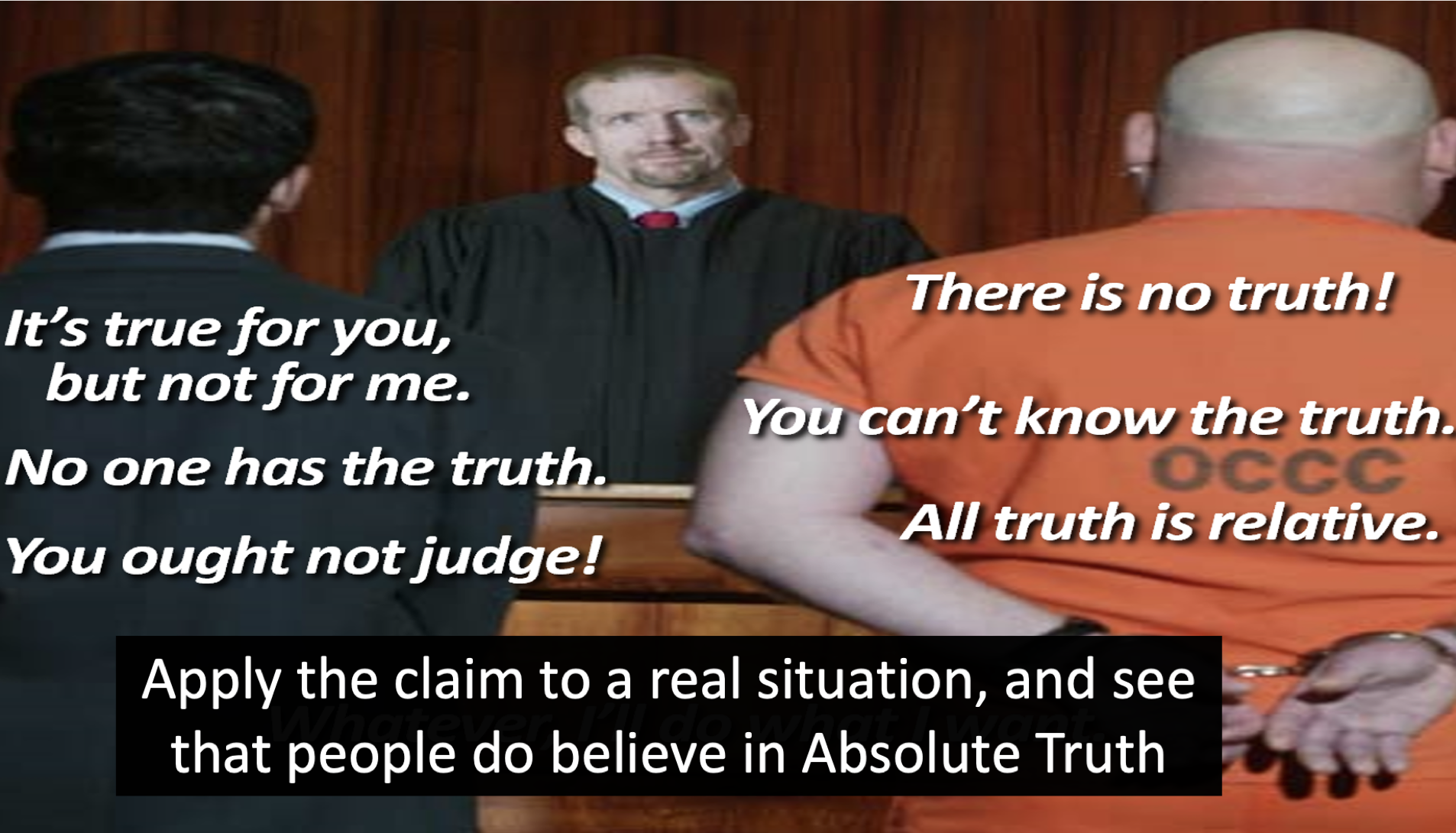
These objections break down when applied to real-life scenarios. Imagine standing before a judge after speeding over 100 mph in a 35-mph school zone with multiple tests proving intoxication. Can you argue, “It’s all just opinions” or “Truth is relative” or “it’s true for you but not for me” or “You can’t judge me”?
Would any of these objections hold up in court? These objections are just as absurd when attempting to argue against the existence of absolute, objective truth.
Truth Can Be Tested
The reality is this: only one belief system, at most, can be accurate where beliefs contradict. Truth will either carry you to expected outcomes, or it will be the harsh reality you crash into, depending on whether you ride with what is true or on a false belief.
Life often brings difficult truths, and many people respond by avoiding, denying, or distracting themselves. They focus on daily life, get caught up in emotions, or choose apathy to maintain their comfort. However, avoiding the truth doesn’t change it, and eventually, false beliefs lead to even greater consequences.
Consider when you’ve seen a friend or relative in an abusive relationship. You may have tried to reason with them, but they could say things like, “He’ll change after we have a child” or “I deserved it; she was just having a bad day.” No matter how much they deny the truth, the reality is abuse often gets worse. Avoiding or denying the truth doesn’t change the truth or its consequences, and some consequences will never go away.
