

When an atheist podcast speaker and debater made this challenge before an audience, I asked him if he was honestly telling the audience the whole story.
Brief Answer: Most people who bring up this challenge are not telling the whole story, and there is a lot of context to be considered to understand this topic properly.
1. The context of history and full context of the Bible:
- A striking feature often ignored is that this same biblical book with this account also provides the morality we use for judgement. Including, the first humanitarian laws for warfare, such as sparing women, children, and trees.
- The book also makes a distinction that this command was not due to war, but a moral judgement.
- The full biblical context demonstrates a God who gives more than gracious opportunity to turn from evil.
The Canaanites had been given warnings, encouragements, and 400 years to turn from their destructive culture saturated in idolatry, incest, adultery, child sacrifice, and bestiality, and if they chose not to heed the warning, then they would be judged irredeemable, cancerous to healthy cultures around them, and have to be removed. It was not about ethnicity, obviously, as God also stated the same judgement will be applied to Israel if they pursue the same irredeemable behavior.
God loves all people at the highest level, which was demonstrated by even taking on the debt of sin of those who reject and abuse him.
Conclusion, it would be wise to hesitate before assuming God is in the wrong, but for those who think they know better, okay, what evidence do you have to believe you are in a better position to know and judge than the authority you reject?
2. Historic and literary context:
Modern biblical scholarship widely recognizes the statement to “kill them all” is hagiographic hyperbole, not literal, but figurative rhetoric common to the ancient Near East (ANE). It is a literary convention intended to describe a decisive victory, similar to how a modern sports team might say they “slaughtered” or “decimated” their opponents.
This is evidenced by, as Nicholas Wolterstorff of Yale observes, just verses later the accounts discuss survivors, cities being re-inhabited, even prohibition about marrying people that were supposedly wiped out.[1],[2]
The research of K. Lawson Younger Jr., a leading scholar on ANE warfare rhetoric, showed that Egyptian, Hittite, and Assyrian kings all used the same “total annihilation” language to describe battles that were clearly limited in scope.
3. Logic context:
Things you may not like or understand about the Bible are secondary concerns. The PRIMARY question is: Is there a God behind the Bible.
If God exists and is behind the Bible, then the only rational response is to take God’s knowledge and authority as seriously as we can. If there is an issue that does not make sense, look into it. But unless you find there is more evidence from this issue to overcome all the supportive evidence that the biblical God exists and is in a better position to know the reality and rightness of a situation than you, then if someone’s thinking is in error, it is much more probable its yours, not God’s.
[1] Douglas S. Huffman’s article “Achan and Annihilation? Hyperbolic Language and the Justice of Yahweh in Joshua 7,” published in Themelios 45, no. 2 (August 2020): 258–73, can be accessed at https://www.thegospelcoalition.org/themelios/article/achan-and-annihilation-hyperbolic-language-and-the-justiceof-yahweh-in-joshua-7/.
[2] James Bishop, “Responding to Defenses of Divine Biblical Genocide: Hyperbole & Land Dispossession (Part 7),” James Bishop’s Blog, May 17, 2018, accessed at https://jamesbishopblog.com/2018/05/17/responding-to-defenses-of-divine-biblical-genocide-hyperbole-land-dispossession-part-7/.
Detailed Answer:
To best answer this question, I’d like to know why you brought this up, what do you think it proves?
If you think this means God doesn’t exist because he is supposed to be loving and this command is a contradiction, then you have two problems. The primary question you should be seeking is: Is there a God behind the Bible? Because if there is, and the evidence supporting this is on a level nothing else ever written can reach, then even if there are biblical passages we do not like or understand, the only rational response is to take God’s knowledge and authority as seriously as possible, as there is no other source remotely approaching the Bible’s knowledge or authority.
Your second problem is atheists and theists in every field of study involving morality will say you are way off base – the only way true morality, true right and wrong, true inherent value and rights of people exist – is if God exists. So claiming what God did was wrong is a nonsensical statement because there would be no basis for right and wrong if God did not exist (see booklet: Morality: you have to sit in God’s lap to slap his face)
Here is a short summary: The leading atheist neuroscientists, philosophers, physicists, biologists, etc., have publicly recognized what theists have always claimed: if there is no God, no authority beyond all the human opinions and in a position to know and ultimately enforce, then there is no objective or absolute morality or ethical behavior, no true right and wrong, it is all just a person or a group of people’s opinions against other opinions, and there is not an objective reason to believe that people have special value, meaning, or inherent rights.
Leading atheist Richard Dawkins, who believes evolution produced our morality, recognizes this means there is no true right and wrong:
“In a universe of electrons and selfish genes, blind physical forces and genetic replication, some people are going to get hurt, other people are going to get lucky, and you won’t find any rhyme or reason in it, nor any justice. The universe that we observe has precisely the properties we should expect if there is, at bottom, no design, no purpose, no evil, no good, nothing but pitiless indifference.” (Richard Dawkins, River Out of Eden: A Darwinian View of Life, 133)
The Declaration of Independence had it correct in recognizing the indispensable grounding of a transcendent Creator is necessary if you want to believe all people are “born free and equal in dignity and rights”. If you believe in these concepts, and that some acts are truly and always right or wrong, then you must accept God exists. It would be nonsense logically if you tried claiming anything God did was truly wrong and deserving of blame.
Here is the logical moral argument for God:
Premise 1: If God does not exist, objective moral values and duties do not exist.
Premise 2: Objective moral values and duties do exist.
Conclusion: Therefore, God exists.
If the two premises are true, then the conclusion is logically inescapable. The first premise just states what leading atheists and theists already know. If anyone claims God did something morally wrong in issuing his command against the Canaanites, this claim can only be made if moral values do exist, meaning the person just affirmed the second premise is also true. Therefore, God must exist, and the only question is: Is God good?
Bottom-line: You have to believe God exists if you want: anything to be truly right or wrong, for any people to have inherent value and rights, or for your argument that God did something wrong to make any sense.
If you accept God exists, do you claim he did wrong here, violated morality?
If the biblical God exists, then his nature is the standard of morality (also covered in the article mentioned earlier), which means all right and wrong flows from how God is, so God cannot violate morality.
You may claim God is violating what you, and others, think he should have done. However, are you claiming you and others are in a position to judge the Creator of the Universe and standard of morality? That is an unjustified leap in logic.
Further, take in the whole context. This is a God who shows unfathomable patience (giving the Canaanites 400 years to turn around; Genesis 15:16), not wanting any people to be lost (Ezekiel 33:11), and love that should shock you by taking on the human condition to personally show his goodness, and innocently suffer extreme pain, displaying how wide his love is as he spread his arms on the cross to take on the penalty of our wrongdoing. If God cares for people to this extent, even those who reject him, why do you believe he would be unfair in the Canaanite situation?
Explain why you believe this. What makes you think you have better knowledge, experience, ability to recognize all possible outcomes, control, etc., to think you are right and God is wrong?
Do you think, considering the love and care God has shown, and your limited position against God’s position, maybe some humility is needed? Claiming human opinion, feelings, belief is right and God must be wrong is an unsupported leap in logic and arrogance.
If you accept God exists and is not able to do moral wrong against the Canaanites, or any people, then do you think the Bible just has an error?
Christians do not believe as Muslims do, that every single word in every single copy of God’s Word is kept perfect by God. Biblical scholars have always noted in the margins words or sentences that are uncertain. For example, 1 John 1:4 says “We write this to make our[a] joy complete.” Notice the [a], which directs you to the margin, which notes some manuscripts have “to make your joy complete.”
Yet, scholars (meaning people whose career involves studying ancient manuscripts, with a PhD, and research published in peer-reviewed literature) have established we have the Bible as originally written, with less the small percent uncertain noted in the margins, and none of the uncertain parts have any impact on doctrine.
So I don’t think the sections describing God’s command are in error, however, it is likely there is a lot more to consider, such as: sometimes we read passages wrong, the Bible is sometimes scant with detail, God does allow the human writers some leeway and cultural impacts come into the writing, there may be something within God’s capability we don’t understand, or other factors we haven’t taken into account.
And so, let’s look deeper, and I can see why so many people struggle with this issue as the topic is deep with many aspects to look into.
If you don’t think this is an error, you just want to understand the situation better
It takes humility to come to this point, as even if logic and evidence bring you to realize the biblical God exists, loves the best, and can be trusted, it is still human nature to think, or just have a feeling, that we are right, and opposing views, even God’s, are wrong.
I can give talks non-stop for days on the evidence supporting Christianity and exposing all other belief systems, including atheism and agnosticism, as inaccurate, but I still have had to research why God would make this command given in the Bible, as it didn’t sit well with me.
I realize when I get judgmental about the destruction of the Canaanites, I do so with what is known as “chronological snobbery”, judging an earlier time period based on standards from modern day, and also while living my whole life in the most secure, luxurious, and one of the most good-behavior-enforced nation in the United States.
In addition, I make my judgment using the morals coming from the Judeo-Christian heritage of the Western cultures, which taught intrinsic value of human beings, and treating people justly. From my background, hearing the call for the destruction of every living thing didn’t sit well. So, for those who also want to dig deeper, there are further details and answers below.
First, I already provided a brief answer to this huge question, in case you just have a brief time, or want to learn a brief answer.
Second, I will give more details than the brief answer, and demonstrate God did not command genocide, or even murder, but instead enforced capital punishment.
Third, we will go into details, such as, why also destroy women, children, and everything that breathes.
The historical context of Canaanite culture reveals God’s reason for commanding their death was not genocide or murder, but CAPITAL PUNISHMENT.

The Canaanites had for centuries been saturated in idolatry, incest, adultery, child sacrifice, and bestiality (see notes at bottom for how nasty the Canaanites were). For example, Molech was a Canaanite underworld deity (John Day, Molech: A God of Human Sacrifice in the Old Testament, 62) represented as a human with the head of a bull, and in whose belly a fire was stoked so that the outstretched arms acted as a cauldron where a child would be placed as a sacrifice to enrich the parents’ and community’s lives. The victims were not only infants; children as old as four were sacrificed (Shelby Brown, Late Carthaginian Child Sacrifice and Sacrificial Monuments in Their Mediterranean Context, 14), and musicians were continually playing to drown out the agonized screams. Kleitarchos reported that “as the flame burning the child surrounded the body, the limbs would shrivel up and the mouth would appear to grin as if laughing, until it was shrunk enough to slip into the cauldron.” (Kleitarchos, Scholia on Plato’s Republic 337A, as quoted in Day, 87) Even with this level of wicked behavior filling the culture, God still sought to redeem them.
Not only was the culture covered in violations against the standards of God, and purposefully rejected God’s attempts to redeem them from the destruction he knows their choices lead to, but also psychology, sociology, and historical studies can exhibit why this is destructive not just to the culture itself, but to others nearby.
I work at a cancer center, and when cells become cancerous, they are not redeemable, and if not removed or destroyed, will bring other healthy cells to ruin – until reaching the natural endpoint – death. There comes a time when a person is never going to turn away from becoming malignant, and upon reaching that cancerous level, there comes a time for judgement and/or removal, so the disease doesn’t spread and hurt others. This is precisely the reason spelled out in the Bible (see notes). Capital punishment.
Let’s look at some of the examples of genocide you may have learned about in history class:
- During WWI, the government of the Ottoman Empire forced two-thirds or more of its Armenian citizens into the deserts of present-day Syria. Most suffered slow deaths through starvation and dehydration.
- The Nazi genocidal actions against the Jews during the Holocaust.
- Pol Pot’s Khmer Rouge regime in Cambodia killed around 31% of its population, targeting ethnic minorities, intellectuals and religious groups.
- In Rwanda, the Hutu ethnic group killed between 500,000 to 1,000,000 of the Tutsi ethnic group.
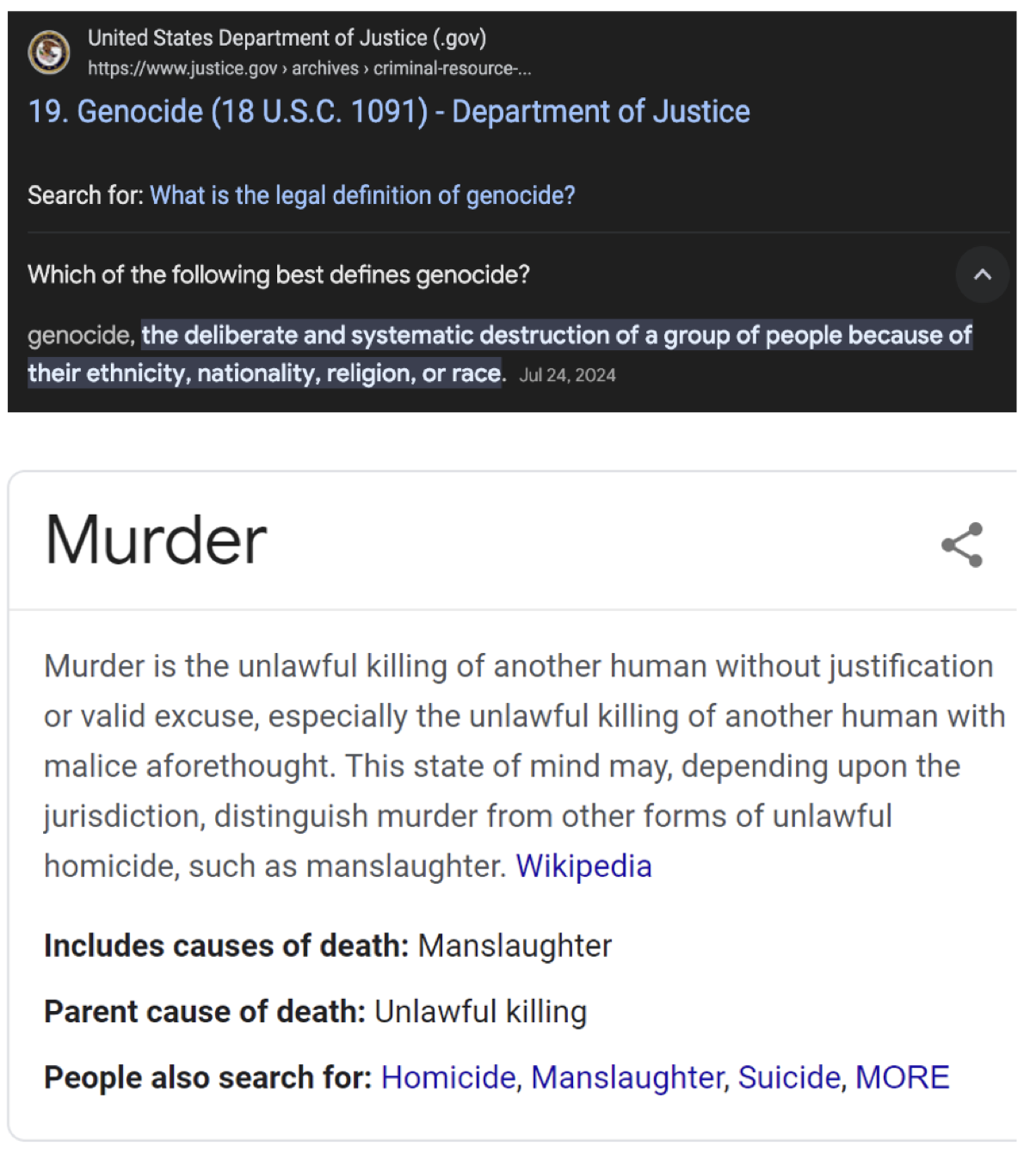 Also helpful to start with definitions to make sure both sides of a discussion are clearly talking about the same ideas, especially when emotion is involved. I just check what generally accepted definitions are out there. For example, the image shows what I found for “genocide” and “murder”, and which was duplicated by other, respected sources. If you don’t accept the definitions, okay, just supply yours and explain why your definition is more accurate.
From the genocide examples and the definitions given, we can quickly see why it is incorrect to label God’s command against the Canaanites as genocide, or even murder. The definition for genocide provides the reason: “because of their ethnicity, nationality, religion, or race.” God clearly did not have any issue with ethnicity, nationality, or race, and the religion of the Canaanites only came into play indirectly as it supported the wicked behavior. It was the people’s choice to saturate their culture with the poisonous behavior that would seep into Israel’s bloodline, and this is the reason they were to be removed from the land, which was openly stated in Deuteronomy 20:18, or Exodus 34:15-16, the Canaanites must be destroyed “lest the Israelites learn the Canaanite ways.” It is not being a Canaanite that was the problem, it was what the Canaanites did, and the menace they would be allowed to infect the new Jewish nation with.
Check context to ensure proper reading
Careful reading of the context the Bible provides, also gives examples disproving the genocide claim. For example, the Amalekites were another group that were to be completely destroyed. Yet, 2 Samuel 1:11-16 describes an event where David, who would become king of Israel, interacted with one of his soldiers, who was the son of an Amalekite who immigrated to Israel. David was not surprised to have Amalekites in his troops, most likely many had immigrated within the two to four century timeframe between the pronunciation to “destroy them” in Exodus 17:14-16.
In addition, the biblical events described do not match the examples of genocide.
The Canaanites:
- Were NOT an internal group, meaning a group in the country where the government or majority were trying to exterminate
- Were NOT a minority group
- Were NOT targeted because of being Canaanites, but failure over centuries to remove aspects within their culture God knew would have disastrous consequences, and also failing to remove themselves from the land God warned them was lost to them
- Were NEVER under the government control of Israel.
- Were NOT pursued and hunted in other countries for extermination, demonstrating that the goal was not extermination, but removal from the land
- WERE combat deaths and noncombatants dying as a by-product of military action, which standard definitions of genocide exclude (although by commanding the killing of everything that breathes, I picture a lot of noncombatants dying, even when not as a by-product of fighting, so this will still need to be addressed later in this answer).
Even the label “murder” does not work, as it is invalidated by almost every part of the definition. Why do you believe this is an “unlawful killing”, why do you claim it is “without justification”, and why think God had “malice aforethought”? What is your conclusive evidence?
The Bible has limited space to record details (if you want people to carry their Bible without needing a forklift), yet it still noted the very unhealthy practices, which if you believe God exists, clearly violated his law, and this violation, along with the threat of passing this disease to Israel, provided justification (see footnotes “The Canaanites Were Nasty”).
Or, do you claim to know more about what justifies the right to take life than the Creator who made and sustains all life, or about right and wrong and justice than the standard of right and wrong? Remember, if you make a claim, then you bear the burden of proof. I think it is shown through stories and movies in our culture that we intuitively understand the Creator of life is on another level of justification regarding life, because when a human makes a decision to take another’s life, we accuse them of “playing God”.
God warned the Canaanites through centuries there is a death penalty tied to their behaviors, especially when it threatens the more important spiritual health of both the Canaanites and anyone who is contact with them? The Canaanites who remained to fight had known of the warnings, and not only choose to continue violating God’s prohibitions, but also doubled down by defying God directly. God’s commands were capital punishment (the death penalty for known offenses), and the combatants had their warning to send their families away and even leave themselves.
But what about those who maybe hadn’t engaged in the damning practices of their culture, or the woman, children, and animals, did they deserve capital punishment?
God didn’t want anything bad to happen to the Canaanite people, he loved and patiently reached out to them. (Ezekiel 33.11) God held off judgement on the Canaanites for 400 years (Genesis 15:16), and throughout the Bible his pattern of sending prophets and other encouragements and warnings demonstrates amazing long-suffering, patience, and opportunity to turn away from destructive choices.
Jonah provides a great case study. The prophet Jonah had great angst against the people of Ninevah and the horrors they visited on God’s people, but God loved the people of Ninevah and commanded Jonah to try to turn Ninevah away from their destructive path and towards God. Ninevah listened and the coming destruction was averted.
Jesus himself, in Luke 20, discusses this pattern of long-suffering care, up to the point when judgement is required. His parable of the tenants and the vineyard ends with “He will come and kill those tenants and give the vineyard to others”, and this was lived out by both the Canaanites and the Israelites. God continuously sent prophets, warnings, encouragements, until eventually Israel was removed from the land themselves, 40 years after Jesus’ warning parable, Roman Emperor Titus brutalized Israel and renamed the area Palestine.
There comes a point when an Authority has to judge between two hard options (the Lifeboat scenario)
Given the Canaanites rejected God’s love and warnings, now God has to govern the situation. I do not like to quote Christian sources as some may assume a bias and discount valid information from that source, but in this case, the writer(s) of Christian-Thinktank.com provide a well-known example used in classrooms regarding being in a position to govern or rule in a situation where you are given only tough choices. There explanation is quoted at length below:
This is a situation where there are two undesirable outcomes, and one has to make a choice (in this case it was God) as to what is the most humane choice? To try to see the complexity of the governance issue let’s construct a hypothetical situation. In philosophical ethics, one of the major hypothetical scenarios one discusses is “lifeboat” ethics. The instructor paints the “lifeboat” scenario:
You are captain of a passenger boat, responsible for the lives of your passengers, which has an accident in the middle of shark-infested waters. No messages of help were sent before the crash, so rescue is not expected or likely. The 30 passengers and crew all cram into the lifeboat (capacity 29), which is immediately encircled by sharks. There are no weapons upon the lifeboat, and the raft is beginning to sink due to the overload. The nearest island (deserted, of course) can be seen, but you cannot reach it without at least one passenger jumping out of the lifeboat to certain death by being fought over and eaten by sharks. You, as captain, cannot be the martyr yourself, since only you have the requisite skills to help the 29 people survive once you get to shore, etc.
The probability of the boat sinking with 30 people is 100%, the probability of being fought over and eaten by sharks (once in the water) is 100%, and the probability of outside intervention (e.g., rescue) is 0%. You ask for a volunteer, to give their life to save the group. If only one person decides to give his/her life for the other 29, then the 29 have a decent chance of making it to shore.
No one volunteers, after repeated requests. You are now forced with killing (against someone’s will) one innocent person, or letting 30 (innocent) people die in the jaws of the sharks. What do you do?
In the classroom, this discussion often proceeds to what criteria one “should” use to decide which passenger or crew member is to die to save the many. It cannot be you, no matter how badly you want to avoid the knowledge you had to kill someone against their will, since your death would be the one most likely to result in the death of the others (and your death would have been in vain). I repeat, the “I will be the martyr” answer is unacceptable, for in your death, you will likely have ‘killed’ the others. You, as captain, will be forced to live with your choices, which will not be easy, but will be important to the lives of 28 other people.
Is it the one who has already enjoyed the longest life? Is it the one who has made the least contribution to life (so far)? Is it the one who has the least probability of surviving on the island once you arrive? Is it the most likely to be a divisive element once at shore (when unity will be essential to the survival of the group)? Is it the most ‘morally questionable’ one (involving ethical judgment)? Is it one selected by random processes (e.g., short straws)? Do you take a vote? Do you have a ‘last man standing’ fight, with the people fighting to throw each other off the boat, so only the strongest people stay on the boat? Do you pick those with the least number of dependents back in the real world? And so on…
Some students will try to avoid the issue altogether, by talking about ‘taking their chances’ on the boat, on the sharks, or on the rate of travel toward the island. But the scenario is not constructed that way, the ‘there must be some other way’ fantasy options don’t exist, just as in real life tough decisions.
The death of the person chosen (in most ethical systems) is morally required, but it is only the “big picture” that justifies this violation of their will. Examining the morality of killing them, without placing it in the context of the alternative of killing 30 people, will not lead one to the ethically correct and overall more humane choice. [In fact, in traditional ethical systems, the killing of the individual in this context is not considered ‘legal murder’, but falls into ‘justifiable homicide’.]
This principle can be abused, of course, as we all know from countless examples in history and in the modern world, but this does not invalidate the principle itself – it only highlights the misuse of it. [This principle was reportedly used by Caiaphas against Jesus in John 11:49-50]
If you—as leader—make a moral judgment to decide NOT to make a choice, then this implies that you would not kill the one to save the 29, and consequently, your moral judgment would kill the 30.
This moral trade-off or dilemma situation actually can be extended in the lifeboat example to an additional (and possibly relevant) sub-scenario:
Once you have decided who to kill (to save the group), how do you kill them?
- Do you literally throw them off the raft screaming, with them frantically trying to climb back in (threatening to capsize the boat, feeding everyone to the sharks) or trying to pull someone else out so they can get back in, before the sharks seize them in their jaws and drag them underwater?
- Do you tie them up, so they cannot jeopardize the boat, and then throw them to the sharks to be fought over and eaten alive as they try to hold their breath while sinking in the ocean?
- Do you knock them unconscious, and then throw them in, so that they only experience the jaws of the sharks for the brief moments the pain brings them up to terrorized consciousness?
- Do you kill them in the boat (while they are screaming and pleading for mercy), by gunshot to the head, snapping the neck, or strangulation/suffocation, and then throw them to the sharks, so that their suffering is absolutely minimized?
Are ANY of these “pleasant” alternatives?—Of course not!—they are stomach-churching, gut-wrenching, heart-hollowing alternatives. The very exercise of thinking through this should deeply disturb any compassionate person! My attempts at the Lifeboat scenario over the last couple of years still bring tears and anxiety and feelings of hopelessness to my heart…But when there is no other “way out”—the toughest choices of one’s life have to be made…and these choices (and consequences—however important and good) haunt one for the rest of their life…no question about it…But a troubled memory and haunted conscience may be a small price to pay for saving 29 lives…
But are some of these alternatives in the lifeboat more humane than others?—absolutely. [Normally, one selects the method that would minimize pain and minimize negative effects on the survival chances of the rest of the group. In this case it would be the swift death in the boat, than the much more terrifying and painful death by sharks. The implication for our case should be obvious: a swift death for the innocents would be morally preferable to the greater-suffering death in the desert.]
Now, some might propose that all must die. Some might say that you the captain discuss the matter with the group and get agreement that all thirty sink and be eaten deliberately, rather than sacrificing someone else, so that the 30 can die with a ‘clean conscience’ of not having murdered someone (although it is quite questionable whether they would have shared your responsibility for killing the individual—they might have simply trusted you to come up with the tough decisions and accountability for the choices). Of course, your moral responsibilities as captain are rather different: to bring back as many alive to their families as possible, regardless of what emotional state they are in. A group suicide of this type is certainly not out of the ethical question, but if ANY ONE of the 29 do not AGREE/WANT TO DIE this way, then you have done the exact same “against their will” killing as in the traditional ‘sacrifice’ PLUS you have killed more people in the meantime. [A variant of this would be to not tell the 30 that the boat will sink, until it is too late, forcing them to die “with a clean conscience” without their consent, but this seems less ‘virtuous’ than the other alternatives.]
This is a vivid textbook illustration, but it shows clearly that specific moral choices must be evaluated alongside the moral consequences of the alternative choices (and even non-choice is a choice, of course). To not choose to do something in this case, invariably results in the death of everyone. In other words—the “big picture”.
And, by the way, this lifeboat ethics scenario is lived out in the real world constantly. I remember engaging this puzzle as a student/reader earlier in life, and thinking through it in abstract terms. But the “blood” in it finally registered itself with me the first time—as a business executive in a firm about to go under, putting literally thousands of people suddenly into the jobless category—I had to decide which of my workers I had to fire, in order to keep the other workers with a paycheck for their family…The decision on who “to throw off the lifeboat” so the others could continue to have paychecks is one of the more painful and distressing ones senior executives (at least the “human” ones) have to make…
We really need to see the reality of the trade-offs in complex moral situations. It is not simply the horror of one set of examples versus the horrors of another set of examples—it really is the ‘bigger picture’ of trying to maximize value and minimize destruction. It’s just not as easy as decrying the death of innocents, no matter how heart wrenching that may be to us or to God. (https://www.christian-thinktank.com/rbutcher1.html, 2001.)
Have you decided what you would do as captain? Let me make it easier for you, and then make it harder. As captain, you warned all 30 passengers that any weapon is strictly forbidden for passengers, and especially if the lifeboat situation is needed as in countless experiences it was shown someone having a weapon led to the sinking of the lifeboat or other tragedies. Yet, one of those passengers not only brought on a knife, but has already threatened to kill other passengers when they got too close, or argued with him, etc. In fact, he waves the knife around carelessly, daily flaunting the captain’s life-risking rule.
Let’s also say the captain had some God-like way of being certain of all possible outcomes, and the outcome that led to the best life for 29 passengers, and the loss of only one in the least painful way was to use his pistol and shoot the passenger (don’t ask me how he does this without sinking the boat, this is a thought experiment).
Now let’s say the passenger placed you in an even more gut-wrenching situation, the passenger decided to tie himself to his wife, or even to his child. Again, say the captain had some God-like way of being certain of all possible outcomes, and the outcome resulting in the best and safest life for 28 passengers, and the loss of only two in the least painful way was to use his pistol and shoot the passenger and the one bonded to him.
Only rough options, which occurs throughout life, but do you think the captain should choose differently? If so, what? And why is your solution, which goes against what the captain knows is the best of the worst options, the better choice to make? Now apply this to the Canaanite situation. God has purpose to allow free will and typically, maybe never, solves ongoing social issues miraculously, but instead allows people and nations to make their free will choice and still carries it all forward in the flow of his purpose.
You don’t like the death of the wife or child tied to the man? Me neither. Paul Copan wrote, in his book Is God a Moral Monster?, that the literary device used when the Bible discussed such commands was hyperbole, or exaggeration common to the Ancient Near East (ANE). If his points are true, then it was just removing the warriors that refused to leave, and anything beyond is just speculation. This would be a simple explanation. However, I didn’t come away feeling this answered the entire concern, as the biblical text seems to indicate if soldiers came across women, children, or even animals, they were to be killed as well. The Bible definitely uses ANE literary techniques like hyperbole, but I do not think it explains everything.
Others have argued when a known force is approaching, the non-combatants were removed from the area, leaving only garrisoned military outposts and soldiers. Old Testament scholar Richard Hess concludes:
The attacks on Jericho and Ai were assaults on military targets. The major wars that Israel fought were defensive. Canaanites remained in all regions (Judges 1) and intermarried with Israelites in the following generations. This is the narrative’s understanding of these battles. The archaeological and extra-biblical textual evidence do not contradict it. In the case of Deuteronomy and Joshua, the Israelites attacked forts. They did so in order to defend their own existence and, in the cases of Jericho and Ai, to challenge the claims of the kings of Canaan and their armies who claimed the land for themselves and their gods. The Israelites fought and defeated the armies of Canaan and their leaders. (Richard S. Hess, Ph.D. Denver Journal Volume 25 – 2022, review of Charlie Trimm, The Destruction of the Canaanites: God, Genocide, and Biblical Interpretation, 2022)
As philosopher William Lane Craig observes, “It is, in fact, a striking feature of these (biblical) narratives that there is no record whatsoever that women or children were actually killed by anyone.” (William Lane Craig, Reasonable Faith, online article “#225 The “Slaughter” of the Canaanites Re-visited, 2011) The Bible, in more than one instance right after noting the people were completely destroyed, remarks how some of those people were interacting, immigrating, and even marrying people of Israel.
That is important and interesting, but to claim this means only fighting men, or scant few women or children were killed requires the same speculation as those who imagine the Jewish people hunting women and children down to kill them wherever they run. Both sides would have to speculate details, but even if we just assume for the moment innocent non-combatants and animals were commanded to be killed and were killed as a result, there are still inescapable facts of the matter that must be accounted for.
As in the lifeboat example, it would be a horrible choice to have to kill the dangerous passenger and his wife, child, or pet sheep, but that is the situation the world and the passenger provided the captain. Some would say God could change the situation, but that assumption ignores the purposes of God, which require free will both to people and to the world (the reasons for this are covered in the question “Why would a loving God allow pain”).
Additionally, do you think the captain can spare the wife or child? They were bonded to the dangerous passenger, and as captain, if you are able to save them, are you certain you can keep them following the rules needed to keep the other passengers and boat safe? Do you know what it would be like to be the future Israelites, wiping out a very nasty culture of enemies, and then trying to incorporate all the non-combatants, from that culture, who just lost their people from your conquering, into your society, while trying to survive, keeping your culture physically and spiritually safe? I have such little understanding of such a difficult living situation, so I don’t know, and neither do the critics, who criticize from the same couch of present-day luxury and ignorance I sit in.
What I do know is the killing of innocent dependents, like women, children, and animals, was not a punishment on them, but a consequence of the punishment on their fathers. This is a very stark difference morally. We see innocents hurt all the time due to justice and punishments being properly administered to those who were responsible to keep them safe.
Further, do you think the wives, and kids would not have a serious negative impact on their captor’s nation physically and spiritually? There is no way you could calculate the impact. But God can. The way the animals were abused by the Canaanites was also horrific, and such abuse causes not only issues with how these animals will act towards their new masters (just ask Caesar Milan), but also the Bible indicates wickedness further has a poisoning effect on all it touches, even innocents, and an area may need to be cleansed, or else the quantity and severity of suffering on innocents may be far worse. While people cannot calculate this effect, a Holy God can.
And what about the alternative of not wiping out these proven dangerous cultures? The Christian-Thinktank again provides a thoughtful response, regarding the Amalekites, a culture of people similarly commanded to be destroyed after continuous unprovoked attacks against the Israelites:
Of course, this scene is horrible(!), but to see this in perspective we would need to:
(1) put this side by side with equally vivid and emotionally stirring stories about:
- the elderly Israelite couple, who after suffering under harsh slavery for 60 years in Egypt finally escape miraculously with their grandchild. They gather the first material possessions they have ever owned—given to them by the Egyptians on the night they left—and are following the main body of Israelites. They are overjoyed by their first experience of freedom and hope for a more ‘normal’ life for their granddaughter. But they are old, and the decades of physical abuse have left them weak. And so, they fall behind the main group of Israelites, and they must rest more frequently and longer. And, as the gap widens, they see a dust cloud behind them, chasing them. They fear that maybe the Egyptians are trying again to enslave them, so they jump up in fatigue and anxiety and begin racing toward the Israelites. But they are no match for the marauding Amalekites, who quickly capture them. They watch in horror as their granddaughter is stripped and evaluated for what price she might fetch at the eastern slave market, with crude suggestions as to what ‘use’ she might be to the plantation slave bosses. They see her bound and tied to the back of the horses, where she will have to walk behind their caravan until exhausted and then thrown into a slave-cart. They are next: the Amalekites strip them of their clothes, take their few belongings, and then cut them down with the sword. Their last images are of their granddaughter screaming for help as she is driven at spearpoint…
- the impoverished and undernourished young Israelite family has been able to hide their small crop so far, this growing season. Each previous year, the marauding Amalekites have burned their small crop and killed the few livestock they used for clothes and cheese, and the family has eaten what little the wild land could provide. They sleep under a rock cropping, in fear of detection, and take turns at night watching for predatory animals, slave-trading bands, and the Amalekites and their allies. Harvest is almost here, and they have actually gathered a few items already (and consumed them hungrily). They suffer from various forms of malnutrition and exposure, and the youngest—Abigail the three-year old little girl—cannot get up due to some unknown sickness. But hope has arisen for the first time in years, and the parents are eager to feed their little ones the food they desperately need. As they are gathering the first pick, with ears always alert, they hear the familiar sound of hooves…And though they run, they are overtaken by the Amalekite raiding party. They watch as their crop is burned to ashes (the raiders only laugh at the sight—they don’t take any of the food at all), along with the feeble hope that grew there too. But they have bigger problems now, because they did not reach the hiding place in time. The raiders size up the family and recognize that such youth will fetch a pretty shekel in the slave markets of Damascus. The young wife and two of the healthier children are stripped and tied together with other captured Israelites, to be marched off to be sold to different owners in different parts of the world. One smaller child is simply cut down—screaming in terror—with the sword in the eyes of both parents. Abigail begins to cry in fear from her cot under the rock, alerting the Amalekites for the first time of her presence. The father tries vainly to defend his family as they plead for mercy, but he is rewarded only with the anti-Israelite taunts of hate and the slash of a sword. The last thing he hears are Amalekite words of the leader, to leave the sick Abigail as food for the wolves, rats, and ants—since she wouldn’t have any value in the slave trade.
And we would need to (2) situate this in the historical “landscape” of the day, in which the “size” of objects in the landscape can be seen in relation to one another.
In this case, we would note:
- The Amalekite scene examples, when defeated by Israel, would have occurred all in one day, and involving a maximum of one to two thousand families.
- The above example #1 would have occurred over the space of probably an entire year, and involved a couple of thousand people minimum (on an exodus party of 1.5 million people)
- The above example #2 would have occurred seasonally for over two hundred years (perhaps as long as for 400 years), and involved easily tens of thousands of families.
(https://www.christian-thinktank.com/rbutcher1.html, 2001)
So, from a perspective standpoint, the actions of the Israelites are of significantly less magnitude and scale than the anti-Israelite actions of the Amalekites—from the standpoint of perspective. If perspective is useful at all, then it is decidedly in the ‘favor’ of the Israelite response to Amalek.
God is in a position to calculate overall effects. Is God in a position to judge. Or, do you argue humans know better?
Remember, if you want to claim anything, for example, the command to destroy the Canaanites is truly wrong or bad or worth condemnation, then God must exist.

Consequently, if we are going to consider if there is a problem with this command, we have to operate with the condition the biblical God exists. Therefore, is it more likely you or God are in a better position to decide how to handle the Canaanite situation?
I already mentioned neither supporters of the Bible, nor its critics can run the calculations to know what ultimately the best choice would be considering all the parameters, but God can.
I still the remember the moment in class when my passion for physics began. We were being introduced to kinematic equations (see image), and found I could reliably calculate where a projectile would land if I had the right equations and knew values for the variables. I loved the possibilities knowledge provided, after all, I was at the age where I was shooting bottle rockets and sling shot ammo at houses in our neighborhood.
Someone knowing all the equations and all the variables, could know all potential outcomes of any situation. Philosophers call this “middle knowledge” or “Molonism”. It would make sense the Creator of the Universe would have this knowledge, and the Bible indicates God does.
I think I know what I would do as captain of the lifeboat, but my certainty of the rightness of my choice is far short of the certainty I would have if I knew all results from any possible choice, which God does know. Therefore, while we are unsure of the level of killing of all men, women, children, and animals, there are factors noted above we do know, including God loving the Canaanites, wanting what was best for them, and knowing what would be best overall, whatever way the situation was to be resolved.
Some will consider it avoiding a biblical problem by using the excuse of we cannot fully understand God and have to trust in some instances. On the contrary, far from an excuse, accepting we cannot fully wrap our minds around a Being such as God is just simple and obvious logic. Admittedly, some Christians do use this “we cannot fully understand God” when they are ignorant of the correct and researched answer, but this does not mean it is never applicable.
Think about it, if I could totally understand everything about God and all his choices and actions, then I would just assume this was just a god invented by man. I can understand Baal, Vishnu, Zeus, and other gods completely, they sound much like me and other humans. But I cannot, and never will fully understand the God of the Bible, who is a Being beyond three-dimensional space and time, all of nature that I am familiar with, Holy, and having other characteristics far beyond my pay grade and experience. While I can understand a lot as God made us in his image (whatever that means), and the Bible, messengers he sent, and my personal relationship with God reveal aspects and facts about this God, yet, I cannot fully wrap my mind around this God, and so will have times where his thoughts and actions are beyond my understanding, and even beyond my liking.
But we must also factor in that this is a God who demonstrated love at the highest level, and knowledge beyond any human capability, including the ability to know all possible outcomes from any choice made, and the Authority to judge. I do not know any human or group of humans remotely approaching such potential, so it seems only reasonable to trust, when we know all there is to know about the Canaanite situation, God handled it right.
If the biblical God exists, and the evidence supports that far better than any alternative, isn’t it possible, or even likely, you just do not have a grasp on all you need to know, and maybe God is in a better position to know and judge the Canaanite situation? Or do you and other people know better, and why do you believe that?
Notes:
The Canaanites Were Nasty
Idolatry: The Canaanites worshiped other gods, which were humorously exposed in the Bible noting these idols were nothing but sticks or art made by human hands that could not “see or hear or eat or smell” (Deut. 4:28 NIV). Yahweh even noted these handmade gods are unable to hear, speak, and must be carried because they are immobile on their own (Jer. 1:16; 8:2–5). These Canaanites did know the Old Testament witness about Yahweh (God), and instead choose to tauntingly depict God as a castrated weakling who likes to play with His own excrement and urine.4
Idolatry, creating something to worship other than the actual God, opens people up to be their own gods, and historically turn towards loving things the actual God hates, and hating things God loves, which Canaanite predilections display.
Incest: The ancient Hebrews were moving into the Ancient Near East (ANE), and the Canaanite people living there believed in a group of many gods, a pantheon, and these gods were incestuous. For example, Baal has sex with his mother Asherah,6 his sister Anat, and his daughter Pidray,7 and none of this is presented as anything wrong.
While early laws in Canaan called for death or banishment for most forms of incest, after the fourteenth century BC, punishments reduced to no more than paying a fine.8 Even outside the ANE, an Egyptian dream book observed dreams of having sex with your mother or your sister were considered good omens.9
Adultery: All non-biblical ANE religions were fertility religions utilizing temple sex. Inanna/Ishtar, called the Queen of Heaven, “became the woman among the gods, patron of eroticism and sensuality, of conjugal love as well as adultery, of brides and prostitutes, transvestites and pederasts.”10 Some ANE manuscripts talk about “party-boys and festival people who changed their masculinity into femininity to make the people of Ishtar revere her.”17 Professor Martti Nissinen writes, “Sexual contact with a person whose whole life was devoted to the goddess was tantamount to union with the goddess herself.”11
Again, the Canaanites portray the God of the Bible, El, through ceremonies as having sex with two women (or goddesses). The ceremony ends with directions: “To be repeated five times by the company and the singers of the assembly.”12 About this John Gray comments, “We may well suppose that this activity of El was sacramentally experienced by the community in the sexual orgies of the fertility cult which the Hebrew prophets so vehemently denounced.”13
Child sacrifice: Molech example given in Answer 2A.
Bestiality: Hittite Laws: 199 states, “If anyone has intercourse with a pig or a dog, he shall die. If a man has intercourse with a horse or a mule, there is no punishment.”18 As was true for incest, the penalty for having sex with animals decreased about the fourteenth century BC.19
Of course, bestiality would be practiced, since their gods practiced it. The Canaanite epic poem “The Baal Cycle” states: “Mightiest Baal hears / He makes love with a heifer in the outback / A cow in the field of Death’s Realm. / He lies with her seventy times seven / Mounts eighty times eight / [She conceives and bears a boy.”20
No prohibitions against bestiality existed in the ANE.21 In addition, an Egyptian dream book declared it a bad omen for a woman to dream about embracing her husband, but good things would happen if she dreamed of intercourse with a baboon, wolf, or he-goat.22In short, their sexual fantasies involved anything that breathes.
God warned the Israelites too
Israel was warned not to let the Canaanites live in their land, but to completely destroy them (Exodus 23:33; Deuteronomy 20:16–18), lest the Israelites learn the Canaanite ways (Exodus 34:15–16). If they did not destroy them, the land would “vomit” them out just as it had vomited out the Canaanites (Num. 33:56; Lev. 18:28; Deuteronomy 4:23–29, 8:19–20). Instead, the Israelites worshiped the Canaanites’ gods and “did evil” (Judges 10:6; 1 Kings 14:22; 2 Kings 17:10). They had “male shrine prostitutes” (1 Kings 14:22), committed acts of “lewdness,” adultery, and incest (Jeremiah 5:7; 29:23; Hosea. 4:13–14; Ezekiel 22:10–11; Amos 2:7), and even Solomon set up an altar to Molech (1 Kings 11:5, 7–8). But instead of repenting when things went badly, they concluded that their misfortune was because they stopped burning incense to “the Queen of Heaven,” Inanna/Ishtar (Jeremiah 44:18).
