
The minimal facts are well-established by the evidence scholarship has already provided, and are useful as a quick way to start considering which theory about Jesus is accurate. But if you have more time, there are many other interesting areas of evidence raising the Easter account to an unparalleled level of support, and leaving alternative claims buried.
We will consider just three other lines of evidence, starting with the external/hostile sources, then the top-rate New Testament (NT) evidence, and the apostle Paul.
External Resources
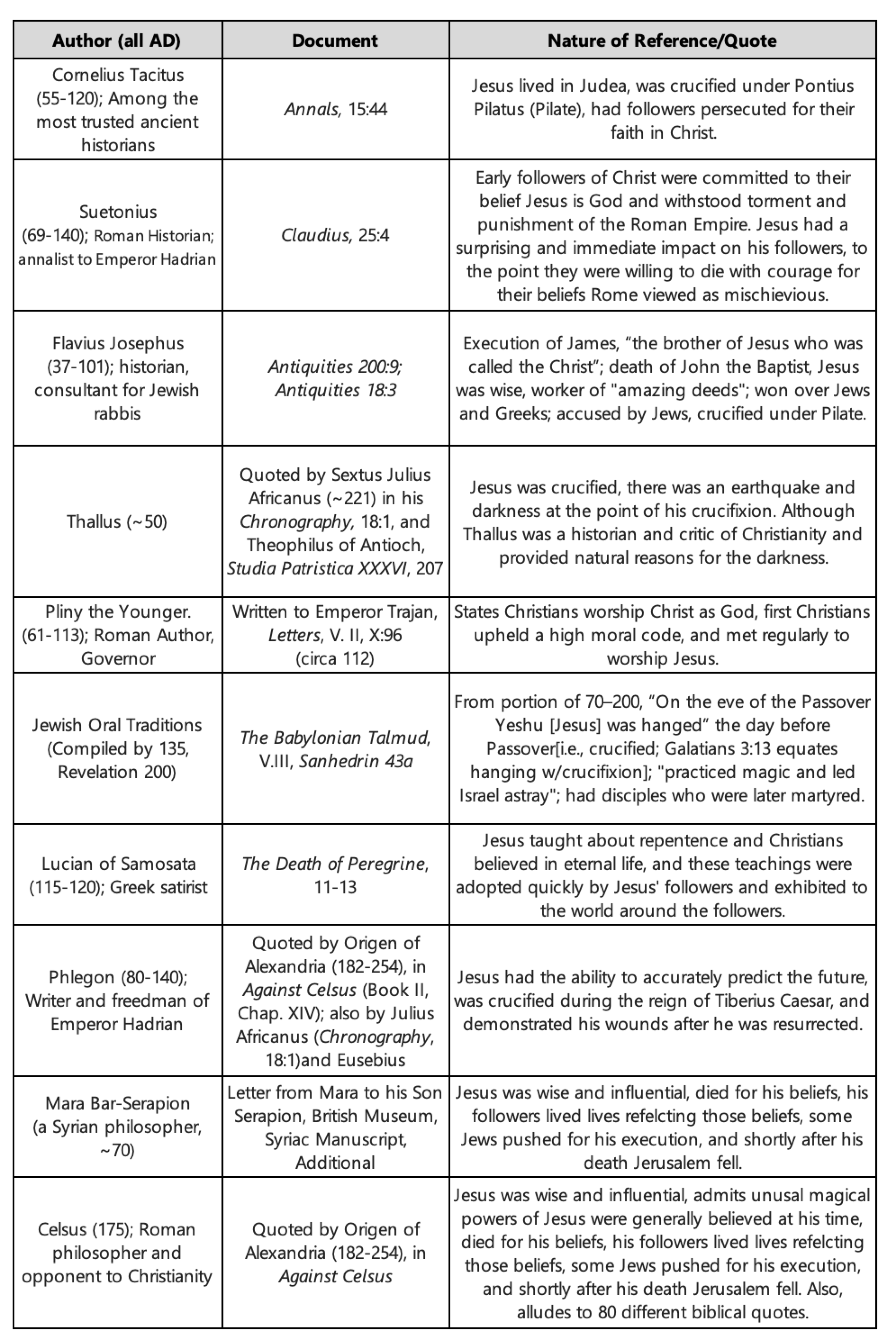
Are there sources outside the Bible to verify facts about Jesus? Non-Christian historical records, including even sources hostile to Christianity, affirm the accuracy of many details, including the ten given here, with references and exact quotes given at the end of the blog:
1. Jesus lived during the time of Tiberius Caesar.1
2. He lived a wise and virtuous life.2
3. He was known to perform miracles.3, 4
4. He had a brother named James.5
5. He was crucified under Pontius Pilate, and on the eve of the Jewish Passover.6, 7, 8
6. Darkness and an earthquake occurred when he died, and traditional Jewish sacrifices, which Jesus’ sacrifice was to replace, were no longer accepted.8, 9
7. His disciples believed he rose from the dead.10
8. His disciples included Jews and Greeks, they believed he was God, they denied the Roman gods and met regularly to worship him.14, 15, 16
9. His disciples and other followers were willing to suffer and die for their belief.11, 12, 13
10. Christianity spread rapidly, even to Rome, to the point of bringing on government persecution.11, 12, 13
The New Testament
Provides the evidence historians and evidence evaluators drool over.
It is interesting how some people ignore the significance of the biblical accounts, some never even looking into them, all based on a faulty belief, such as the objection below.
Objection: You cannot trust the biblical writers, they are biased?
Answer 1: Using that type of logic, then you cannot trust the accounts of the Holocaust survivors, because they are biased. Do you really believe that?
Answer 2: Were the biblical writers biased? Yes. Everyone has a bias, but think further. The critics, who claim you can’t trust the biblical writers because of bias, also have their own biases. Does this mean we cannot accept what the critics claim, because they have a bias? Illogical, shallow thinking. Just follow the evidence where it leads.
Answer 3: Those biblical writers certainly had a bias, but in the opposite direction skeptics claim. These authors were going against their culture, being consistently imprisoned, tortured, with some, possibly many dying harsh deaths because of their claims about Jesus – they had a tremendous bias to walk away from Jesus and claims of his divinity. Yet, these witnesses went through continual suffering, and some to their last agonizing breath knowing for a fact whether what they claimed about Jesus was true or not – making their claim something special.
These New Testament (NT) accounts are documents purporting to provide history and other productive information, and must be given proper analysis. The New Testament is:
- A collection of 27 books and letters, with accounts from the disciples, those closely tied to the disciples, and other direct eye-witnesses or researchers, like the physician Luke, and the apostle Paul.
- These are the right people (those at the right place, right time, and in the right position to know the facts with reliability), and are …
- Making the right claims (they affirm the deity, death and resurrection of Jesus, which are the central facts of Christian belief, and give numerous facts able to be checked by those living in Jerusalem, and by the millions who came to the area for pilgrimages, who could check their facts), and …
- Provide the right verification (they actually say to the audience of the time, “You were there, you saw the miracles, and if you didn’t, ask those who did.” (Acts 2:22-23, 32; 1 Corinthians 15:3-7) These NT writers were then willing to put themselves in harms way, even die for what they knew for a fact was true, or not. Furthermore, history, archeology, and non-Christian sources affirm the details.
Furthermore, these accounts include 8 E’s of evidence scholars long to see:
- Early & Eyewitness Testimony
- Embarrassing Testimony
- Enemy Testimony
- Excruciating testimony
- Elaborate testimony (giving subtle details that tie in to other historical accounts like a jigsaw puzzle; far too elaborate to have been anything but accurate accounts)
- External confirmation from other sources of evidence
- Evidence that invalidates all alternative options
A detailed explanation of each of the E’s is not given here, but will be given in a future detailed blog.
Paul
- Paul is a tough pill for the skeptics to swallow, but is accepted by the critical scholars because they recognize the evidence demonstrates: we have what Paul actually wrote, he was a serious intellectual, was careful, extremely ethical (honest), was at the right place, right time, knew and checked the other apostles and eyewitnesses (very thorough in research and thinking), claimed he himself was a direct eyewitness, and went through consistent and brutal persecution.
- Paul was a Pharisee who studied under the famous Jewish teacher Gamaliel, and was a skeptic. He was persecuting followers of Jesus because he did not accept the claims. He then directly interacted with the resurrected Jesus, experienced numerous miraculous events verifying the claims, and abruptly changed to accept Jesus, dedicating his life, through continual suffering and death, for Jesus. And remember, the critics accept Paul did not lie, claimed to be a direct eyewitness, claimed to be able to do miracles because of Jesus, and checked and verified his facts very carefully.
- Paul says what you do with Jesus determines your eternity. He said if Jesus is not who and what he claimed, then what I preach is useless and those who believe in Jesus are pitiful (1 Corinthians 15: 14-19). Pretty strong challenge as the witnesses, tomb, and other claimed events were checkable for his audience. On the other hand, if the claim is true, then this is of first importance and makes sense why Paul was willing to sacrifice his all.
Paul adds: “Where, O death, is your victory? Where, O death, is your sting?” As Dr. Gary Habermas has noted, Paul is not doing poetry here – he is trash-talking. Paul had been brutally oppressed at this point, due to his witnessing to others and spreading the good news Jesus brought, and he was declaring even though pain and death can be used against us, because Jesus lives, we know Jesus’ message – that we can live too after life – is a done deal.
Paul is pointing to the scoreboard and declaring the game is over, no matter what he suffers now, it will be nothing compared to what God has prepared after this lifetime is done. (Romans 8:18)
Bottom-line: Jesus and his claim stands alone in history. Either that claim is accurate and needs to be dealt with by each of us, or it is inaccurate because a natural explanation is better. Whatever you believe about Jesus, WHY? WHAT EVIDENCE ARE YOU STANDING ON? How does your belief fit the Minimal Facts, or the other evidences presented above?
The next blogs explore the likelihood of alternative belief options concerning what happened with Jesus: Liars, Lunatics, Legends, etc.
External Source References:
(1) Ante-Nicene Christian Library, eds. Roberts and Donaldson, vol. 9, 188. (Cited in J. Warner Wallace, Cold Case Christianity)
Phlegon records that, in the time of Tiberius Caesar, at full moon, there was a full eclipse of the sun from the sixth hour to the ninth.
(2) Josephus, Antiquities of the Jews, 18.3.3 (More specific and supernatural versions of this quote exist but do not have scholarship consensus as authentic copies of Josephus. We just use the quote most scholars agree is authentic, “At this time there was a wise man named Jesus. His conduct was good, and [he] was known to be virtuous.”. See Shlomo Pines, An Arabic Version of the Testimonium Flavianum and Its Implications, Israel Academy of Sciences and Humanities: Jerusalem, 1971, cited in J. Warner Wallace, Cold Case Christianity)
(3) Origen, Contra Celsum, 1.28
Jesus, on account of his poverty, was hired out to go to Egypt. While there he acquired certain powers which Egyptians pride themselves on possessing. He returned home highly elated at possessing these powers, and on the strength of them gave himself out to be a god
(4) Talmud Sanhedrin 43a.
It is taught: On the eve of Passover they hung Yeshu and the crier went forth for forty days beforehand declaring that “[Yeshu] is going to be stoned for practicing witchcraft, for enticing and leading Israel astray. Anyone who knows something to clear him should come forth and exonerate him.” But no one had anything exonerating for him and they hung him on the eve of Passover.
(5) Josephus, 20.9.1
So he assembled the sanhedrin of judges, and brought before them the brother of Jesus, who was called Christ, whose name was James, and some others; and when he had formed an accusation against them as breakers of the law, he delivered them to be stoned.
(6) Tacitus, Annals, 15.44
Christus, from whom the name had its origin, suffered the extreme penalty during the reign of Tiberius at the hands of one of our procurators, Pontius Pilatus.
(7) Josephus, 18.3.3
Pilate condemned him to be crucified and to die.
(8) Ante-Nicene Christian Library: Translations of the Writings of the Fathers Down to A.D. 325, eds. Alexander Roberts and James Donaldson, vol. 9, Irenaeus, Vol. II— Hippolytus, Vol. II— Fragments of Third Century (Edinburgh: T & T Clark, 1870), 188. (Cited in J. Warner Wallace, Cold Case Christianity.)
On the whole world there pressed a most fearful darkness; and the rocks were rent by an earthquake, and many places in Judea and other districts were thrown down.
(9) Talmud, Soncino version, Yoma 39b
When the foundational and sacred annual sacrifices were performed for temporary cleansing from sins, there were several signs that would indicate the sacrifices were sufficient and the people were in good standing before God. For 40 years before the destruction of the Temple, where these sacrifices were done, a dramatic and lasting change occurred, all of the signs failed, every one of those 40 years, and then all sacrifices stopped as the Temple is gone.
Our rabbis taught: During the last forty years before the destruction of the Temple the lot [‘For the Lord’] did not come up in the right hand; nor did the crimson-colored strap become white; nor did the western most light shine; and the doors of the Hekel [Temple] would open by themselves.
(10) Josephus, 18.3.3
[Jesus’ disciples] reported that He had appeared to them three days after his crucifixion; and that he was alive….
(11) C. Suetonius Tranquillus, Divus Claudius, 25.4
Because the Jews at Rome caused constant disturbances at the instigation of Chrestus (Christ), he expelled them from Rome.
(12) Suetonius, The 12 Caesars, Nero Claudius Ceasar, XVI
Nero inflicted punishment on the Christians, a sect given to a new and mischievous religious belief.
(13) Tacitus, Annals, 15.44
Nero fastened the guilt and inflicted the most exquisite tortures on a class hated for their abominations, called Christians by the populace.
(14) Josephus, 18.3.3
And many people from among the Jews and the other nations became his disciples. Pilate condemned him to be crucified and to die. And those who had become his disciples did not abandon discipleship.
(15) Pliny the Younger, Book 10, Letter 96
They [Christians] were in the habit of meeting on a certain fixed day before it was light, when they sang in alternate verses a hymn to Christ, as to a god, and bound themselves by a solemn oath, not to any wicked deeds, but never to commit any fraud, theft or adultery, never to falsify their word, nor deny a trust when they should be called upon to deliver it up.
(16) Lucian, The Death of Peregrine, 11-13
The Christians, you know worship a man to this day—the distinguished personage who introduced their novel rights, and was crucified on that account….it was impressed on them by their original lawgiver that they are all brothers, from the moment that they are converted, and deny the gods of Greece, and worship the crucified sage, and live after his laws.