
Making Your Options Far More Limited (In a Good Way)
Have you ever had so many choices it felt overwhelming?
- What career should I pursue? — a terrifying question for most high schoolers.
- Who should I marry? — often narrowed by circumstances, timing, or our own limitations.
- What should I eat? — a good menu is a good problem, and a buffet makes it easier.
Having too many options can be a blessing—but not when it comes to your worldview. Reality is not Burger King. You cannot “have it your way.” Reality offers only absolute truth regarding worldview beliefs, and wherever they contradict each other, only one can possibly be true and a safe foundation to guide your choices.
Fortunately, reality has a built-in filter. It doesn’t quietly sit back. It pushes against false beliefs and confirms accurate ones. As we progress through the Five Smooth Stones blogs—and the deep questions every worldview must answer—reasonable options regarding our beliefs become remarkably more clear as inaccurate options are exposed and eliminated.
How the Elimination Works
Each stone removes entire categories of belief:
- Stone Two and Stone Three naturally dismantle the core claims of
naturalism, pantheism, and agnosticism, along with the many worldviews built on them. - The evidence for a cause of the universe being beyond nature and also personal invalidates all but theism—leaving worldviews like Christianity, Deism, Judaism, and Islam.
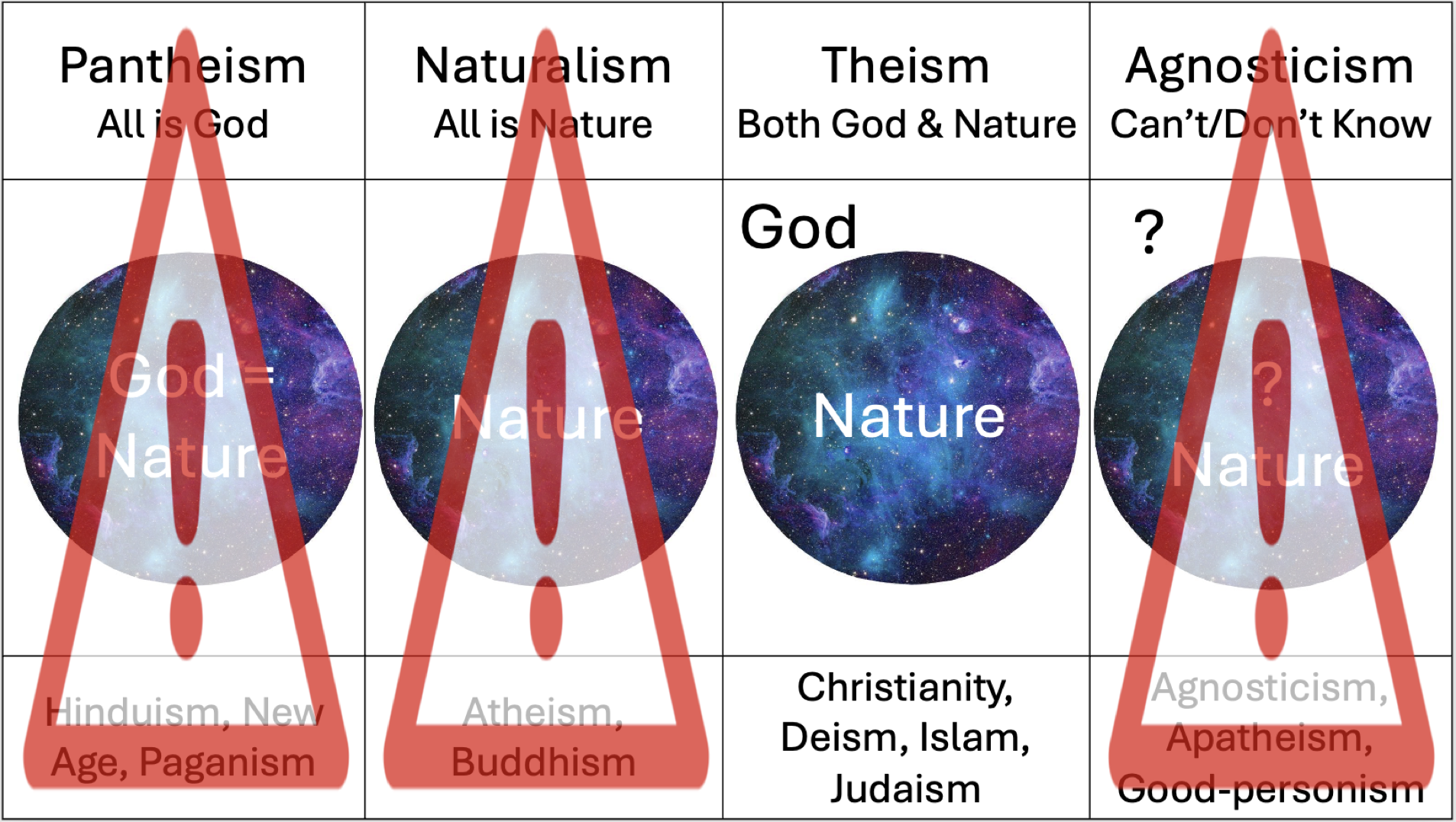
- Stone Four then arrives like a seismic test… and only one foundation remains intact.
What fault lines cleanly divide the inaccurate theist worldviews from the accurate one? Two crucial factors:
- lack of substantial and unique evidential support to verify its claims
- an abundance of critical invalidations
Reality continually erodes inaccurate beliefs, allowing them to fall away from the solid ground of reasonable beliefs.
This Isn’t About Winning Arguments
This isn’t about proving who is right or wrong. We’ve all held wrong beliefs before. That’s not shameful—that’s human.
This is about something far more serious: proving what ideas or foundations we build our lives upon are accurate and safe, or inaccurate and harmful.
I do not want to make anyone feel bad, but even more serious to me, I do not want anyone to experience bad. I wrote this to help people avoid avoidable pain and loss—the kind of loss that comes from building life on a foundation that cannot sustain it.
So, I use my science and teaching background in order to help make clear what people are marrying themselves to when they commit to specific worldviews.
If I communicate unkindly or get something wrong— that is my fault and I would want to know so I can do better for you.
But if the information itself makes us uncomfortable that discomfort may not be an enemy. It may be a warning—and even an invitation. Because every accurate belief system carries consequences (wonderful and reliable benefits) … and every inaccurate one does too (unexpected and harmful losses).
You can find the discussion on Deism using this link: Is God a Distant, Detached, Disinterested Deity? This current blog will briefly focus on Mormonism, Islam and Judaism. While each of these worldviews ties into the Bible, they all contradict each other, therefore, reality will provide the same elimination work as it always does.
We are getting closer now to a foundation you can stand on. One that can carry the full weight of your life and beyond.
Mormonism
Mormonism uses the Bible—but it does not stand on it alone. It introduces additional sacred writings and teachings significantly reshaping the biggest questions of life: Who is God? Where did we come from? What is the purpose of our life? How do we have relationship with God and what is our destination?
Because these answers directly contradict core claims of Christianity, Mormonism forms a distinct worldview—not simply a variation within it. A full comparison is beyond the scope of this section, but even briefly looking at three points for each worldview reveals more than enough to think about.
1. What Source Do You Trust?
Mormonism claims the Bible used by Christians has been corrupted over time. Calling it the “great apostasy.” However, this claim stands directly against the established research of textual critics and scholars across the world. The overwhelming consensus is this:
We possess the Bible as originally written—down to a tiny percentage of variation, none of which affect core doctrine—and those variations are always clearly noted in the margins.
So, the question becomes:
- Why trust the Mormon changes from the Bible and claim of biblical corruption against the consensus of scholarship and centuries of historic, linguistic, archaeological, and manuscript-based research?
- The Bible and Mormon scripture contradict each other in key areas, and these areas allow testing and clear disproof. Do we already have comparative examples?
2. Already Proven Inaccurate at the Foundational Level — Our Origin
Mormonism actually does not fit in the theist category, but instead falls into the same sinking boat of pantheism, worldviews that place God inside the natural universe rather than beyond it.
According to Mormon doctrine, God was once a human—a man who lived rightly according to Mormon principles, progressed spiritually, and eventually became a god over his own planet. With multiple wives, he then populated that planet with spirit children. But it doesn’t stop there. Before becoming our God, he had his own God—who had his own God—and so on, stretching back into an infinite chain of gods in an eternally existing universe.
But here’s the fatal problem with what Mormons have built: That entire structure collapses if the universe itself had a beginning.
Modern cosmology—supported by overwhelming scientific evidence—shows the universe is not eternal. The universe, and all of nature, had a beginning. Therefore, it cannot contain an infinite chain of gods stretching backward forever. The chain breaks at the start.
This also means:
- God cannot be merely part of nature—He must exist beyond it.
- Mormonism places all its Gods and us inside a universe that science has already shown is winding toward decay and eventual extinction in what physicists know as the heat death of the universe.
That is not a firm foundation.
3. Does not remotely approach the unique evidential support provided by the Bible and Jesus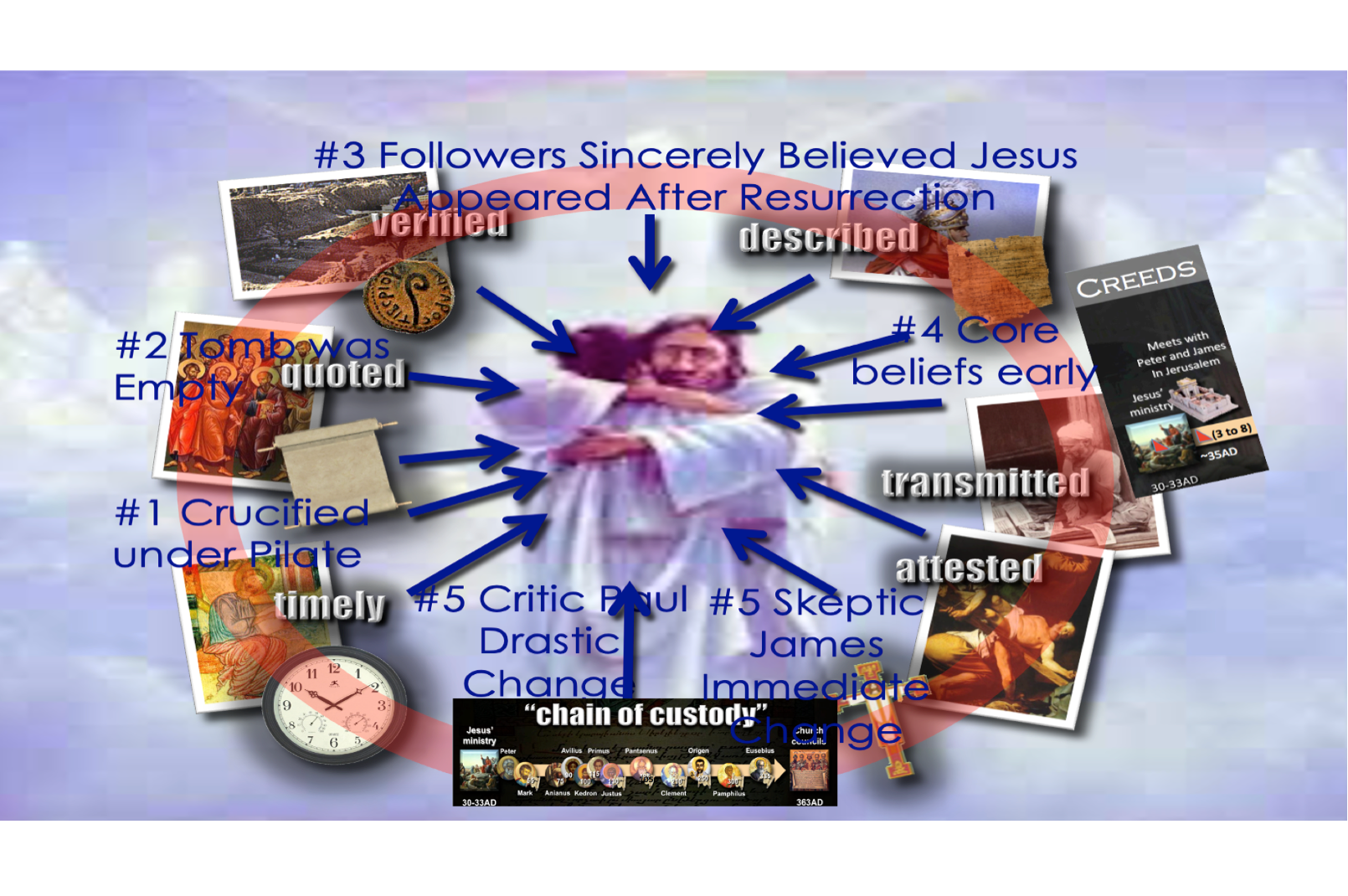
When it comes to evaluating a worldview, evidence matters. Stone Four in the Five Smooth Stones approach, demonstrated that if God chooses to speak or act in history, he does so in a consistent way—through verifiable predictions, historical fingerprints, power beyond human capability, and events that stand the scrutiny of time and reason. This is precisely what we see in the life of Jesus. Unparalleled confirmation.
By contrast, no such confirmation exists for Joseph Smith or the teachings of Mormonism. Research this yourself, it is interesting, but no unique and solid evidence is found. Instead, his story reads much like the pattern seen in many self-proclaimed prophets or cult leaders throughout history. This isn’t meant as an insult, it’s simply the reality anyone can discover if they take the time to investigate. If you disagree, what stronger evidence supports your claim?
I had a few discussions with a man in direct family line to Joseph Smith, which may not be too rare as Joseph Smith did take the multiple wives belief seriously. When I provided reasons supporting Jesus’ claims, and asked for the same for Joseph Smith, despite genuine effort, neither he nor others he brought into the multiple meetings could offer anything comparable.
Not their fault, there is nothing unique, verified, and beyond human capacity supporting this worldview.
The same challenge applies broadly:
- Present even fifty predictions given beforehand and fulfilled historically.
- Or provide one event—just one— beyond human capability to accomplish and supported by the comprehensive case of historical documentation.
That bar isn’t unreasonable anymore because it is simply the standard Jesus himself already set.
One thing has remained clear: only one figure in history stands on uniquely verified ground—Jesus.
Islam
Islam is a theist worldview and also recognizes much of the Bible, but some Muslims will claim the Bible Christians use has been corrupted, and all Muslims have contradictory beliefs with Christianity on essential issues.
1. What Source Do You Trust?
This “Islamic Dilemma” occurs because their holy book, the Quran, says the first five books of the Old Testament (OT) and the Gospels of the New Testament (NT) are the Word of God (surah 3:3, 2:136, 4:136, 29:46, etc.).
The Quran also declares the words God provided us can never be changed or corrupted (“none has the power to alter the words of Allah” surah 6:34; see also 6:115, 10:64, 18:27, etc.). Muslim scholars recognize this. Ibn Kathir, whose commentary on the Quran is considered one of the most famous and reliable, concluded none can remove the Word of God from any of these books.
However, the Gospels contradict the Quran in a number of core claims. A logical contradiction between these two sources would be proof the Quran is inaccurate.
If you disagree, anyone can test this claim firsthand: simply read the Gospels and the Quran side by side.
2. Already Proven Inaccurate at the Foundational Level — Jesus and Allahu Akbar
Surah 4:157 states that Jesus was neither killed nor crucified. But this contradicts every major historical source—Christian, Jewish, Roman, and secular—as well as unanimous scholarly consensus. The crucifixion of Jesus is among the most historically attested events of the ancient world.
Muslims today usually respond saying the Bible has been corrupted. Aside from the fact scholars and archeology have established we have the Bible as originally written, the point is—the Quran itself says the Gospels are God’s Word and can never be corrupted. The contradiction remains.
If the Bible is corrupt, the Quran is wrong.
If the Bible is accurate, the Quran is wrong.
In either scenario—the Quran fails its own test.
There will be other mistakes ancient human authors will make—there are many—just one more monumental one for now.
A primary belief in Islam is given in the saying many of us will recognize: “Allahu Akbar” meaning “God is the greatest.” Christians wholeheartedly agree: God is indeed the greatest conceivable Being in every good attribute. But here is where Islam differs foundationally from Christianity, and where it again gets disproven.
Islam considers associating partners with Allah, or others having qualities of Allah, the gravest sin violating their core principle of Tawhid (the absolute oneness of Allah).
But Tawhid means Allah existed alone before creation. This creates a logical contradiction:
- Whom did Allah love before creation?
- How could love exist without another conscious being to love?
- If Allah needed creation to express love, then Allah lacked something—and was not fully complete.
Before creating any other, whom did Allah love? Himself? That’s weird. In fact, one cannot know or show love without an independent personal being to choose to love or not. Allah would need the Trinity, or us to demonstrate or even know the virtue of love.
Look into the 99 names of Allah (Asma al-Husna), which hold immense significance in Islam and supposedly represent Allah’s divine attributes, including love (by the names Al-Wadud, Ar-Rahman, Ar-Rahim) and absolute self-sufficiency, or lack of needing anything (Al-Ghani, As-Samad).
A Contrast: Why the Trinity Makes Sense of Love
Christian theology offers a solution Islam cannot: one God in nature existing in three independent consciouses as God the Father, Jesus, and the Holy Spirit. This means God did not need to create us in order to express love—He was already relational, already complete, already loving before time began.[1]
Creation, then, is not born of need—but of overflowing love—just as good parents who bring others into being to experience the love already shared.
That kind of love is not dependent. It is pure generosity. And it is only possible if God is more than one in person—but only one in essence. Only the biblical foundation allows for these attributes of Allah to be realized as opposed to contraindicated.
[1] While there is a more detailed description and answer to questions regarding the Trinity on the website, we will not be able to entirely explain the Trinity because if there is a God existing beyond the three-dimensions of space and one dimension of time humanity operates within, then, of course, we cannot entirely wrap our minds around such an existence. Actually, when I do entirely understand a claimed God, like Jospeh Smith’s God, or Vishnu, or Allah, or the Greek Gods, I know I am dealing with a “God” that is entirely man-made.
3. Does not remotely approach the unique evidential support provided by the Bible and Jesus
No such confirmation exists for Mohammad or the teachings of Islam.
Judaism
Judaism is a theist worldview, the Jewish Tanakh is the same set of authoritative books as what Christians call the Old Testament of the Bible, and Judaism and Christianity share the same history, tracing their roots through the same origin, the same patriarchs, the same prophets, and the same knowledge of an upcoming Messiah.
Yet, when history reached its turning point from BC to AD—the person of Jesus of Nazareth—the road split. Christianity continued forward on the same road of predictions and connections with the Old Testament, culminating in the long-awaited Messiah. Judaism adjusted direction, under new guidance from rabbinic leadership, rejecting the only person in all time who could match the prophecies in the Tanakh, and reinventing traditions and shifting beliefs that had been in place for millennia.
1. What Source Do You Trust?
The Tanakh and New Testament are inherently bound, while the rabbinic writings after Jesus’ time diverge. Those who think Christianity began with the birth of Jesus expose themselves as lacking an understanding of theological history and the OT and NT bonds. Christianity did not begin with the birth of Jesus. Christianity begins in Genesis.
A visual study maps every chapter of the Old and New Testaments as bars along the horizontal axis, and shows the nearly 64,000 connections—interwoven references, concepts, predictions, and phrases—forming a stunning web of continuity. Christianity is inherently and absolutely bonded with the OT and NT.
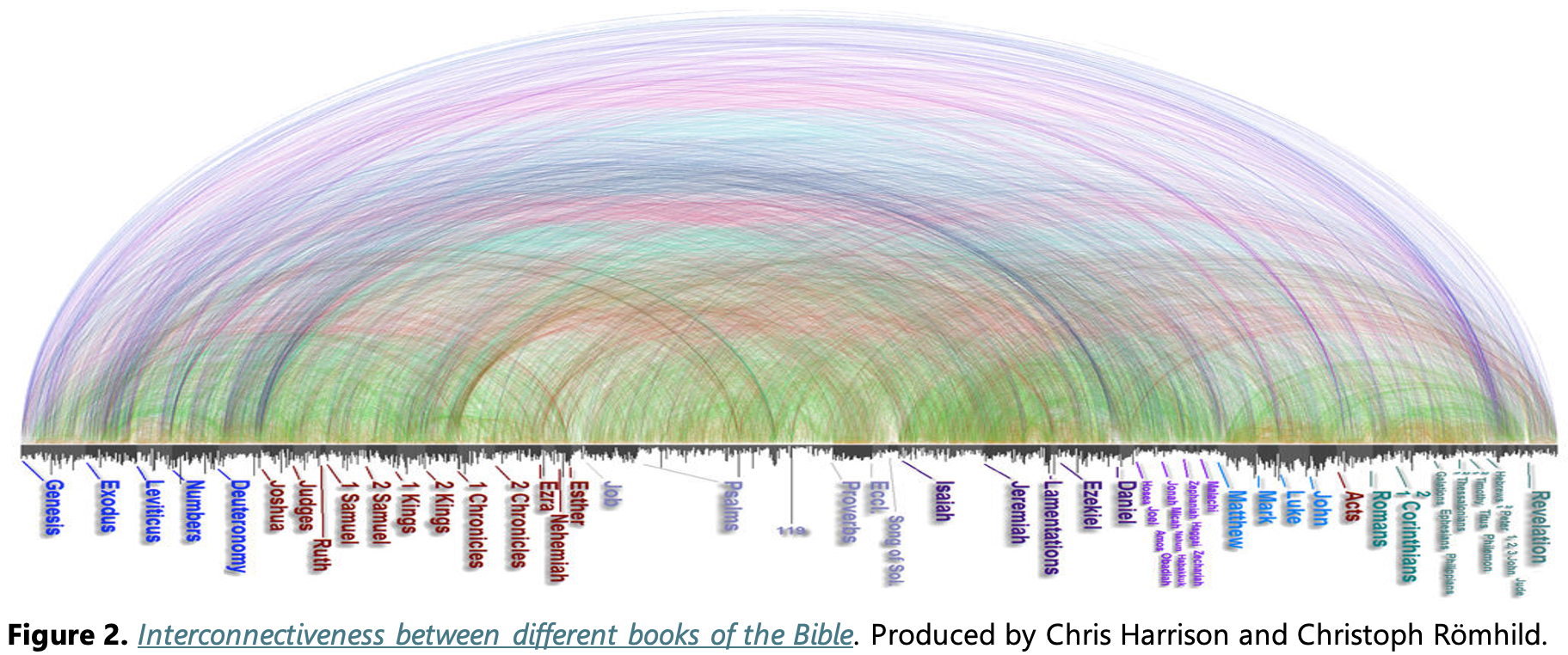
In fact, Jesus affirmed and fulfilled the entire OT (Matthew 5:17, Luke 24:44) and commissioned the NT.
Christianity is not built beside the Tanakh. It is built upon it.
2. Already Proven Inaccurate at the Foundational Level — A Shift Away From Historic Judaism
The Judaism we know today is not the Judaism of the Temple, the priests, and the sacrificial system described in the Tanakh. There was a shift in Judaism after Jesus.
After the destruction of the Second Temple in AD 70, Jewish leadership transitioned to rabbinic authority. Rabbis, who were respected teachers in biblical times, especially knowledgeable in Jewish law and tradition, at this turning point began serving as spiritual leaders and educators, taking over guidance of Jewish religious understanding through their teachings and interpretations of scripture.
With priests and prophets of the Old Testament times gone. and sacrifices now impossible as the Temple is gone, rabbis became the interpreters of Jewish identity and doctrine. New foundations took precedence: prayer, Torah study, and good works.
Their teachings—preserved in the Talmud—reshaped Judaism into what we now call Rabbinic Judaism. With this change, Judaism walked away from some foundational beliefs, traditions, and doctrine going back to the establishment of Judaism.
This was more than an adjustment. It was a theological pivot.
And this comes with a question history cannot avoid: What evidence did God give to verify this new direction? According to Judaism’s own records—none.
3. Does not remotely approach the unique evidential support provided by the One the Tanakh Describes
Not only do rabbinic leaders fail to provide the confirmation Jesus did, but further, their own writings speak of the exclusive singularity of Jesus.
3a. The promise
Throughout the Tanakh echoes a promise: a Messiah would come and be the one to conquer the evil in the world, but would also be the “suffering servant” who would die to redeem us from what would separate us from him.
Israel was suffering under Roman rule and were hyper-focused on the conquering aspects of the coming Messiah. King David was a conqueror, and the Messiah would be greater by far. The idea of a Messiah being killed and rising to accomplish a greater goal than conquering Israel’s foes on earth was not part of what the people were being taught or expected. Even though their own Scripture directly predicted it. Read Isaiah 53 and the rest of the Tanakh (or OT) and decide yourself who this Messiah must be. The main religious teachers also did not believe in a resurrection (Sadducees), or believed all would be resurrected at the final judgement (Pharisees).
Therefore, a large number of the religious leaders rejected and condemned Jesus, moving away from the Messiah, whom the entire Tanakh (OT) is bonded with. This is a departure brought about by some contemporary and post-Jesus Jewish leadership. But who got exposed on the cross and what followed, Jesus or his mockers?
Isaiah wrote of him. David foreshadowed him. The prophets pointed toward him. Every Jewish festival and countless accounts in the Tanakh symbolically surround him.
Jesus of Nazareth didn’t merely claim to fulfill these prophecies—he fulfilled them in ways checkable, traceable, and historically documentable. The data bears witness: only one person of all people who ever have or will live fits precisely the predictions of the Tanakh (or Old Testament)-Jesus. Specific examples of these predictions are provided in the blog 1 in 100,000,000,000 pick.
The questions loom large: If not Jesus, who is current Judaism waiting for? And if no one else fits, what does that mean?
We will go over just two more historical shifts from ancient Judaism to the rabbinic form around the time of Jesus and the destruction of the Second Temple.
3b. Historic Jewish Belief in the “Two Powers” in Heaven
Perhaps most surprising is what early Judaism itself believed — before the rabbinic shift. Michael Heiser, in his studies culminating with a PhD in the Hebrew Bible and Semitic languages, along with a list of other scholars, have shown early Jewish theology acknowledged a mystery within the Tanakh, two Yahweh’s were portrayed:
Early Judaism understood this portrayal and its rationale. There was no sense of a violation of monotheism since either figure was indeed Yahweh. There was no second distinct god running the affairs of the cosmos. During the Second Temple period, Jewish theologians and writers speculated on an identity for the second Yahweh. Guesses ranged from divinized humans from the stories of the Hebrew Bible to exalted angels. These speculations were not considered unorthodox. That acceptance changed when certain Jews, the early Christians, connected Jesus with this orthodox Jewish idea. This explains why these Jews, the first converts to following Jesus the Christ, could simultaneously worship the God of Israel and Jesus, and yet refuse to acknowledge any other god. Jesus was the incarnate second Yahweh. In response, as Segal’s work demonstrated, Judaism pronounced the two powers teaching a heresy sometime in the second century A.D.[1]
Simply put, there were two figures described as Yahweh (the Hebrew word “YHWH”, God’s personal name, translated as LORD): one unseen in Heaven, one visible and interacting with people on Earth. This was Jewish doctrine.
These were not considered separate gods. They were understood as one Yahweh revealed in two persons. Only after early Christians identified Jesus with this second Yahweh did the rabbis declare the teaching heretical.
But that declaration of heresy came after the evidence had already been on the table: the predictions and symbols fulfilled, and the resurrection achieved, proclaimed and unable to be falsified.
3c. When The Atonement Stopped Working
One more example of a change in direction involves the most sacred of Jewish festivals, Yom Kippur, the Day of Atonement (Lev 23: 27). This was the one day each year the High Priest entered the innermost sanctuary of the Temple, known as the Holy of Holies, to perform specific rituals and sacrifice to intercede on behalf of Israel to God to atone for their sins.
The repetitive need for the sacrifices every year makes clear these sacrifices are not effectual. This sacrificial tradition of Judaism was carried out annually for 820 years starting with the First Temple and ending with the destruction of the Second Temple by the Roman General Titus in 70 AD.
Jewish historical records, written by the Jewish rabbis themselves in the Talmud, describe something obviously extraordinary. The religious leadership, during the time of the temple and sacrifices, recorded signs only God could achieve to let the people know if the sacrifice during Yom Kippur was accepted, or if the sins still remained on the people.
One example is the scarlet thread, which was a red cord the High Priest tied on the doors to the Temple court, and it was observed annually by the people and recorded to miraculously turn white on the Day of Atonement (Yom Kippur) for all those years God accepted the atonement. There were some years when the cord remained red, indicating the sins were not yet forgiven as something in the Jewish community, or something about the sacrifice was spiritually wrong and had to be dealt with.
Jewish rabbinic records in the Talmud itself record something extraordinary:
“For forty years before the destruction of the Temple the thread of scarlet never turned white but it remained red.” (Talmud – Mas. Yoma 39b 4-6; Rosh haShana 31b)
Forty years. Starting… just after the crucifixion of Jesus.
As sacrifices stopped being accepted, history was asking a clear question: Had the final sacrifice already been made?
The Christian answer was the culmination of what the Tanakh predicted and the Talmud described.
The repetitive need for the sacrifices every year during OT times demonstrates these sacrifices were never meant to be permanent. And as the book of Hebrews explains, Jesus is God’s final Word, the perfect High Priest, and Hebrews nine and ten explicitly state Jesus’ sacrifice of himself removes the need for the sacrificial system by accomplishing what the old covenant (OT) could not, permanent removal of sin and restored relationship for those who accept the relationship, and establishment the new covenant (new agreement or NT).
Thus, the OT sacrificial system was the precursor to the sacrifice God himself (Christ) made to forever free people from the results of sin and the need for any future sacrifices or intercessors.
However, the new rabbinic leadership, after the destruction of the Temple, provided a different answer. They diverged focus from foundational Jewish beliefs and practices to “prayer, Torah study, and acts of loving-kindness”[2] to replace the sacrifices of historical Judaism. What unique evidence did God provide to verify agreement with this new direction the rabbis provided—none was given.
It may be the prophet Isaiah was speaking of this emergent rabbinic Judaism when he spoke to Israel, “Go, and tell this people: Keep on hearing, but do not understand; Keep on seeing, but do not perceive.” (Isaiah 6:9). Diverging away from the original covenant (which included following the laws and sacrifices annually for sins) and rejecting the new covenant (Jesus’ sacrifice for us, which the Tanakh and old covenant specifically predicted and pointed to), Judaism accepted something else. Why? What supports this diversion?
3d. So, What Does Rabbinic Judaism Claim about Jesus?
What do Jewish religious leaders say happened to Jesus? The records in the Talmud provide the following: “On the eve of the Passover Yeshu [Jesus] was hanged” [i.e., crucified; Galatians 3:13 equates hanging with crucifixion]; “practiced magic and led Israel astray;” had disciples who were later martyred.[3]
So rabbinic documentation itself admits Jesus performed wonders only explained as “magic,” led Israel away from their rabbinic teaching, was crucified and yet had disciples, who were in a position to know the certainty of their claims regarding a risen Jesus and who still believed to the extent of being martyred. These Jewish answers regarding Jesus are seriously problematic.
The gospel of Matthew stated Jewish religious leadership claimed Jesus’ body was stolen (Matthew 28:11-15), even noting the claim is still widely circulated to this day, which, if not true, could be checked and debunked by Jewish leadership. The claim was repeated in the Jewish polemic against Christianity, the Toledoth Yeshu, as well as a second-century debate between a Christian and a Jew recorded in Justin Martyr’s Dialogue with Trypho. So Jewish religious leadership possibly claimed the “stolen body” and conspiracy theory explanations. We already, in other blogs, covered why these theories have been rejected long ago by scholars, based on the evidence.
Therefore, similar to Mormonism and Islam, where modern Judaism diverges from Christianity, you find foundational faults.
For Judaism:
- If not Jesus, who fulfills the Tanakh’s prophecies?
The Tanakh (OT) uniquely predicted the one person in all time who could ever be the Messiah, and it was Jesus. If you disagree, who else fits all the requirements, and what evidence backs your claim?
- Why was the sacrificial system and Two Yahweh doctrines abandoned—and by whose authority?
Why do you believe in the rabbinic shift away from the Day of Atonement and the Two Yahweh understanding provided in the Tanakh? What evidence validates this claim over the previous millennia old understanding and tradition?
- What do you believe happened to Jesus?
Every worldview must answer. However, only one answer has not been rejected by the scholarly consensus long ago, and also aligns with the full weight of historic and textual evidence—Jesus resurrected as the Gospels claimed—and that alternative does not fit the current Judaic worldview.
Any Other Potential Theist Worldview
While traveling, a friend and I stumbled upon a promoted religious gathering. Curious, we stopped and spoke with the leader—a warm, friendly woman eager to talk. She claimed to be Christian and confidently added: “Jesus has already returned. She’s living in New York.”
I was so tempted to ask, “Is she attractive, can I find her on Instagram?” But inappropriate humor would ruin the discussion. So instead, I asked the only question that mattered: “What evidence do you have confirming she is the Messiah?”
She told us about the inspiring words this self-proclaimed Messiah spoke and the good deeds she had done. I listened. Then I gently responded: “Beautiful words aren’t evidence of ultimate truth.” You can find inspiring passages in the Quran, the Vedas, Einstein, or Shakespeare. When your test for truth can point in so many directions, it ultimately points nowhere.
I also asked if she recognized God always marks those actually speaking for God, as a study of the Bible shows miracles are clustered around individuals God revealed truth through, so unless this lady in New York was picked out precisely by hundreds of connections and predictions in the Old Testament, performs miracles only explainable by God and confirmed even by critics’ examinations, and a checkable event with evidence unlike any other claims of deity, why would you believe she isn’t just a fake, nothing beyond human?
She had no answers, but did have a sudden need to speak to someone else. Likely someone more gullible.
The chief Jewish priests mocking Jesus, and those not accepting his claim today, must believe in one of the limited options to explain the evidence. Are you more rational and evidence-based to believe Jesus verified the biblical claim, or to believe one of the other theories?
Because when it comes to a figure so pivotal in all the history of the world, who made claims of absolute importance to each of us, fulfilled unparalleled checkable predictions, and provided a checkable event, you not having an answer is dangerous on the highest level.
Because truth doesn’t disappear when ignored. It simply waits.
Summary
Among all the worldviews on the table, only one should guide your life: the one that can actually stand up to reality. So here is the question every honest seeker eventually must face: Which worldview is supported by diverse fields of research — with the depth, breadth, and quality of evidence that matches Christianity?
If you believe your worldview carries that weight, demonstrate the evidence. If you cannot—or if you feel resistance rising inside of you—perhaps reality is warning you with the discomfort the same way pain warns the body of an underlying health issue. Real comfort, the lasting kind, is built on reliability, not ease.
As we’ve seen throughout this journey, evidence naturally exposes weak foundations. Here again is a brief sample of some fault lines:
Mormonism
- Offers no unique, verified, or beyond-human capacity evidence to support its claims.
- Claims the Bible has been changed or corrupted, but this claim stands directly against the well-established research and consensus of scholarship across the world.
- Foundational beliefs contradict established science—for example, that the universe has always existed. If the universe began, as modern physics establishes, this core idea collapses.
- By placing its “Gods” inside the universe, it falls into the same sinking boat as pantheism: everything—gods included—still needs a cause beyond the universe, and will still end in the heat death of the universe.
Islam
- Offers no unique, verified, or beyond-human capacity evidence to support its claims.
- The Quran claims the Torah and Gospels are God’s Word, and that God’s Word can never be corrupted. But read the Gospels and Quran and you will find obvious contradictions, like whether Jesus was or was not crucified. This is the “Islamic Dilemma”: if the Quran is right, it is inaccurate, and if it is inaccurate, it is inaccurate.
- Allah is contradicted by “Allahu Akbar.” If God does not exist as a Trinity, then how can God be the greatest possible at love and not needing others for anything? Before we were created God would need to create others to even have the capacity for love, much less be the greatest at it. Love, by definition, requires relationship — not dependence.
Judaism
- Offers no unique, verified, or beyond-human capacity evidence to support its claims.
- The Jewish Tanakh (Old Testament) and the New Testament are entirely interconnected. Christianity does not break from Judaism—it fulfills it.
- The prophecies, traditions, important figures, events and aspects throughout the Tanakh all work together to ensure we are able to pick out who the Messiah is—out of all the people who will ever live—only Jesus fits precisely in the crosshairs the Tanakh provided.
- Historical Judaism shifted after Jesus, when rabbinic leadership took over and redirected Judaism away from its original foundation. No evidence was ever provided by God to verify this change.
Mormonism, Islam and Judaism are not enough. Not enough supportive evidence to secure my mind, not enough reliable answers to the purpose of life to fill my heart. My original search into these other worldviews was to determine if there were trustworthy information and an actual God involved with those worldviews. After more than enough evidence demonstrating there is not, the extra time and effort spent in putting these blogs together is for you.
Especially for those stuck in the rut of an inaccurate belief system, which only leads off-track into unsatisfying experiences along the journey, and ultimately in destination failure.
This work is also for Christians to fortify their trust in God, and equipping to help others seeking answers.
If the way I presented the information upset you, not my intention, and that is where I need to do better. If the information upset you, and you cannot refute it with clearly better evidence, then that discomfort may be truth calling you forward.
Because this is not ultimately about feelings. It is about reality. And reality does not bend for us; it invites us to bend toward it, and forces us eventually.
Either … Or …
| The Bible is a human invention—no better than a self-help book plus some folklore and history. | The Creator of the universe did communicate through the Bible with accurate claims about Jesus, meaning this Authority is in a position to know and ensure what is best for us, and must greatly love and value a restored relationship with us if the cross was the cost willing to be paid. |
Therefore, either the claims of the Bible are false and unimportant, or true and ultimately important. The one thing these claims are not is moderately important, so my hope is you do not treat them as such and face the corresponding consequences.
[1] Dr. Heiser on the Two Powers (May 2013); Heiser provided a number of references, including: Segal, Alan F. Two Powers in Heaven: Early Rabbinic Reports about Christianity and Gnosticism. Leiden: E. J. Brill, 1977.
[2] Pirkei Avot. Ethics of the Fathers, 1:2. This work is foundational rabbinic literature and is attributed to Shimon the Righteous. The concept of “acts of loving-kindness” is known as “Gemilut Chasadim”, and is similar to the focus on “good-personism” found in atheism and every other belief system.
[3] The Babylonian Talmud, V.III, Sanhedrin 43a, (from portion of 70–200, compiled by 135, Revelation 200).