
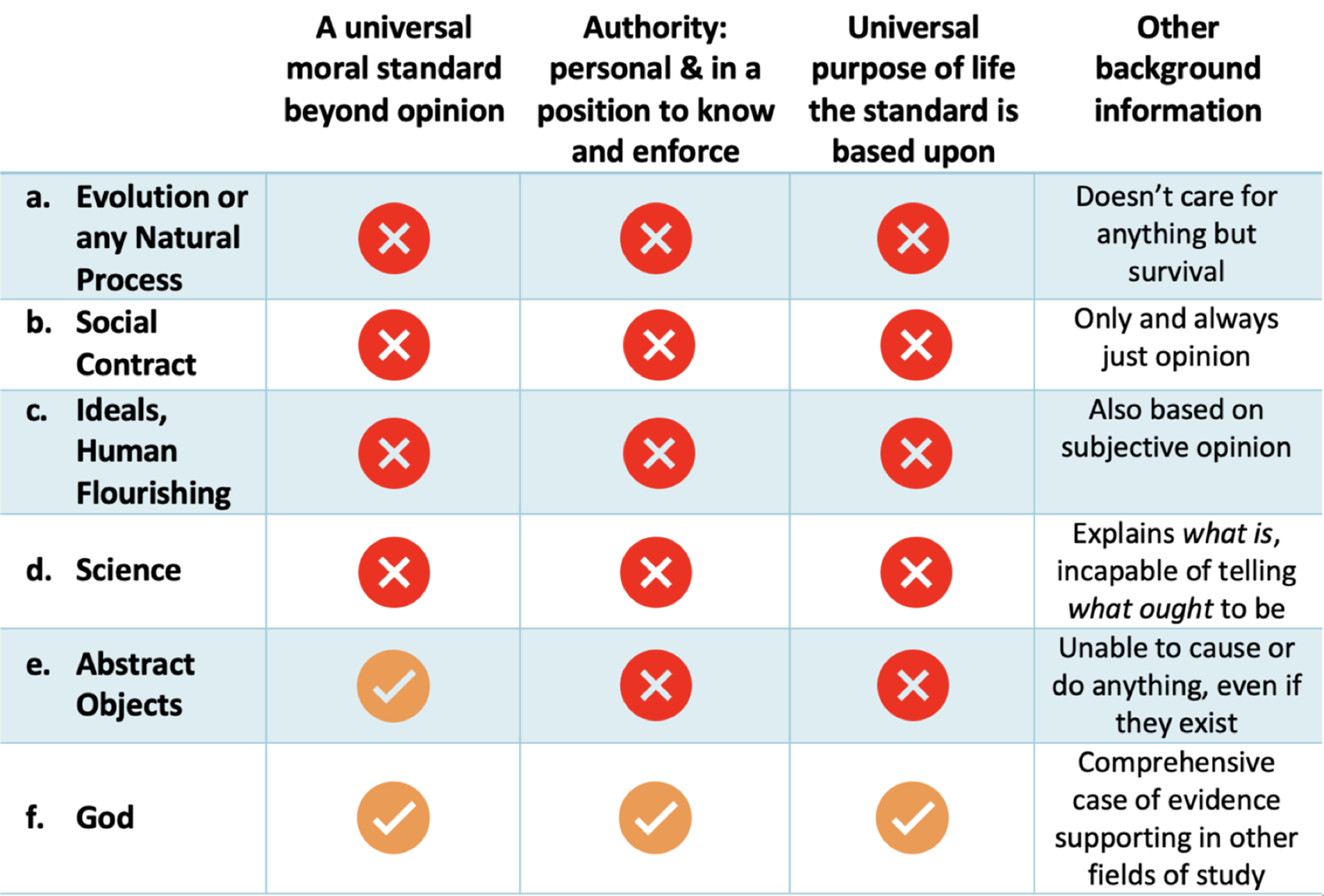
 Since all other attempts to ground objective morality have been exposed as incapable, it doesn’t necessarily mean God is the answer, we need to address the challenges against God being able to establish morality, and in doing so, will see why the biblical God is uniquely able to ground or cause true right and wrong to exist.
Challenge 1. The pain and evil in the world would not be if God exists.
During a question-and-answer period, after a presentation on evidence for God’s existence, a man sitting near the front of the audience challenged the existence of any God who would allow the sexual abuse his daughter suffered, by a man who was freed on a technicality and still living within sight of their house. The conference speaker expressed the sympathy everyone in the audience must have felt, and rightly recognized the man and his family would not be emotionally ready for the logical discussion and evidence on why such a moral and loving God would allow such a tragedy, so instead, he kept to the topic of objective morality and one thing the family clearly sought.
The man had to question what he was more certain about: what the attacker did to his daughter was evil, or that God does not exist. If he is sure the act was evil, and not just his personal opinion, then only if a moral God exists can true good and evil exist. Otherwise, not only is any thought or action just a matter of personal or group or evolutionary opinions, never truly wrong or evil, but also the man seems to have avoided justice, caring so little about what he had done he still lives within sight of his victim’s house.
The alternative, God does exist, not only establishing the moral standard making the perpetrator’s act objectively evil and absolutely culpable, but in the position to ultimately have justice applied, as this authority also governs what comes after this life, when all good and evil are accounted for. There must be a standard beyond the perpetrator’s, the current legal system’s, the father’s, or any human opinion, and in a position to pass judgement and ensure consequences for ultimate justice to exist, after all is said and done.
If God does exist, then it becomes reasonable to ask why a loving God would allow pain and evil. The logical problem of evil has been answered in numerous philosophical sources, and is given in the FAQ section of the website, but aside from the fact the existence of evil and pain do not pose a logical problem for the existence of God, without the existence of God, it is nonsensical, illogical to call anything truly “evil” or “wrong” and deserving of judgement.
Challenge 2. The Euthyphro Dilemma
Is something “good” because God wills it, or does God will something because it is “good” all on its own?
The “Big Questions” in life have been the same throughout history because they have always been the most impactful, life guiding questions. In ancient Greece, Plato ran into ethics and God, and brought up a challenge, known in philosophy as the Euthyphro Dilemma, named after one of the characters in Plato’s dialogues whom Socrates is challenging. Euthyphro claimed something is pious (religious, reverent, holy) when it is loved by all the gods. Religious believers today do this as well, whenever they claim something is good just because God wills it.
Socrates challenges this idea, which others through history, including prominent mathematician and philosopher Gottfried Leibniz, echo by asking if something “is good and just because God wills it or whether God wills it because it is good and just”.[1]
Theists seem to be caught on the horns of a dilemma; picture facing a bull with two pointy horns symbolizing the two choices you have, both of which would eviscerate your belief. One horn of the dilemma arises from the fact if something is good and right only because God wills it, then it is arbitrary, meaning if God just happened to will cruelty or disloyalty as virtues, then these would be moral obligations for all of us! Then we are back to subjective and changeable morality, this time instead of being based on human opinion, it is based on God’s opinion and whims (Muslims do believe we are subject to Allah’s whims).
On the other horn, if God wills something because something is good on its own, then it means some abstract objects of “good” and “evil” and “justice” exist out there somewhere, entirely independent of the existence of humanity or God. This horn of the dilemma would also pierce theism as it would disprove premise one of the moral argument for God as these abstract moral objects existed on their own too, and God is not the only uncreated, self-sufficient entity.
Let’s point out faults with each horn, then explain why neither horn matters in the end. Can “good” exist independently from God? An atheist philosopher from DePauw University, Erik Wielenberg, proposed a theory of morality just being a “brute fact.”[2] Others have claimed it exists the same way as laws of mathematics, 2+2=4. This means ethical facts do not need to be “brought about” or explained by other facts of reality, they just are; causing pain for fun, for example, is just naturally bad.
Belief in morality existing as abstract objects or just brute facts has all kinds of problems. Do you believe, somehow, before the universe began or any people existed to do anything, it was “wrong” to steal, lie, or cause pain for fun? It begs for an explanation why these moral facts somehow existed, and by huge cosmic coincidence this universe did not just produce organisms beholden to instinct, but morally responsible agents (beings able to choose between right and wrong) just happen to exist and are able to appreciate and use these morals. It’s as if this realm of moral facts were personal beings, purposefully waiting for the coincidental existence of us, who would give them meaning.
And why would causing pain for fun be automatically and always bad? Because it would be bad for society, or against evolution, or bad for a person’s legacy? It is fair to ask: How? There was no society or people? Also, so what? History, psychology, and sociology have endless examples of people who have perversely gained fun, power, pleasure, diversion, or other things they desired by hurting others, and many kept going without evidence of regret or negative consequence, until dying of old age.
Another interesting point to consider: if there were such an abstract object as “Goodness,” it cannot act “good,” and if “Justice” doesn’t act “justly,” then doesn’t it fail its own measure of existence?
Probably the most tangible evidence against this attempt to ground morality, abstract objects, by definition, are causally impotent, meaning they are incapable of actually doing anything; we would not have moral obligations or duties to them as they have no knowledge of us or our interactions, no ability to judge or justification for judgement, and no authority to do anything about it. Therefore, even if Wielenberg’s “Good” or “Bad” exists somehow, why would anyone be obligated to it? It is nonsense to claim we “ought” to do or not do something because of such impersonal abstract objects. Laws of logic or mathematics are in a different category, as these do not prescribe how we ought to do something, but instead describe how something will go.
Such a belief in brute fact or abstract object ethics is really far-fetched and would be phenomenally difficult to prove, which is not surprising because whenever someone builds a model or belief supposedly not requiring the reinforcement of appropriate explanation or evidential support, and cannot be falsified, then better keep your distance as such a model will most likely fall apart when reality and evidence crash against it. One horn broken off, now to turn to the other horn.
Both the Euthyphro dilemma and professor Wielenberg did have a good point in asking why would the atheist be any less rational in claiming basic ethics are arbitrary or just brute facts than the theist who says something is good or bad because a God says so, just holding to it as God’s arbitrary whim or brute fact without proper explanation or support.
I don’t know what kind of theists Socrates or Wielenberg have interacted with, but there is a proper explanation and support for why morality can grow from God’s nature and purpose, which meets all the properties – the nutrient rich soil required – for objective morality’s grounding.
Regarding God just dictating what is good and bad, I would be tempted here to say, “So what?” Although I have always had a problem with authority, if a Being such as God arbitrarily dictated morality, then the reality is: I would not win going against this authority, and this authority has demonstrated through time and experience love at the highest level, and knows reality much better than I do. Therefore, I would be okay with this arbitrary morality, which blunts this horn of the dilemma. Yet, I know this is not the point the critics are getting at, and I agree with them: objective morality is not arbitrary, so this point will need to be dealt with.
The reason why the Euthyphro Dilemma is not a problem for theists is because theists are not stuck with two bad options, there is a third alternative splitting the horns of the dilemma as it answers the challenge to Euthyphro: Objective morality or “good” is grounded in the nature of God. These moral values are not independent of God because it is God’s nature or character that defines, or is the standard for, what is “good.” This is the standard because there is no being or anything of greater good than God, as this is part of the definition of God; if there were something of higher good, then that would be God. If God is, by definition, the greatest possible being, and it is greater to be the paradigm of good, than to just be good. This means “good” and God are coincident.[3]
God’s own unchanging nature is the standard of goodness, and from this morally perfect nature and best purpose for humanity come the moral duties (morality) placed upon humanity. Therefore, these moral duties are not arbitrary, they come directly from God’s nature and purpose for us.
As discussed in chapter three, we can know the true purpose of something only from what created it, and there are exclusively two possibilities:
- If humanity was produced as a result of natural laws and chance, then there is no objective purpose, no authority in a position to know and enforce morality, and no moral standard able to rise above human opinion or natural laws to base objective morality upon.
- Conversely, if humanity was created by a transcendent Creator, then not only do we have an objective purpose of our existence, inherent human value endowed by the Creator’s purpose, and human rights tied to our value, but also an objective standard for morality can exist, being logically grounded in, or based upon, this Creator’s purpose and nature. Human actions can be judged truly right or wrong, good or bad, depending on how they conform to God’s purpose for us.
People may disagree or not like the nature and/or purpose of this Creator, for example, they may believe life on earth should have as much flourishing as possible, or pleasure, or freedom from pain, or freedom from rules, but this does not change the fact of the existence of an objective purpose, and the resulting moral values and duties bound to the nature of this Creator and purpose for us. This is why each of us can either choose to trust in this purpose, or reject it and go our different way.
This is the reason I invest such time and effort on this topic, not because it impacts me at all whether someone believes the same as I do or not, but because I don’t want anyone to miss the most impactful, fulfilling, and reliable hope-giving relationship.
A perfectly loving and intelligent God would only issue moral laws to humanity matching that Creator’s nature and best purpose for humanity, and would ensure these moral laws were “written on our hearts,”[4] however this is done (whether it be through evolving genetics or society, spiritual means, experience, culture, caring parents, history, communication from God directly or indirectly through scripture or verified people, or most likely, a mixture of ways).
This standard for morality is apart from human opinion, and while we are given freedom to disobey these moral laws, we would be following our limited and questionable judgement against our Creator, who has the knowledge, authority, and love for us to know the reality of all that our moral choices and actions will lead to. Choices and actions going against such an objective moral standard would be what Christians call “sin,” or “missing the mark” of the standard set by God.
Conversely, when following God’s nature and purpose we will find beneficial things enter our lives, or even when reality still brings pain, loss, or other hard realities, the path God urges us to is still able to provide the protection, hope, and direction towards a final destination making all the journey worthwhile and wonderful.
If there exists such a Creator and objective morality, then when all is said and done, if we had a God’s-eye view of our entire life (and/or all of humanity’s history), like a map displaying not just all of life but also what comes after life, then we would observe the different places in our lives where our path diverged from God’s purpose for us, are the precise locations where we stumbled into harmful environments and future consequences.
Or, there is no God, no lighted path through the forest of right and wrong choices. In fact, if nature and natural causes is all there is, then the path you take is entirely dictated by nature and circumstances, there is no right or wrong for you or anyone else because there are neither free choices, nor objective morality.
The answers to the big questions in life have direct applications in so many areas of life. While we will jump into a fresh criticism against God grounding morality next, if you want a break from the discussion and see how this applies directly in one of the hottest, emotion-laden topics people get challenged with currently, see the website for an answer to: What about LGBTQIA+?
Challenge 3. Even God’s morality would be subjective.
One of the fresher challenges against God being able to ground absolute morality was given by popular atheist speaker Alex O’Connor, formerly known as the Cosmic Skeptic, who presented the same idea I had struggled with myself growing up. Alex argued even if there were a God as the source of morality, moral values and duties would still be subjective, just now the opinion is God’s instead of another human’s, and there is no objective evidence to show why this morality is the standard. Why should I listen to “X,” be it a teacher, a police officer, pastor or God, is a thought I am well-inclined to side with having a natural tendency against authority. Unlike Alex though, I recognized there is objective evidence available.
One argument, probably the least compelling for me, is what was noted earlier: God, by biblical (and probably general) definition, is morally perfect, and if there were one more morally perfect, then that would be God. Therefore, a morally perfect nature is, at least ideally, an objectively worthy standard of morality in any time, place, or situation.
But is there any evidence this God’s morality is “good”? Alex, in-line with my inclination, seems to prefer more objective facts for validation. Here are three different objective tests:
- It depends on what you mean by “good.”
In this case, whatever thoughts or behavior aligning with God’s purpose for us are “good”[5] and anything against this purpose is missing the mark, or bad. Check for yourself, does the biblical instruction for life objectively lead to the purpose sought? If so, and the biblical God exists, then this is objective evidence supporting this grounding of morality because the morality provided does lead directly to the purpose God seeks.
- Does what we seem to inherently know is “right” or “wrong” correspond to biblical instruction?
If you believe there is anything truly right or wrong, then logically a Being with at least some essential attributes matching the biblical God is required. Further, check for yourself, what do you know for certain is right or wrong? For example, compassion, loyalty, loving others, lying, hating, or taking advantage of others, do these match or contradict the biblical prescriptions?
Especially instructive are things you believe contradict the biblical prescriptions. For example, the choice to have sexual intercourse with whomever and whenever you choose is something you may feel is “right,” but the Bible claims is “missing the mark.” What does the evidence report? What is stated in the literature concerning premarital or extra-marital sex?
You cannot do this test if ignorant of the Bible. Too often people misapply commands and laws for a specific time, place and people out of context, for example, not recognizing there was an Old Testament (“testament” meaning “covenant” or “agreement”) applicable to a specific time and group of people. This old covenant served a purpose in the past and was followed by the New Testament commands applicable to us today. Jesus provided a very simple and brief explanation of these biblical commands (see footnote).[6]
- History and daily life provide ongoing evidence.
While pleasure, flourishing and happiness during life on earth is not the goal of biblical morality, if this morality is truly objective, then history and daily life will demonstrate benefits or harm following from actions for or against biblical instruction.
Remember, certain things are “good” if they conform to the purpose God seeks, and if such a God exists, then such a source would be in a position to view the larger context of our existence beyond this life, and would have knowledge about reality beyond our current comprehension. Does this mean “God is mysterious” and we don’t have to provide evidence? Of course not. It simply indicates what should be obvious: if God exists, there may be some things we do not know as much as we think we do, so we must be careful in attempting to judge God’s judgements, but overall, there should be a correspondence between God’s moral commandments, and real good and bad in history and in our daily lives.
If you are new to the Bible, or could use a quick reference, Jesus made it real simple, as noted in the previous footnote. He fleshed this out further, for example, in the Sermon on the Mount. Bottom-line evidence check: How do you think history would be, and your own daily life, if people followed these moral prescriptions? Would it be “good,” or would it be detrimental to God’s plan for us? Would the world be better or worse?
Final history test: Do we have any evidence there is a God behind the Bible and exemplifying the highest morality? How could you know if there is a divine verification of something? Answer: there would at least have to be something beyond humanity’s ability to accomplish.
The Bible and Jesus uniquely placed Jesus’ claim on the examination table by both the Bible and Jesus predicting his death and corroborative return from death (resurrection), both of which are beyond humanity’s ability to predict and fulfill, without God being involved.
This absolutely unprecedented validation is covered on the website, but if this did occur, then it means God came to personally reveal his nature and purpose, experienced our pain (on a level most of us will never have to endure), demonstrated ideal morality (directly by his life), and through words and actions made clear his care and value for us (how much something is valued depends what cost is willing to be paid, and the cross is the cost where an innocent Jesus spread his arms to show the expanse of our value) by possibly the greatest ethic – sacrificial love.
Thoughtfully consider the level of this love, sacrificing self for those who love you is amazing, sacrificing yourself even for those who don’t currently love you and even hate or persecute you, this is on a whole other level. This is objective evidence of the highest moral standard. If you know of better, and it is validated on a level equivalent to what the Bible and Jesus provided, what is it?
To summarize, God by biblical (and probably general) definition, is morally perfect, and a morally perfect nature is, at least ideally, an objectively worthy standard of morality in any time, place, or situation. Further, to directly address Alex’s concern, there are sources of objective evidence to show why this morality is the standard.
The fact that causing pain in others for fun is absolutely bad, wrong, and/or evil may feel obvious, and to an extent, it is, but what you are feeling is this knowledge of right and wrong that comes to us all through a variety of means, but this feeling has intellectual limits. If you want to think such an act is always, universally wrong, you may feel the good of society, science, or other things can make this true, but this is the limit where your feelings are intellectually invalidated if there is no God. The only way you can be intellectually honest and believe in true right and wrong, you must step away from atheism and on to theist ground, as both atheist and theist thinkers recognize.
The fact that causing pain in others for fun is wrong can only be explained by the fact God created humanity on purpose, and for the specific purpose to love Him and all other people (from our neighbors to those who consider us enemies). Since causing pain for fun is definitely unloving, then it does not approximate to the objective purpose of the human existence (an objective truth about humanity irrespective of the subjective opinions from humanity). To a degree a thing does not approximate to its objective purpose, whether a hammer to hammer things, or a person to love God and love others, then to that same degree the thing or being is objectively “missing its mark.” The Hebrew and Greek words for sin have roots in the idea of missing a target, like an arrow missing the mark.
Heard a challenge, given by someone smugly acting as though they were delivering a “mic-drop” moment as they said, “Tell me any ‘good’ thing a theist can do, but an atheist cannot.” Okay, if there is a loving Creator, who knows, made clear, and even took on suffering in your place to allow for the purpose of his creation (including loving, seeking closer relationship, and trusting this Creator), then all failures to love and trust God are good things atheists cannot do.
Does this mean atheists cannot be moral, or the world cannot have morality without religious beliefs? Of course not. Both theists and atheists throughout history have come to have a moral law, however it came to be, and both have the free will to follow morality or not.
The important question to ask is not can those who reject God act morally, it is obvious they can, but do they realize their morality is just subjective, not applicable to anyone else, forced on them through nature and natural laws, and just an illusion for weak-minded atheists who cannot accept the fact there is no real good or bad?
There is no atheist ground for objective morality to grow in, unless a person steps into the theist garden of beliefs, subjective morality is the only fruit atheism can provide.
Answers to interesting questions
If you are an atheist, here are the answers to the questions at the beginning of this chapter, which you are intellectually bound to:
- Are people involved in social justice warriors (SJWs), or just social opinion whiners (SOWs)?
There would be no such thing as justice as there would be no standard to judge anything as objectively right or wrong. Therefore, all reformers would only be social opinion advocates, and some of those annoying ones would be better described as whiners as they are just pushing their agenda, none of which are objective progress as there is no higher up on a non-existent standard.
- Can atheists be more moral than theists?
Yes.
- Was 9/11 good, bad, or neutral? What about my most important political issues?
Objectively neutral, subjectively good for some, subjectively bad for others. The same is true of any of your favorite political issues.
- If objective morality exists, then what worldview belief must be accurate, and which worldviews are exposed as inaccurate?
Only a worldview with a purposeful, personal creator is a position to know and establish a standard, enforce purpose and justice, and can also exist beyond or transcending the natural world.
If you are a theist, here are the answers to the questions at the beginning of this chapter, which you are intellectually bound to:
- There is a standard to judge all actions against, real progress can be measured, so moral reformers pushing morality higher up the standard are social justice warriors.
- Same answer as for atheism.
- Bad, morally culpable.
- Same answer as for atheism.
What set of answers fit the reality you believe in, atheism’s or theism’s?
[1] G.W. Leibniz stated, in Reflections on the Common Concept of Justice (circa 1702): “It is generally agreed that whatever God wills is good and just. But there remains the question whether it is good and just because God wills it or whether God wills it because it is good and just; in other words, whether justice and Goodness are arbitrary or whether they belong to the necessary and eternal truths about the nature of things.”
[2] In contemporary philosophy, a “brute fact” is a fact that cannot be explained in terms of a deeper, more “fundamental” fact.[1] There are two main ways to explain something: say what “brought it about”, or describe it at a more “fundamental” level. (https://en.wikipedia.org/wiki/Brute_fact)
[3] Alston, William. “What Euthyphro Should Have Said.” Pages 283–98 in Philosophy of Religion: A Reader and Guide. Edited by William Lane Craig. New Brunswick, NJ: Rutgers University Press, 2002.
Copan, Paul. “God, Naturalism, and the Foundations of Morality.” Pages 141-61 in The Future of Atheism: Alister McGrath and Daniel Dennett in Dialogue. Edited by R. Stewart. Minneapolis: Fortress Press, 2008.
Craig, William Lane. Reasonable Faith. 3rd ed. Wheaton: Crossway, 2008. [ch. 3]
A paper by C. S. Lewis that resolved the Euthyphro dilemma, declaring, “God is not merely good, but goodness; goodness is not merely divine, but God.”
Quinn, Philip L. Divine Commands and Moral Requirements. Oxford: Clarendon, 1978.
[4] “They show that the work of the law is written on their hearts, while their conscience also bears witness, and their conflicting thoughts accuse or even excuse them.” (Romans 2:15)
[5] God’s purpose is recurrently detailed in the Bible: a relationship of us choosing to trust and enter a loving relationship with our Creator, who first loves us, and to love others, not just those we like, but even those who may persecute us, love all others, and develop our character towards God’s in preparation to be in relationship with God and others after this life ends.
[6] Jesus stated all ethical commands boiled down to two: 1. Love and humbly trust God. 2. Love others as yourself. Matthew 22:34-40: Hearing Jesus had silenced the Sadducees, the Pharisees got together. One of them, an expert in the law, tested him with this question: “Teacher, which is the greatest commandment in the Law?” Jesus replied: “‘Love the Lord your God with all your heart and with all your soul and with all your mind. This is the first and greatest commandment. And the second is like it: Love your neighbor as yourself. All the Law and the Prophets hang on these two commandments.”; also Mark 12:28–31, Luke 10:25-28, John 13:34-35)
How do you love others? Matthew 7:12: “So in everything, do to others what you would have them do to you, for this sums up the Law and the Prophets.”
Jesus goes on the provide examples of how to apply these basic principles in the Sermon on the Mount (Matthew 5-7), and the even briefer Sermon on the Plain (Luke 6:20-49), and notes he is not setting aside the ethical principles of the Old Testament and Ten Commandments (Exodus 20:1-17), but explains them deeper noting God is concerned with our inner lives of thoughts and motives, not just our actions. Not only should we not cheat on our spouse, but not even entertain the desirous thoughts for another; not only should we care for the poor and outcasts of the world, but should treat them as we would Jesus himself.
I was told of an interesting discussion occurring on a long airline flight with a psychology professor from the West Coast. His renown understanding of psychology led to his lectures being so highly sought that his overflowing lecture hall audiences included even other professors. And while the agnostic professor asked for his name not to be attached to his statement, he recalled how a student came to his office hours and asked what was the best way to approach life, and the professor stated the most uniquely concise and perfect answer is found in the Sermon on the Mount.