
 Within the failure of these objections to God being the standard of morality, we find precisely what necessary ground is capable of growing true right and wrong, objective morality, the only rational basis for claiming inherent human value and rights, anything is “good/evil”, “right/wrong”, and worthy of social justice warrior causes.
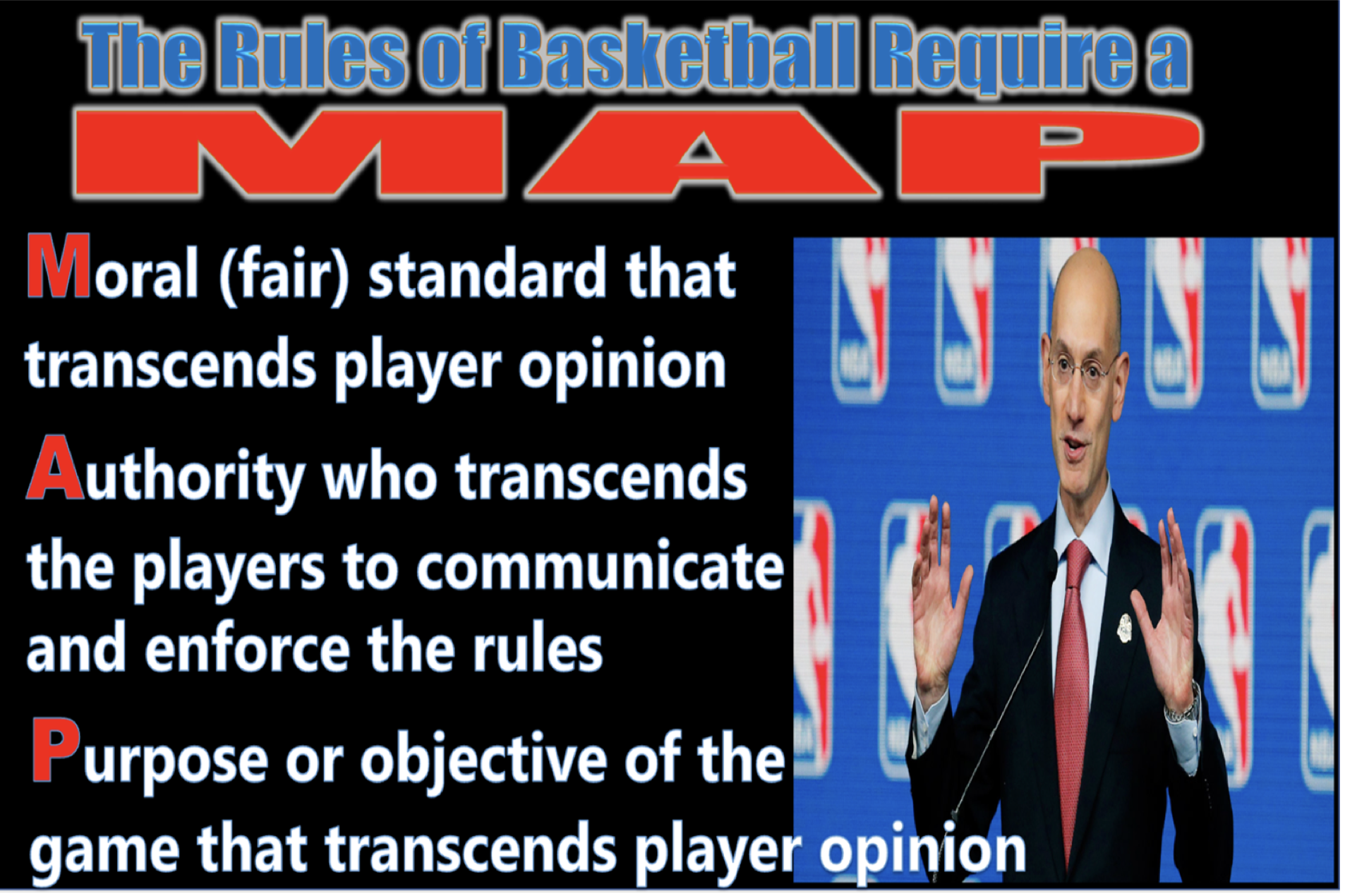
We already have a variety of experience with rules or laws provided by authorities, which helps understand what is necessary for a source of objective or universal or true morality. For example, the National Basketball Association (NBA) operates every one of its basketball games following specific rules. Every player in the NBA, through experience, culture, training, etc., comes to know what is allowed and not allowed on the NBA stage because the NBA has the MAP.
1. A Moral Standard
First, there must be a fairness or MORAL STANDARD that transcends, or is beyond player opinion, which all diverse opinions and situations can be judged against.

Different players will have different standards or differences in how they think the game should be played, but in order to play on the NBA stage and do what is best for the game, they submit to those who have reached positions of authority not answerable to players’ opinions, and are trusted to rise above individual and group preferences to instead do what is best for the purposes of the NBA.
When someone asks someone living in Michigan, “Where do you live”, often an open hand will be presented with the other hand pointing to where their city is on the hand-shaped state. Both the hand, or other approximations of the state, like drawings, can be compared against the actual satellite image of the land, which is the standard as it is the actual geography trying to be matched, to determine how well the approximations match or fall short of the actual or true geography.
For something to be a “standard” it has to be what everything else is measured against. Music lovers, for example, search for the highest-quality copies of their favorite music, so the sound waves produced by copies have to most closely match the musicians’ original performance. Correspondingly, the objective moral standard would have to be based upon the purpose of the original composer or creator, not simply another opinion among many with no reason to distinguish itself as the universal, unchanging, standard of good. Without a moral standard to judge against, it is not possible for anything to be objectively right or wrong, good or evil, just as without an existence of an actual Michigan, or original performance by your favorite band, we would be unable to judge between differing attempts at drawing Michigan or a cover band’s attempt to match the music.
Picture three pools of water we can dip into, one all blue (symbolizing all the morally good choices we could make in life), one all red (all the possible choices going against the moral standard), and one all green (morally neutral waters where a choice has no moral component). Without a moral standard, which is universal, absolute and unchanging, we would never be able to universally, absolutely and objectively separate choices into right, wrong, and neutral sets, the moral pools would just change colors based upon which genetics or person or group added food coloring to the pools at that time. On the contrary, with a moral standard, all thoughts and actions possible in life can be judged against this standard and separated entirely into universal sets of morally neutral, morally right (meets the standard), or morally wrong (fails to meet the standard) thoughts and actions.
 This man in the image deciding between which of the two pools to pull his next choice from, shows a dilemma we all come across probably every day. Even now, I realize I have gone over my break time at work because I am on a writing roll, which is not being fair to my employers. I can see my face in place of the man in the nice hoody, with my foot dipped into that red pool and beginning to stain my shoe.
You may be wondering how can everything we do fit entirely into one of the three pools? Isn’t there a gray area? No, not if there is an objective moral standard and a proper authority behind it. What if you knew where a Jewish family was hiding during the holocaust, and when German authorities came to your house and asked if you had any information, you lied and said you have no information? Even with a moral standard there are higher and lower priorities on that ruler or standard. Common sense can recognize lying as generally wrong, but at the same time the right thing to do when you are bravely risking your safety for the safety of others.
If your heart or motivation was to purposefully violate the moral standard, you are dipping into the red pool; if you truly meant to follow the moral standard (to do what is right), then you are wading into the blue pool, and if neither, then you are standing in the green. It all depends upon what motivated your choice, and if there is a moral standard to be judged against
2. An Authority
Next, where can this moral standard come from? All possible atheist options fail, and only provide subjective morality and the impossibility of universal right and wrong. As noted in previous chapters, what is necessary for objective morality is a single source knowing the purpose of creation, beyond all human opinions, and in a position to know and validate the inherent value and purpose of every life. This is precisely what the writers of the Declaration of Independence knew when stating certain unalienable human rights and dignity are only possible if rooted in “our Creator”, a personal Being who created humanity with a purpose, and in a position to know and ultimately judge right from wrong.
As covered when discussing the Euthyphro dilemma, God doesn’t just act good, but has an unchanging nature of goodness, which then defines, or is the standard of good. Moral obligations are then given from this moral standard and proceed to us as “laws written on our hearts,” which may come to be within humanity from a variety of methods (spiritually, socially, genetically, etc.), and these are just the expression of God’s nature. Therefore, the God described by the Bible would be capable of being the pinnacle moral standard transcending human opinion.
Yet, to be a viable source for actual objective morality, there must also be proper AUTHORITY. Respect for authority has taken huge losses lately, from the defund the police movement, to the systemic and sometimes silly science and academic missteps[1], to a continuous flow of disingenuous politician and media claims. However, as much as I seem to naturally have a problem with authority, authority is not necessarily a negative thing in your life, as long as you have the right one, but it will always be a significant thing in your life.
How significant it is in our lives can be seen from the definitions explaining what “authority” is. From the Merriam Webster dictionary, “power to influence or command thought, opinion, or behavior”, and the Cambridge dictionary gives, “the moral or legal right or ability to control.” In the case of moral authority, what kind of authority would it take to have the moral or legal right to command AND the power to ultimately enforce?
A friend, and more importantly a fellow Pittsburgh Steelers fan, Brett Kunkle, provided an excellent illustration. Imagine eating at a nice restaurant, and receiving a command from a fortune cookie to get up immediately and go outside. No one would follow this directive (well, some superstitious person might). Why not? Because there is no valid authority behind the directive, the person(s) behind the fortune cookie is not in a position for proper communication, judgement, and enforcement in this situation.

Conversely, if the fire department ran into the building all geared up and demanded everyone leave the building immediately, most people would follow the command. Did the command change? No, the authority did, as auth
ority is derived from the appropriate person with the required position, knowledge, and authority to judge and command in certain situations, and consequences will be enforced, either through the proper authority, or by the fires of reality.
Moral laws require the same proper authority. This authority must be in the proper POSITION for us to have any obligation. For example, if I was on a surgery bed, and looking down over me was Will Smith, about to use a bunch of metal tools to fix my jaw issues. Whether I like his movies or not, I would refuse, as he does not have the same position, degree, experience and knowledge as my maxillofacial surgeon.
The universal moral authority must be a position beyond, or transcending, human history, opinion, bias, narrow-sightedness, and lack of knowledge. That is a tough position to fill. The biblical description of God is the only authority logically capable of filling the position as it describes God with a bunch of “omni’s”. God is omnipresent (awareness and influence are everywhere), omnipotence (all powerful), omniscient (all knowing; the root word sciencia is Latin for knowledge, so omniscient is knowledge of all biology, history, mathematics, physics, psychology, etc.), as well as the highest standard of justice, love, grace, and morals, and being beyond the constraints of time, in a position to know all the consequences from any choice made from the beginning to the end.
For this reason, I would be reasonable to tell Will Smith to keep himself “out my mouth”, and any person, group, society, or anything short of the credentials of the biblical God to keep out of my morality.
Notice, this moral authority also has to be PERSONAL. If there is a moral law in place, we do not rationally look for anything inanimate as a source of the moral laws, we look for a personal source behind the law. Why? While a natural law describes what must occur because of the constancy in how nature works, a moral law prescribes what ought to occur as it is dealing with a more complex situation. There is a world of difference between how something is, and how something ought to be. Duties or obligations can only be to, and come from, a person (mind).
Additionally, a person under a moral law or obligation, unlike purely natural things under natural law, has rules to follow, but also has options, to make a choice whether to follow the moral standard or not. Therefore, a moral law giver must be capable of not only understanding the moral standard or moral laws, but also applying the laws in the complex environment of free will, diverse situations, motivations, and options, to reach consistent and proper judgment.
Moreover, this law giver must be capable of passing judgement and enforcing the rules and responsibilities. If it was up to society, genetics, or people, then history shows none of these options are appropriate to be the final source of morality, or capable of trustworthy enforcement. An endless flow of people escape life without justice. The standard of rules is only as binding as the sole authority is capable of passing judgment and enforcing its standard. However, a creator of the universe and author of all that follows this life, can be both the appropriate judge and final enforcement of a universal morality. Justice can be ultimately served.
The final Authority of morality must be personal, but do we automatically trust people just because they hold a position of authority? Some people seem to mistrust anyone in authority. I had taken the owner of a company to court, he never showed, but sent someone in his place. This means his case was forfeit as his name was the only one who could appear in court to contradict my charges against him. However, the judge said I had to go with this other person and come to some agreement. I said I did not have to, as I tried to come to an agreement for months, but was treated poorly, and now since the owner did not show, by law, I already won.
The judge told me again to go, I said no, and asked why he is oddly going against the law here. He asked if I knew who I was talking to, demanded respect for his position and authority, and threatened to charge me with contempt if I kept arguing against him. I said I respect authority I trust, and I don’t trust or respect you if that’s how you handle the law and someone disagreeing with you, and if your bailiff wants to keep giving me tough looks, we can check his authority outside as well. Surprisingly, I did not get charged with contempt, but this illustrates how authorities like this judge are personal, allowing us to interact, observe, and learn to trust or reject their authority. He did have the authority to make me miserable, so I followed along, but only as much as I had to and dripping with contempt.
Some people are naturally okay and trusting with authority, and some instinctively do not accept or trust a moral authority, but this does not change the facts of the situation. If there is a proper moral Authority, you will experience the reality of it, but before any final judgements, the time we have on Earth allows for us to freely make moral choices, experience and observe natural consequences following from these choices, and the opportunity to learn of the moral law giver to develop trust, or not. And what lays the foundation of the trust is the final aspect the moral Authority must have – PURPOSE.
3. Purpose
Anyone watching or involved in the NBA can have some problems with the rules or NBA enforcement. The commissioner and board of governors of the NBA are human, make mistakes like the rest of us, and the rules do change over time, but while the institution is made and run by people, unless you create a better basketball institution, then to play on the NBA stage you have obligations and duties (standards to meet) determined by the NBA. And these obligations and duties transcend, or go beyond any player’s or fan’s opinion, because they are all based upon meeting clear purposes of the NBA.
The purposes, not necessarily in order of importance, are to make money, keep players safe, keep the games at the highest quality, and provide the best entertainment to the fans. This fixed purpose, or purposes, creates the standard all choices can be judged against as being “good” or “better”, to the degree they support the purpose(s), or “bad” or “worse” depending how much they subvert the purpose(s) sought.
As long as players and fans know the purposes the NBA decisions are built upon, and especially once they have interacted with the NBA authority, they can choose to trust and accept the authority and rules, or not. And if the commissioner and board of governors decide you fail to meet the standard, you will receive consequences, and even be removed from the stage. Even more so, if and only if there is a transcendent Creator of this stage of life, solely capable of providing, judging and enforcing a standard of morality based on specific universal purposes, can objective morality exist. Without universal purposes (applying to all people, places and times) the rules would have no goals to head towards, no standard to judge against, and would instead tend to go off in any unproductive direction.
For non-sports fans, sorry for another sport analogy, but you will empathize with this one. Watching a football game, how do you know your team’s quarterback throwing a touchdown is better for your goals than a pick-6 (throwing an interception to the other team, who then runs the ball in for their own touchdown)? You know by knowing the purpose of the game. If there is no universal priority of purposes, then there is no way to know or categorize one thing as better than the other.
There is similarly no way to know anything as right or wrong without universal, objective, absolute purpose, and atheists admit if their belief is true, then there is no such purpose in life. If atheism is true, we would be logically incapable of stating “how things ought to be” morally, regarding any situation, behavior, or choice. The most we could do is state how things are, or how oneself or a group feels about it.
For example, we are only able to state the majority of our culture and myself are against racism, it has all kinds of consequences we do not like, and currently there are laws against it. However, standing on atheism, lacking grounding for objective purpose and morality, we would be spewing logical nonsense to state racism, rape, etc., are wrong for all people and times and places, and therefore ought to be worked against as there is no objective standard and purpose to move towards for “progress”. Social justice warriors are reduced to social opinion whiners, when standing on the atheist platform.
On the other hand, if and only if there is a MORAL STANDARD, provided by the AUTHORITY in a position to know and enforce universal moral laws and obligations, all based upon a universal PURPOSE, then the universe has the necessary logical grounds for true or objective right/wrong, good/bad, social justice progress, inherent human rights and value. All potential sources for objective morality, aside from the biblical God, fail to meet these necessary criteria.
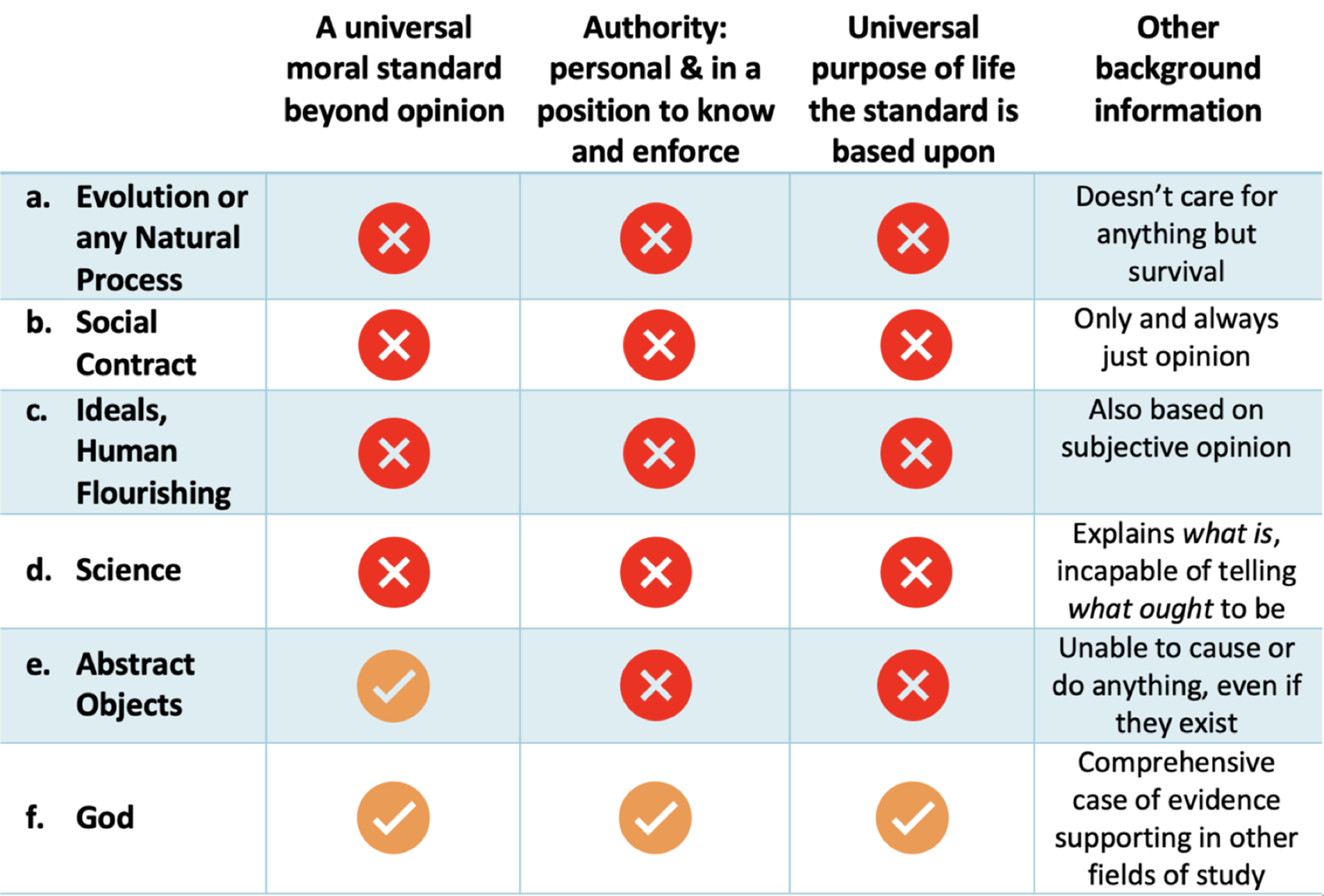
Before we look at what this means for you, a quick summary from a handout audiences seem to like is given below:

Point 3 was displayed in the chart of all potential sources of ground able to produce real morality, ethics, right/wrong, and all are logically unable to satisfy the necessities, except for a personal authority with the credentials of the biblical God.
The final point to be made is the conclusion of the moral argument: Therefore, God exists. And the conclusion of the logical argument is logically inescapable, unless one of the premises is false.
The final thing to look at in this series on morality, which is in the following part 6 blog, is the most personally important: What does this mean for me?
[1] Brainard, Jeffrey, Fake scientific papers are alarmingly common: But new tools show promise in tackling growing symptom of academia’s “publish or perish” culture. Posted 9 MAY 2023, https://www.science.org/content/article/fake-scientific-papers-are-alarmingly-common; one of my favorite exposures of academic journals was noted in numerous places, including an entertaining spot on the Joe Rogan podcast: Oct 30, 2018 episode #1191; https://www.youtube.com/watch?v=OlqU_JMTzd4