

Introduction
An interesting phenomenon comes into play in today’s topic: normalization of deviance, which is deviating from well-established standards of practice without having better reasons to support your new approach.
In June 2023, Titan, a submersible operated by an American tourism and expeditions company, OceanGate, was diving deep to view the remains of the Titanic. During the expedition, the vehicle imploded, suddenly ending five lives.
My physics partner at the cancer center, Mohammad Bakhtiari, published an analysis of this tragedy in a medical journal, insightfully recognizing the sudden catastrophe was brought about by a gradual process:
“One of the crucial lessons from the Titan submersible tragedy lies in understanding the ‘normalization of deviance’ phenomenon (Price MR, Williams TC. Doing wrong feels so right: normalization of deviance. J Patient Saf. 1-2), where unsafe or irregular practices become normalized over time due to their frequent occurrence without immediate detrimental consequences. What makes this particularly dangerous is its insidious nature; the deviation becomes the new norm so subtly that the associated risks might go unnoticed until a catastrophic event occurs.” (Bakhtiari, Mohammad. “Lessons from the Titan submersible: A wake-up call for radiation oncology”, Journal of Applied Clinical Medical Physics, 25(2) doi: 10.1002/acm2.14121)

Looking over the Titan’s record, displays the trademarks of normalized deviant behavior:
a. Sidelining safety concerns
- The carbon fiber hull had been sourced at a discount from Boeing because it was too old for use in Boeing ‘s airplanes. Boeing stated they have no records of any sale to Rush or to OceanGate.
- The hull’s ability to withstand pressure at necessary depths was not verified.
- A “loud acoustic event” was recorded in a previous dive, which may have signaled change in the fabric of the hull, but this evidence was sidelined.
- The Titan experienced over 100 equipment problems, 70 occurred two years prior, and 48 the year before the fatal failure.
- The company dismissed deviations because “nothing has happened so far,” or “it works just fine in other places,” they are inadvertently promoting a culture tolerating, and even encouraging unsafe practices – this is how it gets normalized.
b. Suppressive culture against dissenting views
- An employee was fired after voicing concerns about the submersible’s safety.
- OceanGate overlooked the safety reservations expressed by a group of thirty-eight experts.
- The Titan was never certified by a third-party safety organization as seaworthy, and the company kept this information and warnings about design flaws hidden.
c. Improperly prioritizing innovative freedom
- OceanGate had initially not sought certification for Titan, arguing that excessive safety protocols hindered innovation.
- Titan’s design and operation deviated from industry standards, and the company refused to submit to standard industry independent checks.
The company’s decisions to deviate from established standards in order to be an innovator and avoid holdups, proved to be fatal, and sadly, this normalized deviant behavior is prevalent in another area, our education system, leading to further examples of catastrophic failure. However, instead of being exposed in a sudden tragedy, this failure is being exposed in many, many gradual tragedies.
Many in our culture, usually those around the college years, who have bought in to “deconstruction” are submerging into the depths of the normalization of deviance phenomenon. Like the Titan experience, the process appears normal, can bring some benefits, and keeps the real danger hidden until it has already gained entrance. Hauntingly, one of the final responses from the Titan as it submerged and the communication became spotty, was “All good here.”
Yet, the pressure from reality on those who deconstruct is no less inevitable, and the result on the lives involved may also be more permanent than those who were trapped in the Titan. Fortunately, reality cannot help but produce warning signs as it presses against deconstruction as the whole endeavor is wrapped in a flawed hull.

This paper will expose the dangers of deconstruction as it applies to worldview beliefs, in order to encourage a safer, more reliable journey to determining accurate beliefs.
- First, to better understand this idea, we will deconstruct deconstruction, applying its own process on itself.
- Second, we will provide a well-established process to replace deconstruction.
- Finally, we will demonstrate the practical applicability by practicing on a common challenge.
Deconstructing Deconstruction
As with the tourists on the Titan, I have observed those who have deconstructed were unaware of the history and proper applicability of the vehicle carrying them. Therefore, after briefly covering the basics, we will deconstruct deconstruction.
A. The Basics

Jacques Derrida, a French Algerian philosopher, argued against any ultimate or secure meaning in texts or ideas, the meaning is not the same to everyone and unchangeable, as these meanings are constructed through language and social context. There is no single objective truth to discover, meaning is always open for interpretation. Derrida further believed language was used to shape power in culture and reinforce dominant ideologies, and texts and ideas relied on binary oppositions (e.g., good/evil, male/female) that have a hierarchy with one term favored over the other. Therefore, he originated deconstruction as a process to break down language and ideas to reveal underlying inconsistencies, assumptions, biases, contradictions and values or power structures. The basic steps of this process are shown in figure two.
There are a number of ideas and aspects of deconstruction I appreciate, and this process has been used productively in literary criticism, art, music, architecture, political theory and philosophy. For example, in literary theory deconstruction has challenged traditional approaches of interpretation and assuming author intent. The approach seems fitting, but there needs to be established checks and limits. For instance, I would like to find a study whether this approach typically leads to new and accurate or spurious and inaccurate interpretations.
In architecture, you can see influence in the postmodern style emphasizing fragmentation and unpredictability. But again, there should be limits of reasonable application? Should architects apply deconstruction, and the associated postmodern belief rejecting objective truth, when constructing the building’s foundation and load-bearing walls?
In fact, art, music, literature and architecture rely heavily on the creator’s perspective creating their art. In contrast, political theory, philosophy and worldview beliefs depend on facts, and while subjective experiences (remember, there is no such thing as “subjective truth”; all truth is universal) are involved, and it can be productive breaking down language and knowledge, choices and answers in these fields are best founded upon objective or universal truth. Is the spread of deconstruction into these fields appropriate, or is it pushing innovation and sidelining better methods as was illustrated by the Titan?
I may gain some insight using deconstruction to process a Kendrick Lamar song, but serious warnings are sounding when considering applying this process to worldview beliefs, which entirely rest on objective truth, depending on and being demonstrable through evidence. Using deconstruction productively in the arts is testing it in the shallow waters of consequences. Misinterpreting a song lyric is one thing; basing your life on an inaccurate worldview foundation, and the corresponding consequences are on a much deeper level.
I will not do Derrida or deconstruction justice as I am not an expert in the topic, nor do I have the experience. I did have doubts and questioned my entire belief system, however, I used an appropriate critical thinking approach, as opposed to deconstruction. Therefore, for a reliable understanding of this topic, I would encourage you not to simply accept what a professor or preacher, social media or social circle, or I tell you. Look into it for yourself as you are responsible for your own learning and choices.
For our purposes, not only has deconstruction changed over time as its application spreads into new areas of study, but how it is understood and applied varies widely, therefore, we only seek a basic understanding of how this process is being applied to one’s worldview beliefs because our goal is only to encourage people (including ourselves) to handle our foundational beliefs in the most reliable and beneficial way.
To simplify, the prefix “de” is from the Latin meaning “to take something away from.” For example, you defang a snake, you defrost the windshield, you degrade something as opposed to upgrading. Similarly, deconstruction is a negative or critical process that breaks down beliefs, attempting to reveal underlying inconsistencies, assumptions, biases, contradictions, or other problems, which may lead to taking away a part or entirety of a worldview belief.
Such a critical process is normal and necessary – if done appropriately. If one has doubts or questions about their beliefs, it is incumbent upon them to determine if these are actual fault lines in the foundation to be filled in, or if the foundation they base their life on is inaccurate and therefore will crumble under the pressure of reality. In this case, while the short-term struggle and challenges in reconstructing a worldview can be very stressful and difficult, it is demonstrably more terrible not to move onto the only safe reliable foundation to base our permanent expectations and hopes upon – the accurate belief system.
I appreciate any process encouraging focus on the too frequently ignored or avoided beliefs about the big questions in life, but in such an impactful area – the process must be appropriate – and deconstruction is not.
B. The Steps
Below are the basic steps of deconstruction, but in this case, I apply them to deconstruction itself:
- Identify the goal: Analyze deconstruction to determine if the process is beneficial or harmful to apply to one’s worldview beliefs.
- Research the subject: I researched the subject and provided the basic outline above, and you are encouraged to look into the topic further if necessary.
- Break it Down: Identify the key components, elements, or parts that make up the system or idea. Find underlying assumptions, biases, and values shaping it.
- Look for Contradictions and Ambiguities: Identify any inconsistencies, contradictions, or ambiguities within the system or idea.
- Analyze Each Part: Examine each component individually, looking for its function, purpose, and relationship to other parts.
- Consider Alternatives: Explore alternative interpretations, perspectives, ideas and possibilities.
- Reconstruct and Reframe: If you deconstruct an idea or part of a worldview, you must solidify, adjust or reform it, if you fully deconstruct and break away from the worldview, then you must reconstruct your stance on a different worldview with your new understanding.
Actually, there is a lot of variance on the last step as some claim the goal is to deconstruct from a religious belief, and stop the process once away from toxic theology (obviously a bias showing there). While others recognize one is always standing on some worldview, so once deconstructed from one worldview, you must then reconstruct the new foundation.
I already did steps one and two, and the last five steps will be done together now, and just as Derrida used the term “fault lines” for problems he found when deconstructing, we will point out several important fault lines in the foundation of deconstruction.
Fault line #1: Assuming no definite or secure meaning of text or ideas
- Do deconstruction textbooks or ideas have definite or secure meanings?
- Appropriate in artistic fields, questionable applicability in other fields
While Derrida’s basic idea can be appreciated, this assumption can only go so far. Dr. Frank Turek was discussing objective or absolute truth at a university, when a student declared we can only have subjective or relative truth because even our words and communications are saturated with different perspectives of each person. Turek responded by saying, “Good, you agree there is no such thing as subjective truth, only objective truth.” The student said “No, that’s not what I said”, and repeated his antithetical position. Turek responded, “Correct, we agree, all truth is absolute or objective.” For the next few minutes I was trying unsuccessfully to hold in laughter, while the frustrated student kept trying to get Turek to understand there was no way to secure understanding and communicate truth to another person.
Were you laughing with me as you recognized the problem the student displayed in trying to carry deconstruction assumptions too far? It is not a virtue to be so open-minded your brain falls out. We can appreciate the point of questioning the meaning of texts or ideas, but claiming we cannot get secure meanings and truths about our world is carrying the idea too far. Do Derrida and other deconstructionists live their lives according to that assumption? If so, why spend time trying to convince us with their textbooks and ideas, when neither would be capable of secure meanings and objective, and therefore ultimately reliable, truth?
Deconstruction is troubling in its attempt to undermine the importance of meaning and interpretation in communications. While potentially useful in some arenas, in the reality of making important choices based in reality, communication of objective truth is serious, and Derrida and deconstructionism’s assumptions against secure meanings of words or ideas is seriously faulty.
Fault line #2: Inconsistent application
- How people apply the deconstruction process varies widely.
- Sometimes we need to be critical of our criticism, skeptical of our skepticism.
- Have you deconstructed your new belief? Ad Infinitum?
The application of this process is wildly inconsistent. Discussions with many students and adults who have deconstructed display ambiguous ideas of (a) what were the proper steps in the process, (b) when was deconstruction warranted, (c) what fault lines to look for, (d) how to determine actual versus perceived problems in beliefs, (e) how to handle a discovered fault line. Basically, ambiguous and inconsistent application throughout the entire process.
You will find some people deconstructed entirely based upon discomfort, due to a contrast between their worldview and the current cultural perspective, while others felt a contrast with culture is not a fault line at all. Additionally, some would simply adjust or refortify an exposed fault line, but remain on the same worldview foundation, while others claim if one does not entirely leave a religious worldview, then they did not deconstruct at all and are still toxic, due to the theology they remain standing upon.
Online coaches and other proponents are strict in their lack of proper protocol, such as Jo Luehmann in her video Our Journey of Faith Deconstruction, “it’s important to understand everyone lands wherever they land, there is no right place to land with deconstruction … all of those routes in the deconstruction are valid.” The obvious question arises: if there is no right place to land, then why do it at all? Do you apply this flawed logic in other areas of life? Hope she isn’t a pilot, as there are objectively better and worse places to land.
At this point, a person should be skeptical of their skeptical process. Think about it: any process supposed to test for truth, but whose results can point a person to any different and contradictory end points, is clearly an ineffectual or inappropriate test.
Moreover, if deconstructing to atheism, agnosticism, or whatever metanarrative you end up landing on, should you then start the deconstruction process again? And then again? If not, why not? When inconsistencies in your process evaporate any established standards, and if real harm can arise, then this is sidelining safety standards for personal preferences. Can real harm occur? The implosion of the Titan displays the brutal answer.
This should be obvious, but our culture avoids or is apathetic about beliefs to an extent that would shock most other cultures and times. Just take a moment and think. Your worldview beliefs are the way you view the world and your place in it, the foundation from which you guide your thoughts, actions, responses, priorities and directions in life. There are only so many factors that come together to make up your life:
(a) what you are born with and the background you grow up in
+
(b) what life brings to you
+
(c) your thoughts, actions, responses, goals, direction in life
= (d) the map of your entire life and beyond, all of your experiences and destinations
The only aspect under your control is (c), and these are determined or based upon your worldview foundation. As a result, your worldview beliefs will have the highest quantity and quality of impacts throughout your life, and if there is an existence beyond this life, then the impacts go off the charts. Normalizing a process that jeopardizes accurate processing of beliefs can be as harmful as it gets.
Such behavior is becoming the new norm for many people as the associated risks may go unnoticed in the short-term. Yet, just as with the Titan, the warnings keep coming, and get worse.
Fault line #3: No objective truth to find or hold
- This fundamental assumption of deconstruction is fallacious.
- Is it true there is no truth?

Deconstruction is associated with postmodernism because it carries similar assumptions. Assuming there is no truth regarding worldview beliefs is fundamental to deconstruction, and explains why mantras of “you be you” and “find your truth” are continuously repeated. If there actually exists objective truth, then deconstruction is inherently unfit to apply to worldview beliefs, and another, more established and validated critical thinking approach should be used. We can briefly, and with some humor, expose the fundamental fault line by showing objective truth exists.
One humorous method is to apply any of the common claims against themself. If anyone claims, “There is no truth”, ask them, “Is that true?” When postmodernists state, “All truth is relative”, respond by asking, “Is that only relatively true, or is it absolute truth?” And if told “no one has the truth, and you ought not judge”, ask, “are you really saying no one has the truth, except you? And, are you judging me?”
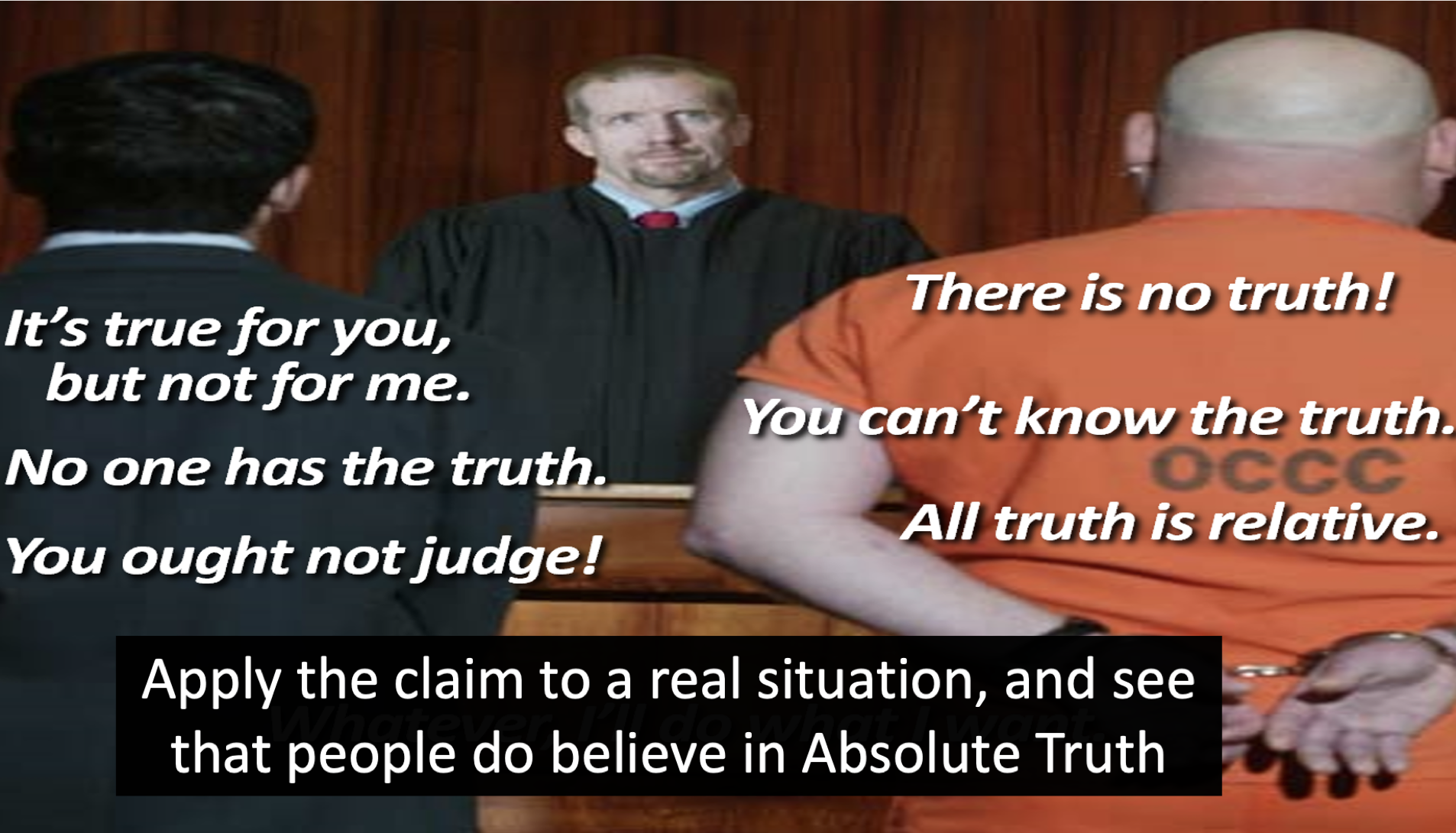
Another method gets to the point quicker because it simply tests whether the postmodern belief in relative truth works in real life. Imagine yourself standing in court, accused of driving 80 mph in a 30 mph school zone, with camera evidence from the school, and video and radar records from the eye-witness police officer. Are you really going to make any of the claims shown in figure four? Imagine confidently declaring, “From my subjective intake of the world, my truth says I was not speeding.” How do you think the judge and others in the court will respond? Would you try any of these claims of relative truth with an oncologist diagnosing you with cancer? Objective, absolute, or universal truth exists, and worldview beliefs make claims of objective truth, which means these claims are either true or false.
For any process evaluating a worldview belief, the end point absolutely matters because worldview claims are either true or false, and reality never fails to bring the consequences to those who stand on accurate or inaccurate worldview foundations.
By the Law of Noncontradiction, whenever two or more things contradict each other, only one, at most, can be accurate or true. Different worldviews may be similar in some aspects, but contradict each other on the most fundamental points, therefore, only one, at most, can be accurate and a safe and reliable foundation. Consequently, it very much does matter how you critically evaluate your beliefs and where you ultimately land. This foundational claim of deconstructionism is demonstrably inaccurate.
Against logic, deconstruction does not accept a single, objective truth, which is a crack in the hull unable to withstand the pressure of reality. This crack should sound like the “loud acoustic event” heard from the Titan hull, which signaled the need for change. Yet, just as the company silenced the warnings, deconstruction proponents silence dissent and cognitive diversity.
Fault line #4: Suppressive culture against dissent
- If only you can speak to your truth, who can dissent and help keep you from mistakes, which we all make?
- Told to be skeptical of established authority of science, history, philosophy, or metanarratives (worldviews) – what’s left for cognitive diversity?
Unsure if this existed in early uses of deconstructionism, but current practice often displays several troubling features. You begin with the assumption you have special knowledge, which only you can judge. Who then can offer dissent against your results? We all know reality can and will. Additionally, cognitive diversity or dissent from validated sources of knowledge, such as history, philosophy, science, and theology as well as metanarratives are rejected, or at least doubted and effectively filtered before any disproof or contrary evidence can be brought to bear. This is self-induced blindness to well-established sources of knowledge, which are all deemed untrustworthy compared to your special knowledge. This is how those weird cults start.
Further, those deconstructing are often funneled to others who have experienced or coach deconstruction, creating an echo chamber of validation, and potentially soundproof to dissent and cognitive diversity. Records show Oceangate at least was aware of dissent and evidence against use of the Titan, but purposefully chose to ignore the advice and data.
With safety concerns and dissent sidelined, it is easy to picture people deconstructing their worldview descending into the depths and still saying, “All good here”? This makes me sad.
Do not gloss over this significance. Each person who deconstructs is either a person who stepped away from an inaccurate worldview, and therefore escaped a foundation that would inevitably drop them into unexpected and unwanted consequences, or is a person who stepped off an accurate worldview foundation, the only one supported by reality and capable of reliably supporting their expectations, hopes, and best outcomes. This is as serious as it gets. Thankfully, reality cannot help but support the one accurate worldview to a level none of the others will be capable of reaching.
The Best Way for You
Bottom-line: deconstruction is a faulty process at best, unsuited for choices resting on objective truth, and prone to lead to unreliable conclusions. On the other hand, the best and well-established method to deal with doubt or questions about your beliefs is to use common sense critical thinking. This paper was written with the struggle I faced at a time when it really hit me: either God exists or not. If God doesn’t exist, then I did not want to waste any time with theology or religion, and if God did, then I knew there was nothing more important than getting that relationship right. I was confronted with questions I could not answer and knew my upbringing and comfort could not ensure my worldview was true.
Fortunately, I was educated in proper use of the critical thinking process to answer the questions we all must answer to have a reliable foundation in life. And really, the process is simply common sense problem-solving we all do naturally, which will be presented now with explanations. After this section, we will practice with a common doubt, using common sense critical thinking.
Basic Steps of Critical Thinking
1. RECOGNIZE DOUBT & QUESTIONING ARE NORMAL AND HEALTHY:
- Doubts, misunderstandings, and questions are natural, if you didn’t have any that would be strange. Having doubts or questions becomes unhealthy if one pushes them down or ignores them, or at the other extreme, obsesses on doubt.
2. CHECK YOUR CONTEXT:
- Where did the doubt come from?
- How well-constructed is your current worldview foundation?
3. IDENTIFY THE DOUBT:
- Be Specific: Don’t just say “I have a doubt.” Pinpoint the specific uncertainty or problem, and what does it mean.
- Understand the Context of the Topic: Where does this doubt come from? How well-constructed is your current worldview foundation: is it better supported than any alternative; are the reasons solid; do other worldviews have better supported foundations, or do you not know? Personal biases and wants can overwhelm correct reasoning, be aware of yours.
4. SEEK INFORMATION:
- Reliable Sources: Consult credible, validated sources.
- Multiple Perspectives: Consider different possibilities, from different viewpoints to gain a broad enough understanding of the issue.
- Gather Evidence: Find confirmed facts, data, evidence, and reasons to support or refute your doubt or problem.
5. REFLECT AND CONCLUDE:
- Objectively Analyze: Carefully examine the evidence gathered, looking for standard problems, such as inconsistencies, assumptions, biases, logic errors, inaccuracies, and possible solutions with standard tests for truth, such as explanatory power, scope, testability, predictability, coherency, cumulative case, and trends of evidence.
Honestly is also essential as personal biases, wants, comfort, background, and emotions can overwhelm rational thought process, and if you allow these, you simultaneously allow less reliability and probability of best outcomes into your decision.
- Draw Conclusions: Based on your reasons, reach a reasoned conclusion, and include remaining uncertainties. If needed, go back to previous steps and do the process again.
- Accept Uncertainty: This is an important point many people do not seem to understand. Not all doubts can be resolved with absolute certainty, in fact, possibly none can. We can’t be absolutely certain our brakes won’t fail on our drive home, but based on the evidence we most likely will be fine. We don’t become driving atheists and fail to drive home because of uncertainty. Get comfortable with some level of uncertainty and make decisions based on the best evidence, which leads to the best probability for the best outcome.
6. REFORTIFY, RECONSTRUCT:
- Refortify: If some part of your foundation just needed refortification because you needed better reasons WHY you believe WHAT you believe, then this is normal upkeep of a reliable foundation whether in a building or in your beliefs.
If you found some part of your foundation is inaccurate, then you need to determine what this means. Some issues are not foundational, such as disagreements about interpretations of the end times, which will not affect salvation and do not deconstruct your whole foundation. You just need to adjust and solidify this area.
- Reconstruct: Other issues, such as if the Universe had no beginning but was eternal, or if Jesus stayed in his tomb or was a myth, these should lead to deconstruction of the Christian worldview foundation and movement toward an entirely different foundation with better evidence.
Okay, those steps do seem like a lot when I babble on for so long, but we all do these steps naturally, and will practice them on a common doubt Christians face.
Practice
1. RECOGNIZE DOUBT & QUESTIONING ARE NORMAL AND HEALTHY
Sometimes I have to reassure Christians their doubts and questions are okay. Church leaders and parents are too busy keeping the entire church and family functioning well, and do not have time enough to become experts in all areas to be able to answer all questions. They should be honest and wise enough to seek other people or sources with expertise, but instead, too many have made the biblically unsupported claim to “just have faith and ignore the doubts.”
2. CHECK YOUR CONTEXT
I was taking my class of middle schoolers on a field trip, and an incident occurred. Picture this, there was a young mother with her six-year-old daughter standing behind her, and while the mother was holding her daughter’s furry panda backpack, a man stepped up, grabbed the backpack, and rather harshly said, “Let go.” After the mother failed to let go, the man said loud and very demanding “Let go now” and took the backpack. What are you thinking about the man? I can give better context because I was the man.
The zoo was fantastic because it had the big cat exhibits at ground level with a large opening in the wall, with only vertical wire fencing separating us from the animals. Unfortunately, the mom from the story took her daughter’s furry koala backpack beyond the “keep out” boundary, and began waving it in front of the tiger that had come to the wire fencing to investigate. In an instant, the tiger swept a paw through the fencing and pierced the backpack with only one incredible claw. I knew in the next instant the tiger could effortlessly pull the women against the fence and into his control, so I grabbed the backpack and forced the mom to let go. The next moment the tiger yanked the furry koala into the exhibit, tore it in half, and scared himself when biting into a Pepsi can. Context frames every story.
What is the context of asking your worldview question or doubt? Did you simply wonder one day how we could possibly know what was written in the Bible thousands of years ago? Did someone else ask this question and you want to provide an answer? Does the question go any deeper, for example, if you question whether God is capable of ensuring we get his Word, do you question whether God became distant, or maybe doesn’t exist? It is good to get the context of the question because it informs what type of information and answers to seek.
Also, it is important to run checks now and then on your overall worldview foundation, especially before facing a significant doubt or challenge. What are several unmatched reasons or evidence WHY you believe WHAT you believe? Is reality supporting your belief on a level no other worldview is capable of reaching, as would be true for an accurate worldview? Or, are there cracks in the foundation? Do you feel unstable and are looking for a more reliable foundation?
Be honest about what emotional or social pressures, biases, preferences, comfort, avoidance or other common diversions may guide your thinking unreasonably into short-term comfort rather than overall safe and best results. Especially on the college campus, I have heard students admitting they were looking to have fun and not be responsible to any authority. As Tim Barnett has observed: Some people are not asking questions for answers but asking questions for exits. Do not just assume this though, we are not in a position to know, but encourage honesty as anything less only increases probability of bad decisions and worse consequences.
Others face strong negative pressure to stay right where they are, not to move from their current worldview foundation. I felt this, as I knew my family would be upset, and I had grown comfortable viewing the world as I did, but I knew any negative pressure or reasons to stay with an inaccurate worldview are dwarfed by the positive evidence and reasons to move to an accurate worldview. This is obvious and easy to say, but tougher to follow through with. A close friend, one of the top lawyers in the state, and also known for being a Muslim apologist, Abdu Murray, related to me his struggle.
He recalled sitting in his room, with stacks of relevant books, copies of debates and other material pertaining to his study on the accuracy of his current belief system versus Christianity. He recalled sitting there with the understanding the evidence supporting the worldview he was trying to disprove was clearly beyond any other, and rationally the only way to make the best investments in life would be to reconstruct his worldview on the new foundation of the opposing worldview. As he was dealing with this realization, his dad walked past and looked at him with such pride for his studies supporting Islam. Abdu said even with the evidence being clear, he still took more than a year to make the change. And when he did, his uncle immediately threatened his life. His family had to struggle with his change as well, but all family members eventually followed his move. There are real costs to move from your current comfortable foundation. However, there are, once again, greater costs not to move to an accurate foundation.
3. IDENTIFY THE DOUBT
Here is a doubt many have noted as the reason they deconstructed from Christianity: I cannot trust the Bible is from God. This is a very fair thing to question, after all, why the Bible over the Vedas, or the Quran, or my own observations and ideas, or Stephen Hawking’s The Grand Design? How would we even know if there was a God behind something?
4. SEEK INFORMATION
I had this question myself, and decided there is a straightforward way to validate, or more likely invalidate, any source by asking one question: How would you know if there was a God behind something? And the answer is simple: it would have to do something beyond the capacity of all humanity. Applying this standard will clearly eliminate anything ever produced by humanity, except the Bible, in this case, unprecedented verifications are distinctly provided. I still remember when my study of this question made goosebumps go up the back of my neck.
There are multiple, clear, specific knowledge claims, which went against every other belief system, science and knowledge of its time, to predict what modern discoveries in science would only discover hundreds to thousands of years later. No human has the capacity to produce such claims. I would have thought the above statements a gross exaggeration or unsubstantiated religious talk, before looking into the topic. It does not matter what it sounds like, the evidence is in, and examples are provided in the beginning and cause of the Universe blogs, among others throughout the website.
Bottom-line: if you think the Bible is only the product of people, then there should be many, many other examples, from all things ever produced by humanity, able to match the multiple, clear, specific predictions, which went against all other beliefs, science and common sense of its time, thousands of years in advance of the modern science discoveries confirming their accuracy. What are the other examples, from all humanity? Nothing remotely comes close. These are more than enough to establish the point, but there is much more.
We could add another dozen predictions about the correctly ordered aspects of planet formation, the quantitative CMBR prediction, other astronomical, geological, historical and even psychological knowledge far beyond anything else in all human history. The astronomical predictions or the historical predictions from the Old Testament are probably my favorite. The latter may be more useful as it is bound to another foundational claim about Jesus.
There are historical predictions in the Old Testament pointing clearly and directly to one possible person in all history, who simultaneously fulfilled all symbolism within every Jewish festival and book in the Old Testament – Jesus. Imagine trying to invent a belief system whose supposed God would not only personally come to validate both his purpose and love, but also provide dozens and dozens of predictions, written by different people in diverse walks of life and across large time and location differences, that all mark out only one person in all history, who would precisely fit the predictions hundreds to thousands of years after the predictions were written. This is picking 1 out of around 100,000,000,000. Not humanly or coincidentally possible.
After providing some of these examples, the burden of proof will be on critics to explain why they disagree, and then what well-established evidence and reasons they base their alternate belief upon. Reality cannot help but support only one to a level of support none of the others can reach due to the Law of Noncontradiction.
There are many questions people will wrestle with in any belief system. Since I gave this talk to a Christian group, here are some questions our doubts or curiosities may bring to us:
- The Bible has changed over time, we don’t know what was originally written.
- There are errors in the Bible, so it cannot be from God.
- There are some horrible things in the Bible and in things Christians do today.
- The Trinity is a contradiction, it makes no sense, no analogy can even describe it.
All of these are good questions to look into, but these are all secondary questions. The primary question is – Is there a God behind the Bible – because if there is, then all the things we do not like, or understand, or have answers for, become very secondary.
If there is God behind the bible, then obviously it must be taken infinitely more seriously than any other source of knowledge. Any supposed wisdom from any human source, including our own assumptions would correctly be recognized as arrogant and ignorant in the face of such a singular source of knowledge. And there will likely be good answers for the secondary questions.
For example, only the Bible predicted an entity beyond all matter, energy, space and time, making the concept of a Trinity not a contradiction but a possibility. Further, if I did understand everything about a supposed God, then I would assume that God was entirely man-made, and I think I do understand every other non-biblical God, but the Trinity is beyond me.
The last set of predictions also stands out as it provides and unmatched claim:
- Where we fail, God pays the penalty himself from the cross.
- Choosing to accept God and what was done for us, frees us from everything that would keep us from Heaven and a full relationship with God.
- This claim is backed by unmatched verification and reasons to trust.
Remember be honest with yourself as doubts are just a normal and healthy in wise reasoning. Don’t be ashamed or ignore yours; you should hear the doubts atheists, agnostics and those in other worldviews must face.
Unlike any other belief system in history, Jesus made an extraordinary claim: God doesn’t measure us based on how “good” we are, but on a standard of holiness—one that none of us can meet. He made it clear that we’ve all fallen short (we’ve all done things against God’s nature), and those things separate us from a holy God. Like oil and water, sin and holiness just don’t mix. If this is true, it’s bad news.
This is the good news: God didn’t leave us separated. Instead, Jesus came to personally show us God’s nature and how much he loves us by spreading his arms wide, and taking on the death penalty for our wrongdoings on the cross, so only at the cross do perfect justice and love cross. The justice against unholiness is paid and our debt was cleared, with God paying the sacrifice. This is the Gospel, which literally means “good news.”
Then, to prove his authority over life and death, Jesus rose from the grave, validating his claim that he can do the same for us. Some may wonder if this is just wishful thinking, but unlike baseless hope, this claim comes with unparalleled evidence.
5-6. REFLECT AND CONCLUDE and REFORTIFY, RECONSTRUCT
As a group in my presentation, we covered these last steps together for practice, but with this question, about whether there is a God behind the Bible or any other source, or any other question you face, all the steps are each of our own responsibility.
In addition to running through the whole process, including dynamic gathering of your own information, honestly reflecting and drawing conclusions that are the best-supported explanations of the evidence are yours to apply and bear, as the corresponding consequences that naturally follow are also yours to bear.
Personal Practice
If you want to practice this with a group, it will place you in a better position to do so when life throws something unexpected at you. Each of you come up with a question or doubt you would most like an answer to. Then each person share your ideas with your group, and groups brainstorm to help each idea as part of step three. Each person will then have time to go through every one of the six steps on their own, and on the last day of the conference we will share our findings and debrief them.
Here are some examples of common questions or doubts:
- Why would a loving God allow pain and suffering?
- How can one belief be right and all the rest wrong? Isn’t that narrow-minded and inteolerant.
- Why does it even matter what worldview I believe? Why will this choice impact me with higher quantity and quality and probability than any other choice in life?
- What about supposed errors in the Bible?
- Isn’t theology just wishful thinking, a crutch to cope with life, or a system of control?
Feel free to use any of these, but better if you have one that is interesting or important to you.
Conclusion
The implosion of the Titan submersible should have been expected and averted, as opposed to surprising and tragic. The normalization of behavior deviating from supported standards hid the dangers lurking within their own systems, keeping normal safety gatekeepers away to facilitate doing what they wanted to do.
This same phenomenon is often observed in those submerged into deconstruction. Deviation from proper critical thinking standards include:
- ignoring the comprehensive case of evidence for worldview beliefs
- suppressive culture against cognitive diversity as theology is often viewed as toxic or wrong from the start
- dissenting views are dismissed if entering the echo chamber of others who deconstructed
- pursuing an innovative idea without proper validation as deconstruction itself is based on a false assumption
Assuming there is no objective truth regarding worldview beliefs is logically absurd. Have you ever started something important based on a false assumption? Do you think doing so would make you more or less likely to reach a conclusion best for you? While there is no clear and validated process in how deconstruction is to be carried out with worldview beliefs, the deviations have become the new norm as often there are no immediate detrimental consequences, but reality is never fooled, and never fails to eventually bring the consequences.
Unlike the passengers of the Titan, prior to using such a vessel to travel through life, we can determine whether the vessel can carry us to where we want to go, or will inevitably bring us to unexpected loss – the evidence is already available. While deconstruction implodes under the pressure of poor logic and reality, you can have a safe, interesting, and reliable journey within the verified vessel of proper critical thinking.