Square Meets Sphere in Flatland
In Flatland: A Romance of Many Dimensions (1884), Edwin Abbott imagines a strange and orderly universe known as Flatland—a world of only two dimensions, inhabited entirely by geometric shapes.
Picture these conscious shapes existing and moving through life in only two dimensions, length and width, as though living only on the surface of a piece of paper. Rank and privilege in this society is determined by the number of sides one possesses: the more sides, the greater the status. The story is told by a humble Square, a respectable but unremarkable citizen who has never questioned the limits of his world—until the day a mysterious visitor arrives.
The visitor is a Sphere, a being from a three-dimensional realm, who gently reveals that reality is far larger than anything the Square has ever imagined. For example, when Sphere makes contact with the two-dimensional world, it was like a ball passing through the piece of paper. First, a dot appears out of nowhere, violating the law of conservation of matter, as Sphere touched the surface of the paper. Next, as the Sphere keeps moving through the paper, the dot becomes an ever-growing circle.
Of course, the Square can only see two dimensions, so he sees a line that is expanding to either side, and when Square touches his side to Sphere, in order to determine the rank of this figure by how many angles and sides there are, Square just slides around Sphere and feels no angles or endpoints!
Eventually, after the halfway point passing through and beyond the Square’s universe, the circle becomes smaller and smaller, until there is once more a dot, and then it disappears. When Sphere talks, it is also strange, as the sound does not travel through vibrations on the plane Square exists on, instead the sound waves hit the entire two-dimensional sheet at the same time, as though Sphere is talking right next to you no matter where you are.
As the Square struggles to comprehend this astonishing possibility, his expanding insight becomes both a revelation and a burden. When he tries to share what he has learned, his fellow Flatlanders cannot—or will not—believe him.
Through this deceptively simple tale, Abbott offers more than a playful meditation on geometry. He exposes the rigid hierarchies and intellectual blindness of Victorian society Abott lived within, and, more broadly, the human tendency to dismiss truths that lie beyond the boundaries of familiar experience.
Similar to the relationship between the Square and the Sphere, the biblical God is clearly described as being beyond the three dimensions of space and one dimension of time we exist and operate within. A being like God is beyond our complete comprehension, as God exists in realms and has characteristics far different from our everyday experiences. Whenever I can fully grasp a supposed God, I would assume this “God” is merely a human invention, because I can understand human inventions, which were made-up by people in my similar, limited perspective.
Does this mean we can simply answer, “God is mysterious,” whenever there is a question about God we cannot answer? No.
If God exists, and cares enough about our relationship to communicate essential information, then there are things we can know, and there are answers we should seek.
So, us Squares will now interact with The Sphere, and explore this strange, amazing, singularly unique, and essential claim of Christianity.
And if the interesting aspects of an extra-dimensional being are not enough, examining this claim can either invalidate Christianity, or invalidate every other worldview belief system.
This is the power and effect of just this one aspect of the biblical God.
Of course, over thousands of years, objections have been brought against the idea of the Trinity. These objections below seem to be the best and/or most common:
- The Later Development Argument: The word Trinity is not even in the Bible, the doctrine developed later, and was formalized in councils, like Nicaea.
- Exact Words Argument: Jesus never stated, “I Am God, worship me,” in those exact words.
- The Logical Contradiction Argument: Christianity says God is one, and also says God is three. This is a contradiction, like claiming “1 equals 3.”
- The Subordination Argument: Some critics point to passages where Jesus appears less than the Father, such as: “The Father is greater than I.” (John 14:28) So, Jesus cannot be fully God.
- God is Monotheistic not Polytheistic: Some argue the Trinity conflicts with the strict monotheism of the Shema by rejecting the unity of God. The Father, Jesus, and Holy Spirit being the supreme deity means multiple Gods or polytheism.
- God is Schizophrenic: God seems to suffer from multiple personalities. This one is my favorite, and while not being useful as far as a solid objection, it is used effectively for mocking.
- The Simplicity Argument: Shouldn’t there be divine simplicity, not a God composed of parts.
This post will be organized to explore the Trinity in a way that answers the objections in turn.
- First, we will explore when and where the idea of the Trinity originated.
- Next, we explain what the concept of the Trinity is actually revealing about God.
- Then, how this concept gets confused or misunderstood.
- Finally, we will demonstrate why every belief system not including a God with aspects matching the biblical Trinity is invalidated.
Origin of the Trinity
If the biblical God exists, then the Trinity has always existed, and the concept was discovered by us only after being revealed by God.
If the claim is false, then humans originated the inaccurate idea. However, the idea still did not originate as late as critics claim, but instead can be found throughout the Old Testament, meaning people had the basics of this concept hundreds to thousands of years before Jesus was even born. In fact, since the Old Testament was only written down when it was needed, God may have revealed the understanding of the Trinity much earlier, but we do not have records of that.
For now, we will just show the Trinity was not just a later invention as the first objection claims, but is revealed throughout the Bible.
Seven Simple Statements[1]
The Trinity is forced on us from Scripture, and notice, all seven statements are supported by both the Old and New Testaments.
- There is only one true God (Deuteronomy 6:4, Isaiah 45:5, James 2:19, John 17:3).
This phrase is part of a foundational confession of faith in Judaism, known as the “Shema.” Many use this statement to reject the Trinity. However, the phrase appears to be emphasizing how incomparable God is.
How do we know this? Consider all the other places where the phrase is used, for example: Isaiah 47:8,10 and Zephaniah 2:15, where the phrase is referring to the cities of Babylon and Ninevah respectively, and of course, the passages where not saying the one city is the only city that exists. It is saying no other city is like this one.
The same phrase is used in these verses: Isaiah 46:9, 47:8, Deuteronomy 32:39, 4: 35, 39, Isaiah 46:9. This phrase focusses on God being incomparable to any other potential deity, as the Bible refers to other spiritual beings as being divine as well.
This may surprise a lot of people, but the Bible notes there are other gods, even a divine council God allows to have responsibilities (Psalm 82:1, 6; 89:5-7; Psalm 89:6, Job 1:6, Deuteronomy 32:8, John 10:30-36). The Bible simply refers to other spiritual beings, what we today refer to as angels or demons, as gods. But only God (or Yahweh, YHWH, LORD, or Most High) has the ultimate attributes we associate with what we call God.
Further, even if the focus was on God being only one being, it does not pose a problem for the Trinity. Deuteronomy 6:4 itself uses the Hebrew word for God, “Elohim,” which is literally a plural word for “Gods.” And “ehad,” the Hebrew word used for “one,” can mean a singular unit and can also mean unification.
It is used in the Old Testament when observing many nations coming together as one to fight against the Israelites, and in Genesis 2:24 in describing the unification of diversity in Adam and Eve to become “one flesh.”
Therefore, the concept of the Trinity is not refuted by any of these passages that critics tend to use, and most significantly: the concept of the Trinity agrees that God is one.
Okay, so if Christianity agrees that God is one, how does the Father, Jesus, and Holy Spirit fit in?
- The Father is called or referred to (or granted status) as God (Psalm 89:26, Isaiah 64:8, Matthew 3:17, 2 Peter 1:17).
- The Son (Jesus Christ) is called or referred to (or granted status) as God (Zechariah 12:7-10, Psalm 110, John 8:58, John 20:28; Hebrews 1:8-12).
- The Holy Spirit is called or referred to (or granted status) as God (Genesis 1:2, Psalm 104:30, Psalm 139, 2 Corinthians 3:17, 1 Corinthians 2:9–10, Acts 13:2-4, Hebrews 9:14).
- The Father, Son, and Holy Spirit are distinct persons and can be distinguished from one another (the Father is not the Son nor the Holy Spirit; the Son is not the Holy Spirit nor the Father; the Holy Spirit is not the Son nor the Father).
- Jesus says to baptize disciples in the name of the distinct personhoods of the Triune God (Matthew 28:19).
- Jesus asks the Father on our behalf to send us the Spirit (John 14:15-16, 16:13).
- All three are on the scene at Jesus’ baptism (Luke 3:22).
- Here is a beautiful example from the Old Testament of all three in the Trinity being identified as God (translations use the word “LORD” in all caps, or YHWH to refer to God): God (YHWH or LORD) is speaking and says he has been sent by God (YHWH or LORD) and comes with the God’s (YHWH’s or LORD’s) Spirit:
16“Come near me and listen to this: “From the first announcement I have not spoken in secret; at the time it happens, I am there.” And now the Sovereign Lord has sent me, endowed with his Spirit. 17This is what the Lord says—your Redeemer, the Holy One of Israel: “I am the Lord your God, who teaches you what is best for you, who directs you in the way you should go. (Isaiah 48:16-17)
Who is talking in verse 16? Who is the “me”? If he says he was sent by God (LORD), and has sent him with his Spirit, who is left – Jesus. [2]
- The three persons (Father or God, Son or Christ or Lord, and Holy Spirit or Spirit) are frequently listed together in a triadic pattern of unity and equality (John 14:26; 15:26; Matthew 3:13-16).
- Jesus makes it clear: In the Gospel of John, Jesus also speaks about the persons of the Trinity by expressing an apparent unity of nature and an equality of personhood within the Godhead: “When the Advocate [3rd person] comes, whom I [2nd person] will send to you from the Father [1st person]—the Spirit [3rd person] of truth who goes out from the Father [1st person]—he [3rd person] will testify about me [2nd person] (John 15:26, emphasis added).
Much more than can be brought up. Such as:
- Jesus, being the culmination of God’s redemption plan, is in every book of the Old Testament, not just the New Testament, and given titles and attributes only God has.
- For centuries before Jesus’ birth, there was an understanding of a God that was in heaven and never seen, and a God who came to earth and was seen interacting with people and events.
- You can make charts demonstrating the three WHO’s having the same nature or identifying attributes of God.
- There are instructive, even shocking, biblical questions to ask critics, such as, “When was Yahweh (YHWH or God) pierced? (Zechariah 12:7-10)”
We will add these other evidences later, when I can find time away from the physics job, but for now, the seven simple statements are all we need.
Here are the seven statements again, and some common objections refuted.
- There is only one true God.
- The Father is called or referred to as God.
- The Son (Jesus Christ) is called or referred to as God.
- The Holy Spirit is called or referred to (or granted status) as God.
- The Father, Son, and Holy Spirit are distinct persons and can be distinguished from one another.
- The three persons (Father or God, Son or Christ or Lord, and Holy Spirit or Spirit) are frequently listed together in a triadic pattern of unity and equality.
- Jesus makes it clear.
Objection 1.
The Later Development Argument: The word Trinity is not even in the Bible, this whole concept was later invented long after Jesus’ time, and was formalized in councils, like Nicaea.
Answer 1.
It is true the word “Trinity” is not mentioned in the Bible. So what? Claiming the concept must have been invented later, after Jesus’ time, simply does not logically follow.
On the contrary, while not using the specific term “Trinity,” which was a term later invented to describe the concept, understandings regarding the reality of the Trinity were revealed by God hundreds to thousands of years prior to Jesus’ birth. Consider just the seven statements above, and numerous other examples throughout the Bible and study of Jesus.
The words “omniscient” and “omnipresent” are not in the Bible either, but both words came about to describe concepts clearly taught in the Bible. It is strange that a critic requires exact words, especially when those words come from a source that has been translated from another culture. Another related challenge is what we will consider next …
Objection 2.
Exact Words Argument: Jesus never stated, “I Am God, worship me,” in those exact words.
Answer 2.
This challenge typically comes from Muslims trained to use the exact words criteria, but this is logically absurd. Flip it by asking a Muslim to show me where Jesus says, “I am only a prophet, don’t worship me,” in those exact words. By their own criteria, if you do not show those exact words, then the Islamic claim is false. Or why do Muslims believe Jesus was the virgin born son of Mary, which Jesus was never recorded to have said in those exact words, in either the Bible or the Quran. This is covered further in another post: Jesus never said “I Am God.”
A very significant point to bring up, when a Muslim brings this challenge: the Quran gets the Trinity wrong, mistakenly thinking it is Father, Son and Mary (surah 5:116 is a polemic against the Christian belief in the Trinity).
Compounding this error, the writers of the Quran also incorrectly assume Christians believe God is three Gods, which is polytheism (see surah 4:171 and surah 5:73). The Bible does not teach God is three Gods, and agrees with the rejection of polytheism.
The Quran (Surah 57:1) and Old Testament (Isaiah 42:8) both agree all glory belongs to God. Clearly, it would be entirely wrong for any prophet or anyone short of God to assume the authority to receive glory. Yet Jesus, as recorded in the Gospels, which the Quran declares have been given by God, states, “Father, glorify me in your presence with the glory I had with you before the world began (John 17:5).” Ask a Muslim if this is the sort of thing only a prophet would say. Let alone, claiming to exist to receive this glory before the world even began!
Read through the Bible yourself. Jesus may not use the exact words critics require, but Jesus still makes the point unavoidable. Even the critics living during Jesus’ time, who were in a better position than you to know what Jesus meant, did not miss the point that Jesus claimed he, the Holy Spirit, and the Father are God.
Some critics today miss that point, and even critics of Jesus’ day found other ways to reject him. Jesus responded:
I did tell you, but you do not believe. The miracles I do in my Father’s name speak for me, but you do not believe because you are not my sheep. My sheep listen to my voice; I know them, and they follow me. I give them eternal life, and they shall never perish; no one can snatch them out of my hand. My Father, who has given them to me, is greater than all; no one can snatch them out of my Father’s hand. I and the Father are one. (John 10:25-30)
The Jewish leaders knew what Jesus said here; they knew that Jesus claimed equality with God. That’s why they sought to stone him for blasphemy:
Again, the Jews picked up stones to stone him, but Jesus said to them, “I have shown you many great miracles from the Father. For which of these do you stone me?” “We are not stoning you for any of these,” replied the Jews, “but for blasphemy, because you, a mere man, claim to be God.” (John 10:31-33)
Or were they were going to execute him for being a good guy and teacher they did not like?
As a close friend and former Muslim, Abdu Murray, observed during a talk before a Christian and Muslim audience: Muslims want to sincerely believe and submit to the one and only great God. As do Christians. I would argue that they must believe in the Trinity for a trinity of reasons. First, the Gospels (which the Quran declares are God’s word and incorruptible) teaches it. Second, the Trinity does not defy logic. And third, the Trinity proves God to be the Greatest Possible Being over and above a Unitarian conception of God. This is explained further in this post: Comparing Mormonism, Islam, Judaism to Christianity.
Explanation of the Trinity
John Barnett summarizes the understanding the Bible reveals about the Trinity:
There is only one God, and yet he exists and has always existed as a Trinity of persons, the Father, the Son, and the Holy Spirit. To deny or misunderstand the Trinity is to deny and misunderstand the very nature of God himself because that’s how he revealed himself.[3]
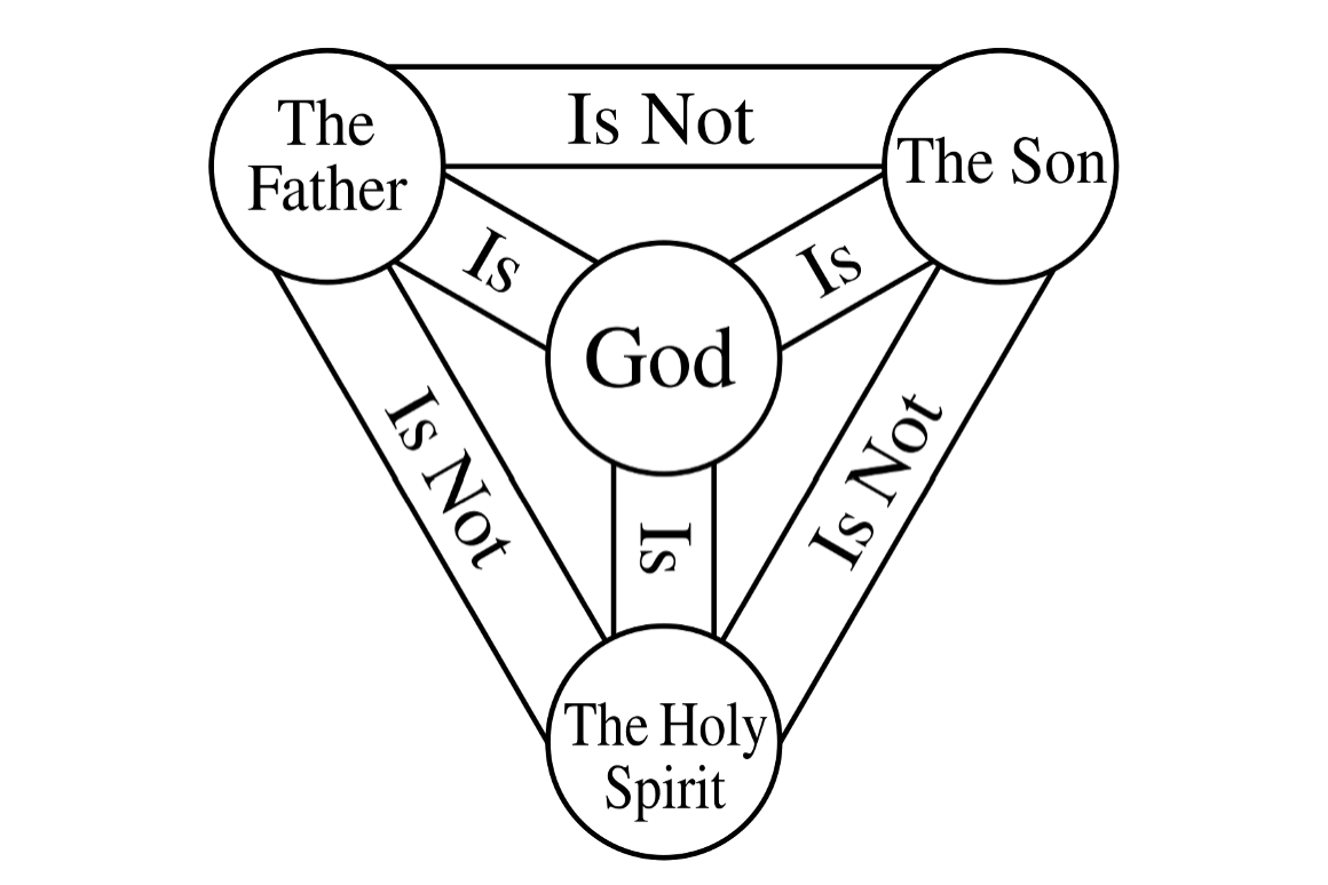
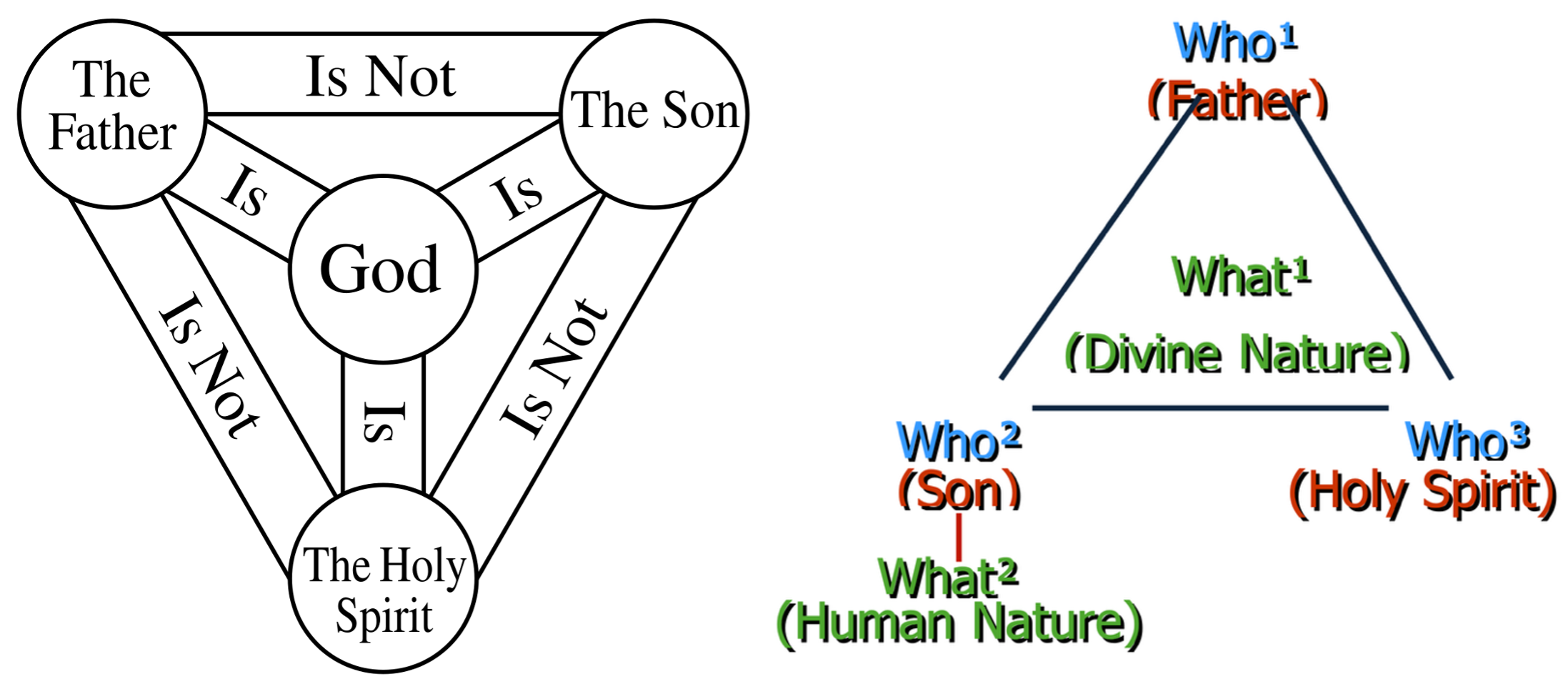
Meaning God is the Father, God is the Son, God is the Holy Spirit. But the Father is not the Son nor the Spirit, and the Son is not the Father nor the Spirit, and the Spirit is not the Father nor the Son. Theologian Wayne Grudem provides a useful illustration in the first image, and Frank Turek uses the second image to illustrate what we will discuss next:
WHAT-ness and WHO-ness
Consider again the difference between the two-dimensional world of the Square and the three-dimensional perspective of the Sphere. Abdu Murray describes how higher fundamental natures similarly result in differences we may not be able to wrap our minds around. This is what causes the confusion, making critics misunderstand what the Trinity means.
If I hold a cup, we can ask WHAT is this, what is its fundamental nature.
- WHAT is it = a non-living object
Now, looking at me, we could ask WHAT I am. In addition, I have a different fundamental nature or WHAT-ness than a cup. In addition, I also am a WHO.
- WHAT am I = a living thing
- WHO am I = Scott David Symington
Notice, you cannot say about the cup, “WHO is that,” while you can about me. Why? The cup is a lower form of being. I have a property or dimension of my state of nature or state of being that the cup does not have. I have personhood, the ability to relate to the outside world, rationally, emotionally, and spiritually. So, I have WHAT-ness and WHO-ness. I am a living thing, and Scott is who I am.
WHAT something is and WHO something is are not the same concept.
Therefore, when saying God is one WHAT in fundamental nature and three WHO’s in the dimension of personhood, it is no contradiction because WHAT-ness and WHO-ness are not the same thing.
If Christians claim God is one in nature and three in nature, or one and three persons, then those are contradictions, one does not equal three, but those were never the claims of the Trinity.
A cup only has a what and not a who because it is less in its nature. Every person has a what and a who. Correspondingly, God is a being already higher in nature or dimensions by transcending the 3D-space and time we are familiar with. Therefore, just as a non-living object is incapable of understanding something with the complexity of a person, we may be similarly incapable of understanding something beyond the nature and dimensions we understand.
Do critics of the Trinity really think they comprehend enough to say it is not possible for God to be more complex than us and our understanding?
God reveals himself as a being having the nature with all the attributes fundamental to what we call God, and included in those features is a unity in that nature of God of diverse personhoods, or centers of consciousness.
We are 1 in our nature, and 1 in our personhood. God is 1 in his being or nature, 1 WHAT, and 3 in his personhood, 3 WHOs. Additionally, the Bible notes Jesus has the added dimension of being fully God, WHAT1, and fully human, WHAT2.
If you understand there is a difference between asking WHAT something is and WHO something is, and the one WHAT (a being with the nature of God) has three WHOs (independent centers of consciousness known as the Father, Jesus, and Holy Spirit), then you apprehend the Trinity, even if you do not fully comprehend the Trinity. Which is about the best we can do.
This understanding of the Trinity resolves a trinity of objections.
Objection 3.
The Logical Contradiction Argument: Christianity says God is one, and also says God is three. This is a contradiction, like claiming “1 equals 3.”
Answer 3.
This criticism misunderstands the Christian claim. If Christians claimed there is 1 and 3 Gods, or 1 and 3 personhoods, then that is a contradiction, but the Trinity makes neither of those claims.
Objection 4.
God is Monotheistic not Polytheistic: Critics argue the Trinity conflicts with the strict monotheism of the Shema by rejecting the unity of God. The Father, Jesus, and Holy Spirit all being the supreme deity means multiple Gods or polytheism.
Answer 4.
Christians are monotheistic, believing there is only one God. Jesus, his early followers, and Christians today all reject polytheism and accept God is one, just with the added dimension of three personhoods.
Objection 5.
God is Schizophrenic: God seems to suffer from multiple personalities. This one is my favorite.
Answer 5.
Schizophrenia? No, we are not saying God is one personhood delusionally thinking he is three. God transcends the dimensions of time and space we are limited to, existing as a single being with three conscious centers having the single nature of God.
There are instances in both the Old and New Testaments where all three are shown interacting in the same event, so this is not a mental disease but a spiritual reality.
I said a trinity of objections would be refuted here, but it is actually a quinternity as I thought of two more …
Objection 6.
The Subordination Argument: Some critics point to passages where Jesus appears less than the Father, such as: “The Father is greater than I.” (John 14:28) So, Jesus cannot be fully God.
Answer 6.
The critic needs to take into account all the evidence. When considering the context of the entire Bible, Jesus did provide clear claims to be God, which is why his critics at that time called it blasphemy and tried, and eventually did, execute him. Click here for a post that goes into more detail how Jesus handled revealing himself.
Even if the critics read the whole Gospel of John, they would have clarification of what Jesus was saying. For example, earlier in John, Jesus stated, “That all may honor the Son just as they honor the Father.” (John 5:23)
This statement is astonishing in Jewish theology.
The phrase “just as” (Greek: kathōs) means in the same way or to the same degree. So, Jesus is saying: People must honor the Son in the same way they honor God. If Jesus were not divine, this would be encouraging idolatry, something Jesus would never do.
Another clear example in the same Gospel, Jesus made Himself equal with God as recorded in John 5:18: “For this reason the Jews tried all the more to kill Him; not only was He breaking the Sabbath, but He was even calling God His own Father, making Himself equal with God.” This verse is extremely important because it shows again how Jesus’ own audience understood his claims.
If you think you know better than Jesus and his contemporaries, that he never claimed to be God, please explain why you know better? And you need more than John 14:28.
How do we understand Jesus’ statement that the Father is greater? The explanations were not only known long ago, but also better explain the evidence than the claim that Jesus is not God. Consider the two below.
- When Jesus says, “The Father is greater than I”, He is speaking during the incarnation, when he voluntarily took a lower position. This is what Christian theologians call the Hypostatic Union.
The Bible explicitly describes this: “Who, being in very nature God, did not consider equality with God something to be grasped, but emptied himself, taking the form of a servant.” Philippians 2:5-7
In John 14, Jesus is explaining that He is returning to the Father in heaven.
While on earth, Jesus was:
- limited by a human body
- subject to suffering
- temporarily humbled
The Father remained in heavenly glory.
So, the statement can mean: After the resurrection, that limitation ends. The idea is:
- Nature: Jesus is equal with God.
- Role during incarnation: Jesus humbled Himself.
This is functional subordination, not ontological subordination.
- The Trinity includes ordered roles.
This indicates role distinction, not inferior nature.
Within the Trinity there is role distinction, but no difference in essence.
Example:
|
Person |
Role |
|
Father |
Sends |
|
Son |
Incarnates and redeems |
| Spirit |
Applies salvation |
Different roles do not imply lesser divinity.
Summary
The Subordination Argument fails because:
- Scripture clearly affirms his divinity elsewhere.
- Jesus temporarily humbled himself in the incarnation.
- “Greater” refers to role, not nature.
- The Trinity includes ordered relationships without inequality of essence.
The Bible consistently teaches both truths:
- Jesus submits to the Father in role
- Jesus shares the same divine nature
This is why historic Christianity concluded:
One God — three persons — equal in nature, distinct in role.
Objection 7.
The Simplicity Argument: Shouldn’t there be divine simplicity, not a God composed of parts.
Answer 7.
Discoveries in nature have found a profound and elegant simplicity, however, those making the objection above misunderstand Occam’s razor.
Occam’s razor is a principle used in the construction of theories or in problem-solving. It states when you have competing hypotheses or answers to the problem that equally explain the data, then the simplest one, requiring the fewest assumptions, is usually the best.
First, this is a principle, not a law of nature, sometimes the more complex answer is the right one as it has all the necessary components that the simpler answers do not.
Second, oversimplification can lead to incorrect conclusions.
Third, you choose the simpler hypothesis when it can explain the data as well as more complex hypotheses that unnecessarily add complexity, but in this case, the Bible reveals data that is not explained with simpler hypotheses. Additionally, we will discuss how worldview beliefs without the added component of a Trinitarian God are invalidated by logical contradictions.
Can I provide an analogy to better understand the Trinity? It would be nice, but, no.
Some have attempted to compare this feature of God to the components of an egg: yoke, egg white, and shell. But this violates what God has revealed, and commits the heresy of Partialism. This error suggests that God is composed of three distinct parts that, when combined, make up one whole. Orthodox Christian theology, however, teaches each person of the Trinity is fully and completely God, not merely one-third of God.
Others use the comparison of water going through its different phase transitions: water, ice, steam. Again, this is another heresy known as Modalism. God does not become each of the three persons and roles of the Trinity. The three personhoods have always existed and always have the nature of God.
The nature of God is beyond our 3D space and 1D time dimensions, and therefore, beyond our capacity to wrap our minds, or our analogies around.
Don’t like that, neither do I, but reality and logic do not care what we like, are comfortable with, or how we think things should be. Reality just brings the consequences to those of us who reject reality because of our likes or dislikes.
A being like God is beyond our complete comprehension, as God exists in realms and has characteristics far different from our everyday experiences. If I could fully grasp God, I would assume this “God” is merely a human invention, because human inventions, coming from my similar perspective, I can fully understand.
What would make you think you should understand what God is like?
We can understand a lot about God because:
- He made us in his image (ask a theologian what all that entails)
- The Bible, messengers he sent, Jesus providing a personal disclosure of himself, and what we learn about through what was created all provide knowledge
- Our personal relationship with God can reveal aspects and facts
Yet, I cannot fully understand this God, and so will have times where his thoughts and actions are beyond my understanding, and even beyond my liking.
This is why trust (faith) is so important. I think even when we gain the wider perspective that being in Heaven with God brings, God will still be beyond us to the point of requiring our trust. And I look forward to this situation as a God I could entirely understand sounds like a boring God, and I expect wonder, holiness, and endless interesting and even surprising phenomena.
What Does This Mean For Me
Logic tells us we don’t need to fully explain everything about and answer or explanation to accept it as the best explanation. The validity of an explanation relies on the evidence and the standards we use to determine truth.
Admittedly, some people do avoid serious questions about God by saying, “Well, God is mysterious, so we just have to trust.” This is weak and wrong when used to avoid a serious question, but entirely appropriate, accurate, and appreciating the reality of the situation in other instances.
For example, there is no appropriate analogy I know to explain the Trinity. And this is not surprising as we are trying to correlate something in nature and our natural experience with something transcending nature.
Yet, while not fully comprehending this concept, the biblical Trinity is:
- The proper understanding revealed by sources (the Bible and Jesus) with unprecedented and incomparable evidence of authority (in the position to know the truth of the matter).
- The only answer to fit the evidence and necessities of the cause of the universe, and logical necessities of the greatest possible being (God).
The Trinity avoids contradictions found in other worldviews concepts of God, including Islam, rabbinic Judaism, and Mormonism, and also avoids disproof from science for every other belief system’s cause of the Universe (covered in the Five Smooth Stones book, other blogs and FAQs on the website). Thus, if the biblical God is supported by compelling evidence, our inability to fully understand God cannot invalidate that explanation.
But what does this mean for me? For my relationship with God? Should we expect a relationship with God to match our experience with other people? God is a consciousness beyond the familiar dimensions we operate in, as well as having properties unfamiliar to us, such as holiness and omniscience. Even further, God may have objectives beyond our expectations.
However, we can safely assume if God wants a relationship with us, then he would communicate how we can best have relationship with him. This part of knowing God is simple—it was meant to be. This is further explained in the Knowing God post, but seek him and trust him as you would someone you owed everything to, someone who loves you to the point of going through what Jesus did to have relationship with you.
Knowing God is more complex than knowing another person, just as knowing another person is more complex than knowing a house. The knowing of something gets more complicated when the complexity of the object goes up. Inspection and exploration are steps we can take to know a house. With a person we need further steps, such as interaction and observation of how a person reacts in diverse situations.
With God, there likely would be further steps, even further levels of interaction, such as spiritual interaction we may not even be aware of. While this complexity bothers some, we are promised if we seek him, then we will find him.
When time permits, I plan to enter more on this topic, including more evidence from the Bible regarding the Trinity, showing why something equivalent to a Trinity invalidates every other belief system, and answering more objections that may come up.
[1] Kenneth Samples, Responding to Islam’s Objection to the Trinity, reasons.org blog, February 22, 2022.
[2] John Barnett Online Teaching. “Understanding the Trinity—God Gives The Best Explanation of The Trinity in Isaiah.” YouTube video. Accessed March 10, 2026. https://www.youtube.com/watch?v=Q0104IpdQYI
[3] Ibid.