
Brief Answer:
The scholars disagree with you as there are well-established ways to know what was originally written.
Detailed Answer:
It is true we do not have any of the original writings from the biblical authors, what manuscript scholars call “autographs.” Unsurprisingly, those original ancient writings have been lost in history. So how do we know the words of the originals made it all the way to us accurately?
Once again, the primary question is always whether or not there is a God behind the Bible, and if evidence supports there is, then WHY would you believe God would not be able to get into our hands what he wanted?
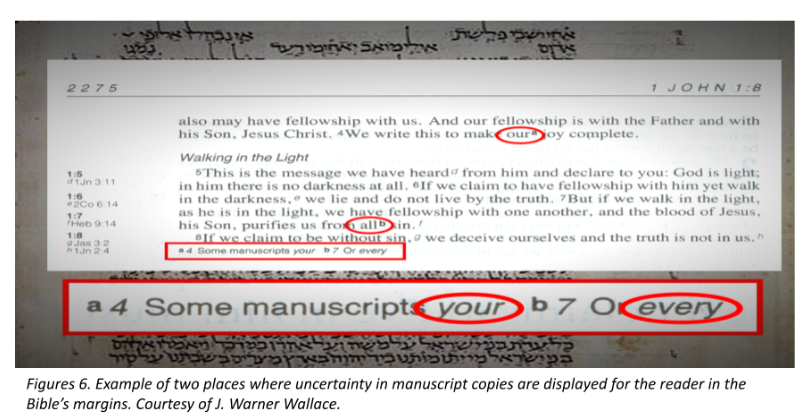
Further, the scholarship disagrees with you. When use the term “scholars,” I mean those people who have a PhD and career in the applicable field of study, and have their research tested by other scholars in peer-reviewed literature. The scholarly consensus is we have the Bible as it was originally written, except for a small percentage of uncertain parts, which are noted in the margins. Check for yourself, a Bible is open and clear about this, noting any uncertain words or passages in the margins. And none of these uncertain parts impact any important Christian belief or doctrine, especially considering the Bible covers the important points over and over again, redundantly, in other places in the Bible.
So, what evidence can you provide that overwhelms the evidence forcing the consensus of the experts to affirm we do have the Bible as originally written?
Why does the scholarship in ancient literature, biblical studies, ancient language experts, etc., which includes a huge percentage who believe there is no God behind the Bible, have a deep-rooted consensus the Bible we read today is the same as was read when originally written? Because they have to accept this, based on the evidence. We will cover several areas of evidence here:
- Examples showing how we know what was in the originals
- Standard tests scholars use to evaluate reliability of manuscripts
- Chains of Custody
Examples showing how we know what was in the originals
Some argue the Bible cannot be trusted because it is comparable to the “telephone game”, where one person whispers a statement to another, and that person repeats the statement in a whisper to another, but maybe doesn’t get the words exactly right, and the next person whispers what they heard to the next, and so on, until the last person has a different message then what began the exercise. Those who think this situation applies to the Bible need to think further, as they are giving a false analogy.
When the original books of the Bible were written, the writers were inspired and verified by God, causing the writings to be recognized as sacred and of utmost importance. Therefore, copies upon copies were made wherever possible, and as meticulously as possible, in order to allow different locations to keep a copy, and also for the spreading of God’s message. Aside from some amazing facts about how fantastically strict and obsessive copyists of the Bible were to ensure correct copies, which will be covered briefly in another FAQ or blog, copy mistakes still occurred here and there.
Some argue the Bible cannot be trusted because it is comparable to the “telephone game”, where one person whispers a statement to another, and that person repeats the statement in a whisper to another, but maybe doesn’t get the words exactly right, and the next person whispers what they heard to the next, and so on, until the last person has a different message then what began the exercise. Those who think this situation applies to the Bible need to think further, as they are giving a false analogy.
When the original books of the Bible were written, the writers were inspired and verified by God, causing the writings to be recognized as sacred and of utmost importance. Therefore, copies upon copies were made wherever possible, and as meticulously as possible, in order to allow different locations to keep a copy, and also for the spreading of God’s message. Aside from some amazing facts about how fantastically strict and obsessive copyists of the Bible were to ensure correct copies, which will be covered briefly in another FAQ or blog, copy mistakes still occurred here and there.
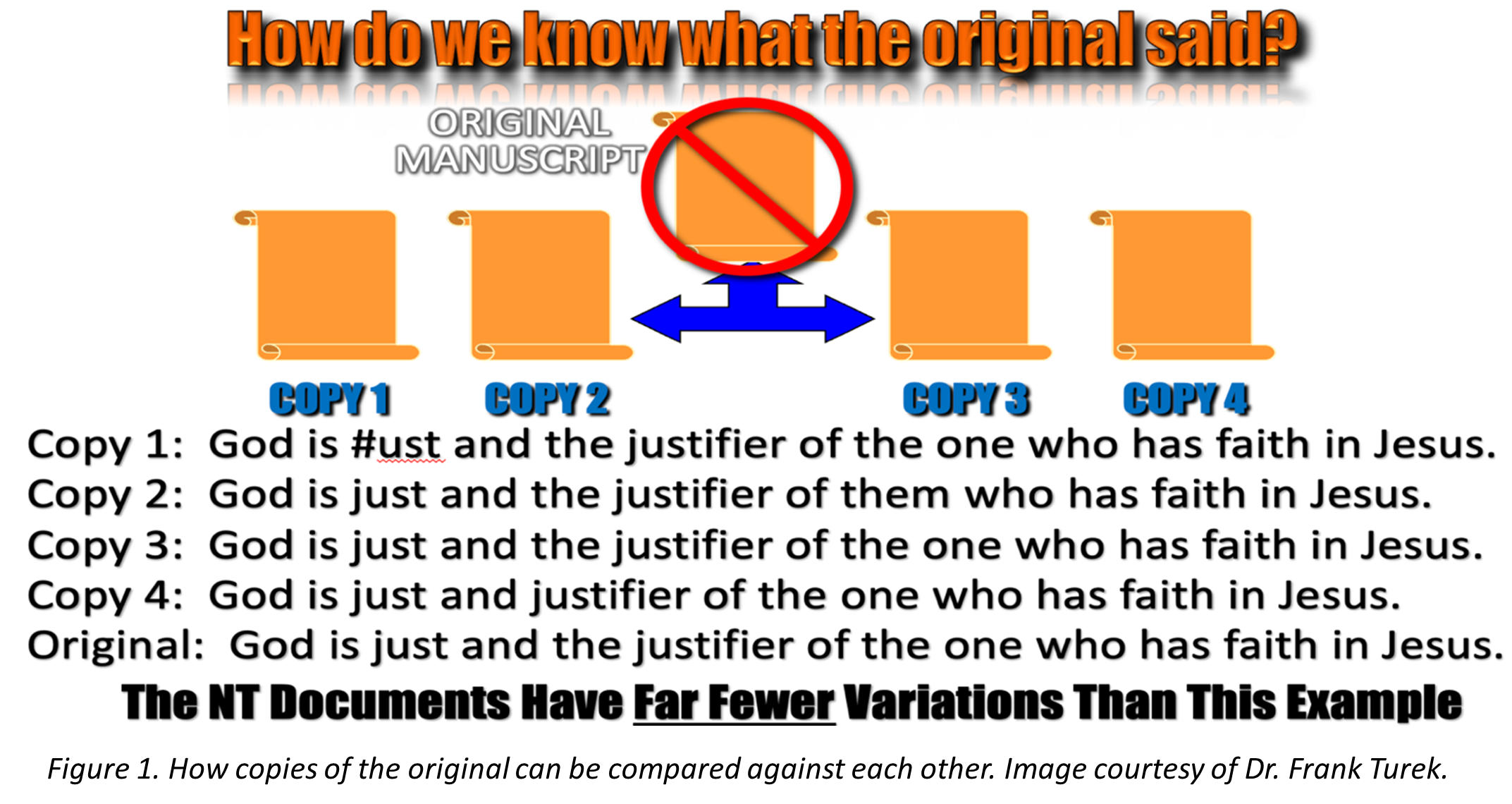
Notice in the image, even with errors in three of the four copies of the original, we can still know what was originally written. Systematic theologian and philosopher, Norman Geisler, asks readers to consider this message: Y#U HAVE WON TEN MILLION DOLLARS. Even with an error in it, we can still be sure of the message. Now consider the same message with two copies and two errors.
Y#U HAVE WON TEN MILLION DOLLARS
YO# HAVE WON TEN MILLION DOLLARS
We are even more sure of the original message with two errors in it because every new copy brings a confirmation of every letter except one. In fact, you can even have serious differences in the letters and have the exact same message. Line 2 and line 3 below only have 25% of the letters in common, yet the message is 100% the same. (Norman L. Geisler, A Note on the Percent of Accuracy of the New Testament Text)
YOU HAVE WON TEN MILLION DOLLARS
THOU HAST WON 10 MILLION DOLLARS
Y’ALL HAVE WON $10,000,000
Therefore, even knowing copy mistakes exist, can you start to see how we know what was originally written? There is a simple test: compare all the copies. Even with a mistake made in every line in the first example, we can know what the original document stated and where mistakes are made in the copies.
We can use cell phone text messages today as an example. You have a daughter going to college, and you want to meet her to give money for tuition and other expenses, but you are not the most skilled at texting. Even as annoying as this parent is in texting, do you know exactly what the parent was trying to say?
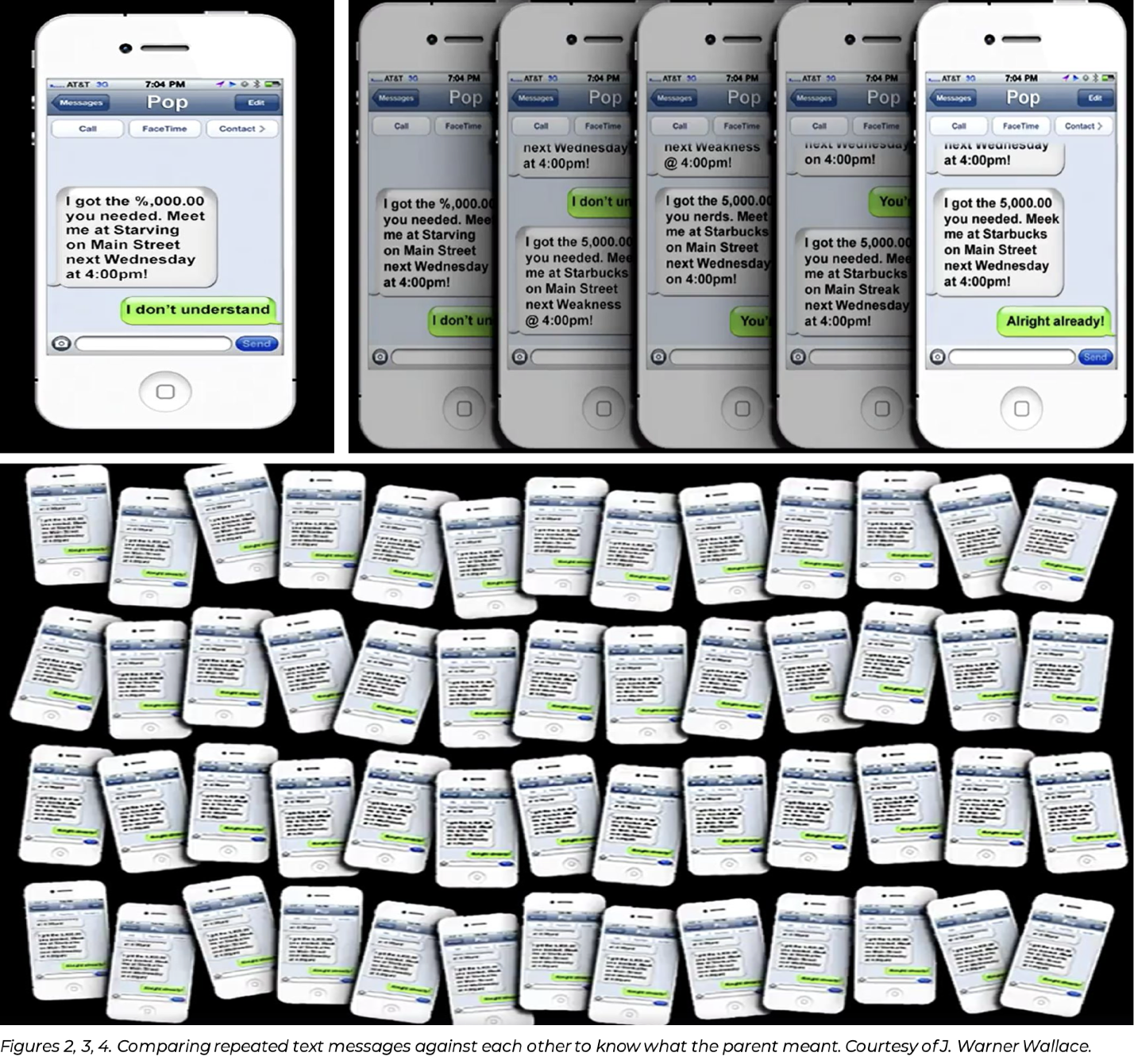
The books of the Bible are even more obvious. If a book in the Bible wasn’t written on a scroll, but in a text message, even if the copyist was as bad as the parent in texting, with numerous copies to compare against each other, do you think you can figure out what the original said?
Unlike the telephone game, the Bible is not oral communication, but written, so unlike the people just passing the message along by word-of-mouth, the copies can be directly tested against each other, as with the cell phone text messages.
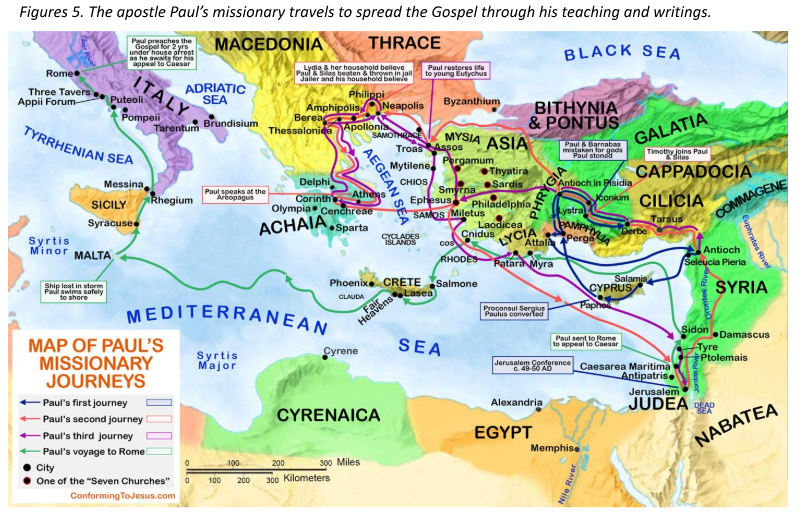
A further difference from the telephone game false analogy, transmission does not occur linearly, from just one person to another to another, it is geometric, meaning one scroll would lead to maybe 10 copies, which themselves would lead to another 100 copies, and so on. Ultimately, you will have a massive number of copies, from different regions, languages, and groups across the Mediterranean world, to all compare against each other. Consider just the apostle Paul’s tireless work to spread the Gospel, and his writings in the NT were copied, and spread, and copied again, and verified by himself, the other apostles, and his committed followers through all their traveling and work.
How does the Bible compare to other ancient writings as far as having enough copies to compare against each other to ensure we have what was originally written? Daniel Wallace, professor of New Testament Studies at Dallas Theological Seminary and the founder and director of the Center for the Study of New Testament Manuscripts, states if you take any book from antiquity, and stack up all the manuscript copies found for that book, the average amount of copies collected stack up to 4 feet high, which is actually very good as you can compare it all together and determine we know what was originally written. If you stack up just the Greek manuscript copies of the New Testament (NT), many of which are catalogued here, you will have a stack one mile high!
That is around 2.5 million sheaves or pages, and the vast majority of these copies have been discovered in the last 120 years, in fact, there are so many still being discovered, scholars cannot even keep up as there are so many discoveries still waiting for the scholars to have time to study and verify and add to the count. And each new copy catalogued has added confirmation to the already mile high stack of evidence.
Stacked on top of that are around 20,000 more manuscript copies in other languages to bring in to compare against the Greek manuscript copies. And stacked on top of that are tens of thousands of quotations of the NT from early church fathers’ (those who were the early Christian leaders, many of whom were mentored by the apostles or in the direct line of succession to the apostles) sermons and letters, which in turn were passed on to other churches.
A foremost biblical scholar, Bible translator, textual critic and longtime professor at Princeton Theological Seminary, Bruce M. Metzger, observed if we had lost every manuscript copy of the New Testament, then we could still reproduce 95% of the New Testament with just the writings of the early church fathers. (Metzger and Ehrman, The Text of the New Testament: its transmission, corruption, and restoration, 126)
And yet, in all of the copies, there is no variant (copy mistake that varies from the original writing) in those found, which make scholars question the Bible’s message today is as it was when originally written. There is a small percentage that is not certain, and this is always provided in the margins for readers to consider.
Norman Geisler documented in his article:
NT textual authorities Westcott and Hort estimated that only about one-sixtieth (of the copy mistakes) rise above “trivialities” and can be called “substantial variations.” In short, the NT is 98.33 percent pure. Second, Greek expert Ezra Abbott said about 19/20 (95 percent) of the readings are “various” rather than “rival” readings, and about 19/20 (95 percent) of the rest make no appreciable difference in the sense of the passage. Thus the text is 99.75 percent accurate. Third, noted NT Greek scholar A. T. Robertson said the real concern is with about a “thousandth part of the entire text.” So, the reconstructed text of the New Testament is 99.9% free from real concern. (Norman L. Geisler, A Note on the Percent of Accuracy of the New Testament Text)
And it is essential to understand – that small uncertain percentage does not affect any fundamental Christian doctrine – because all these doctrinal points are covered over and over again in other passages throughout the rest of the Bible.
World-renown archeologist and authority on manuscripts, Sir Frederic Kenyon summed up what the evidence leads to: “No fundamental doctrine of the Christian faith rests on a disputed reading. It cannot be too strongly asserted that in substance the text of the Bible is certain.” (Kenyon. Our Bible and the Ancient Manuscripts, 23, as cited in Josh McDowell. A Ready Defense, 46)
The interval between the dates of original composition and the earliest extant evidence becomes so small as to be in fact negligible, and the last foundation for any doubt that the Scriptures have come down substantially as they were written has now been removed. Both the authenticity and the general integrity of the books of the New Testament may be regarded as finally established. (Kenyon, The Bible and Archaeology, 288)
NT scholars have long agreed the massive manuscript evidence, as well as the tens of thousands of quotations of the NT made by the early church fathers, make reconstructing what was originally written well assured. We have what was originally written in the Bible, with the insignificant uncertainties always being honestly presented in the margins (see image below).
Standard tests scholars use to evaluate reliability of manuscripts
1. Number of manuscripts (partial or complete): Generally, the more manuscript copies of an original work you can find, the better the reliability since the original words can be determined with greater accuracy through cross-checking the various copies. The NT, as noted in a blog and other FAQ, has over 25,000 extant (existing) manuscript copies, with over 6,000 in Greek. Compare this to most early historical manuscripts, which have somewhere between 4 to 20 copies. No other ancient writing remotely comes close to the NT.
2. Time span between copies and original: How old are the copies compared to the original? Generally, the closer the manuscript copies are to the original, the more reliable they tend to be. The earliest confirmed manuscript is within 25-35 years from the original; it is called the John Bodmer fragment of the Gospel of John. Currently another earlier potential manuscript, a part of Mark dated in the 60’s, is being studied. There are other manuscript copies appearing in the middle of the second century (about 150 AD), and from there increase exponentially in number. This is unheard of in the study of manuscript evidence compared to other writings of ancient times.
3. Time span between original writing and events they describe: The smaller the gap in time between the original writing and the events they describe, the more accurate the accounts are likely to be. The NT was likely written between late 40’s to late 60’s AD, possibly including John’s Gospel and the Book of Revelation. Some date one or more, if not all, of John’s five books from 85-95 AD. At least 22 NT books, if not all 27, were written within the lifetimes of most of the people who witnessed Jesus’ earthly ministry. Again, this is unprecedented in ancient manuscripts.
The core message of the NT is also given in “creeds”, which are recorded throughout the NT, and are brief and easy to remember core belief statements. Scholars accept these statements originated, at the latest, within three years, and possibly within a year to months of Jesus’ crucifixion and resurrection.
4. Eyewitnesses: The more eyewitness accounts included, the better, for obvious reasons. The NT was written by many eyewitnesses: Matthew, John, Peter, Paul, and Jesus’ half-brothers, James and Jude. The Gospel of Mark, written by Peter’s apprentice Mark; the Gospel of Luke written by Luke, an apprentice of Paul. These eyewitnesses account for 26 of the 27 NT books. The twenty-seventh book, the book of Hebrews, does not have an author definitely known (it was probably Barnabas, another eyewitness). And do not forget the unprecedented nature of these eyewitnesses: (a) they knew for certain whether their claims about Jesus rising from the dead and giving them many convincing proofs (Acts 1:3) were true or not, (b) made their claims in a time and place where the facts could be checked, (c) and where they would receive consistent persecution, even up to death, (d) were known for integrity, and (e) it is likely many of the apostles were martyred, and tortured, for proclaiming the resurrection of Jesus. This use of eyewitnesses is quite rare in ancient documents.
5. Supporting evidence from other fields of study: How well does historical, archeological, and other findings confirm the reliability of what was written. Much support could be offered here. Even if all the copies of NT books had been destroyed, we could reconstruct around 95% of the NT from the quotes of verses from the early church fathers prior to about 250 AD. (Metzger and Ehrman, The Text of the New Testament: its transmission, corruption, and restoration, 126)
Many books have been written attesting to the historical and archeological accuracy of the Bible. What is known as “internal evidence” within the Bible of ancient language, proper nouns and cultural details matching exactly what we later find through historical or archeological discovery, the Bible is corroborated better than any other ancient text. In fact, countless historical and archeological studies have been initiated by trusting the Bible provides accurate information.
“Undesigned coincidences” is another area of evidence, which is covered very well by Lydia McGrew in her book: Hidden in Plain View: Undesigned Coincidences in the Gospels and Acts.
On the other hand, aside from the Bible, all other ancient writings or manuscripts (those written before the end of the Roman Empire ~476 AD) have the following typical characteristics:
- Number: They number anywhere from 4 to 20 copies, a few are higher. The next closest are Homer with ~2000 copies and Demosthenes with ~340. Even if Homer had 30,000, then good for Homer, but it does nothing to change the fact the NT has vastly superior manuscript evidential support.
- Time span between copies and originals: The earliest non-biblical manuscript copies are typically dated anywhere from 700-1500 years after the original work.
- Time span between opriginals and the events they describe: Non-biblical ancient manuscripts are often written a very long time after the event (for example, the earliest manuscript about Alexander the Great is around 300 years after his death).
- Eyewitnesses: fairly rare.
- Supporting information: scarce.
The Bible has a preponderance of more manuscript evidence than any other writing of antiquity. If you think you cannot trust the Bible is reliable to what was originally written, then you would have to throw out everything we know of ancient history (approximately 1,000 AD and earlier for our purposes), as no other ancient documents or their early copies have anywhere near the Bible’s manuscript evidence.
The graph below shows in white numbers how many manuscript copies we have to compare against each other for each source, while the orange numbers show the gap in years between the original writing and the events they describe. Notice the comparison between the other ancient writings we learn about in school and accept as accurate. (Jones, Clay. “The Bibliographical Test Updated,” Christian Research Institute, article ID JAF4353)
William F. Albright was an American archeologist, biblical scholar, a leading theorist and practitioner of biblical archeology, served as the W. W. Spence Professor of Semitic Languages at Johns Hopkins University and as the Director of the American School of Oriental Research in Jerusalem, and is considered “one of the twentieth century’s most influential American biblical scholars”. (Steven Weitzman. “Chapter 9: American Biblical Scholarship and the Post-War Battle against Antisemitism”. Protestant Bible Scholarship: Antisemitism, Philosemitism, and Anti-Judaism. 182–199)
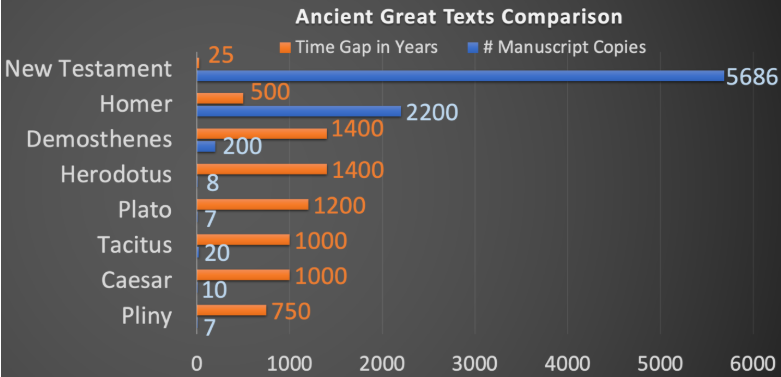
Albright affirms: “We can already say emphatically that there is no longer any solid basis for dating any book of the New Testament after about A.D. 80, two full generations before the date[s] between 130 and 150 given by the more radical New Testament critics of today.” (William Albright, Recent Discoveries in Bible Lands, 136; William Albright, ‘Towards a More Conservative View,’ Christianity Today, 3) The time gap between the oldest surviving copies and the first manuscript is much smaller for the New Testament than any historical works cited earlier. For Homer, the gap is 500 years (900 BC for the original writing, 400 BC for the oldest copy), Caesar, it’s 900-1000 years (circa 100-44 BC to 900 AD), Herodotus, 1300 years (circa 480-425 BC to 900 AD) and Thucydides, 1300 years (circa 400 BC to 900 AD).
Chains of Custody
 Former cold case detective, featured on Dateline on numerous occasions, J. Warner Wallace was an outspoken atheist and was planning to do research to disprove Christianity. Like many before him, this led him to a relationship with Christ, and his studies led to useful information to consider in the reliability of the biblical account of Jesus.
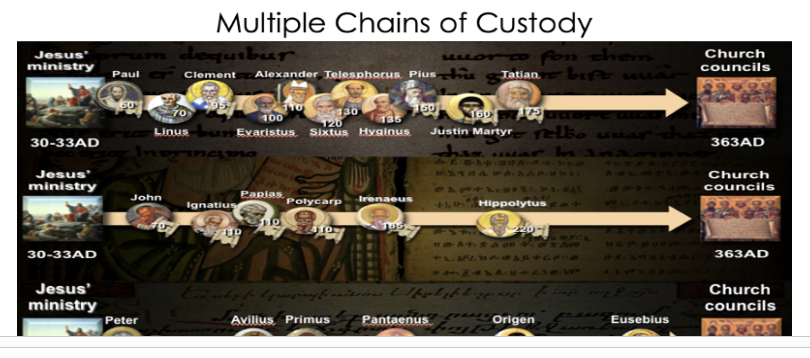
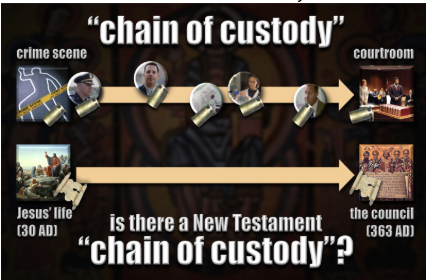
One problem he had with the biblical accounts was his expectation the gospels (the first four books of the New Testament focussing on Jesus’ life and plan) probably changed over time and were not reliable to the original accounts from the disciples, the eyewitnesses or one in contact with the eyewitnesses. But after his study, he concluded the transmission was uniquely reliable. There are a number of factors involved with the reliable transmission, including the passing on of the writings and teachings through history, what Wallace refers to using a phrase he operated with as a detective, “chain of custody”. I included a couple of slides Wallace gave me to use, and his concluding statement:
“I typically evaluate the potential alteration of evidence over time by tracing the “chain of custody”. From the first officer who reported a particular piece of evidence, to the detectives who next handled it, to the criminalists who then examined it in the lab, to the detectives who eventually delivered it into the courtroom, I want to know what each and every one of them had to say about the evidence under question. Did they write about it? Did they take a picture of it? The “chain of custody” will help me determine if the evidence was altered over time. In a similar way, there is a NT “chain of custody” related to the transmission of the Gospels and letters of Paul. The Gospel of John, for example, can be traced from John to his three personal students (Ignatius, Polycarp and Papias) to their personal student (Irenaeus) to his personal student (Hippolytus). These men in the chain of custody wrote their own letters and documents describing what they had been taught by their predecessors. These letters survive to this day and allow us to evaluate whether or not the NT narratives have been changed over the years. The evidence is clear, the foundational claims related to Jesus have not changed at all from the first record to the last.” (Wallace, “Four Reasons the New Testament Gospels Are Reliable”, Cold Case Christianity website, February 23, 2024)
And it is not just the apostle John, but the apostles Paul and Peter bring similar documented transmission. We have multiple, known chains of custody from the eyewitness disciples, who knew for fact what they claimed about Jesus was true or not, to their students or those they mentored, and so on, all the way to us today.