
Brief Answer:
No. People who make this claim, such as fiction writer Dan Brown in The Da Vinci Code, are either feeding you a fictional narrative, or just did not research well and have a misinformed knowledge of history.
Detailed Answer:
This claim sounds like a reasonable thing that could happen. However, it didn’t, and someone claiming it did is either feeding you a fictional narrative, as Dan Brown did in his best-seller, The Da Vinci Code, or just did not research history well. When you spend even a little time looking into scholarly work on this topic, Constantine and the Council of Nicaea had nothing to do with what books were in the Bible.
In fact, even before we use the historical facts to demonstrate why we know what books belong in the Bible, criticisms of the Bible almost always begin with an error in logical thinking making the entire claim suspect. These questions about what books belong in the Bible are based on the assumption no God is involved in the Bible, which is a tremendous assumption to make, especially considering the background of evidence verifying God’s involvement is demonstrable (see blogs on the beginning and cause of the Universe, or Is the Bible Reliable – The PRIMARY Question). Those who want to claim the list of books in the Bible is questionable, are basing their criticism on the error in thinking known as the genetic fallacy, unless they first ensure their assumption of no God involved in the Bible is accurate.
That is a secondary question, what is the primary question to answer?
The list of books that belong in the Bible is known as the “biblical canon”. How did we come to have this list? It depends on the answer to the primary question. If there is no God behind the Bible, then the list just came about through human interactions and history, and the Bible is nothing more than a man-made collection of historical documents, just like any other, except that it claims to be from God, therefore, it is a list of lies.
On the other hand, if there is a God behind the Bible, who purposed to communicate something to us, then the list of books belonging in the Bible began when the first book was inspired by God and written down, and each successive book inspired and authenticated by God added to the list, until the last authenticated book was added. This canon is as reliable as it gets. If God is behind the Bible, do you think he would have a problem getting to us the exact biblical canon he purposed? Why would you believe that?
Consequently, the canon of the Bible was not invented by people, but discovered by people. How did people throughout the history of the Bible discover what books belonged? There were both principles and practices setting the books apart from any others.
The canon was simply discovered by people, being recognized through standards of principle and practice.
Recognized through PRINCIPLES
- Written by prophet/apostle of God
- Confirmed by acts of God
- Confirmed or matches word of God
- Accepted by people of God
Recognized in PRACTICE
- Validated by prophet/apostle/Jesus
- Accepted by church fathers
For example, as far as principles 1 and 2, if you do a Bible study on miracles (acts or events violating laws of nature, or beyond human capability alone) and prophecies (predictions about what was coming in the future), you will find miracles, and of course prophecies, clustered around prophets (individuals validated by God to speak on his behalf) or apostles (disciples or followers specifically chosen by Jesus to carry his message) before and during the time they were revealing God’s word. This is how people recognized the message was coming from a source beyond humanity.
Even with the first two principles met, the message requires further checking against what God already provided. Many today fall into chronological snobbery, believing the thinking of people in the past is inherently inferior to ours, as though they would just accept any stupid claim someone made without trying to verify. But aside from the fact God provides unmatched reasons to verify his communication over all others, people also would not just base their life on something new without testing the claims.
Regarding people claiming to speak for God, the Bible encourages us: “Do not treat prophecies with contempt but test them all; hold on to what is good, reject every kind of evil.” (I Thessalonians 5:20-22) In other words, test the claims, especially against other established communication from God to us, and see if there is a match.
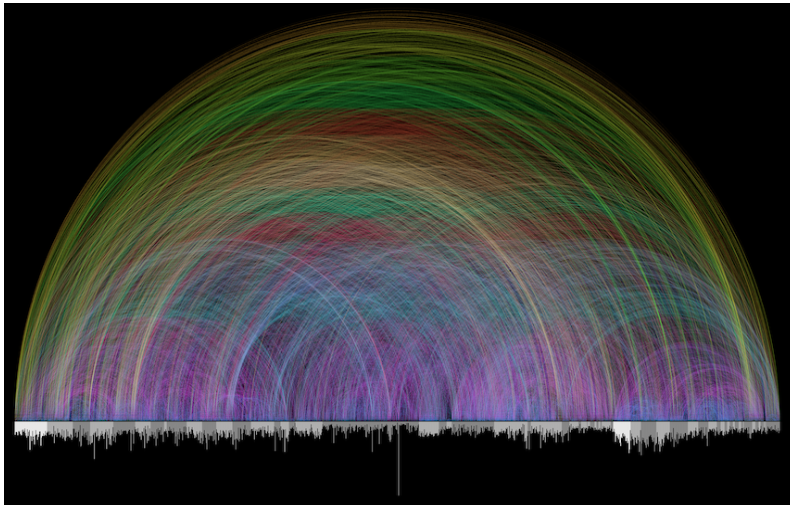
The Bible was written by over 40 authors, from diverse walks of life, including kings, peasants, soldiers, scholars, etc., across three continents and separated through a span well over a thousand years – yet in all this diversity is unity – even in covering the most divisive topics in life.
This allows serious cross-checking, as displayed in the graph below. Every chapter in the Bible is shown by bars along the bottom-horizontal axis of the graph, and every colored arc you see is a cross-reference confirming a statement made elsewhere in the Bible (further explanation and link to the graph in references).
It is reasonable to assume God could accomplish the authentication of his word in a number of ways, including methods not mentioned in the principles above. Yet, once you have verification of the first three principles, it is easy to see why the fourth principle falls into place as the specific books, which were to become the Bible, were accepted by the people of God.
These prophets and apostles, and their work were accepted by the ancient Hebrews during Old Testament times, and later by the early church leaders, known as the church fathers, who followed Jesus’ apostles. Again, not surprising, these people, their message and addition to the Bible was verified in ways everyone recognized was beyond what people could do. Jesus also had to provide authentication for his claims, and did so on a level no one has, before or since.
One who had been specifically predicted to come and to die as a substitute for us, then to rise from death to prove his authority over even death, and then accomplishes exactly that – has credibility – and this unprecedented source of credibility recognized the entire biblical canon as coming from God.
Read through all of Jesus comments regarding the Old Testament: he never cast any doubt on the authority or accuracy, he accepted the people, events, and concepts taught (Matthew 5:17-19, Matthew 4:4), noted how God sent his wisdom through messengers like Abel (from the first book of the Bible) to Zechariah (the second to last book of the Old Testament) (Luke 11:49-51), he even pointed out how clearly these books pointed directly to him (Luke 24:27, John 5:39).
“It is written” is a phrase used to speak of well-accepted, authoritative word from God, and this phrase was used 92 times when citing the Old Testament. To Jesus, there was a completed Old Testament. Then, Jesus himself commissioned his apostles, and later Paul, and said he would ensure the authoritative writing of the New Testament (John 14:26, John 16:13).
The books belonging in the Bible are determined and ensured by God, and engrained through standards of principle and practice. Scholars recognize and we can trust we know the books in the Bible have been inspired and validated by God.
When researching this topic, there is debate between Christians regarding the inclusion of some “apocryphal” books. For example, Protestant Christianity and Judaism do not accept some books the Roman Catholic Church and Greek Orthodoxy accept, which will be covered in another FAQ, as will the topic concerning the Gnostic Gospels, which were simply fraudulent books, using the names of biblical apostles or charactrs as authors in an attempt to gain legitimacy. These books are interesting as they contradict significantly with the Bible in an attempt to push different religious beliefs.
References:
Chris Harrison and Christoph Römhild; https://www.chrisharrison.net/index.php/Visualizations/BibleViz. As stated by Chris Harrison: “Cross-references are conceptual links between verses, connecting locations, people, phrases, etc. found in different parts of the Bible. Cross-references are included in the margins or footnotes of some Bibles (example here) … The bar chart that runs along the bottom represents all of the chapters in the Bible, starting with Genesis 1 on the left. Books alternate in color between light and dark gray, with the first book of the Old and New Testaments in white. The length of each bar denotes the number of verses in that chapter (for instance, the longest bar is the longest chapter in the Bible, Psalm 119). Each of the 63,779 cross references found in the Bible are depicted by a single arc – the color corresponds to the distance between the two chapters, creating a rainbow-like effect.”