

Brief Answer:
If you supposedly know the Bible and Jesus well enough to claim that Jesus never claimed to be God, how do you miss the vast number of references directly refuting your claim?
Why do you believe you know better what Jesus meant than those living at the exact time, place, and position to know whether he was claiming to be God or not? People at the right time, place and position understood Jesus claimed to be God, so why do you think you know better than they do?
Even a basic knowledge of the Bible provides diverse and unmistakable statements, circumstances, ties to the Old testament, and claims that Jesus is God.
Here are related challenges, with shorter answers, and after these, the detailed answer to those who think Jesus did not claim to be God.
Question: “Why didn’t Jesus just say, ‘I am God’?”
Answer:
Because that sentence would not have clarified anything in a Second Temple Jewish context—it would have guaranteed misunderstanding, political revolt, or immediate execution. Jesus disclosure was strategic and clear.
Question: “Couldn’t Jesus just be misunderstood in his claim to be God?”
Answer:
Misunderstanding does not explain repeated and consistent claims by Jesus, acceptance and demonstration of attributes belonging uniquely to God, and reactions to those around Jesus, including: attempts to stone Him, charges of blasphemy, and execution under Roman authority. The claims, actions and responses indicate recognized claims to divine identity, not confusion.
Question: “Did Jews believe a human could be divine?”
Answer:
They did not expect the Messiah to be just like Jesus, but they did understand God’s unique titles, attributes, and authority. Jesus did not move beyond Jewish monotheism, but instead had to refocus it, and sometimes drive out man-made and unbiblical ideas.
Question: “Isn’t John’s Gospel too late to trust?”
Answer:
No. That is not how historical scholarship works. Historians go by evidence, and there is a lot of other evidence available. Even if the book of John didn’t exist, the earlier Gospels present Jesus being worshipped and having titles and attributes unique to God, as do other books in the New Testament, including Paul’s letters, and the creeds. Also, even critical scholars agree what John provides are earlier beliefs, not later invention.
Question: The Council of Nicaea in 325 AD invented the idea of Jesus being God.
Answer:
Historians entirely disagree with that claim. We have the records and you can check yourself. The earliest creeds, New Testament books, and early church fathers all recognized Jesus’ deity. But over time, some proposed new ideas, such as Arius, who began teaching Jesus was created and not eternal. The Council voted to confirm the prevalent church view that Jesus was divine, and of the over two hundred participants, only two sided with Arius.
Question: Jesus can’t be God if he is called heir and firstborn Son (Heb. 1:4, Col. 1:15).
Answer:
In the context used for Jesus, being begotten or the son of another represents being inaugurated into special status, not birth. You read the same situation with David (Psalm 89:27) and Israel (Exodus 4:22), who are called firstborns when neither were firstborn, but both were inaugurated into special status.
Question: Jesus can’t be God if he had knowledge limitations (Matthew 24:29–36, Luke 2:40–52).
Answer:
Jesus is equal to God as he is God (Philippians 2:5–11, John 5:18, 10:33, 12:41–43, 20:28), and humbled himself purposefully (Philippians 2:5–11) by adding the nature of humanity to his divine nature.
Question: Jesus said the Father is greater than him (John. 14:28).
Answer:
Jesus is equal with God in the book of John as the exact glory of YHWH Isaiah experienced and if you have seen Jesus you have seen the Father (John 5:18, 10:33, 12:41–43, 20:28). The Father has a different function or rank to the Son but is of the same essence or nature.
Question: If Jesus is God then who did he pray to (Matt. 26:39)?
Answer:
God is one in being (Deut. 6:4), three in person (Matt. 28:19–20, 1 Cor. 12:3–6, Eph. 4:4–6, Is. 48:12–16) meaning Jesus communicated with a person he is coequal to in nature but had temporarily humbled himself from having the status of to save man- the perfect sinless sacrifice to bear the sins of man by shedding blood. The incarnation bridges the gap between sinful man and the divine.
Don’t leave it up to your work when Christ has done the work for you. Come to him who came to seek and save the lost (Luke 19:10). We don’t believe in a distant God but one who bears in our suffering yet didn’t need us to show love for love was naturally inbuilt into the Trinitarian Godhead. Having no need of humans for God to experience love, but choosing to create them for humans to experience divine love.
Detailed Answer:
I once heard a story explaining a situation I immediately empathized with.
On a bitter winter night in Maine, when the temperature outside a man’s cabin had fallen to dangerous levels, a small group of birds descended onto his windowsill. They pressed their fragile bodies against the glass, huddling together in a desperate search for warmth.
Moved by their plight, the man approached the window to open it, assuming the birds would simply fly inside. After all, safety and warmth were just inches away.
But the moment the window opened, the birds scattered—vanishing back into the freezing darkness.
He tried again. And again. Each time, the same result. The very act meant to save them frightened them away.
Standing there, helpless, the man found himself wishing he could become one of the birds for a moment to remove the barrier of fear and misunderstanding. To communicate safety through familiarity. To remove the separation keeping the birds from entering safe haven.
That story captures something deeply human—and something profoundly theological.
How do you reveal yourself without triggering panic?
How do you disclose truth without igniting resistance?
How do you bridge a gap between radically different modes of existence without destroying the very relationship you hope to create?
This is precisely the problem Jesus faced. When a being from a radically higher level of existence approaches us, there are necessarily limitations, steps, and accommodations shaped by the goal of the encounter. Therefore, to assume we understand all the factors involved and how God should approach us is bird-brained.
A necessarily transcendent and holy God stepping too close, too fast, would likely be overwhelming to us in a number of ways. The Bible redundantly remarks that God unfolds knowledge about himself as we are able to take it in. It seems God understands opening the window of heaven and coming at us with his full transcendence, holiness, and absolute power would not have the inviting effect sought.
If the goal were merely to prove God exists, God could simply come before us, and dance to our needs for assurance. But if the goal is something greater—love, trust, relationship, rescue—then something far more is required.
To personally step into our world.
To live through our experiences within our limits.
To experience our suffering.
To demonstrate, relationally, who he is—and why he can be trusted and should be followed into the warmth and protection of his house.
I am not claiming everything about God is so mysterious, we cannot know anything. Quite the opposite, the Bible, creation, and Jesus Himself provide clear, direct knowledge about God. At the same time, God must also be approached with humility, as claiming to know more than you are able to justify leads to faulty critiques and unproductive discussions.
With such humility in mind, we will now step towards the very serious question: “Did Jesus actually claim to be God?” Here is one such version of this challenge, which pops up primarily among atheists and Muslims: Jesus never used the words, “I am God, worship me.”
That claim is true. At least, if Jesus made this statement at some point, it is not recorded in the Bible. However, the claim is strange.
Why should the absence of those exact words determine the truth of the claim? The assumption seems to be that unless Jesus used a modern, Western, philosophically explicit sentence, He could not have believed he was God—and that the idea was later invented by his followers.
This reasoning collapses under even minimal scrutiny.
First, it commits a classic non sequitur: it simply does not follow that because Jesus did not make that specific statement, the belief in His divinity must be a later fabrication. That leap is unsupported.
Second, the challenge can be reversed. Ask the Muslim critic to show where Jesus says, “I am only a prophet; do not worship me,” using those exact words. If those words never appear, does that invalidate the Islamic claim? Or ask where Jesus explicitly says, “I am the virgin-born son of Mary,” in either the Bible or the Qur’an—again, in those exact words.
Behind the objection lies a deeper assumption: You already know how God must speak and act. But do you really possess the knowledge required to make that claim?
My biggest problem with this challenge is: If you supposedly know the Bible and Jesus well enough to claim that statement was never made, how do you miss the vast number of passages directly refuting your claim?
It often raises the suspicion that their familiarity with Scripture comes more from social media than from the text itself. Even a basic knowledge of the Bible provides unmistakable statements that Jesus and the biblical writers affirm he is God.
Here are seven baskets full of answers to feed the skeptics:
- Is it possible Jesus used a method different from what you expect?
- Jesus did claim he was God.
- Every book in the Old Testament provides symbols, traditions, and theological frameworks—such as the “Two Powers” doctrine—that anticipate a divine Messiah.
- Jesus pointed specific predictions that identify the Messiah to himself, which demonstrate a precision unmatched by any other figure in history.
- Every book in the New Testament, including the earliest Gospel, depict Jesus as God.
- Attributes belonging only to God are directly given to Jesus as well.
- Jesus repeatedly tied his claims to publicly verifiable events—on a level no other divine claim even attempts.
If you still think either Jesus or the biblical text does not identify Jesus as God, some details will be given below for each of the seven points above, and while more can be given, there is no need until someone refutes these.
The burden of proof is on the critic to answer these diverse and clear affirmations of Jesus’ divinity.
Or, simply read the Bible and check for yourself if the Bible and Jesus himself affirm his identity.
-
Is it possible Jesus maybe used a method different than you expect?
Do you truly understand the context? Should Jesus have announced, from His first sentence, “I am God”? Repeating it daily? If you think so, you have not accounted for Second Temple Judaism (roughly 516 BC–AD 70).
In that context, such a declaration would not have clarified anything. It would have guaranteed misunderstanding, sparked political revolt, or resulted in immediate execution.
| Claim Type | Jewish Expectation | Jesus’ Approach | Result |
| Messiah | Political liberator | Suffering servant | Rejection |
| Authority | God alone | Exercises divine prerogatives | Accusations |
| Worship | God alone | Accepts worship | Shock |
| Timing | Immediate triumph | Gradual revelation | Preservation of mission |
Like the birds on the windowsill, humanity needed more than a shout from outside.
We needed God to step inside—carefully, patiently, relationally—so that fear could give way to trust, and cold confusion to the warmth of truth.
So how do you approach the need to disclose your position, but avoid setting off the explosives all throughout the environment of the time? Jesus chose to use Israel’s Scriptures, divine prerogatives, symbolic actions, and later more direct claims that his audience understood clearly enough to accuse him of blasphemy, which we will cover shortly.
What is important to note for now is that Jesus may not disclose his identity and purpose the way you may assume.
Multiple passages explicitly show Jesus intentionally delayed, limited, or controlled the disclosure of his identity and mission, especially early in his ministry. This is widely recognized in biblical scholarship and is often called “the Messianic Secret.”
Jesus does not deny his divinity—he governs its disclosure.
One of the most overlooked features of Jesus’ ministry is not whether he revealed his identity, but how deliberately he did so. Across the Gospels, Jesus never denies his divinity. Instead, he carefully controls when, how, and to whom it is disclosed. The pattern is so consistent that it cannot reasonably be dismissed as coincidence or confusion. What we see instead is strategic restraint.
Below are some of the most frequently cited passages demonstrating this intentional self-disclosure, each revealing a Messiah who knows exactly what he is doing—and when.
“My time has not yet come” — Delayed Self-Disclosure
At the wedding in Cana, when urged to act publicly, Jesus responds: “Woman, what does this have to do with me? My hour has not yet come.” (John 2:4) This is not reluctance or uncertainty. It is an acknowledgment of divine timing. Jesus understands that full revelation must wait for the proper moment.
Later, speaking to His brothers, He is even more explicit: “My time has not yet come, but your time is always here… I am not going up to this feast, for my time has not yet fully come.” (John 7:6–8) Here Jesus openly states that the timing of His public actions—and by implication, the disclosure of His identity—is not yet appropriate.
Commanding silence about his identity
When Peter correctly identifies Him as the Messiah, Jesus immediately responds—not with celebration, but with restriction: “Peter answered him, ‘You are the Christ.’ And he strictly charged them to tell no one about him.” (Mark 8:29–30)
Matthew records the same moment with equal clarity: “Then he strictly charged the disciples to tell no one that he was the Christ.” (Matthew 16:20) These are among the clearest examples of intentional concealment following a true confession. The issue is not accuracy—it is timing.
Silencing demons who recognize him
Perhaps most striking is Jesus’ refusal to allow even supernatural beings to announce His identity: “And he would not permit the demons to speak, because they knew him.” (Mark 1:34) Luke adds: “Demons also came out of many, crying, ‘You are the Son of God!’ But he rebuked them and would not allow them to speak.” (Luke 4:41) Even true declarations are suppressed when they are premature or in the wrong context.
Speaking indirectly through parables
Jesus openly explains why much of His teaching takes the form it does: “To you has been given the secret of the kingdom of God, but for those outside everything is in parables, so that ‘they may indeed see but not perceive…’” (Mark 4:11–12)
This is not obscurity for its own sake. It is graduated revelation. Some understanding is intentionally withheld, revealed only gradually to those prepared to receive it.
Explicit statement of partial revelation
Jesus says plainly: “I still have many things to say to you, but you cannot bear them now.” (John 16:12) This is perhaps the most direct admission that full disclosure—of His identity, mission, and meaning—must wait. The delay is intentional, not evasive.
Full disclosure comes only at his trial
Only when concealment no longer serves His mission does Jesus speak without restraint: “Again the high priest asked him, ‘Are you the Christ, the Son of the Blessed?’ And Jesus said, ‘I am,’ and you will see the Son of Man seated at the right hand of Power…” (Mark 14:61–62) Here, knowing the cost, Jesus speaks plainly. The result is immediate condemnation—and the path to the cross.
Across the Gospels, Jesus consistently:
- Delays public claims to Messiahship
- Suppresses correct but premature recognition
- Reveals His identity progressively
- Explicitly emphasizes timing and audience readiness
This is not confusion. It is careful, strategic self-revelation.
Why did Jesus utilize strategic disclosure? To understand why this approach was necessary, we must understand the world He entered. Second Temple Judaism (roughly 516 BC–AD 70) did not hold a single, unified vision of the Messiah. Instead, there were multiple competing models, all of which created tension for Jesus’ self-disclosure.
Many Jews anticipated one or more of the following:
- A political liberator who would overthrow Roman rule (e.g., Psalms of Solomon 17–18)
- A national restorer who would purify Israel and defeat her enemies
- A priestly or prophetic figure, but clearly subordinate to God
- A triumphant Messiah—not a suffering one, and certainly not one executed by pagans
Against this backdrop, an early declaration—“I am God incarnate, and I will die for sin”—would almost certainly have resulted in immediate catastrophe.
Jesus would have been:
- Branded a blasphemer
- Rejected as a false Messiah
- Eliminated before completing his mission and preparation of the disciples
This explains why Jesus repeatedly:
- Reframed messianic expectations (Mark 8:31–33)
- Introduced suffering before glory of the Messiah
- Redefined kingship away from nationalism (John 18:36)
Premature disclosure would have derailed his mission. It would have also led to mission failure through both political and theological consequences. Open claims to messiahship were politically dangerous.
- Rome executed messianic claimants as insurgents
- Crowds repeatedly attempted to make Jesus king by force (John 6:15)
- Jesus actively avoided this outcome
A premature claim would have:
- Turned his ministry into a political revolt
- Triggered Roman intervention
- Ended his mission early
Premature disclosure would also cause theological misunderstanding. Jesus’ mission required redefining core concepts:
- Kingdom of God
- Messiah
- Power
- Victory
- Sacrifice
These could not be comprehensively understood before:
- His teaching
- His death
- His resurrection
This is why Jesus says: “I still have many things to say to you, but you cannot bear them now” (John 16:12) The delay is pedagogical, not evasive. In short, Jesus’ gradual self-disclosure fits precisely within the volatile messianic expectations of the period.
And the conclusion is unavoidable: Jesus was very clearly understood by His contemporaries to be claiming divinity.
That is precisely why He was accused of blasphemy—and why He was executed.
The issue was never whether Jesus made the claim. The issue was when, how, and to whom He chose to reveal it.
-
Jesus did claim he is God
As far as the objection: “Jesus Never Claimed to Be God,” this objection assumes: If Jesus were divine, He would have said it plainly, early, and repeatedly.
That assumption is not only unwarranted, it is historically naive.
Jesus does claim divine identity—but He does so within the categories of Second Temple Judaism, not in language tailored to modern philosophical expectations. He speaks in ways His original audience understood perfectly, even if later critics miss the force of His words.
Some Examples:
- “I AM” (John 8:58) — invoking the divine name
- “The Son of Man” (Daniel 7 imagery of divine authority)
- Forgiving sins (Mark 2:5–7)
- Accepting worship
- Claiming unity with the Father (John 10:30)
Each claim:
- Is indirect but unmistakable to Jewish audiences
- Provokes accusations of blasphemy
- Leads to attempts at execution
Which raises an obvious question: What, exactly, do you think Jesus was executed for? Teaching people to love your neighbor as yourself?
If Jesus had not claimed divine status:
- He would not have been executed for blasphemy
- Jewish leaders would not have reacted as they did
- Execution would have made no sense
Several passages in the New Testament have long been interpreted by scholars as presenting Jesus not merely as a moral teacher or prophet, but as making claims that place him within the identity of God as understood in Second Temple Judaism. Whether one accepts these claims as true is a separate question; the point here is that the texts themselves present them explicitly and repeatedly.
“Before Abraham Was Born, I AM” (John 8:58)
While you may not find the phrase “I am God” in the Jesus’ words, you do find the ancient equivalent. Jesus declares: “Truly, truly, I say to you, before Abraham was born, I am.” (John 8:58, NIV) This is not ordinary grammar. Jesus does not say “I was.” He uses the present tense—ego eimi—the very phrase associated with God’s self-revelation to Moses in Exodus 3:14: “I AM WHO I AM.”
For over a thousand years, Israel treated this divine name (YHWH) with extreme reverence. It was never to be applied to anyone or anything other than God. The response tells us everything we need to know: “They picked up stones to stone him.” This was not confusion. It was comprehension.
Critics may claim Jesus did not mean this as a claim to divinity—but the people standing there, steeped in Jewish theology and language, clearly thought He did. Why assume the critics understand the moment better than those who lived it?
The “I AM” Statements in John
The Gospel of John records seven metaphorical ego eimi declarations:
- “I am the bread of life” (John 6:35)
- “I am the light of the world” (John 8:12)
- “I am the door” (John 10:7)
- “I am the good shepherd” (John 10:11)
- “I am the resurrection and the life” (John 11:25)
These are not poetic flourishes detached from theology. They link to Old Testament imagery used of God Himself, reinforcing Jesus’ divine identity. Jesus also uses ego eimi in Matthew, Mark, and Luke (e.g., Mark 14:62; Luke 22:70), often in confrontations with religious authorities where his identity is directly at issue.
Jesus Before the Sanhedrin (Mark 14:61–64)
At Hhis trial, the high priest presses Jesus directly: “Are you the Messiah, the Son of the Blessed One?” Jesus answers: “I am. And you will see the Son of Man sitting at the right hand of Power and coming on the clouds of heaven.”
The response is immediate:
The high priest tears his robes.
“You have heard the blasphemy.”
They condemn Him as worthy of death.
This is not metaphor. This is a courtroom verdict.
Jesus combines ego eimi with Daniel 7 imagery, placing Himself beside God in authority and judgment—something no faithful Jew could claim unless He believed it to be true.
“I and the Father Are One” (John 10:30)
In the temple courts, Jesus is pressed again: “If you are the Messiah, tell us plainly.” He responds that his works already testify to who he is—and then states: “I and the Father are one.” The reaction is swift: “We are not stoning you for any good work, but for blasphemy—because you, a mere man, claim to be God.”
Once again, the issue is not thinking Jesus only meant moral or functional unity. The critics grasp Jesus’ claim with clarity.
“Whoever Has Seen Me Has Seen the Father” (John 14:9)
Jesus tells His disciples: “Whoever has seen me has seen the Father.” This goes far beyond prophetic representation. In a fiercely monotheistic Jewish context, equating one’s visible presence with the revelation of God Himself is staggering.
Thomas’ Confession (John 20:28)
After the resurrection, Thomas addresses Jesus: “My Lord and my God.” Notably, Jesus does not correct him.
Throughout Scripture, humans and angels reject worship or divine titles when misapplied. Jesus does neither. He receives the confession.
What This Means
Through His words, actions, and titles, Jesus reveals:
- Pre-existence
- Divine authority
- Unique unity with the Father
- The right to forgive, judge, and receive worship
The claim that Jesus’ divinity was invented later simply cannot survive contact with the text itself. And this evidence alone is already decisive. But if someone insists on more… there is plenty more to come.
-
Throughout the Old Testament we find symbols, traditions, doctrines, and other connections to a divine Jesus.
One of the most persistent misunderstandings about Jesus is the idea that his divinity appears suddenly or unexpectedly in the New Testament, as though it were a late theological invention. In reality, the soil for a divine Messiah is prepared throughout the Old Testament—not in one place, but across centuries of symbols, traditions, doctrines, and prophetic patterns.
Although Second Temple Judaism contained a variety of expectations about the Messiah, Jesus Himself repeatedly insisted that Israel’s Scriptures pointed directly—and uniquely—to him. Amazing examples can be found clicking on this link, and more in the section on Judaism by clicking on this link.
You can find Jesus in every book of the Old Testament. Cannot recall where I found this chart, and I think the chart is accurate, but maybe not so straightforward in some cases.
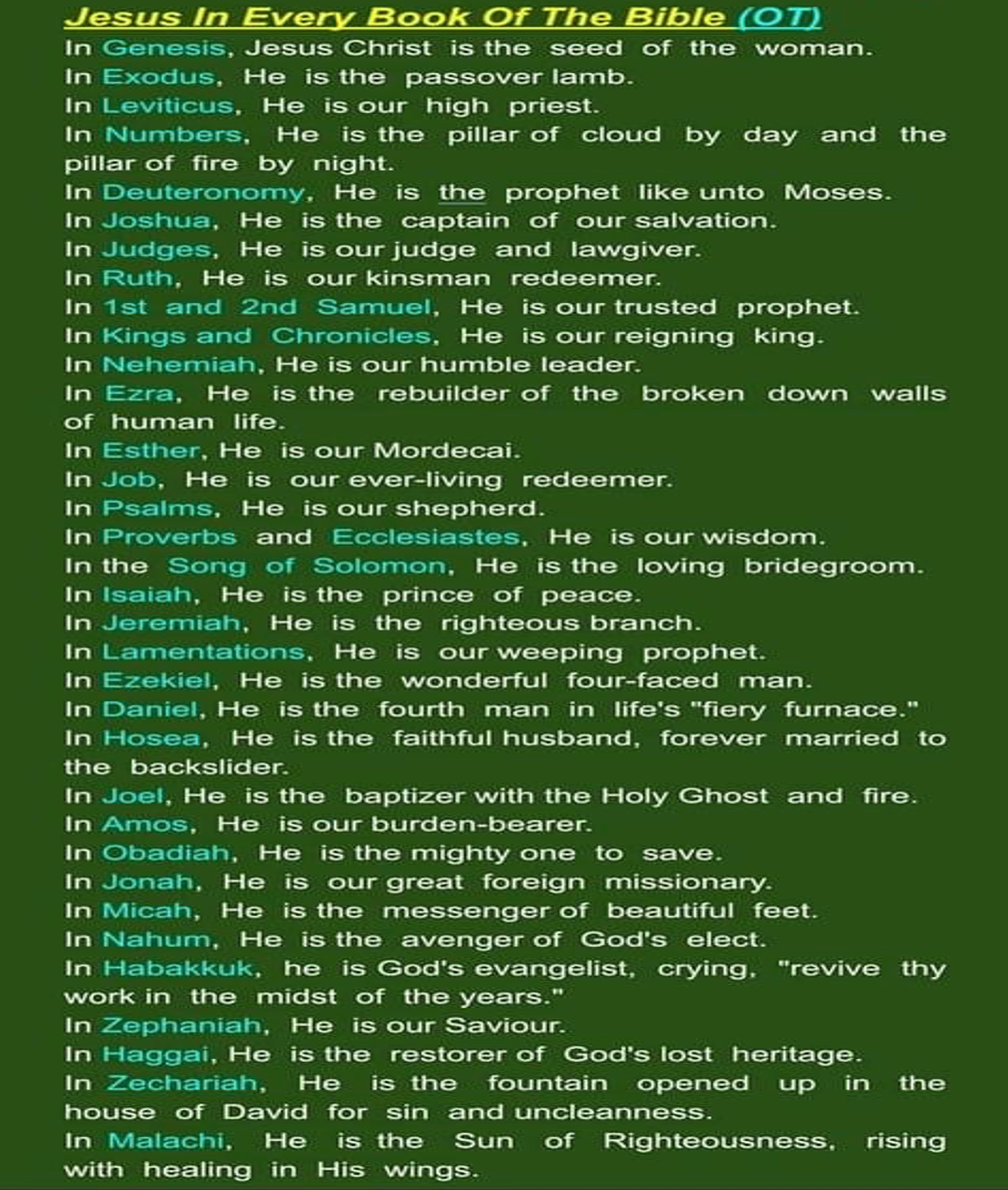
After His resurrection, Jesus tells His disciples: “Everything written about me in the Law of Moses and the Prophets and the Psalms must be fulfilled.” (Luke 24:44) This is a sweeping claim. It is not that the Scriptures merely anticipate a Messiah in general, but that they converge on one specific figure—and Jesus identifies himself as that figure.
Scholars have long recognized that the Old Testament contains multiple streams of expectation that exceed a merely human deliverer. These include:
- Divine-human figures who act with God’s authority (e.g., the Angel of the LORD)
- Royal sons who rule with God’s own power (Psalm 2)
- Heavenly “Son of Man” imagery (Daniel 7)
- Wisdom and Word traditions that pre-exist creation (Proverbs 8; Psalm 33)
- The “Two Powers in Heaven” framework, widely discussed in early Judaism, which allowed for a second, divine figure alongside God without abandoning monotheism
These are not Christian retrofits. They are Jewish categories, already present in the text long before Jesus. For this reason, many scholars have noted that Jesus can be found—sometimes overtly, sometimes typologically, sometimes symbolically—in every book of the Old Testament. Not always in simple or obvious ways, but consistently and cumulatively. The result is not a single proof-text, but a tapestry.
Jesus does not merely fit into this tapestry. He claims to be its focal point.
-
The Old Testament also makes predictions that identify the one who will be the Messiah out of all the people who will have ever lived!
The full convergence of all relevant predictions exceeds anything plausibly attributable to coincidence, manipulation, or human planning. Details can be found by clicking on this link. This level of specificity lies well outside human capacity.
What the Old Testament offers, then, is not merely theological poetry, but historical markers—markers that, when traced forward, land squarely on Jesus of Nazareth. And this matters for the central question at hand. If Jesus fulfills uniquely identifying predictions that no ordinary human could orchestrate—and if those predictions emerge from texts written centuries before His life—then they provide independent validation of His authority and identity.
Not proof by assertion.
Not belief by tradition.
But confirmation by convergence.
Taken together, the Old Testament’s symbolic framework and its predictive precision form a powerful cumulative case: Jesus does not appear as an unexpected intruder in Israel’s story. He appears as its long-anticipated fulfillment.
And that fulfillment does not merely support his messianic role—it reinforces his claim to divine authority in a way no other figure in history remotely approaches.
-
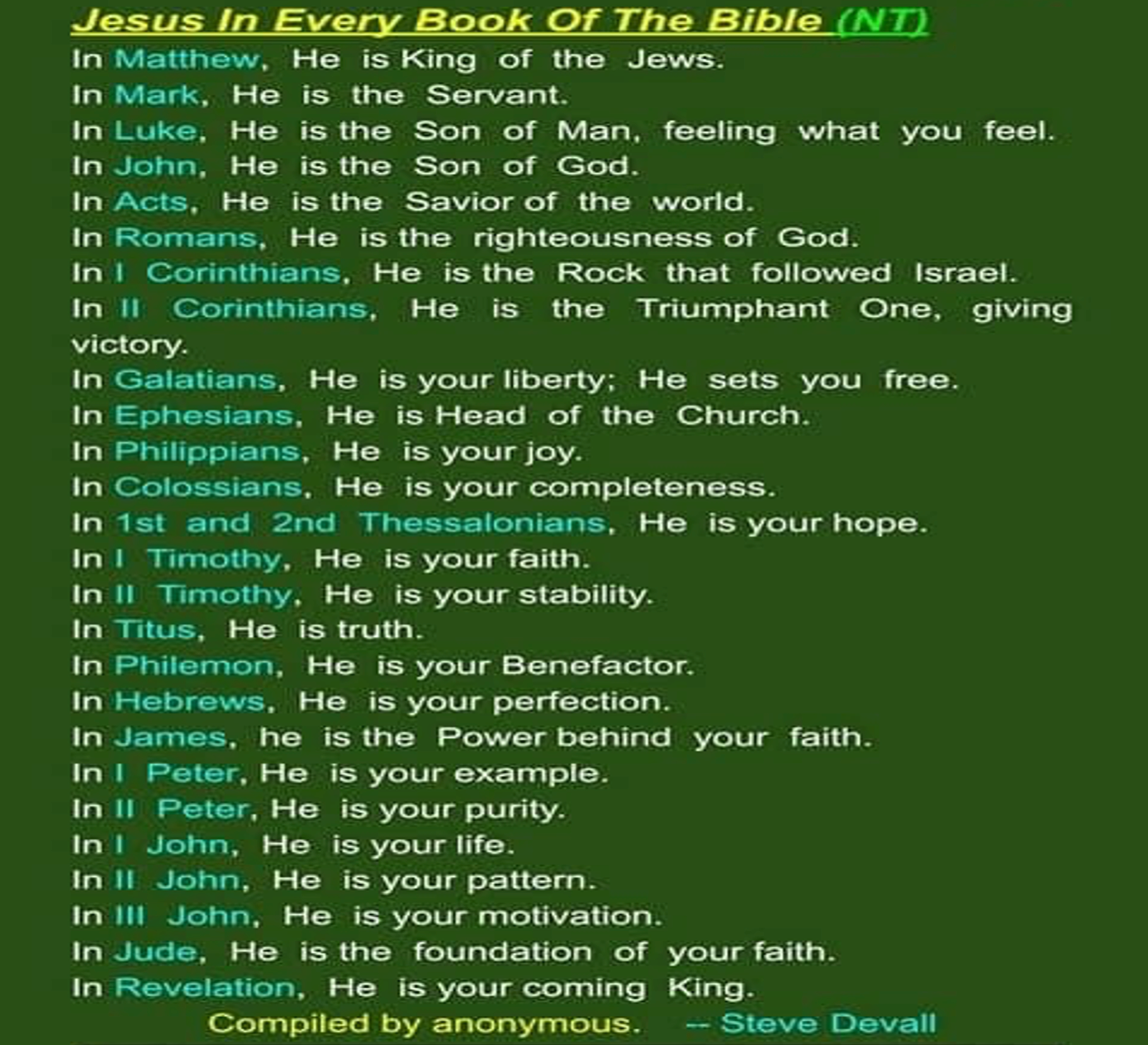
Every book in the New Testament, including the earliest Gospel, depict Jesus as God and therefore to be worshipped.
Anyone claiming Jesus did not claim he was God, or the word “Trinity” is not in the Bible and is a concept Christians added later, expose themselves as someone who doesn’t really have a strong grasp of the biblical contents, as Jesus’ divinity and the Trinity is throughout the Bible, redundantly.
Every book of the New Testament contributes to Jesus’ divine identity. The portrait does not emerge slowly or reluctantly; it appears early, often, and consistently.
Even prominent skeptics have acknowledged this. Professor Bart Ehrman—one of the most well-known critical scholars of early Christianity—initially argued that the Synoptic Gospels did not portray Jesus as divine. He later revised that position:
These Gospels do indeed think of Jesus as divine. Being made the very Son of God who can heal, cast out demons, raise the dead, pronounce divine forgiveness, receive worship together suggests that even for these Gospels Jesus was a divine being, not merely a human… so yes, now I agree that Jesus is portrayed as a divine being, a God-man, in all the Gospels. But in very different ways, depending on which Gospel you read.[i]
A modern revolution in the understanding of the Gospel accounts occurred in scholarship recently. It was discovered that there are creeds embedded throughout the New Testament, which are concise statements of Christian belief summarizing core doctrines. Creeds were used for teaching, unity, defending against heresy.
Crucially, scholars agree that many of them originated within months to just a few years of Jesus’ death and proclaimed resurrection—far too early for legendary development. These creeds typically included affirmation of the death, resurrection, and deity of Christ.
Examples include:
- Romans 10:9
- 1 Corinthians 15:3–8
- Matthew 16:16
These creeds already precede the Gospels, but some skeptics made noise about the deity of Christ not being evident in Mark. Most agree Mark is the earliest written Gospel, so the conjecture followed that the high Christology (viewing Christ as deity) came about over time in later Gospels and New Testament books.
While it is true that John’s Gospel contains the most explicit verbal claims of Jesus’ divinity, the Gospels were written with different audiences and purposes. Mark’s approach is not less theological—it is more narrative and symbolic, embedding divine identity into actions, titles, and scriptural fulfillment.
Regardless, we will spend the rest of this section displaying the divinity of Jesus in Mark alone, with a summation of an analysis taken from a friend’s website.[ii] In fact, Mark presents Jesus as divine from its opening lines.
“Prepare the Way of the Lord” (Mark 1:1–3)
In the first three verses we read: “The beginning of the gospel of Jesus Christ, the Son of God… ‘Prepare the way of the Lord, make his paths straight.’” (Mark 1:1-3) This quotation comes from Isaiah 40:3, a passage referring explicitly to Yahweh. Mark does not soften the claim. He applies a prophecy about the coming of Yahweh directly to Jesus. From the first sentence, Jesus is identified as the Lord whose way is prepared.
“The Holy One of God” (Mark 1:23–25)
Early in Mark’s Gospel, even demons recognize who Jesus is: “I know who you are—the Holy One of God.” This title echoes Old Testament language used of Yahweh Himself (e.g., Psalms 71:22; 78:41; Isaiah 12:6). Jesus does not reject the title—He silences its public proclamation, consistent with His strategic disclosure.
“Who Can Forgive Sins but God Alone?” (Mark 2:5–7)
When Jesus forgives a paralytic’s sins, the scribes object: “Who can forgive sins but God alone?” They are correct—and Mark presents them as such. The sins forgiven were not committed against Jesus personally. The act presumes divine authority. Rather than retracting the claim, Jesus confirms it through a public miracle, validating His authority to forgive.
Lord of the Sabbath (Mark 2:27–28)
Jesus declares Himself “Lord even of the Sabbath.” The Sabbath was instituted by God and governed by divine authority. No prophet, priest, or king ever claimed lordship over it. Only God could.
Calming the Sea and Walking on Water
Twice in Mark, Jesus calms the sea (Mark 4:39–41; 6:50–51). In one instance, He also walks on water. These actions directly echo Old Testament descriptions of Yahweh alone exercising dominion over the chaotic waters (e.g., Psalm 89:9; Psalm 107:29; Job 9:8). The disciples’ response is telling: “Who then is this, that even wind and sea obey him?”
The Transfiguration (Mark 9)
At the Transfiguration, Jesus appears in glory with Moses and Elijah—two figures who, centuries earlier, sought to encounter God. Moses was hidden in a cleft of rock, unable to see God face to face (Exodus 33). Elijah encountered signs, but not God directly (1 Kings 19). In Mark 9, both stand freely conversing with Jesus—face to face. What they sought, they now encounter in Jesus.
The Fig Tree Judgment (Mark 11:12–14)
Jesus curses a fig tree, an act that initially seems strange until placed within its Old Testament framework. The withering fig tree repeatedly functions as a symbol of divine judgment enacted by God Himself (e.g., Isaiah 1:30; Jeremiah 8:13; Hosea 9:10–16). Jesus’ action intentionally mirrors Yahweh’s prerogative.
The Son of Man (Mark 14:61–64)
Jesus’ favorite self-designation he even used at His trial: “You will see the Son of Man seated at the right hand of Power and coming with the clouds of heaven.” This is a direct citation of Daniel 7:13–14, where a divine-human figure receives eternal dominion and worship from all nations. The High Priest understands immediately. He tears his garments and declares blasphemy.
Who but God is worthy of universal worship?
Even considering just the earliest written Gospel and creeds, which preceded even the Gospels, those claiming Jesus’ divinity was invented later are demonstrably incorrect. The early Christians did not invent Jesus’ divinity, they became Christians because of it.
-
The attributes of God are directly given to Jesus alone.
The first murder solved by fingerprints was in 1892. In the small town of Necochea, Argentina, two young boys were found murdered in their home. Their mother, Francisca Rojas, claimed an intruder had killed them.
At the time, criminal investigations relied mostly on eyewitnesses and confessions. But one investigator, Juan Vucetich, was experimenting with a new idea: fingerprints. At the crime scene, investigators noticed a bloody fingerprint on a doorframe. While fingerprints were already suspected to be unique to each individual, they had never been used successfully in a murder case. Vucetich compared the bloody fingerprint to the fingerprints of Francisca Rojas. They matched. Confronted with this evidence, Rojas confessed.
She was convicted. No one saw her commit the crime. No one heard her confess beforehand. There was no eyewitness testimony. Her identity was established by something only she could possess: A fingerprint that no other human being on earth has.
The court did not say:
- “She resembles the murderer”
- “She claims to be innocent”
- “She was nearby”
Instead, it said: “This mark belongs to you—and only to you.” From that moment forward, fingerprint identification became standard worldwide.
This case established a foundational rule still used today: Identity can be known with certainty when exclusive attributes are present.
You don’t need speculation.
You don’t need philosophy.
You don’t need assumptions.
Unique attributes identify unique identity. When an attribute exists that cannot be replicated by others, identity is not inferred — it is recognized.
If Jesus were mute or had a code of actions only, nothing verbal, we would still know he claimed to be God by his accepting or demonstrating attributes recognized as belonging exclusively to God. And those who witnessed or knew him confirming such attributes, which Jesus poignantly did not deny.
a. Existing eternally without beginning, and having a rule that will not end.
Jesus stated, “Truly, truly I say to you, before Abraham [s]was born, [t]I am.” (John 8:58) As noted earlier, this is purposefully taking the title of the divine name, which also indicates “I exist” or one who always existed eternally. Further, the disciples also applied absolutely distinctive attribute of never having been created, and repeated twice in the opening lines of John to ensure we did not miss the crucial point:
In the beginning was the Word, and the Word was with God, and the Word was God. [a]He was in the beginning with God. All things came into being through Him, and apart from Him [b]not even one thing came into being that has come into being. (John 1:1-3)
Those familiar with the Old Testament understood “The Word” was something with creative power in its own right, having the power to fulfill God’s purposes—and John explicitly explained the connection to Jesus. Really, all of Hebrews chapter one makes Jesus’ identity clear, but in Hebrews 1:8 God the Father says about God the Son: “Your throne, O God, will last for ever and ever; a scepter of justice will be the scepter of your kingdom.”
Additionally, Jesus (Hebrews 1:8-12) and the Holy Spirit Psalm 104:30, (Psalm 139, Hebrews 9:14, 1 Corinthians 2:9–10) are labeled with the same divine attributes as the Father.
b. He created all things.
- “In the beginning was the Word, and the Word was with God, and the Word was God.He was with God in the beginning. Through him all things were made; without him nothing was made that has been made.” (John 1:1-3)
- Colossians 1:16: “For in him all things were created: things in heaven and on earth, visible and invisible, whether thrones or powers or rulers or authorities; all things have been created through him and for him.”
c. Shares authority and claims parity with God the Father.
The Son of Man, Jesus’ most used title for himself shares authority with God the Father as noted in Mark 14:62 and Psalm 110, linked to Daniel 7, and claimed parity between himself and God the Father (John 10:25-29). Jesus said both the angels and the kingdom were his: “The Son of man will send His angels, and they will gather out of His kingdom all causes of sin and evildoers” (Matthew 13:41).
Other places in the Gospels and the common understanding of the time was that the “angels of God” and the “Kingdom of God” belong to God the Father.
d. Jesus accepted worship.
This type of worship is an act reserved for God alone, and Jesus accepted it as proper (Matthew 2:10-12, 14:32-33, 15:25-26, 20:20-21, 28:8-10, 16-17; John 9:35-38).
The first century Jewish culture and beliefs based upon the Old Testament (Tanakh) included the understanding that God alone is worthy of such worship (Exodus 20:3-6, Deuteronomy 4:35, 6:4, 6:13-16, 32:39, 2 Samuel 7:22, Isaiah 8:13, and 43:10-11). This was repeated by Jesus and the writers of the New Testament (Matthew 4:10, Revelation 22:8-9, Acts 10:25-26 and 14:11-15). Worshipping anyone or anything else would make you an idolator and in violation of the first commandment.
Jesus was worshipped as God from the moment of his birth, by the angels no less (Hebrews 1:6), and the worship continued all the way past his ministry on earth up to today. Critics have responded to this saying there are instances of people “worshipping” men or angels. True, but a study [iii] of all the times the word for “worship,” proskuneo, was used, the kind of bowing to the ground and worshipping that Jesus and the Old Testament said to reserve to none but God alone (Matthew 4 and Luke 4), was given to Jesus and accepted.
Therefore, either thousands of eyewitnesses, early believers, and Jesus himself were in serious and dangerous rebellion against cultural, moral and spiritual law, or these direct eyewitnesses were convinced by what they knew that Jesus was God.
e. Who can forgive sins and grant eternal life but god alone?
Noted previously in Mark 2:5-7, also Matthew 25:31-33, John 10:28, 11:25-26.
f. Authority over nature.
This was also noted above in the section on Mark’s Gospel.
-
Jesus validated his claim with public, checkable evidence, unklike any other claim to divinity in all history.
What other acclaimed deity lived life on earth, and was verified with checkable events like the predictions, miraculous acts, and resurrection? Jesus appealed directly to these confirmations as displayed in:
- His healing of the paralytic as validation of his authority to forgive his sins (Matthew 9:1-8, Mark 2:1-12, Luke 5:17-26, John 5:8-9)
- His providing evidence of who he is to John the Baptist’s disciples, and telling them who witnessed them to report what they saw (Luke 7:18-23)
- His predicting his death and resurrection (Matthew 16:21, 17:22-23, 20:18-19, 12:39-40, parallel accounts in Mark and Luke; John 2:19-22)
Jesus anchored his identity to miraculous acts that functioned as verification, not spectacle. When we examine the historical record, the evidence for Jesus’ miracles comes from two primary—and highly significant—sources: his close followers and his critics.
The earliest witnesses were individuals who were so convinced of what they had seen that they willingly endured persecution, suffering, and death rather than retract their testimony. While martyrdom alone does not prove truth, it powerfully demonstrates sincerity—especially when those witnesses had nothing to gain and everything to lose. And unlike other martyrs, many followers of Jesus knew what they were proclaiming was accurate or not. How certain would you have to be to risk all? And would you sacrifice all for something you knew to be false?
Modern historical scholarship overwhelmingly agrees on several critical points:
- Jesus’ followers sincerely believed he performed miracles
- They sincerely believed He appeared to them after the crucifixion
- These beliefs emerged immediately, not generations later
- The claims were made publicly, in hostile environments, where they could be challenged
These conclusions are not theological assumptions. They are historical judgments based on standard criteria used across ancient history.
Enemy testimony is also extremely powerful, being regarded by historians and legal experts as among the strongest forms of evidence. Non-Christian sources—including Jewish rabbinic writings in the Talmud and the second-century Greek philosopher Celsus—do not deny that Jesus performed extraordinary acts. Instead, they attempt to explain them away by attributing them to sorcery. That response is telling. It concedes the events while disputing their source.
In other words, the debate in the ancient world was not whether Jesus performed miracles, but how He did them.
Common objections—and why they fail
Some dismiss Jesus’ miracles not because of evidence, but because of preconceived beliefs against them. Two objections are especially common.
“Ancient people were primitive and easily fooled.”
This view is a textbook case of chronological snobbery—the assumption that people in earlier eras were intellectually inferior simply because they lived earlier.
In reality, ancient people were no more gullible than modern ones. They knew dead people stayed dead. They knew blindness, paralysis, and leprosy did not vanish overnight. That is precisely why Jesus’ miracles caused controversy. If miracles were commonplace or easily accepted, they would not have provoked outrage, investigation, or attempts at suppression.
“Miracles never occur.”
This is not a historical argument. It is a philosophical assumption.
Historians do not begin by declaring what cannot happen. They evaluate competing explanations and infer the best one based on the evidence available. To rule out miracles a priori is not skepticism—it is methodically removing the possibility of something one does not like.
Ironically, the largest and most difficult-to-believe miracle already occurred and was verified by some of the most profound discoveries in modern science. Details of this miraculous event can be found in The BIGGER Cause blog, and more details on miracles can be found in Miraculous Misunderstanding of Miracles. The question, then, is not whether extraordinary events are possible—but whether the evidence warrants belief in this one. If one wishes to dismiss Jesus’ miracles, the burden of proof does not rest on the witnesses alone.
It rests on the critic.
What evidence do you have that Jesus did not perform miracles?
How is that evidence stronger than the combined testimony of followers, enemies, early creeds, and historical consensus?
And why should your presuppositions override the data historians actually use?
Jesus did not ask people to believe without reason. He tied his identity to evidence. He invited scrutiny. And He staked everything on events that could be examined, challenged—and remembered.
No other claim to divinity in history has subjected itself to that level of verification.
And it is not surprising none has survived in quite the same way as Jesus.
Conclusion
There is so much more to add, But even limiting ourselves to what has already been presented, the conclusion presses inescapably upon us.
Jesus named himself with the same recognized name as God the Father.
He claims eternal existence and an everlasting throne.
He declares Himself Lord of the Sabbath—and even Lord over David, Israel’s greatest king.
He can forgive people of sin.
He promises to raise the dead at the final resurrection.
He accepts worship proper only to God.
He performs miracles as public validation of divine authority.
He predicts his own death and resurrection—and stakes his credibility on their fulfillment.
He claims authority over life and death itself.
He declares that he will be judge over the world.
He states that all that belongs to the Father belongs also to him, and that they share authority.
These are not the claims of a moral teacher.
They are not the claims of a prophet pointing away from himself.
They are not the claims of a misunderstood revolutionary or a later legend.
They are the claims of someone placing himself squarely within the identity of God.
Endnotes
[i] Ehrman, Bart D. “Jesus as God in the Synoptics: A Blast from the Past.” The Bart Ehrman Blog, 13 Apr. 2014, https://ehrmanblog.org/jesus-as-god-in-the-synoptics-a-blast-from-the-past/.
[ii] The Deity of Christ in the Gospel of Mark. CrossExamined.org. December 15, 2014. https://crossexamined.org/deity-christ-Gospel-mark/.
[iii] Koukl, Gregory. “Was Jesus Worshiped?” Stand to Reason. February 5, 2013. www.str.org
