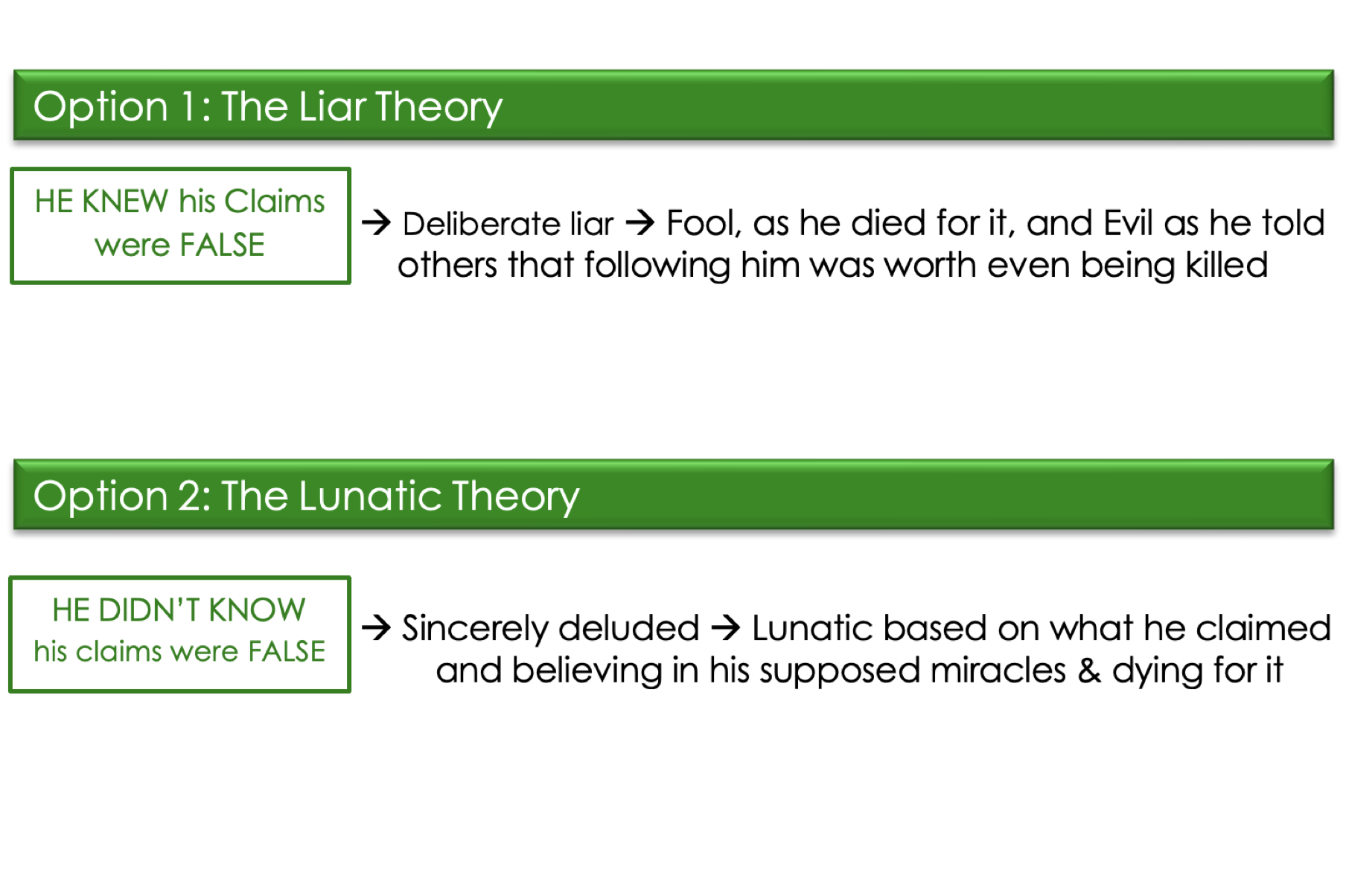
Option 1: The Liar Theory
HE KNEW his Claims were FALSE
This means → Jesus and those who knew him were deliberately lying, were fools, as Jesus died for what he knew to be false, as did some of his disciples, and they all suffered. Further, they are evil as they told others following Jesus was worth losing everything.
For each of the possible explanations regarding Jesus, we will first cover the support for each alternative theory, then will cover reasons against belief in the theory, to display for the reader how solid each theory is to stand upon.
Positive supports for this theory:
+1 Many examples throughout history of people lying about religious issues
+2 The Talmud declared the disciples stole the body
+3 Maybe Jesus just went into a coma, but didn’t die
+4 What’s easier to believe, that they lied, or Jesus actually rose from the dead?
Problems with +1
If you have to discard everything with a history of people lying in it, then you would lose science, history, politics, family, … everything. People lie in every area of life, therefore it is not valid to assume lying occurred regarding this claim just because people have lied before.
When someone 2000 years ago invents a lie, often they have no idea of the investigative abilities that may come to expose the lie. For example, Joseph Smith, founded Mormonism and produced the Book of Mormon a couple hundred years ago. Smith made claims about Jesus coming to America, complete with descriptions of massive civilizations, metal-working, and specific plants, animals, buildings and battles involved. Yet, every single applicable archeological find and historical study disproved his claims. Joseph Smith fabricated history and claimed it was the word of God, that is amazing arrogance, thankfully it is accompanied by ignorance, allowing it to be exposed rather easily. Jesus went even further and claimed he was God, the difference is Jesus backed up his claim with entirely unique and checkable events, which his followers checked to verify, and every generation up to today has also checked using multiple fields of study.
What evidence do you provide Jesus and the disciples were lying? All the evidence we have points to their honesty. This was a public execution in Jerusalem and his post-death appearances and empty tomb were first proclaimed right in that same city. The skeptics were challenged from the beginning to prove the claims about Jesus were false, and the Jewish religious leaders (at least the ones who rejected Jesus) and Roman authorities had the motivation and authority to prove the claims false, but provided nothing, there is a silence, except …
Problems with +2
The Talmud (early writings of Jewish Rabbis), claimed the disciples stole the body, and in a letter to a skeptic, an early Christian leader remarked that you (the critic) was still claiming the body was stolen. Aside from the phenomenal problems with the idea of anyone stealing the body in that situation, all those critics have done was admit the tomb was empty.
So if the body was stolen, it agrees with and explains the empty tomb (one of the minimal facts), but does nothing to explain the other established facts, including the disciples sincerely believing they saw Jesus risen from the dead. Very difficult to explain, actually absurd, if they had stolen the body. Early critics’ writings also confirm Jesus did “wonders,” but explain the miraculous acts away by claiming he must have been demon-possessed.
Problems with +3
The idea Jesus didn’t actually die on the cross, and after recovering, came out of the tomb, has been known as the swoon or coma theory. Anyone, who understands how crucifixions operate, realizes the fantasy of this idea.
Crucifixion is an agonizingly slow death by asphyxiation. The stresses it causes on the muscles and diaphragm force the chest into the inhaled position; basically, in order to exhale, the individual must push up on his feet so the tension on the muscles would be eased for a moment. In doing so, the nail would tear through the foot, eventually locking up against the tarsal bones. After managing to exhale, the person would then be able to relax down and take another breath in. Again, he’d have to push himself up to exhale, scraping his bloodied back against the coarse wood of the cross. This would go on and on until complete exhaustion would take over, and the person wouldn’t be able to push up and breathe anymore. (Metherell, Alexander M.D., Ph.D., as interviewed by Strobel p. 195-9)
It’s fairly obvious when a crucifixion victim is dead. In addition, the Roman and/or Jewish authorities, who went to the trouble of giving a Roman scourging and then crucifixion, can ensure or speed up death by breaking the legs, or by putting a spear in the heart. When this occurred, the NT writer noted blood and water came out, which modern medicine now knows to happen with pericardial and/or pleural effusion. It takes too much blind faith to believe Jesus survived this, and there are more problems.
The blood loss and trauma would be fatal while in the tomb, and even if he survived and was flown to the best hospital, worked on by the best surgeons of modern times, then flown back so he could appear to his disciples, do you really believe they would buy his story of being God, who is capable of resurrecting us to new life? They would realize he somehow survived, and is a total wreck, not a God who they can trust with their lives. And they claimed he gave them many convincing proofs, for over a month, then rose into Heaven. So we are back to the Lie Theory, and all the problems that come with it.
Islam began around 600 years after Jesus, and accepts much of the NT accounts, with some major exceptions, such as the claim Jesus was neither crucified, nor killed. (Qur’an, sura 4 (An-Nisa) ayat 157-158) Muslim ideas on how to explain this have included: God gave someone else Jesus’ appearance and caused all to believe it was Jesus; other minority claims include: Jesus was not on the cross long enough to die, or his immortal body could not die on the cross, or that the crucifixion just never happened. All of these claims have obvious problems, no supportive evidence, and are contradicted by all the evidence we do have. This is a direct evidential contradiction for Islam.
Another theory, is Jesus had an identical twin, and they were somehow separated at birth. This Jesus-look-alike hears of Jesus’ works, and lurks in the shadows until after the crucifixion. Then he self-inflicts crucifixion wounds, and comes out to present himself as the risen Lord. As is true with all the naturalistic theories: no historical evidence, cannot even explain the minimal facts, excessively strains credibility, and exposes the desperation of people, who really want to avoid the conclusion that naturally follows from the evidence. This theory was actually proposed by a professor, which should really make us more wary of who is teaching and what is being taught for the massive finances and effort we invest in a college or university education.
Problems with +4
This commits a fault in logic known as a priori reasoning, which means one assumes something is fact prior to any empirical research. Or, a person makes up their mind before (or without) taking in the evidence. Many have decided miracles cannot happen, so it doesn’t matter what the evidence is. Reminds me of people in scary movies, who close their eyes tight and hope somehow the danger will go away. Your ignorance or disregarding of information does not make the consequences of those facts go away.
It is not about what is easier to believe, it is about the facts and what actually did happen. Many things may be difficult to believe, but reality does not care what our preferences or opinions are. Almost everyone rejected the idea the Universe actually had a beginning, and came up with every possible (and impossible) alternative, but reality is what it is, and exposed the critics’ faulty hold on inaccurate presumptions.
Of course, if we didn’t look at any of the evidence, then it is easier to believe they lied. Always check the natural explanation first. But sometimes typical explanations fail, and when the evidence points to something else, it is unreasonable, faulty, wishful thinking to hold onto your belief in the impossibility of miracles, when that is where the evidence points. And, as covered in The BIG BEGINNING blog, the greatest miracle has already occurred and comes with scientific proof.
Someone can say in all their experience they never saw a miracle. That may, or may not, be true, but miracles are rare by definition – that is the point! If you do a Bible study, you will find that miracles are clustered around a few individuals or times, in order to establish the authority beyond humanity’s capability. There is much more to this topic, as people often bring a lot of misunderstandings into their discussions of miracles. Check the Miraculous Misunderstandings in the Frequently Asked Questions folder.
Why the LYING THEORY is not a reasonable option:
− 1 Why would they lie?
Former detective James Warner Wallace, who has been featured on Dateline for his solved crimes more than any other cold case detective, has observed every crime can be traced back to one or more of these three motives: financial greed, relational lust, or the pursuit of power. If Jesus and the disciples profited and lived like some modern televangelists, that would provide possible motivation, but the contrary is true.
Any disciple could be used as an example, but Paul and James are good as initially both were critics of Jesus’ claims, and had no motivation to lie to support a belief they rejected. Yet, both abruptly changed their belief, and Paul went through every form of punishment imaginable, yet never stopped working for Jesus with total devotion. Among many other recorded punishments, Paul suffered through the forty-minus-one lashes five times, yet even during his sentencing, stated as soon as he was released he would continue to tell others about the one he had full trust in. The forty-minus-one punishment used a whip with multiple leather strips with battering or shredding material tied at the ends. At the time it was said that 40 lashes would shred a person so badly the person would likely die, so they gave 39 lashes. Paul not only lacked reasonable motivation to lie, but also had to have absolutely no doubt in the resurrected Jesus to face the abuse he knew he would consistently receive.
− 2 How could they lie?
- The claims (including the creeds mentioned earlier) were made to the people living at the same time and place where Jesus was just crucified. They even appealed to the eyewitnesses in that city, empty tomb, and other checkable sources.
- How does one convince the skeptics, like Paul & James, to lie along with you?
- Cold case detective Wallace also makes clear why the conspiracy theory regarding Jesus is irrational to believe, as conspiracy theories do not work unless 5 requirements are met: 1) small number of conspirators, 2) short timespan the conspiracy has to last, 3) excellent communication and 4) strong “familial relationship between the conspirators”, and 5) little or no pressure to confess. Wallace explains through decades of experience, as well as basic common sense, he was led to the same conclusion against a lie or conspiracy. For example, when you put someone on the torturer or executioner’s table, you start to hear true confessions. Yet that is precisely what we do not have with Jesus and the disciples. Different groups brought all forms of persecution, yet eventually only silenced them with martyrdom.
− 3 There is no evidence supporting the lie/conspiracy/hoax theory.
- If you want to believe a theory, you must have evidence. Otherwise, it is just wishful thinking, or even delusional thinking if there is more/better evidence against your theory.
- Why are there no charges of lying? Skeptics of that time admitted a lot of information about Jesus, including performing wonders, but no charge of lies other than stealing the body.
- All evidence seems to point to strong moral character and honesty of Jesus and the disciples, and the scholars accept this. If they lied they would be hypocrites, fools, and wicked at the highest level, as they were willing to die for their lies, and countless others followed Jesus, even through severe loss and death because of their witness and advice. What evidence is there for Jesus and his early followers being fools and wicked to such a remarkable level? There is none.
The Bottom-Line
- The Liar Theory does not have supportive evidence
- Fails miserably in every way we judge theories to provide an explanation of the evidence (even fails to explain the minimal facts)
- Requires unrealistic and unsupported beliefs – it does not work – you would be unreasonable and against the scholarship and common sense to believe it.
Option 2: The Lunatic Theory
HE DIDN’T KNOW his claims were FALSE
This means → Jesus and those who knew him were sincerely deluded, on the level of lunacy based on what Jesus and his disciples and NT writers claimed, and believing in his supposed miracles and willing to suffer consistently and die for it.
Positive supports for this theory:
+1 If anyone I knew claimed to be god, insanity is my first guess
+2 Just like the Heaven’s Gate members, who drank the poisoned Kool-aid
+3 They checked the wrong tomb
+4 What’s easier to believe, all the miracles happened, or the witnesses are crazy?
+5 All the supposed witnesses had hallucinations
Problems with +1
If God did come to Earth to achieve something for our relationship with him, then it better be accompanied by verification beyond man’s ability to do, otherwise, it is likely just someone with mental issues, or just another attempt by man to make a god how we want God to be, by inventing beliefs we like, instead of determining what God is actually like.
The difference beween Jesus, and anyone else who ever claimed to be God: Jesus brought the verification, such as the entire Old Testament and Israelite traditions, and predictions, which all came way before Jesus, all pointing clearly to Jesus; miracles; resurrection with extraordinary evidence no other comparable claim can compare with. If you do not think this claim is entirely unique, what other examples can you provide of one claiming supernatural authority, and then verifying the claim with a comparable level of evidence?
My first guess about quantum mechanics was that parts of the theory seemed foolish and were wrong, but the problem for me was the facts overwhelmed my thoughts on the issue, and what I thought was foolish, is in fact reality. Even the brightest minds in science have through experience recognized the need to have humility. Sometimes our best guesses or understandings may turn out to be the foolish ones, especially if they are presumptions, and not backed up with solid support.
Therefore, while insanity should be investigated first, if the evidence does not support that theory, then, if you want to be rational and base your choice on what is most likely true, you better look for another theory, even if it goes against your comfort and opinion.
Problems with +2
On a vacation, I drove by what seemed like some big religious meeting, and had to check it out. It was very different from meetings I was used to, so I located one of the leaders and asked her what the basic beliefs were. Very interesting. The leader said Jesus had already returned, and she was currently living in NY. My natural, not-so-nice instinct was to ask her if this Jesus was attractive, and then ask if I could have her number. But, I held back on the sarcasm because I did not want to ridicule, or make her defensive. Instead I said I believe in a different Jesus, one that verified his claim, and I gave her a brief set of evidences. I asked if her Jesus provided any verification able to be checked … and the leader left the conversation shortly after, frustrated by being unable to provide any examples.
People have a spiritual need to be filled, and because people have a tendency to bypass truth and fill themselves instead with what they think is appealing, we will always have things like the group I ran into, or Heaven’s Gate tragedies. Marshall Applewhite convinced the Heaven’s Gate group a spacecraft travelled in the tail of the Hale-Bopp comet, and they had to commit suicide to “evacuate Earth” in time to be transported to the spacecraft. Creative idea and promises of spiritual fulfillment beyond human existence led 38 people to commit suicide. A tragedy of flawed thinking. These people, as well as the 9/11 plane hijackers, and others through history have died for beliefs, but can you see the difference with Jesus and the disciples?
Jesus and the disciples died not for beliefs, but for what they knew for fact to be true or false. Entirely different situation, which disproves the +2 idea.
Problems with +3
The tomb Jesus was buried in was specifically named as one owned by a known Jewish religious leader, Joseph of Arimathea. Naming a well known and checkable leader leaves little room for failing to determine the correct tomb. What evidence is there they went to the wrong one, other than someone doesn’t want to believe in the resurrection?
The Roman and/or Jewish authorities, who went to the trouble of giving a crucifixion under Pontius Pilate, would not then just allow Jesus’ disciples to continue to give the same message, plus the added emphasis that Jesus just overcame the authority of Roman and Jewish religious leaders, and death. It was a short walk, and those opposed to Jesus’ claim had the resources, motivation and authority to end the empty tomb claim, unless it was indeed empty.
And this would, at best, only explain the empty tomb, it entirely fails to give reasonable explanation to the other minimal facts involved, such as the disciples sincerely believing they saw Jesus after the cross – so we are back to liars or lunatics.
Problems with +4
Same as for +4 in the liar theory.
Problems with +5
Sure psychiatric events like hallucinations, conversion disorders, and bereavement-related visions occur, but these are medical symptoms, and therefore require a clinical appraisal of the likelihood of these theories. Rarely do those offering hallucinations as a theory provide such an analysis, as most are NT scholars and not in the medical field, or maybe because the disciples’ belief in the resurrection is entirely inconsistent with the medical records and understanding of these psychiatric events, which would invalidate the psychiatric claims.
NEVER in the peer reviewed medical or psychology literature[1], [2] has there been published examples of collective-hallucinations, at different times, places, and circumstances, where 100% of the group is all seeing the same things and routinely interacting tangibly with who they claimed to see. Nor are there examples of people then giving their lives over to testify to the fact, and being certain even to the point of death.
Bereavement-related visions only convinced those in the medical studies that the person was dead, Jesus’ appearances and activities, on the other hand, unanimously convinced all who saw that Jesus was alive, entirely well, and active for over a month before ascending to Heaven, with angels also present for the occasion. And grief surely was not influencing Paul, who at the time when Jesus appeared to him was a critic of Jesus and supported his crucifixion.
This theory also does not explain all the numerous other miraculous signs Jesus provided, nor does it explain the empty tomb. And these people were so certain of what they knew concerning Jesus, they challenged others, saying you too witnessed these things or can check with those who did. The proposed psychiatric theories are naïve when proper medical and psychological analysis is included, and therefore do not offer plausible explanations for the biblical account of Easter.
More Reasons why the lunatic theory is not a reasonable option:
− 1 No supportive evidence
The NT is characterized by careful, clear thinking, proven ideas, accurate historical details, and harmonization between very different writers. I have not heard of any facts to support the idea Luke, Paul, or any of the disciples were lunatics. If you have some facts, what are they?
Consider Jesus’ and the disciples’ actions, words, care for others, and psychologically, emotionally, and morally healthy lives. Opponents never claimed they were crazy, just that Jesus must be demon-possessed to perform his wonders.
Either some of his family or his associates at one instance said Jesus is “beside-himself”. That is an embarrassing thing to write in the Bible, but scholars regard this highly because when a source includes details that embarrass their own claims, it is likely to be very trustworthy in its other claims. Can you blame a sibling or someone close? You think you have problems with a perfect sibling, or perfect friend, “Oh Jesus, he never does anything wrong,” and then to hear Jesus claim to be God come to Earth to fulfill a purpose, that would be a lot to handle, and not surprising the comment was made. But notice, it did not occur again, Jesus did healings at that time to verify his authority and claims, and his family and associates were later confronted with the risen Lord, and knew and committed to this truth. Jesus’ skeptical brother James then abruptly came to fully accept all Jesus claimed, even led the church in the very place that had just crucified Jesus, and because he wouldn’t stop his testimony, several ancient sources record James was thrown from the roof of the Temple, then stoned or beaten to death as he hadn’t died immediately from the fall.
There were plenty of critics, but no witnesses or evidence of insanity.
− 2 Doesn’t explain any of the minimal facts
Even if there were evidence supporting Jesus being a lunatic, it does nothing to explain all the other evidence, such as the minimal facts.
Some facts may be explained if Jesus just happened to get lucky enough to assemble a group of people, who were as insane as he was, who were just as willing to die and lead others to suffering. If they were all lunatics, then it could explain some of the minimal facts, but the abrupt change in skeptics, empty tomb and other stubborn facts still tear down the lunatic theory. And of course, there is no evidence to support the insanity of them all.
[1] This is based on Bergeron’s comprehensive data base search of the Pubmed and American Psychological Association websites. In agreement with this conclusion, another author and researcher also attested in March, 2009: “I have surveyed the professional literature (peer-reviewed journal articles and books) written by psychologists, psychiatrists, and other relevant healthcare professionals during the past two decades and have yet to find a single documented case of a group hallucination, that is, an event for which more than one person purportedly shared in a visual or other sensory perception where there was clearly no external referent.” Gary A. Sibcy, Ph.D., Licensed Clinical Psychologist, Piedmont Psychiatric Center, Centra Health Hospitals, Virginia, USA, as cited in The Resurrection of Jesus: a Clinical Review of Psychiatric Hypotheses for the Biblical Story of Easter. Joseph W. Bergeron, M.D. and Gary R. Habermas, Ph.D, https://docs.google.com/document/d/1rQljKoh2ki-yVDwIzgpqLoLj2w9tp_60OSBJ4YVr3ZA/mobilebasic?pli=1#ftnt1
[2]American Psychiatric Association, Diagnostic and Statistical Manual of Mental Disorders, 5th ed. (Washington: DC. 2013).
The Bottom-Line
- The Lunatic Theory does not have supportive evidence
- Fails miserably in explaining even the minimal facts
- Requires unrealistic and unsupported beliefs – it does not work – you would be unreasonable and against the scholarship and common sense to believe it.
Option 3: The Legend Theory
Positive supports for this theory:
+1 It sounds like a myth/legend.
Problems with +1

It does not sound like a myth/legend, according to literature scholars. Read Matthew, Mark, Luke, or John, or the book of Acts, and see for yourself. Myths, legends, fables, etc., have certain characteristics, like occurring in the murky, vague past, no checkable events to verify core claims, no historical details initially doubted but later verified by scholars, etc. On the other hand, the biblical accounts have all the characteristics of the type of literature known as historical narrative (giving an account of what happened). I understand appealing to what the “scholars” think doesn’t necessarily prove anything, but you can simply check this yourself. Read a myth, for example, Babylonian myths, or read the Vedas (Hinduism), or the paragons of thinking, the Greeks sown in the image, and then read the Bible.
Or compare the Bible to the Gnostic Gospels, which were written as a reaction against Christianity about 100-300 years after Jesus. The Gnostics took things they liked, such as a blend of Jesus and eastern religious ideas, and added what they claimed was “secret knowledge.” Followers of Gnosticism put out a number of books and attempted to capitalize on the authority of those connected with Jesus, deceptively calling their books the Gospel of Peter, Gospel of Thomas, Gospel of Mary, etc. This fabrication has been exposed by literature scholars, along with historical errors and adding legendary content, such as declaring when Jesus came out of the tomb he was so tall his head was in the clouds, and the cross also floated out of the tomb and was talking.
The only similarity with myths or legend is the inclusion of a supernatural God and miracles, which does make it sound like some myths we do have, but does not make the account myth/legend. If it did, then modern physics books must be myth too, because of things many of us would think are beyond reason. Further, science has demonstrated the necessity of a supernatural cause of the Universe (something outside all matter, energy, space, and time of nature) as explained in The BIGGER CAUSE blog. There are many claims that may surprise, or shock us, but reality does not depend on our limited understanding. And for those who are uncomfortable with the idea of “miracles,” see the article Miraculous Misunderstandings in the Frequently Asked Questions (FAQ) section of the website.
Why the legend option does not work:
− 1 No supportive evidence
If you believe it is legend, why? The scholarship does not accept the legend theory, so if you do, you need to have the appropriate evidence.
− 2 Fails to explain any of the minimal facts
− 3 The legend option has already been directly eliminated by the disciples
The disciple Peter stated, “We did not follow cleverly invented stories when we told you about the power and coming of our Lord Jesus Christ, but we were eyewitnesses of his majesty.” (2 Peter 1:16) He could be lying about them being eyewitnesses, but this removes legend as an option – you are inescapably back to the liar theory.
− 4 No time for legend to develop
The creeds (belief statements) cover the core facts about Jesus, and allow no time for legend to be added. Even the NT was written when witnesses were still alive, and in a culture really non-conducive to legend building, providing no time or conditions legends typically require to arise from, in order to begin their obfuscation of the facts.
− 5 Endless other problems
- The standard historical method places the burden of proof on the historian to show the written historical account is unreliable. The NT claims to give an historical account, and reads that way. So the rule of thumb is: if the author seems to attempt to communicate history, assume it is, unless you have good evidence it is not historical. We have amazing and continually growing evidence of the accuracy of the Bible, so much so historians and archeologists rely on the Bible to direct them to new finds.
- The biblical account has been scoured over with the finest-toothed combs, by far the most read and studied in all history – and what do we find – a trend: the more information we gather, the more the biblical record is verified at the expense of critics.
- There is much more, but any one of these reasons is alone fatal to the legend theory, which is why no one familiar with the evidence attempts to use this theory.
The Bottom-Line
- The Legend Theory does not have supportive evidence
- Fails miserably in explaining even the minimal facts
- Cannot help but fall into the Liar Theory
- Requires unrealistic and unsupported beliefs – it does not work – you would be unreasonable and against the scholarship and common sense to believe it.