

Brief Answer:
The primary question is: Is God involved in the Bible or not. If there is—and we have evidence there is—then we have good reason to believe the OT is reliable, and the only reasonable response is to take this communication as more serious than any other source, as no other source has such an authority behind it. If there is no God involved, then it is only as serious as other man-made, ancient and inaccurate sources.
Detailed Answer:
The Old Testament (OT) has been handed down with incredible accuracy. However, the manuscript scenario is a bit different from that of the NT. The OT was written over a period extending from about 1446-1406 BC to the fifth century BC, and was predominantly written in Hebrew, with some Aramaic. Some scholars claim the book of Job is the oldest book of the OT, perhaps originating during the patriarchal period.
The Greek translation of the entire OT (called “The Septuagint”) was completed in the third to second centuries BC. There are not as many manuscript copies to compare against each other as was the case with the NT, which is to be expected. Jonathan Morrow observes: “The oldest OT manuscript discovered so far is a fragment of the priestly blessing from Numbers 6:24-27 found in a silver amulet near Jerusalem dating to the 7th century B.C. (2600 years old). Now you might be wondering why we don’t have more OT documents. Here are several reasons: 1) Old manuscripts written on papyrus or leather would age and deteriorate over time. 2) Much of Israel’s history is marked by war; Jerusalem was destroyed and burned at least twice during the time the OT was written. 3) When manuscripts began to show signs of wear, the Jewish scribes reverently disposed of them because they bore the sacred name of God. Disposing of the manuscripts avoided defilement from pagans. Since scribes were meticulous in copying biblical manuscripts, there was little reason to keep old manuscripts. When scrolls became worn, they were placed in a storage room called a genizah…until there were enough to perform a ritual burial ceremony.” (Wegner, The Journey from Texts to Translations: The Origin and Development of the Bible, 165)
There is a lot more background to cover, but for now, here are two unique facts supporting the unique reliability of the OT.
How ancient Hebrews made copies of OT manuscripts was painstakingly unique
Although the number of OT manuscripts are not as numerous as the NT’s, the transmission methodologies utilized ensured accuracy, which in some ways explains the fewer number of manuscripts.vHistory shows the Jewish transmission of the OT books was done by highly-qualified, specially-trained scribes to ensure accuracy.
For example, in commenting on the Masoretic method (c. 500 – 950 AD) of copying manuscripts (the Masoretes were Jewish scholars responsible for the standard Hebrew text today), Bible scholar Sir Frederic Kenyon states:
“The Masoretes undertook a number of calculations which do not enter into the ordinary sphere of textual criticism. They numbered the verses, words, and letters of every book. They calculated the middle word and the middle letter of each. They enumerated verses which contained all the letters of the alphabet, or a certain number of them. These trivialities, as we may rightly consider them, had yet the effect of securing minute attention to the precise transmission of the text, and they are but an excessive manifestation of a respect for the sacred Scriptures which in itself deserves nothing but praise. The Masoretes were indeed anxious not one jot nor tittle, not one smallest letter nor one tiny part of a letter, of the Law should pass away or be lost.” (Our Bible and the Ancient Manuscripts, London, 38)
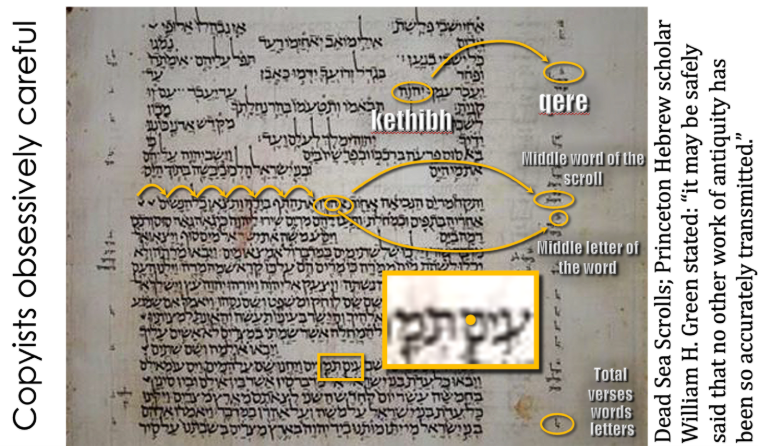
Scholar F.F. Bruce further states:
“They counted, for example, the number of times each letter of the alphabet occurs in each book.” (The Books and Parchments: How We Got Our English Bible, 117)
Using the English language for comparison, the number of times the letter “a” appeared in the book of Isaiah would have been counted, the same for “b” and so on through “z.” The middle word and the middle letter of each manuscript would have been identified; also the verses, words, and letters of every book would have been counted. If the resulting new copy differed from the prior copy (from which it was copied) by more than 3 differences (based on the above methodology), the new copy was destroyed. When a successful new copy was accomplished, the old copy was either thrown out or delegated for use in schooling, etc. (Paul D. Wegner, The Journey from Texts to Translations: The Origin and Development of the Bible, 171-75)
Prior to the Masoretic scribes, the Jewish Talmudists (c. 100 AD to 500 AD) had a very rigid process for copying OT books. Samuel Davidson describes the process (numbers added by Bible Scholar Norman Geisler; below quote from Josh McDowell, The New Evidence that Demands a Verdict, 1999, 74):
“[1] A synagogue roll must be written on the skins of clean animals, [2] prepared for the particular use of the synagogue by a Jew. [3] These must be fastened together with strings taken from clean animals. [4] Every skin must contain a certain number of columns, equal throughout the entire codex. [5] The length of each column must not extend over less than 48 or more than 60 lines, and the breadth must consist of thirty letters. [6] The whole copy must be first-lined; and if three words be written without a line, it is worthless. [7] The ink should be black, neither red, green, nor any other colour, and be prepared according to a definite recipe. [8] An authentic copy must be the exemplar, from which the transcriber ought not in the least deviate. [9] No word or letter, not even a yod, must be written from memory, the scribe not having looked at the codex before him. [10] Between every consonant the space of a hair or thread must intervene. [11] between every new parashah or section, the breadth of nine consonants; [12] between every book, three lines. [13] The fifth book of Moses must terminate exactly with a line but the rest need not do so. [14] Besides this, the copyist must sit in full Jewish dress, [15] wash his whole body, [16] not begin to write the name of God with a pen newly dipped in ink, [17] and should a king address him while writing that name, he must take no notice of him (Samuel Davidson, The Hebrew Text of the Old Testament. London: 1856. Quoted in Norman L. Geisler and William E. Nix, General Introduction to the Bible. 89).”
Copies not adhering to the above principles were buried or burned or banished to the schools to be used as reading books. Once certified, the new manuscript was considered just as valid as the prior copy, which was destroyed when any age-related issues occurred to the manuscript itself.
The Zugoth were assigned to the OT transmission from the second to first centuries BC. The Tannaim (“repeaters” or “teachers”) were active until 200 AD. The Sopherim were Jewish scholars and custodians of the OT text between the fifth and third centuries BC.
The above does not present all the relevant information on the transmission of the OT, but is enough to display the incredibly unique levels Hebrew scribes went through to ensure fidelity to the originals. There are also interesting studies from other fields, for example, archeological discoveries provide excellent verification of historical reliability and also shed light on numerous people, places, and events discussed in the Bible.
If you read and look into the Bible a little bit, then I can understand how you could reject the Bible is the Word of God and is trustworthy and reliable. However, such insignificant study provides you with only insignificant understanding. If you read and look into the Bible on an appropriate level – considering its credentials and potential impact on you – you will be amazed how clear it becomes God is behind the Bible and there is no other source in all human history able to compare with the credentials or the ability to add wonders to your life.
A test of reliability: the Dead Sea Scrolls
Before the discovery of the Dead Sea Scrolls (DSS), the earliest Hebrew manuscript evidence dated to the tenth century (900s AD). When the DSS were discovered, over 300 Hebrew copies of OT books were included, dating from the third to the first centuries BC. All copies (parts, whole) of the OT books were included in the DSS, except for the book of Esther.
When the DSS were discovered, the world could then compare the Hebrew documents from the third to first century BC to the later Hebrew manuscripts of the tenth century AD, a period of transmission of about 1100 years. The comparison showed that after 1100 years of transmission, the two sets of manuscripts were, for all intents and purposes, the same.
For example, as Geisler and Nix explain, for the 166 words found in Isaiah 53, only 17 letters are in question when comparing the Masoretic (standard Hebrew) text of 916 A.D. and the Dead Sea Scrolls’ main copy of Isaiah, copied about 125 b.c. Ten of these letters concern different spellings, so they don’t affect meaning. Four more concern small stylistic changes like conjunctions. The last three letters add the word “light” to verse 11, which doesn’t affect the verse’s meaning much. The Septuagint (the ancient Greek translation of the Old Testament) also has this word. Thus, only one word in a chapter of 166 words can be questioned after a thousand years of transmission, of generations of scribes copying the work of previous scribes. Gleason Archer said the Dead Sea Scrolls’ copies of Isaiah agree with the standard printed Masoretic Hebrew text “in more than 95 percent of the text.” The 5 percent of variation consisted chiefly of obvious slips of the pen and variations in spelling.” (Archer, A Survey of Old Testament Introduction, 29) Their discovery further justifies William Green’s conclusion written nearly 50 years earlier: “It may safely be said that no other work of antiquity has been so accurately transmitted. If it was so well preserved for this period of time (c. 100 b.c. to 900 A.D.) that previously wasn’t checkable, it’s hardly foolhardy to have faith that it was for an earlier period that still can’t be checked. (Norman Geisler & William Nix, A General Introduction to the Bible, 263)
Bruce Waltke’s lifetime study of the OT texts led to a similar conclusion for the entire OT: “95 percent of the OT is…textually sound.” (Waltke, “Old Testament Textual Criticism,” 157-58) The 5 percent in question does not impact any key Christian belief, and based on the pattern of discovery and confirmation we have observed so far, as more texts are found and the plethora of existing findings still waiting to be studied and translated, the percentage of uncertainty will decrease.
