
Brief Answer:
The question of errors in the Bible is a secondary issue, the primary thing we need to know is if there is a God behind the Bible. If there is, then the issue of errors becomes secondary.
But, what if you think there is a provable error, what do you think this means?
Detailed Answer:
I do not think the Bible has contradictions or factual errors, but am always willing to discuss. And I have come across questions of possible errors I have not resolved.
What to watch for when you check a supposed error
Most of the supposed errors proposed by genuine questioners or skeptics have already been shown not be issues once proper research was done. In fact, Frank Turek provided a useful acronym, which resolves so many examples of supposed contradictions or errors.
S – What’s the SITUATION
Don’t read just one verse, what is going on in the context surrounding that verse.
T – TYPE of literature
Is it history, poetry, law, prophecy, parable? You have to interpret different types of literature differently.
O – Who is the OBJECT of the message
Was it applicable only to the ancient Hebrew tribe in God’s attempt to have them stand apart from their neighbors, or just to one person in the New Testament church, or universally?
P – Is it PRESCRIPTIVE or descriptive
Is the passage just telling what the writer or people of the time thought, or was it God directly giving truth? For example, I had someone tell me the Bible believes in folk magic as Jacob used some bizarre breeding trick to help the coloring of his flock. However, when we read the passage we find this was Jacob’s method to help control the situation, but later in the same account it was noted that God had blessed Jacob with the outcome (it was not due to Jacob’s actions).
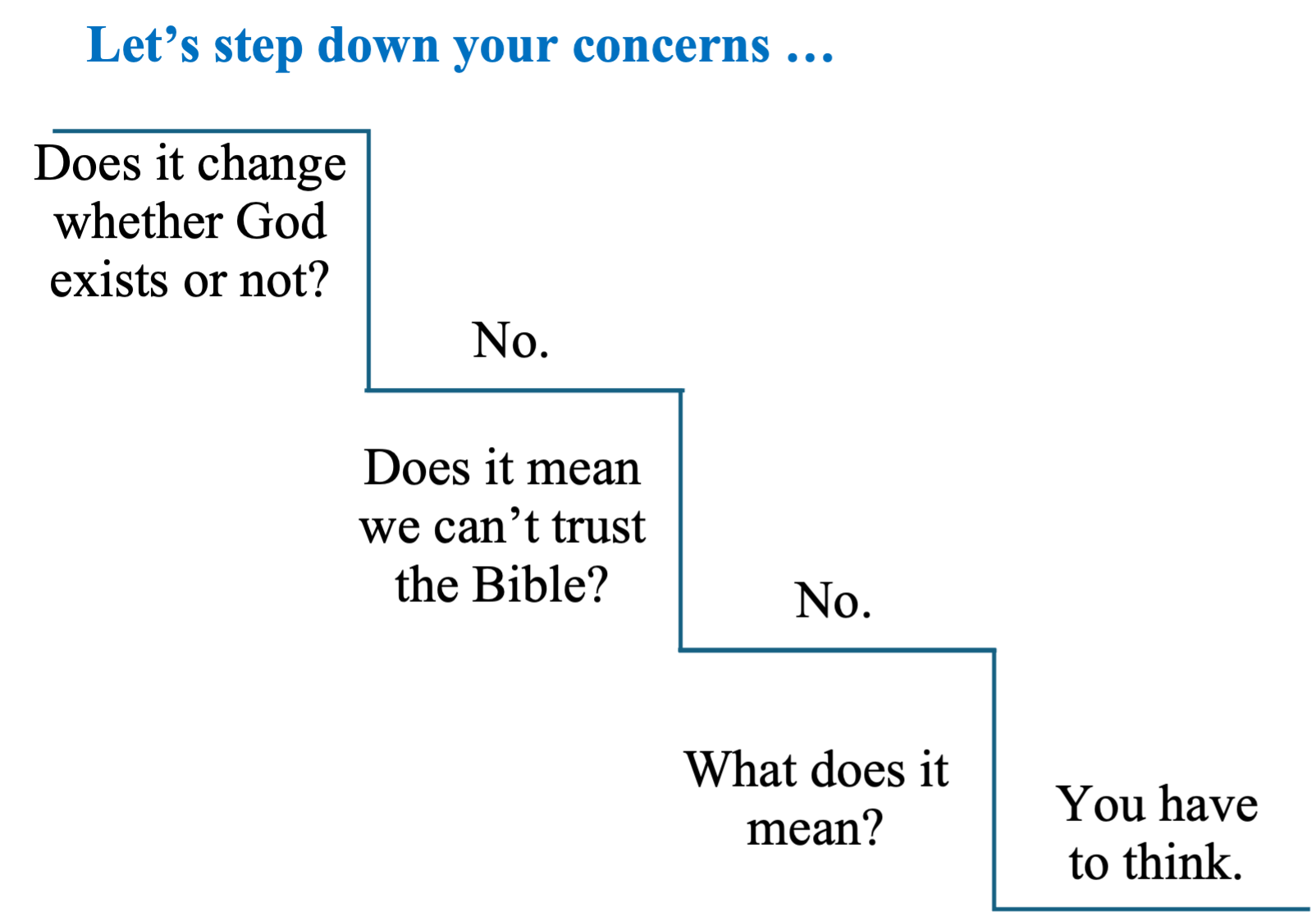
Let’s Step Down Your Concerns
Sometimes I have not researched, or do not remember the research well enough to provide an answer for a supposed error. But no matter what the supposed error is, you can just go with the hypothetical situation and say, “Let’s just say it is a proven error – so what? What do you think this means?”
1. Does it change whether God exists or not?
No. This issue does not change all the other evidence surrounding God, including the evidence from the beginning and cause of the universe, the fine-tuning, verification through history, Jesus’ resurrection, existence of objective morality, and the demonstrably beyond human knowledge provided in the Bible, and more. All this evidence is covered throughout the website. The most reasonable belief, based on the evidence, is God exists and has personal interest in us.
If you disagree, then what evidence do you have to validate your belief, and what answers do you provide for the evidence posed in just this website?
2. Does it mean you don’t need to take the Bible seriously, or you can’t trust it?
Of course not. We already established the evidence is unrivalled in showing there is a God behind the Bible. If you believe you do not have to take a resource, having such credentials, seriously, then what are your reasons?
3. So, if there was an error, then what does it mean? Do not stop thinking, think more.
For example, let’s say we come across evidence proving without a doubt there was never a time when only one man and one woman existed. It leaves us with a couple options:
- One of the other theories Bible believers accept may be the accurate interpretation, and doesn’t contradict the Bible. Such as Adam and Eve having existed alongside pre-human species, and being unique in either being specially created by God or simply having their physical form endowed with their spiritual component. Or, the theory that the couple is only an analogy of humanity as “Adam” is a Hebrew word derived from adamah (soli/ground) and means “man”.
- Or, the biblical account has an error.
I think Adam and Eve are a literal couple. Therefore, if the former options is true, then I would need to be more mindful of my reading, teaching, extrapolating and application of the biblical writings. If the latter is the case, the Bible has an error, then this would be more interesting, so this is the situation we will discuss here.
What would it mean?
It means God simply didn’t care to keep an error from slipping into the biblical text.
It may surprise some people, including some uninformed Christians, to know it is not part of Christianity to believe every single word in the Bible is kept absolutely safe through all time by God. That is what Muslims believe about the Koran.
According to Islam, every single word in the Koran (and the Tanakh or Old Testament, and the Gospels of the New Testament) are kept pure by God, not a single change or mistake is ever made in those scriptures.
Christianity, on the other hand, has always shown what possible textual changes or uncertainties exist in the margins or footnotes of the Bible.
Therefore, we know God is behind the Bible, and know God didn’t worry about letting in a small percentage of uncertain changes. Scholars recognize we have what was originally written, except for those uncertainties, which are all noted in the footnotes, and none impact doctrine as all the major aspects of Christianity are covered over and over throughout the Bible.
Similarly, just as God was fine with allowing the textual changes, if there was an error, it would simply mean God didn’t worry about that error getting in and degrading the message he wanted to communicate to us.
Does it mean we can’t trust the Bible?
Again, of course not, as it doesn’t remove: (1) the evidence demonstrating the Bible is the only source we have from God, or (2) reasons to think God is in a position to know or understand better than us, or (3) all the evidence supporting things we do reliable know from the Bible. Yet, we would have to be cautious, and “test and examine” everything as the Bible already instructs us to do.
Has this situation ever come up before? Yes, and we have two historic and excellent examples. One example, discussed in this website, occurred when every belief system and the accepted consensus in science claimed there was no beginning of the universe, but the Bible seemed contradicted by clearly indicating there was.
In this case, it took some of the greatest discoveries in modern science, and entirely one-sided evidence, to bring the consensus understanding in-line with the seemingly absurd claims the Bible made thousands of years prior. Those in science, who rejected the biblical claim, were surprised and humbled.
On the other hand, further back in history, we have the church following the general understanding of the time that Aristotle set up thinking the Earth was not moving, and certainly not revolving around the Sun as Copernicus and Galileo later claimed. Galileo was a Bible believer, yet felt the general understanding of the time, and inaccurate extrapolations from the Bible regarding an entirely stationary Earth were wrong. Those in the church, who promoted the faulty claim, were surprised and humbled.
Should we be concerned about the possibility an important error was allowed in, which is foundational and will cause unredeemable consequences because we believed it? No.
Aside from what was noted in the previous paragraph, we have evidence God cares for us and is capable of getting to us the Word he wants. Jesus and the resurrection provide demonstrably strong reasons to believe the Creator loves us deeply and has the authority to back up this care. The New Testament did not invent the resurrection, the resurrection invented the New Testament as evidence supporting the resurrection is what motivated the New Testament writers.
If God went through what happened at the cross for us, and verified his authority with the resurrection, then claiming you can’t trust the Bible, or don’t need to take it seriously is foolish. If you don’t recognize this, why? What is your explanation and support?
There is already a trend to be aware of
The trend through time has been: claimed biblical errors have, through further discovery, resulted in incredible affirmation of the biblical account.
How should I approach this topic of the existence of Adam and Eve?
It depends. Some Christians throughout history, who fully accept biblical authority, have different views concerning the historicity of Adam, some of which will be briefly noted below, and would not have any problem with Adam not existing.
Many others, myself included, hold Adam as historical. So let’s imagine, as noted earlier, we get proof, or even very good reasons to believe Adam never existed, then of course we should re-evaluate some things. “a” and “b” noted above are established on their own evidence, but it would mean either our reading, teaching, or thinking about what we think the Bible claims is inaccurate on this issue, or the Bible has an error.
In this case, for people like me, who accept the existence of the historical Adam, this would pose a problem to deal with as I think both Paul and Jesus seem to assume Adam as historical, as does my basic understanding when reading Genesis. How should I approach this?
- Watch out for your defense mechanisms messing with your seeking truth.
Just as those who are comfortable in their position of rejecting God, those of us who accept God are comfortable in our current beliefs. Meaning, a number of psychological, personal, and emotional mechanisms may act against good thinking. We need to be aware of this because reality doesn’t fail in bringing the consequences to those choosing to accept what is comfortable, as opposed to truth.
Additionally for Bible believers, the same Bible we supposedly follow, warns us to test and examine things even religious teachers claim (1 Thessalonians 5:21), and at the same time, be humble in your understanding and loving towards those who may disagree with you. Believers have been taught incorrectly before, and embarrassed themselves by not humbly taking in new information and thinking.
- Gather a comprehensive case appropriate for the likely impact of the issue.
While trying to keep to the truth, as opposed to what I may want to believe, I would ensure I had the most complete understanding of the biblical account I could. It’s worth noting, this issue of Adam and Eve is a secondary issue to me, regardless of the answer I found, it does not impact the answers to the big questions enough to warrant the exhaustive seeking I would do for other decisions in life. But, if I had a passion for this issue, then I would seek a proper, if not exhaustive, understanding of specific ancient Hebrew, Greek and Aramaic words used, the specific literary styles operating, the full context of the Bible, how all of it comes together, and what meaning it would provide to those of the time recording the accounts.
- I would apply the relevant knowledge from other fields of study, including, biology, history, ancient literature, etc.
If you don’t think God expects us to use information gathered from sources outside the Bible, why do you think that? I’d recommend looking inside the Bible more, as God consistently used extra-biblical sources to support people in knowing truth, even noting we can know there is a God just by reading the book of nature.
- I would take all the information and determine what answer stands apart in best explaining what we have.
Which, if my hypothetical situation of discovering as fact there was no historical Adam, leaves two possibilities, either (a) the biblical account was inaccurate, or, (b) my former understanding of the biblical account was wrong, and I gained a better/more accurate understanding of the Bible.
If the biblical account was proven to have an inaccuracy, then see “a-c” in the previous answer, and bottom-line: the evidence still shows God is behind the Bible, and God cares for us deeply and is not deceptive, so whatever error came into the Bible, while deserving further thought and consideration, would simply mean God didn’t care to keep the error from entering, and wouldn’t be of a nature to hurt us.
Option (b) has occurred before in history. Even regarding the Genesis account, there are strong Bible supporters and scholars throughout history who believe in different theories – they have some freedom to do so – the Bible coverage of creation is not as exhaustive or detailed as we may want.
Again, this is just supposing an error had been proven. Remember, the Bible is a book:
- Composed of writings from over 40 different authors from various backgrounds (including shepherds, kings, scholars, warriors, and fishermen).
- Written across a time span of over approximately 1,500 to 2,000 years.
- Written from a geographical scope of three different continents.
- Written across a cultural scope of time, distance, and three distinct languages.
- Included a wide range of literary forms: including historical narrative, poetry, prophecy, law, wisdom literature, and personal letters.
- Best-selling book of the year, every year. Because it is not a new release it is typically kept off weekly bestseller lists, but it is the most translated, distributed, and widely read book in human history.
Find another book in human history that has this much diversity in its authorship, this broad of coverage of life issues, including some of the most controversial issues, been studied more exhaustively line-by-line than any other writing in history, written so long ago in the past and able to have all modern examination applied to it, and still demonstrates the level of unity of thought, internal consistency, and accuracy as the Bible.
A book having the background like the Bible, if not having a God behind it, should have a massive list of proven errors. The fact it does not should make the questioner or skeptic think more.
