
Modern science has determined properties of the cause of the Universe, and these specific properties were predicted by the biblical account thousands of years in advance of modern science, or any other source. Does the necessary, uncaused, cause of the Universe have to be the biblical God? Or, is there anything else that could be the cause the universe?
What alternative, no-God-involved causes of the Universe are possible?
In all scientific and philosophical literature, there are only four possible types of causes for the universe:
(1) a natural cause, such as: quantum vacuum fluctuations, the Universe somehow creating itself, or the claims of all belief systems with a God that is part of the Universe, or as Eastern religions claim “all is One with the Universe”.
(2) some type of hypernatural stuff, such as: a multiverse, some supernatural or hypernatural matter, energy, or force.
(3) an abstract object, such as: laws of nature like quantum gravity as Stephen Hawking suggested, or mathematical structures, or Leibniz’s “monads”.
(4) an immaterial mind, such as: the biblical God. All non-biblical proposed Gods are part of the natural Universe and fit within the natural cause type.
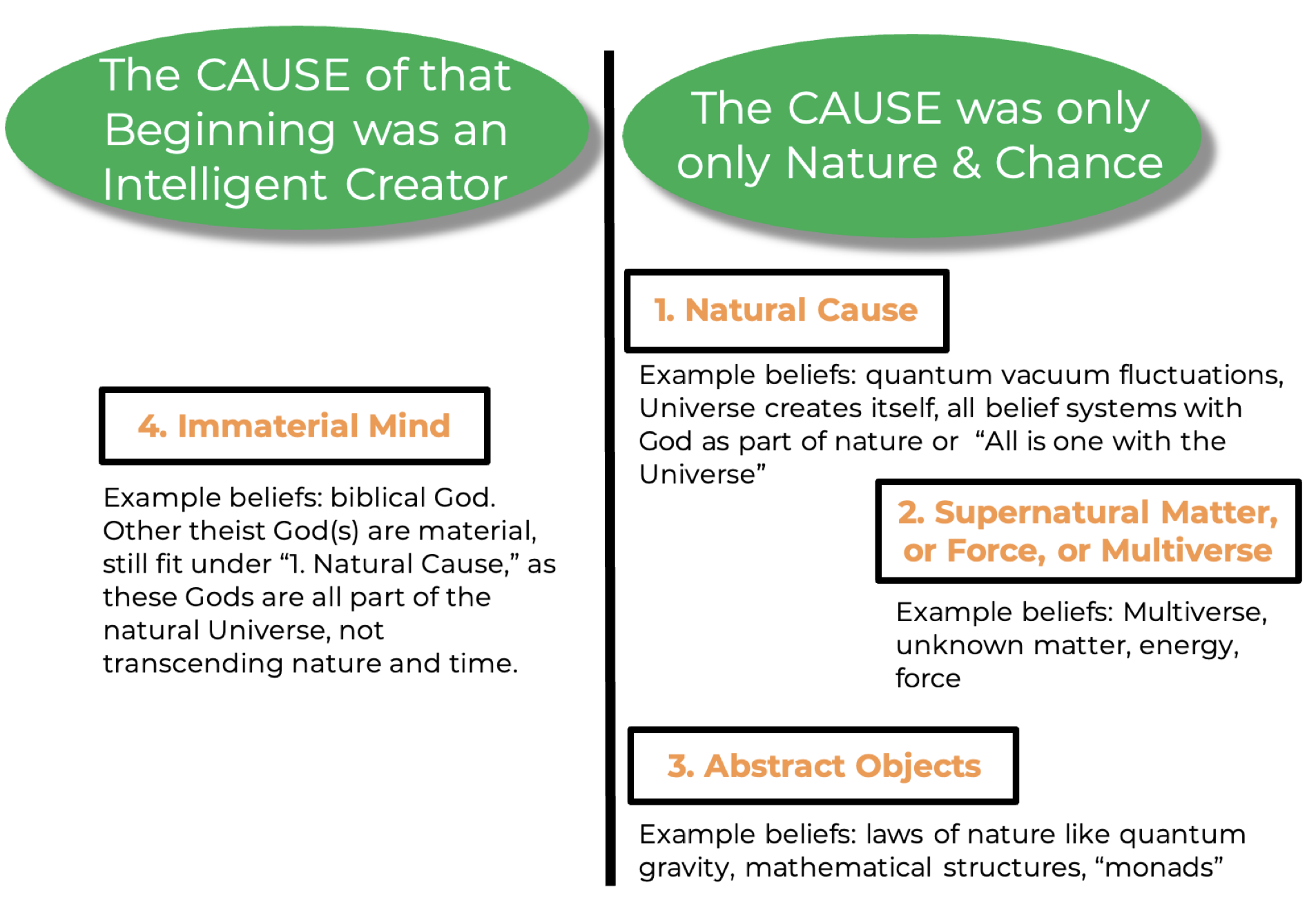
Philosophy and Scinece have put the Four Types of Possibly Causes to the Test

1. Naturalism or materialism has already been disproven.
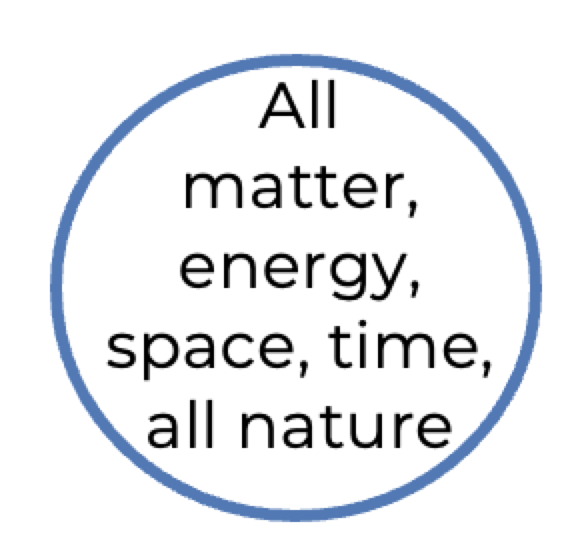 If all things of the Universe (of nature) are contained in that circle in the image, then because all in that circle had a beginning and was caused, the cause must be outside the circle – otherwise being in the circle just means it had a beginning and also requires a cause.
What does this mean? Naturalism (the belief all things can be explained by things in nature and there is nothing supernatural or beyond nature) has already been disproven by modern scientific discoveries.
2. Something in nature cannot be the cause of nature – because there was no nature. There was nothing, not anything, or at the least, no natural things of this Universe. A “God” that is claimed to be “one with the Universe or nature” would also need a cause, and would also suffer the same fate as our Universe – what physicists call “heat death.” The cause must be transcendent, supernatural, or beyond nature.
If I was standing on a no-god-exists belief, I would be very uncomfortable with this, but the fact remains, science determined these properties, and those directly involved recognize this:
“The world began abruptly in an act of creation. . . . That there are what I or anyone would call super-natural forces at work is now, I think, a scientifically proven fact”,[1] as stated by Astronomer Robert Jastrow, and echoed by astronomer, physicist, mathematician Sir Arthur Eddington, and others.[2]
3. Logically, nature cannot be the cause because claiming X created X is nonsensical. If you want to say something (let’s call it “X”) creates something else (let’s call the created thing “Y”), then you must presuppose the existence of X in the first place in order to bring about Y. X -> Y, for example, parents -> child. However, people who want to claim some natural cause led to the Universe are saying something in nature (X) created something in nature (X), and they must presuppose the existence of X to create X. In other words, part of nature has to exist before it or the rest of nature exists, in order to create itself and the rest of the natural Universe! Confusing? It should be because it is logically absurd; as Dr. Frank Turek has noted, it’s like believing you gave birth to your parents.
[1] Robert Jastrow, as quoted by B. Durbin, “A Scientist Caught Between Two Faiths: Interview with Robert Jastrow,” Christianity Today, Vol. 26, 6 August 1982, p. 15.
[2] Eddington, Arthur. “The Expanding Universe,” Penguin: Harmondsworth, Middlesex UK, 1940, p.117.

In a debate, an atheist made the traditional naturalist claim, but after being faced with evidence displaying naturalism is already falsified, he adjusted to the argument there could be something beyond nature, but was not God. That was a reasonable thought to look into. What about stuff entirely outside of or beyond our Universe being the cause? Maybe super-matter, a pre-existing quantum vacuum state, or maybe something generating multiple universes?
- Any pre-existing quantum vacuum, supernatural matter, or any nature-like thing in any multiverse would still have a beginning, and therefore, would itself require a cause.
When it was becoming apparent the Universe had a beginning, Arvind Borde, Alan Guth, and Alexander Vilenkin produced five papers over ten years demonstrating even if there were supernatural matter or even multiverses, it would all[1], just like our Universe, have a beginning and therefore require a separate cause. It just pushes the need for the necessary, uncaused, transcendent cause back-a-step, as displayed in figure 3.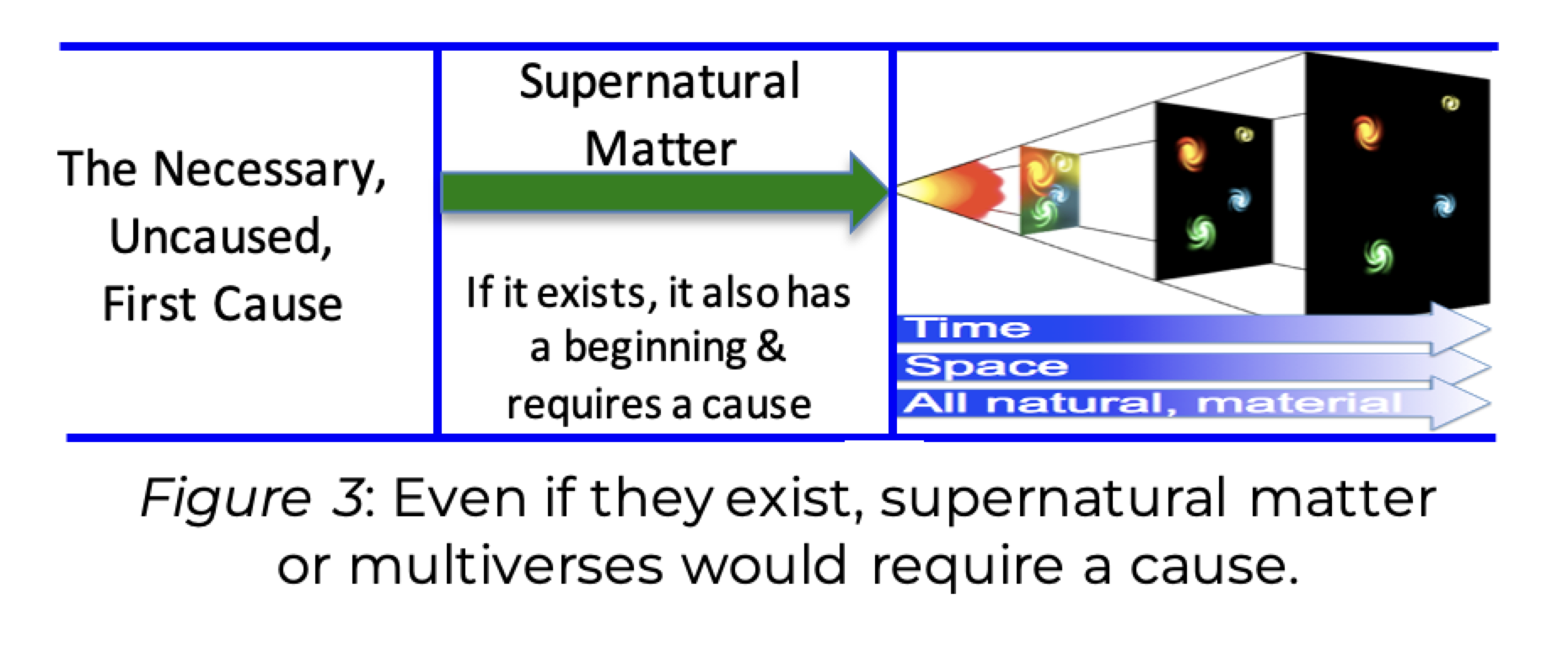
- Any hypernatural explanation still fails because one thing we know about matter, energy, or any part of any universe – nature is unstable and ceaselessly changing.
This is how things get done as a fundamental property of any type of natural thing. Sometimes it takes a long time to be a change we can measure, but inevitably nature always hits that point where it changes. Any natural stuff is always moving closer and closer towards heat death (or at most a cold expansion of space) when all the energy, or instability, which is what nature uses to change and do anything, is used up, and nothing else would be able to happen.
Any natural cause beyond our Universe cannot be the eternal first cause, because, if so, then a long time ago we would have already reached heat death – no instability or potential to do anything – yet, the fact stars are still shining disproves any natural cause even beyond our Universe.
A natural or even hypernatural cause, like anything in nature, is described by initial conditions (how it starts off) and natural laws describing how nature constantly changes over time. Therefore, a flashlight can be compared to a supposed natural cause of the Universe as both can be described by the initial conditions and natural laws involved. If a flashlight were turned on, then knowing the initial conditions (new batteries) and natural laws involved (batteries convert chemical energy into electrical energy, and the reaction can be sustained for maybe 24 hours in typical flashlight batteries), what would we be observing if the flashlight had been turned on an infinite time ago (or even a week ago)? No light. This is exactly what we would see if any natural thing caused the Universe, because it would similarly have used up all ability to do anything, not a single star would still be shining – no light.
Therefore, even if there were some speculative stuff beyond our universe it cannot be the necessary, uncaused, first cause because even if it was in another time dimension (separate from the time dimension that began with our Universe) it would have ran into heat death a long time ago, and no stars would be shining, or anything else happening.
- What if some super-matter or quantum vacuum was outside of our universe and outside of any time dimension, in a timeless state?
If no time passes, then nature would not move closer to and eventually reach heat death. True. But if the super-matter was outside of time – then nothing can happen – including causing our Universe because physical processes require time to do anything.
We describe the changes in nature with equations, and the equations assume or depend on time. For example, here is the equation for the radioactive decay of an atom: (N(t) = N0*e-λt). If in a timeless state where (t)ime equals zero in the equation, then the result is: N = N, which means there is no change, there can be no change, nothing happens.
If there were any natural stuff outside of time, then it would simply stay the exact same forever.
- Philosopher Richard Swinburne notes any cause is either explained as a NATURAL CAUSE, which is fully explained by initial conditions and the natural laws followed, or a PERSONAL AGENT CAUSE, which has the added factor of choice. One or both types of causes may be involved in an effect.
For example, how do you explain the effect of the teapot boiling?
Natural explanation: The flame’s heat is conducted through the copper teapot bottom, increasing the kinetic energy of the water molecules to the point of some breaking the surface tension of the water and come out as steam.
Personal agent explanation: I put the teapot on because I want some tea.
- The first cause of the universe cannot have a natural explanation because there was nothing prior capable of change from inaction to action – no initial conditions or laws to work on them. Therefore, the first cause must involve a personal agent.
- If just a super-natural cause, why just 14 billion years ago? When the conditions were right the natural laws would just make the beginning happen, and that would have been an infinite time ago. Furthermore, if in a timeless state, initial conditions do not change and there is no operation of laws of nature. For a beginning to occur a specific time ago, or from a timeless state, requires a choice to have been made.
- The cumulative case shows other evidence of personal agency, e.g., the fine-tuning of the beginning and development of the Universe.
[1] Some multiverse models did not require a beginning, but any of the models that were capable of leading to our current universe did require a beginning.

Aside from having no supportive evidence, failing to meet most of the necessary properties of the first cause given in the The BIGGER CAUSE evidence in the previous article, and intractable problems mentioned above, the no-God alternatives 1 and 2 could only be held with unreasonable faith (belief in them against the evidence or better reasons), which is why in scientific and philosophical literature only two other options are typically offered for the timeless, changeless, immaterial, uncaused, first cause of the Universe: an immaterial mind or abstract objects.
Abstract objects proposed include mathematical structures, and laws of nature, like quantum gravity, which Stephen Hawking offered in an enjoyable book, The Grand Design. Yet, while Hawking was an excellent scientist, he struggled with philosophy, and the philosophical response quickly invalidates his proposal.
- Abstract objects by definition cause nothing, they DON’T EXIST IN CAUSE-AND-EFFECT relationships, they have NO POTENTIAL TO DO ANYTHING, and are impotent to cause or change any physical thing.
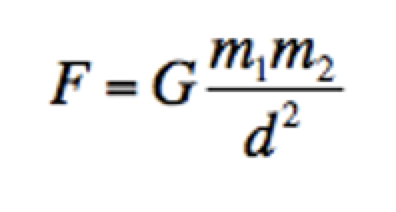
Laws of nature, for example, describe how things change in nature, but do not cause the change. Here is the equation describing the force of gravity:
where m1 and m2 are masses and d is the distance between them. If there is no mass before the Universe begins, then the (F)orce of gravity = 0, and can cause nothing. Actually, the equation is invalid as d wouldn’t even have a value. Nothing can occur. Also, quantum gravity, as well as any law of nature, requires both something to act on, and time to act, which makes it fail just as completely as the other natural causes.
If you disagree, what evidence do you provide for an abstract object creating any physical thing? As Oxford mathematician John Lennox observed in a lecture some summers ago, “The laws of arithmetic never added anything to my bank account.”[1]
[1] Lennox, John C. “God and Stephen Hawking: Whose Design Is It Anyway?” Oxford: Lion Hudson, 2011, Page 41.

This leaves one option left – an immaterial mind – precisely the same type predicted accurately and specifically thousands of years ago by the Bible, and that model has significant further supportive evidence.
Testing models for truth
What model best fits the facts, best explains what we know about the Universe and life, has core beliefs supported with evidence, provides claims (especially predictions) we can test, and the evidence from all fields of study and the trends of further discovery point directly to its accuracy?
These are the standards historians, scientists, attorneys, crime scene investigators (CSI), logicians, and everyone associated with evaluating evidence have relied upon. It is extraordinary how far separated the biblical option stands from all other theories – One of the worldviews is not like the others. These are standard tests for truth, there are more, but these I try to remember using the acronym EETTCCA.
- Explanatory power: The biblical model accounts for all the necessary properties of the uncaused, first cause. While all other models fail to account for the necessary properties.
- Explanatory scope: The model also comprehensively accounts for the fine-tuning evidence, personal agency properties, coherently answers the big questions of life, explains how humanity can have free will, inherent rights and value, true right and wrong, and other areas of study, which natural explanations cannot.
- Testability, especially predictability: Models need to be tested for truth. The biblical model provided multiple, clear, specific predictions about the beginning and cause of the Universe, against the other belief systems, including atheism, agnosticism, and scientific thought, thousands of years before modern scientific discoveries reached the same answers. Nothing else produced by humanity compares (if you disagree, provide examples).
- Trends: As time and discoveries go on, support for the biblical model grows exponentially (this will be shown in a graph in a later blog), while other belief systems have equally steep drops in reasons to believe their validity.
- Coherent answers: The biggest questions in life are all coherently, and elegantly answered by the biblical model, while other models cannot compare.
- Cumulative case: There is evidence in history, philosophy, biology, etc., and when all fields of study are taken into account, the biblical model’s support is consistently best and growing, while other belief systems have serious and fatal failures in one or more areas of study.
- Avoids poor logic: Does not avoid critics or new information, or uses fallacious thinking to protect its claims. For example, Biblical beliefs are not ad hoc, but given thousands of years in advance of confirmation. For good examples of ad hoc arguments, the natural models provide many, including possibly the most ad hoc claim I ever heard, the multiverse, which does though provide fantastic science-fiction.
What worldview(s) is accurate & which worldview belief(s) conflict with reality?
The no-intelligent-agent-involved options all have several features in common:
- Fail to meet even the NECESSARY PROPERTIES of the first cause,
- Do not have EVIDENCE necessary to support belief in them,
- And, as shown above, all have FATAL PROBLEMS.
If you have faith something other than the biblical God having caused the Universe, then why? Is it due to reason, logic, or evidence, if so, then what are your reasons, logic, or evidence with the necessary greater explanatory power, scope, predictive ability, and other features of an accurate model, which surpass the biblical model? If you don’t have such sufficiently, then that says something unsettling about how you approach your beliefs.
If you expect (hope) someday some other cause will be found, then you are involved in wishful thinking, standing on a faith based on a logic error. Think about your stance, “Ignoring the model having astounding, unmatched evidence, I’ll wait for evidence to someday support a no-God-involved model I want to believe.”
We all can be carried along by false beliefs or invalid thoughts at times, but life in many ways exposes faulty beliefs and supports what is accurate. The difference making all the difference – some people, for any number of emotional or willful reasons, live their life according to beliefs they want – while others choose to ensure to base their life on what is supported by reality, leading to the best, expected outcomes.