Part 1. A Big Universe, A Bigger Question:
Does my life have purpose & value, or are we just Dust in the Wind?
Part 2. An intelligent cause of the Universe or pure chance: How can you know?
Part 3. The evidence is in: Learn some amazing science facts.
Part 4. What are you standing on?
What was covered so far & What’s next?
What we know about the beginning & cause of the Universe exposes faults in almost all worldviews, and provides unmatchable support for the validity of the biblical worldview. Is there any other evidence to support whether a personal, intelligent creator or a purely natural cause created the Universe?
Also, aside from further scientific support, how do the worldviews handle the other big guiding questions in life, such as: “Does life, MY LIFE, have objective meaning, purpose and value?”
Part 1: A Big Universe, A Bigger Question …
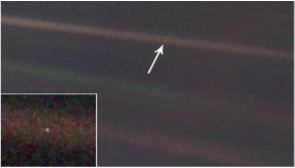
In a debate entitled “God, or No God,” the speaker supporting the claim there is “no God” asked why such a big universe, if a God made it specifically for us? When first asked this question years earlier, I thought … that is a good question, and it seemed even stronger when I began looking into it.
As the Voyager 1 space probe finished its primary mission and was leaving our solar system, Carl Sagan requested it be turned back towards Earth and take a picture from about six billion kilometers away. That pale blue dot, from which the picture and Sagan’s book got their title, highlighted within a beam of light caused by camera optics (sunlight obviously goes out isotropically, or relatively even in all directions) is Earth.
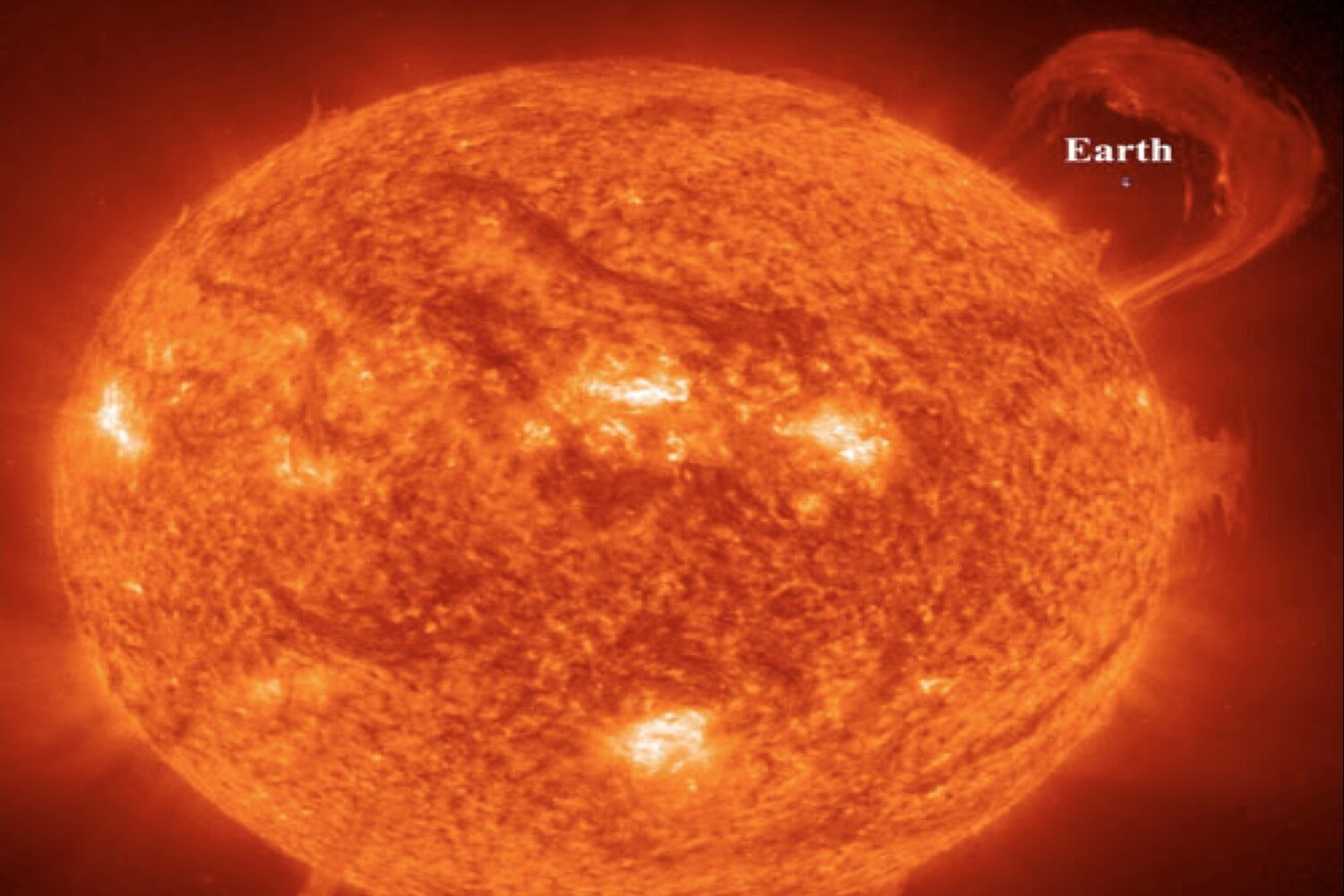
You can see why such an image causes some to question our importance in the universe, when our entire world appears as a tiny dot against the vastness of space. If our Sun were shrunk to the size of a basketball, the Earth would be the size of the head of a pin, 100 feet away. Because the Sun is so much larger (has more mass) than the Earth and other planets, it holds these planets together by gravity to orbit the Sun in our Solar System. Yet, the Sun itself will appear miniscule compared to the size of other stars, like VY Canis Majoris (which is Latin for “Greater Dog”).
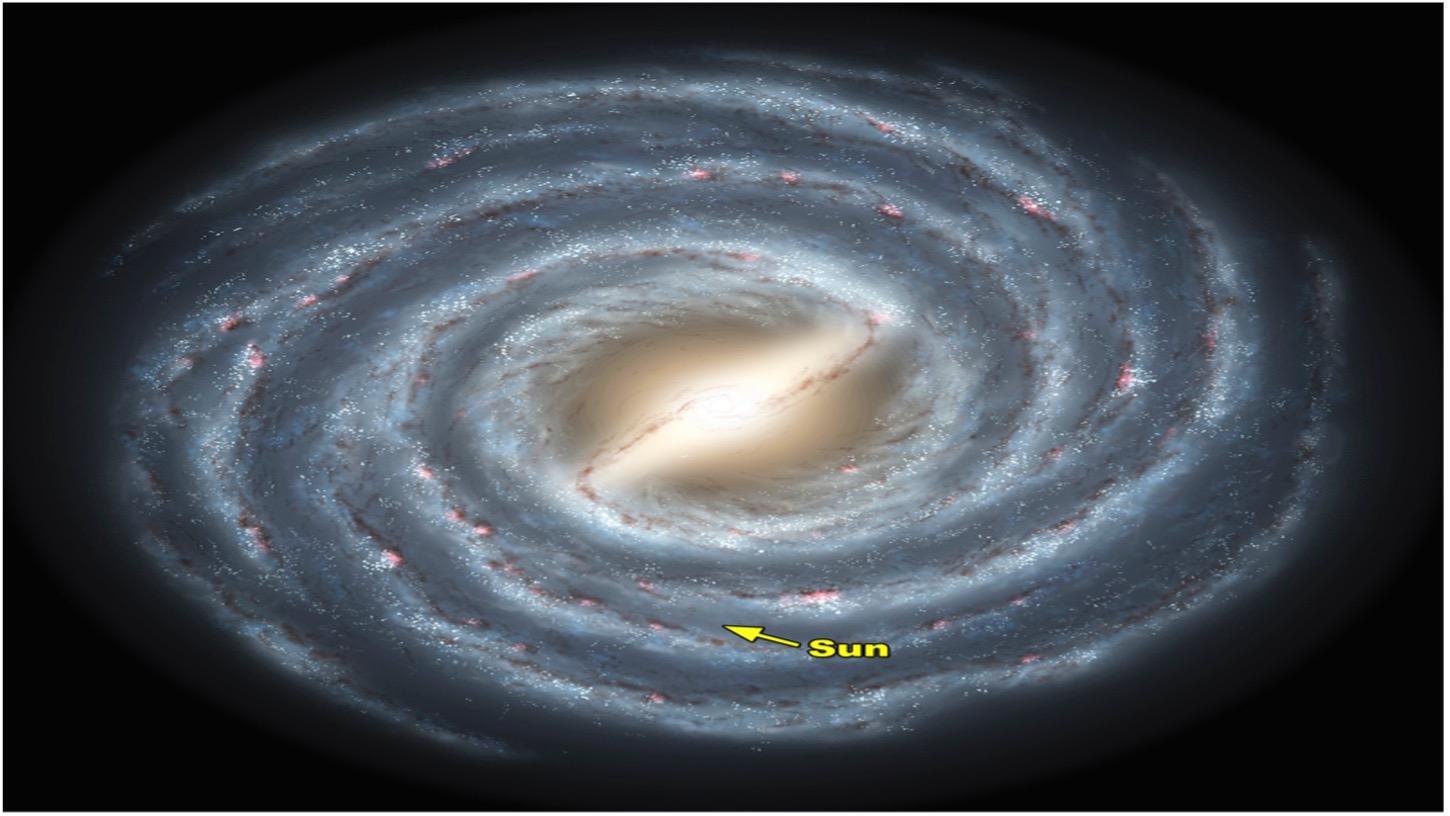
And the Sun and VY Canis Majoris are just two of several hundred billion other stars all held together by the gravitational attraction of all the mass of those stars, gas and dust, dark matter, and a supermassive black hole residing in the center of a system called the Milky Way galaxy. The second image shows a computer-generated image of our galaxy and our Sun’s location.
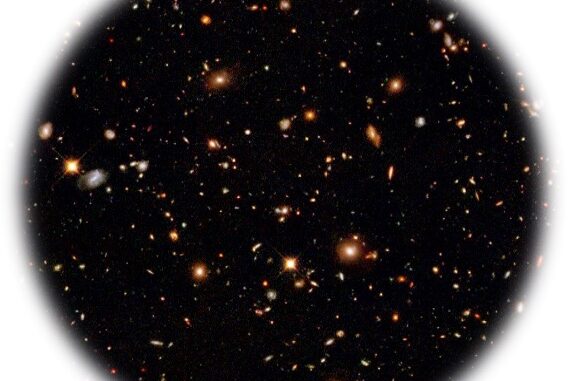
And, our galaxy is not alone. The Andromeda Galaxy is the closest major galaxy to ours. Suppose you heard Yoda was living there giving free light saber lessons, and you had a ship able to travel at the speed of light, you better pack a lot of food, toilet paper, and necessities for the generations after you, as it would take around five million years for the round-trip. And, there are hundreds of billions of other galaxies even further away. If you were to hold your little finger up to a beautiful starry sky, and if you had a telescope capable of enlarging just the space covered by your littlest finger fingernail, this is what you would see. Those aren’t stars, well a few are, but almost all are galaxies, each typically with a hundred billion or more other stars.
Physicist Victor Stenger stabs the point home:
If God created the universe as a special place for humanity, he seems to have wasted an awfully large amount of space where humanity will never make an appearance.[1]
The mind-blowing vastness of the Universe blows the mind toward the questions: what is our meaning, value, purpose in the universe, do we even have any?
And what do we mean when we say “meaning”? Dictionary.com defines the “meaning” we are considering as: “the end, purpose, or significance of something.” Basically, the reason something exists. Philosophers refer to the concept as “telos” (τέλος) from the Greek word signifying “end, purpose, or goal.” For instance, the “telos” of a telephone was communication from a distance, it is the reason it was invented or created.
[1] Victor Stenger, God: The Failed Hypothesis: How Science Shows That God Does Not Exist (Amherst, NY: Prometheus, 2007), 156.
What is the meaning and value of life? It depends.
It depends on what is true. From the absolute vastness of the Universe, we are led directly to this big question about life. If atheism is true, then Bill Nye the “Science Guy,” in addressing the 69th American Humanist Association annual conference, provided a summary answer:
I’m insignificant. … I am just another speck of sand. And the Earth really in the cosmic scheme of things is another speck. And the Sun is an unremarkable star. Nothing special about the Sun. The Sun is another speck. And the galaxy is a speck. I’m a speck on a speck orbiting a speck among other specks among still other specks in the middle of specklessness. I suck.
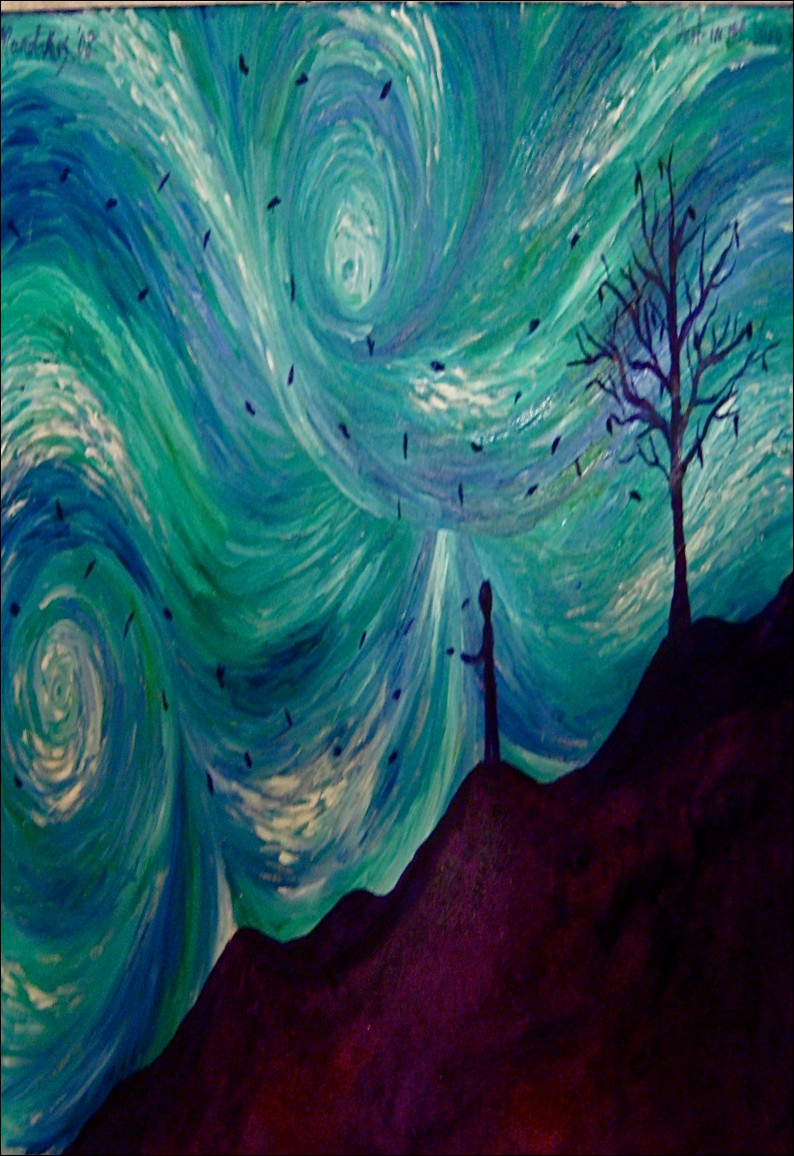 I like how he makes light of a heavy reality, but many other well-known thinkers, writers, songs, and paintings have displayed the heavier, more practical, side of this reality – we are Dust in the Wind.
If nature and natural law is all there is, then we are carried along by forces with only the appearance that we have some control, with no meaning or purpose to life, which is just accidentally caused, can be lost at any time, is all determined by natural laws, and without lasting or objective value, at least no more than other animals.
You may be thinking we have the capacity to love, and sacrifice for family, be a “good person,” and choose what our purposes in life are, but according to understandings from diverse fields of science – no we don’t.
Stephen Hawking states: “Though we feel we can choose what we do, our understanding of the molecular basis of biology shows that biological processes are governed by the laws of physics and chemistry and therefore are as determined as the orbits of the planets.”[1]
Francis Crick, co-discoverer of helical structure of DNA, accurately in-line with the no-god-involved belief observes: “You, your joys and your sorrows, your memories and your ambitions, your sense of personal identity and free will, are in fact no more than the behavior of a vast assembly of nerve cells and their associated molecules.”[2]
Distinguished Cornel University professor, William Provine, states: “Let me summarize my views on what modern evolutionary biology tells us loud and clear . . . There is no ultimate foundation for ethics, no ultimate meaning in life, and no free will for humans, either.”[3]
Just like other animals, or plants, there can be no chosen purpose in life, aside from passing on DNA, because none of our thoughts and actions are free, but all entirely controlled by natural laws. It sounds good to take care of your children and pass on your genetics, but there are fish doing that too. Did the salmon in your salad have the same value as you? Even though humans have more mental capabilities than fish, never forget the same fact looming over every higher functioning organism: all thoughts, feelings and actions come from our brain, and all matter and energy in our brains only and always follow natural laws, therefore, all thoughts, feelings and actions are entirely controlled or determined by nature, not us.
And how much time do you spend thinking and talking about your great, great grandparents, who felt the same sense of value about their life just a spec of time ago? Nihilists, and those that believe nature and natural laws are all there is, understand this grim reality well.
It sounds extreme to say that if there is no God, then:
- Our existence is just coincidentally caused,
- With no objective meaning or purpose to life,
- We are carried along by forces in nature with only the appearance of having any control,
- With all our thoughts, choices, feelings and actions 100% determined by initial conditions and natural laws,
- Leading to no lasting or objective value, no inherent rights, no objective good/evil or right/wrong choices or actions, no justice,
- All we think we have can be lost at any time,
- And with nothing for us after this life ends, except decomposition into component chemicals.
Nevertheless, if nature and natural laws are all there is, then each of these points logically follow. You can find detailed support and explanations in numerous books by leading atheists, and from non-atheists as well as the science and logic follows regardless of one’s beliefs, and if you want more support or details why this is true, see the booklet: The Freedom Scale: Assessing Levels of Freedom Corresponding to Different Belief Systems and Morality: You Have to Sit in God’s Lap to Slap His Face.
[1] Stephen Hawking, Grand Design, pp.31-32
[2] Francis Crick, The Astonishing Hypothesis, 1994, p. 3
[3] Provine, W.B., Darwinism: Science or Naturalistic Philosophy? The Debate at Stanford University, William B. Provine (Cornell University) and Phillip E. Johnson (University of California, Berkeley), videorecording © 1994 Regents of the University of California. (See also: Origins Research 16(1):9, 1994; arn.org/docs/orpages/or161/161main.htm.)
 So, above is one possible answer to our big question. However, there is another possibility—Life, your life, is special, with meaning and value worth more than all the massive galaxies combined, because a personal creator made it all, specifically with us in mind. Sounds really nice, but just because it sounds good, that we have real value and importance endowed by a creator, with an actual purpose for what we go through in life, is not evidence that it is true.
I understand it may seem like there is no way there can be evidence to supply definitive answers, but that assumption gets overwhelmed when you actually start seeing the answers and evidence, including some of the most amazing and important discoveries in all science. Some of these will be covered in the next blog.
So how can we know which of those two possibilities is true, purely natural chance or a purposeful creator? No real value & meaning, or infinite meaning established by an authority? We determine which answer is accurate to reality the same way we do with other questions in life, we follow the evidence where it leads.
Part 2: How do we Know when an Intelligent Agent is Involved? Answer: CSI.
Evidence of Purpose: Ranges & Combinations
Goldfish seem so simple to sustain, basically just add some water and food periodically. Yet, as my nephew tearfully found out, all life is dependent on ranges & combinations.
 Your school locker would not open unless you follow the pattern, and are close enough to the right values on each stop in the combination. Like the locker, unless the universe matches each requirement within a safe range, and all requirements fit in combination with each other, then the locker to life stays closed.
Researchers know, and study the difference between intelligent agents acting and purely natural results. This understanding is productively used in criminal jurisprudence (CSI), copyright law, patent law, reverse-engineering, cryptanalysis, archeology, anthropology, information theory, etc. And we will use it.
The next blog, Personal Cause or Purely Nature-we Know the Difference, will cover how we know when an intelligent agent is involved.
To answer the question from the beginning of this post, why a Universe so big if it is just for us? Answer: because it had to be JUST PRECISELY that big, or we would not be here to even think about it. This is explained in the next blog.