1. “One of these Claims is not like the Others …”
The phrase above is part of a Sesame Street song that asked children to pick out one object from a group, which didn’t belong in the group; for example, a baseball, basketball, an apple, and a soccer ball. Similarly, of all the worldview beliefs claiming to give truth about the God that exists, only Christianity places itself on an entirely other level – on the examination table – by backing the claims with checkable events.
The evidence presented in the previous blogs points to the inaccuracy of atheism and agnosticism, and directly to the reality that God exists. Yet, for any belief system claiming to provide accurate knowledge of God, or communication from God, natural questions come up: What does the source provide to confirm its claim? What evidence? Do these sources provide any verification distinguishing it beyond the ability of people to produce? Or is the source entirely a man-made invention, with no God involved?
Belief systems or models can be tested for truth, the same way we do with other claims or choices we come across in life. Unfortunately, most people seem to have a number a negative criticisms of belief systems they want to reject, and only a shallow idea of positive reasons why they believe what they believe.
Instead of focusing on the negative evidence against atheism, agnosticism, Buddhism, Islam, etc., this blog will focus on unequalled positive evidence only Christianity brings to the table. Jesus established his authority as something entirely beyond man’s capability in numerous ways, and this and other blogs go right to a testable claim of Christianity – maybe the most difficult/amazing thing to accept – the resurrection of Jesus.
2. Easter: the greatest T or F answer possible
As noted earlier, the Easter account is either true, or false, there is no middle-ground, and considering what is at stake, makes the account either unimportant (and pitiful to believe in), or ultimately important (and pitiful to reject) – the one thing it is not is only moderately important.
The Easter account has been read and studied by the best minds, effort, and tools, more than any other claim throughout history. There is so much research able to be done on all the evidence surrounding the resurrection, it can appear overwhelming. But, we can begin with a simple approach because the experts have scoured the evidence with the finest-toothed combs throughout history, which has led to a consensus on critical facts.
If scholarship in an area of study reach such a consensus on critical facts, then the options become clear and limited. Therefore, we have a tool to directly deal with the question of whether the biblical explanation, or a natural (no-God-involved) explanation fits the facts.
3. Facts Up, Options Down
We enter this section knowing[i]:
- Truth about worldviews exist, and will have the highest quantity and quality of impact on you, depending on whether your choice fits reality, or not.
- A personal agent, transcending all nature and time, purposefully caused the existence of all nature and the possibility of life.
- Miracles are possible as the greatest miracle (all nature coming into existence) already occurred and we have scientific confirmation.
- The Bible is unmatched by any other belief system, science or anything else produced by humanity, in foreseeing not only numerous aspects of the personal cause of creation, but also aspects of the creation, which modern science was only able to verify millennia later.
- That same unmatched Bible also predicted the personal Creator would come to personally reveal his nature, the value we have, how serious our situation is, and provided qualifications pointing to only one person in all history to be this Messiah.
This is very serious background knowledge that must be applied to the next logical question: What happened with Jesus?
While there is an entire comprehensive case available to discover yourself[ii], most of us do not have the time or scholarship to do so. However, in this case, there is a specific set of “facts,” meaning circumstances surrounding the resurrection that are so well-researched and well-established by scholarship, beyond any competing claims, they have risen to the level of being the best explanation of the evidence and most probably true.
Further, these facts are significant enough to limit viable options of what happened to Jesus, therefore, even these basic facts can have dramatic impact.
The facts chosen are taken from the Minimal Facts argument developed by professor Gary Habermas, who carried on a systematic review of every peer-reviewed book or article, written by one with a finishing degree (PhD), concerning aspects of the resurrection, written in German, French, or English, from 1975 to today. Habermas’ study involved a list of all the events or potential facts surrounding what happened before, during, and after Jesus’ crucifixion, and catalogued what each scholar either rejected, was not yet certain about, or accepted as fact based on the comprehensive case of evidence. The basic criteria Habermas set to be considered part of his Minimal Facts approach: Each of the events had to be established by an “abundance of strong evidences,” having undergone critical historical examination, and the “vast majority of published contemporary scholars with credentials in relevant fields of study have to acknowledge the historicity of the event.”[iii]
[i] Knowing something does not mean having certainty. People’s misunderstanding of “certainty” causes a lot of problems. Science does not believe in certainty anymore, but accepts the best explanation of the evidence as knowledge or knowing something. This knowledge ranges in reliability or probability of accuracy based on the evidence. The same is true of beliefs, and having doubt does not mean disbelief, it is only part of the process of knowing something. Certainty is not necessary or sufficient to know something. Certainty is not necessary because we can “know” something probabilistically, as noted above. And certainty is not sufficient to have knowledge, because we have endless examples of people being certain about something—and were wrong.
[ii] Professors Lydia and Tim McGrew argue against using the “minimal facts” approach, instead noting the strength of the case supporting the resurrection is best found using all the data points that are well-evidenced or should be accepted as true based on the evidence—a “maximal data” approach.
[iii] Habermas, G. R. On the Resurrection: Evidences. Volume One, 91-92.
After going over these five, we will apply them in the Fact Up, Option Down method. I have found only a handful, five, is sufficient for almost any discussion, and use a memory-aid graphic to help people remember the five facts. Take a moment and think about these facts …
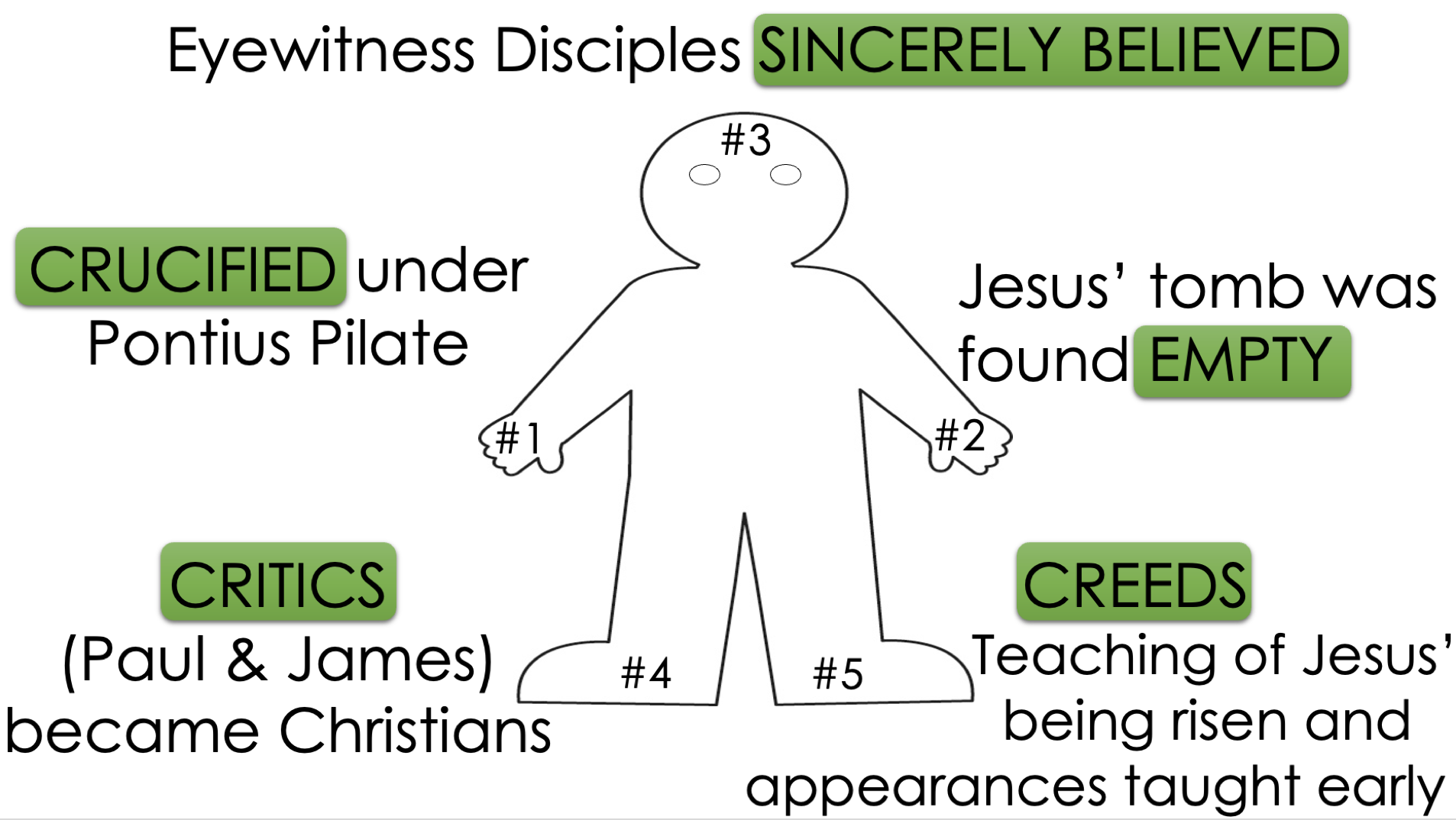
Why are these facts accepted by even critics of Christianity? These are accepted as facts because scholars want to keep their credibility in academic circles, and the flow of evidence is too much to swim against without being swept away as one who goes against the evidence without academic or rational support.
While it is amazing to consider the entire comprehensive case yourself (professors Lydia and Tim McGrew argue the strength of the case supporting the resurrection is best found using all the data points that are well-evidenced, or should be accepted as true based on the evidence—a “maximal data” approach) most of us do not have the time or scholarship to do so. Therefore, as long as a specific set of facts are so well-established by scholarship and are significant enough to limit viable options of what happened to Jesus, the Minimal Facts (or Five Minute Fact Run) approach has dramatic impact.
This means: when considering which of the limited options regarding what to believe happened to Jesus, we can use these minimal facts to evaluate the options. Disagreeing with the established scholarship is fair, and sometimes warranted, but if anyone does not accept any of these facts, or the conclusion these facts support, the burden of proof (which must be borne by anyone making a claim, because a claim is only as worthy as the burden of proof it is able to carry) has already been carried by all the peer-reviewed scholars who established these facts. The burden of proof is now dropped at the feet of the skeptic, who must bear this burden with enough evidence to match or exceed all the evidence presented by the scholars establishing these facts, if hoping to reasonably reject the facts.
Scholars in the relevant fields of study accept as fact Jesus was sentenced and died by crucifixion under the authority of Roman governor Pontius Pilate. Jesus’ tomb was empty days later is accepted as another fact. The third fact is extremely instructive: eyewitness disciples reported experiences they were convinced were actual appearances of the risen Jesus. Obviously, atheist and non-Christian scholars do not claim as fact the disciples saw the actual risen Jesus, but scholars do not have to believe that for our purposes, only that, as probably the most famous skeptic, Bart Ehrman, concludes,
We can say with complete certainty that some of his disciples at some later time insisted that he soon appeared to them, convincing them that he had been raised from the dead. (Bart Ehrman, Jesus: Apocalyptic Prophet of the New Millennium, 230)
Next, two known facts are actually given together to remember easier. The critic Saul of Tarsus, recognized by historians as an honest, highly respected Jewish scholar, and denier and persecutor of Christians, became the apostle Paul after his claimed interactions with the risen Jesus. Also, Jesus’ brother, James, was a skeptic. Wouldn’t you be? How frustrating would it be getting in trouble by your parents, and getting compared to perfect Jesus? Even more, Jesus, his parents and others claimed Jesus is God. Yet, something caused a complete reversal of James’ skepticism. After the claimed resurrection and appearances, James became a prominent leader of the Christian church in Jerusalem, the dangerous city having just sent Jesus to his death.
The fifth accepted fact is the proclamation of Jesus’ resurrection and appearances took place very early, meaning soon after the events themselves. Habermas provides superior cataloguing of this research, and noted a modern revolution in biblical study occurred when scholars realized early creeds were woven throughout the New Testament (NT). Creeds are brief, memorable statements of a person or group’s beliefs.
The NT wasn’t written right after Jesus’s death. So what were the disciples doing before they decided to write the accounts? Most people of that time could not read or write, it was an oral culture, which developed skills and methods for transmitting information effectively without books, and the best way to get the information out was by word-of-mouth through creeds. “Two all beef patties, special sauce, lettuce, cheese, pickles, onions on a sesame seed bun.” This phrase has been stuck in my head for five decades, and if you type it in a search it is probably word-for-word correct as some diabolical marketing expert for McDonald’s made this description so catchy I can’t get it out of my brain. Creeds were also concise and may even come with a rhythm, making them more memorable. So those who eventually wrote the books of the NT were spending their time speaking to people about what they saw with Jesus, and providing creeds to help the people remember the teaching. This is explained below in what has become a discovery so significant that, by itself, eliminates many faulty beliefs people have regarding Jesus.
A good example of a creed is one provided by the apostle Paul in 1 Corinthians 15:3-7. Experts recognized the first phrase used, “For I delivered to you as of first importance what I also received,” is a standard rabbinical phrase (and Paul was highly trained as a Pharisee) to indicate when the author is passing on some sacred traditions or belief statements, which were given to them by some authority. It is similar to how today we put statements in quotes. After this first phrase, then this rhythm begins, and there are Aramaic expressions, which Paul does not use, but the disciples did use, and there is also a syntax change and other signs pointing to Paul receiving this creed from the disciples.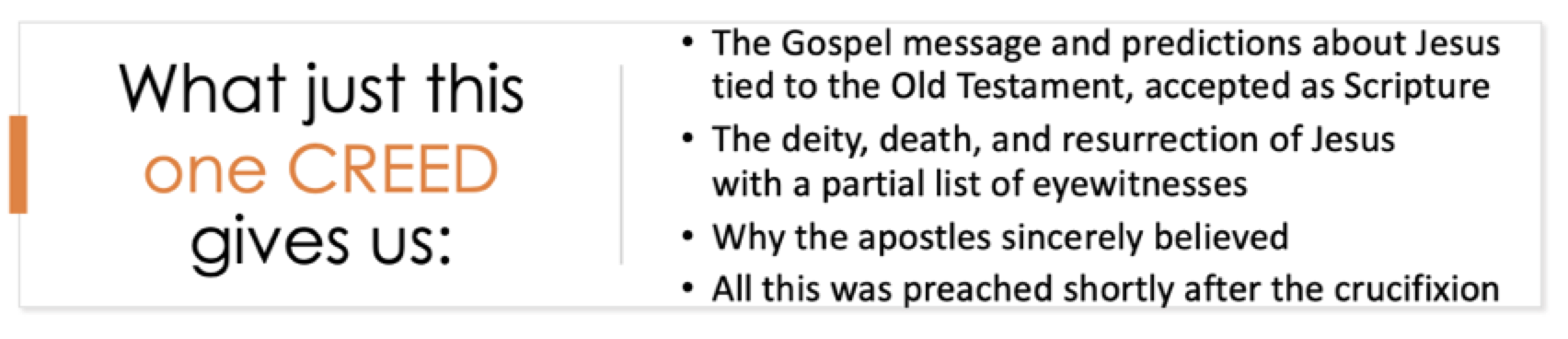
There are numerous creeds, but this is a good one to use because the scholarly consensus regarding the apostle Paul is that he is intelligent, honest, and his well known books are a reputable source of information. If even critical scholars are accepting this, it eliminates extraneous arguments and allows us to focus on what these early creeds mean. Also, this creed spells out the same core beliefs other creeds do: Christ died for our sins as the OT predicted, was buried and was resurrected from death, then made numerous appearances verifying the resurrection. The next verse also notes Jesus appeared to Paul, which is what began Paul’s own conversion.
Based on the evidence, scholars have a good timeline of this creed:
- Paul wrote 1 Corinthians around 55 AD.
- Paul used this creed to teach while he was in Corinth in 51-52 AD.
- Paul first received the creed from Peter & James in Jerusalem in 5 AD, +3 years.
- The creed was set up, agreed upon by all the disciples, and began being used to teach about Jesus within a year or so, likely less, of the crucifixion (see quotes from the scholars below).
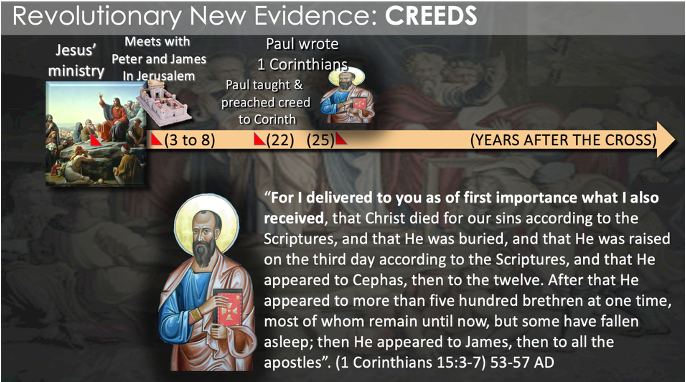
Senior scholar at Ridley Hall in Cambridge, Richard Bauckham, explains in his book Jesus and the Eyewitnesses the consensus view of scholars is Paul was given this creed from Peter and James, when he went to Jerusalem in 35 AD. Paul went to speak with the disciples, and consider how rigorously they would compare their eyewitness accounts, especially in a potentially life-changing set of events. So when did Peter, James and the other disciples begin this creed?
- The Oxford Companion to the Bible: “The earliest record of these appearances is to be found in 1 Corinthians 15:3-7, a tradition that Paul ‘received’ after his apostolic call, certainly not later than his visit to Jerusalem in 35 CE, when he saw Cephas (Peter) and James (Gal. 1:18-19), who, like him, were recipients of appearances.” [Eds. Metzer & Coogan (Oxford, 1993), 647.]
- Gerd Lüdemann (Atheist NT professor at Göttingen): “…the elements in the tradition are to be dated to the first two years after the crucifixion of Jesus…not later than three years… the formation of the appearance traditions mentioned in I Cor.15.3-8 falls into the time between 30 and 33 CE.” [The Resurrection of Jesus, trans. by Bowden (Fortress, 1994), 171-72.]
- Robert Funk (Non-Christian scholar, founder of the Jesus Seminar): “…The conviction that Jesus had risen from the dead had already taken root by the time Paul was converted about 33 C.E. On the assumption that Jesus died about 30 C.E., the time for development was thus two or three years at most.” [Roy W. Hoover, and the Jesus Seminar, The Acts of Jesus, 466.]
- James Dunn (Professor at Durham): “Despite uncertainties about the extent of tradition which Paul received, there is no reason to doubt that this information was communicated to Paul as part of his introductory catechesis (when meeting the disciples the first time). He would have needed to be informed of precedents in order to make sense of what had happened to him. When he says, ‘I handed on (paredoka) to you as of first importance (en protois) what I also received (parelabon)’, he assuredly does not imply that the tradition became important to him only at some subsequent date. More likely he indicates the importance of the tradition to himself from the start; that was why he made sure to pass it on to the Corinthians when they first believed. This tradition, we can be entirely confident, was formulated as tradition within months of Jesus’ death. [Jesus Remembered (Eerdmans, 2003) 854-55.]
Some feel the creed was “in use by AD 30” ( Walter Kasper, Jesus the Christ, trans. V. Geen (Paulist, 1976), 125.). Virtually no scholar puts it beyond the 40s (Gerald O’Collins, What Are They Saying About the Resurrection (Paulist Press, 1978), 112.].).
So we have the Right People …
- Paul, Peter, James and the other disciples interacted with Jesus after the cross, meaning they are eyewitnesses to the resurrection and other miraculous acts.
- They were willing to suffer and die for what they knew for fact was true, or not. How sure would you have to be to devote your life to a claim?
- Paul & James were actually skeptics, then abruptly changed after witnessing and interacting with Jesus after his death on the cross.
Saying the Right Things …
- The creed briefly gives the “Gospel” (good news) message: Jesus died to cover the separation (due to our sin) we have from God, and God rose Christ from the dead as verification of Jesus’ claims and God’s ability to fulfill his plan for us.
- Eyewitnesses are listed. Jesus appeared and gave convincing proofs of his claims for over a month, before ascending into Heaven, and at one time to over 500 brethren (usually this includes just the grown men present, so likely this one crowd was over 1500 people). The disciples and apostles, who then gave their lives to teaching God’s plan, were also counted as direct witnesses.
- This creed directly challenges the skeptics. Being first taught in the very place where Jesus was crucified and buried, where those wanting to end the belief were strongest, and where millions came annually for religious reasons, it is saying, “You know the witnesses, you know the tomb is empty, check for yourself.” This would ruin the belief if it were not true. Instead, so many came to believe Christianity spread all the way to reaching Rome and standing up to every pressure, so Christianity was outlawed in Rome just 19 years later.
Saying you cannot trust the New Testament, doesn’t stand.
- The creed originated before the NT
- Scholars agree we have the creeds as they were originally given
- The creed covers the Gospel message
Significantly Exposing Alternative Beliefs about Jesus as Unreasonable
These people had real experiences, really believed it, and began claiming the central points right after the crucifixion happened. By recognizing these creeds existed right after the crucifixion, scholars have dramatically tightened the restrictions on which options concerning Jesus are valid, and which are exposed as invalid.
For example, saying belief in Jesus’ divinity and resurrection was made-up later – the legend theory – is unreasonable. The belief in Jesus’ divinity and resurrection began right after the cross. Saying the followers of Jesus made the world’s greatest conspiracy – the lie or conspiracy theory – is unreasonable. Scholars, including the critical ones, accept the disciples and apostles really believed the claim, and they suffered and died for what they knew.
A Simple Approach to Analyze the Options Regarding Jesus
Whether you are trying to determine what you believe about Jesus, or are interacting with someone else, who may be asking your thoughts or challenging your beliefs, the approach is the same. And, the approach is simple, follow three steps, and apply the five facts to any claim about what happened to Jesus.
1) First Question to ask: What exactly do you believe?
Clearly figure out where you, or the other person, currently stands: (a) do you believe the biblical claim, or (b) one of the no-God-involved claims, or (c) are not really sure what to think.
2) Second question to ask: Why do you believe that?
Ask this of yourself, or the other person. Why are you standing where you currently stand on this issue? If you do not have significant support, then the way you approach your belief in this area, and your current position is unstable, and so will be the results following from your choice.
Claiming you don’t know what to think is honest, but it is intellectually honest only if you put the necessary effort in to know the evidence available. Have you really looked?
3) Third question to ask: Have you considered even just the Minimal Facts?
In just 5 minutes you can go over the 5 facts shown above, which are well-established by the scholarship, and use them to compare and contrast which explanation(s) fit the facts, and which are exposed as inaccurate, or, at least, are very unreliable or suspect to believe in. Consider the table of theories about what happened to Jesus, and the application of the five facts.
4. Analysis: What happened to Jesus? Every option is falsified, except one.
What explanation best fits these five facts? A quick summary is below, and more detailed coverage of all the possible explanations surrounding Jesus, possibly the central figure in all history and in your life, are covered in following blogs.
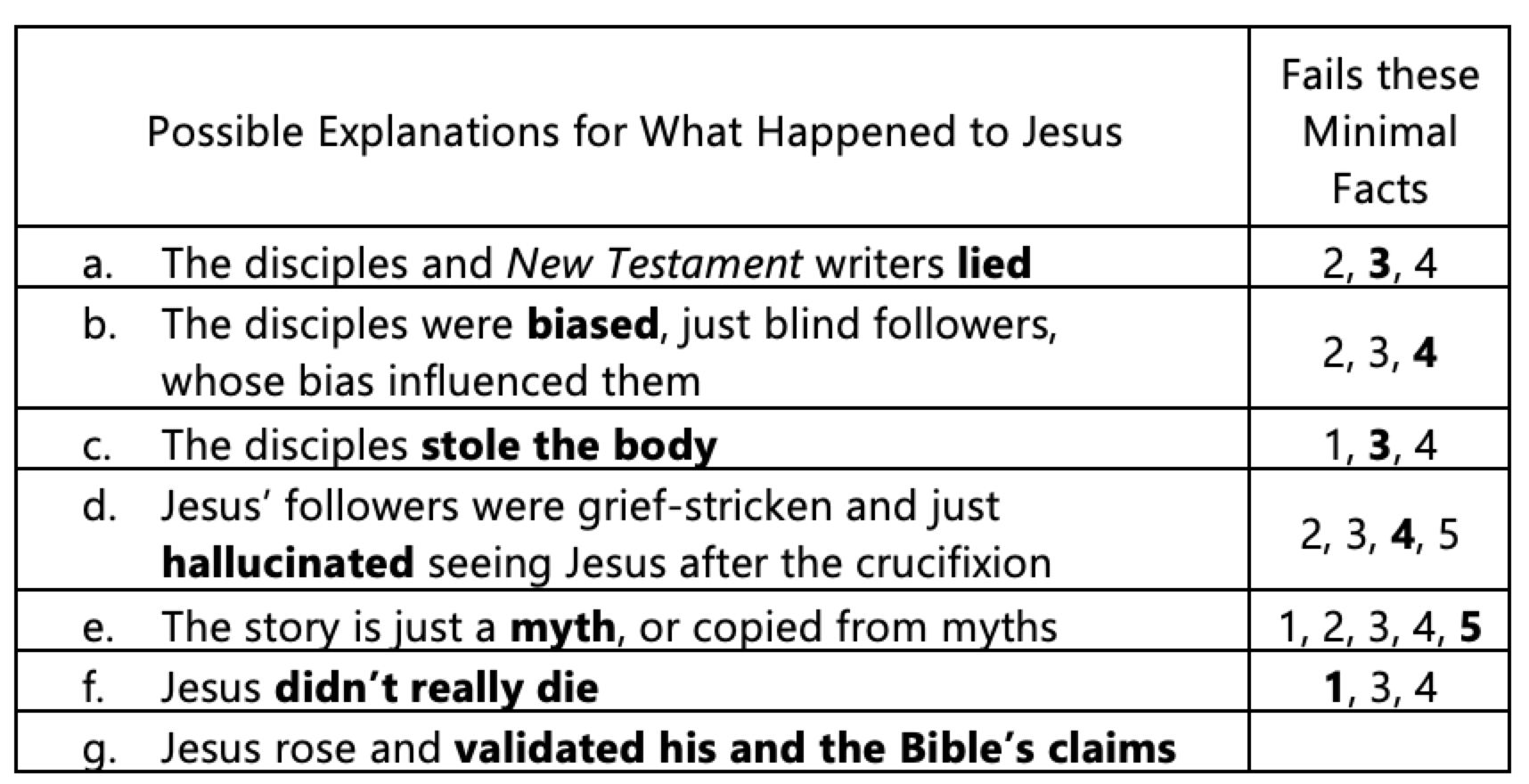
Note: if you want to believe options a,b,c,d,e, or f, then what evidence do you have? Realize, scholarship has rejected the possibility of those options a long time ago, meaning if you do not accept the explanation directly supported by the evidence, you are being unreasonable, unless you provide a better evidenced explanation. What is your explanation?
Are you starting to see how rationally restricted the options are regarding Jesus? Feel free to use the maximal evidence available, but the minimal facts already provide robust falsification of the limited options. For example, consider the hypothesis some believe: the disciples simply lied about seeing Jesus appear to them. This option was rejected long ago, and with good reason as it is refuted with minimal fact #3. The scholars recognize, based on all the evidence, the disciples sincerely believed to have interacted with Jesus after the cross. They were not lying or creating a conspiracy. This hypothesis is also criticized by minimal fact #2, the tomb being empty (unless the disciples somehow stole the body and then lied), and minimal fact #4. Skeptics James, and especially Paul, would not have lied about interacting with the resurrected Jesus as they did not believe in Jesus, and in Paul’s case, actively persecuted those who claimed Jesus was the Messiah.
Two more quick examples. The belief that legendary material crept in over time, so Christian beliefs evolved and added ideas like Jesus being God, or rising from the dead accompanied by public appearances and interactions, are disproven directly within the NT (for example, 2 Peter 1:16 For we did not follow cleverly devised stories when we told you about the coming of our Lord Jesus Christ in power, but we were eyewitnesses of his majesty), and with the creeds, which gave no time for myth or legendary material to develop.
Another theory some people claim, including Muslims due to the Quran’s claim in Surah An-Nisa (4:157), is Jesus did not die from the crucifixion. Historical and medical understandings have led the scholarship to establish minimal fact #1, which refutes this belief and a pivotal point in the Quran to validate or invalidate.
Even after considering the analysis above, and adding in whatever further facts or points you may have, because questions concerning one’s beliefs are so personal, and will have a serious impact, our personal wants and emotions are involved, which means after the intellectual analysis of a choice we face, it is essential to also analyze ourselves to ensure our choice is guided by the best reasons and not our wants or expectations.
More in-depth coverage of personal roadblocks, which run us off the road of correct choice-making, will be added by contributors with psychology or psychiatry PhDs. For now, the next article displays some common Responses Against the Minimal Facts.