
Brief Answer:
When asking whether or not a person believes in aliens, the most common answer I hear is: “They just have to exist.”
That is only a claim, and a claim is only as good as the evidence supporting it versus the evidence refuting it.
A good way to approach this topic is similar to many choices we make in life:
- State specifically what you believe.
- Compare all the evidence you can for and against your belief, compared to the alternative claims.
- Honest to yourself, decide what claim has the best support, and what it means for you.
There are reasons that make belief in intelligent alien life seem reasonable. However, when investigating these reasons with modern science, mathematical analysis, and trends of evidence lead to the following conclusion:
To bet so much global investment and even hope on aliens existing is an astronomically bad bet.
Detailed Answer:
Aliens are everywhere—but are they everywhere in space, or just our imagination?
Are they part of science, or just science-fiction?
Is there reliable evidence, or just unfounded hype and opinions?
Will we ever see an alien?
Whether aliens exist or not, this topic is already having real impacts on your life, and will impact you significantly more in the future.
How Does the Question of Aliens Impact My Life
One impact is certain, aliens give us stories—they fuel imagination, shape blockbuster films, and stretch the boundaries of what we think is possible.
A second impact is certain: an enormous amount of money, time, intellect, and hope is being poured into this question.
Although humans always wondered what else may be “out there” in the universe, the modern scientific search for extraterrestrial life (SETI) began around 1960, when Frank Drake conducted the first formal SETI search. Today, institutions like the SETI Institute operate with tens of millions of dollars annually, supplemented by massive private donations and global collaboration. NASA and other organizations continue to invest heavily, not just financially, but intellectually.
The funnel of money, time, hopes, and people into the search will likely only dramatically increase as population demands, international competition to get ahead, and expensive search requirements continually rise.
Other impacts are less certain, but more personally dramatic.
What If It’s Not Just About Curiosity?
The real weight of the question lies here: What if they exist?
IF intelligent extraterrestrials are real—
and IF they possess the ability to reach us—
and IF you are alive when that moment comes…
Then there will be a redefinition of humanity’s place in existence.
The possibilities span the full spectrum of imagination:
- Our Annihilation
- Our becoming livestock
- Or cooperation leading to new worlds worth of discoveries, knowledge, advancement, and opportunities.
But What If They Don’t Exist?
Then the impact is quieter—but no less profound.
If alien life does not exist, then the consequences are not cosmic… they are human.
It means vast resources—financial, intellectual, emotional—are flowing into something that doesn’t exist to hold the investment. Therefore, so much of those resources are wasted.
Resources that could have been directed toward:
- Hunger
- Disease
- Human flourishing
Even hope itself can be misplaced.
Some, like Carl Sagan, anchored deep hope in the expectation of extraterrestrial discovery. But if that expectation is misplaced, then something deeper is lost—the opportunity to ground hope in something enduring, something reliable, something truly life-altering.
So Where Does That Leave Us?
Whether we realize it or not, we are already on this journey.
We are searching.
We are investing.
We are asking one of humanity’s oldest questions: Are we alone?
But instead of wandering aimlessly, we can approach it with intention.
A reliable answer requires a reliable method. So we ask:
- What are the strongest reasons to believe alien life exists?
- What are the strongest reasons to believe aliens do not exist?
- And once you decide—what does that mean for your life?
We are going to seek out alien life and alien civilizations, and boldly go where so few have gone before—a well-reasoned answer to the question of aliens.
Before Bringing Science into this … What About Worldviews?
Before diving into equations, probabilities, and astrophysics, there’s another layer worth considering:
Do belief systems say anything about aliens?
Ancient cultures often told stories of beings descending from the sky—gods, ancestors, celestial visitors. But these are not direct equivalents to modern concepts of extraterrestrial civilizations. They reflect something deeply human: a natural curiosity about what lies beyond.
Modern belief systems, however, sometimes go further.
Movements like Raëlism, certain teachings within the Nation of Islam, Heaven’s Gate, and Scientology make explicit claims about alien beings and advanced civilizations. These are not vague ideas—they are testable claims.
And then there’s the Bible.
It clearly affirms the creative aspect of God, and even a reality beyond the physical—
a realm of conscious, non-material, interdimensional beings (what we call angels and demons).
Yet, the Bible says nothing, one way or the other, about life elsewhere.
Which means something important: Based on the Bible alone, claiming aliens do exist or do not exist is speculation. If there were another world with lower forms of life, it would have little impact as both naturalistic and theistic worldviews can account for it. If there were intelligent extraterrestrial life, with free will, then we would have a lot of fun speculating whether redemption would be required, and how it would be accomplished, and so on, but it would all be speculation.
The Bible believer has no biblical commitment for or against extraterrestrials (ETs).
The Real Journey Begins
Now we’re ready. Not just to wonder—but to evaluate. Not just to speculate—but to reason.
The question of aliens is no longer just about what’s “out there.” It’s about:
- What we have reason to believe is true or not
- What is worth basing hope upon
- And ultimately… What kind of life you choose to live based on that answer
What Are The Best Reasons To Believe In Aliens?
If you listen closely to scientists, philosophers, and especially popular culture, you’ll notice something remarkable: Belief in extraterrestrial life is no longer fringe.
It’s becoming… expected. Not because we’ve found definitive proof—but because the belief feels right, even compelling.
Let’s walk through the strongest reasons why so many have become convinced we are not alone.
1. The Drake equation — turning curiosity into numbers
In 1961, astronomer Frank Drake attempted something bold: He turned the question “Are we alone?” into a mathematical framework.
The result was the now-famous Drake Equation, designed to estimate how many communicative civilizations might exist in our galaxy.
It considers factors like:
- How many stars are formed
- Fraction of those stars having planets
- Fraction of planets that could support life
- How often life actually emerges
- Fraction of alien civilizations with interstellar travel or communication
- And how long civilizations survive
Drake Equation:
N = R* x fs x fp x ne x fl x fi x fc x L
R* = average star formation rate
fs = “suitable” stars that could support a habitable planet
fp = fraction of suitable stars with planets
ne = number of “Earth-like” planets
fl = fraction of Earth-like planets with life
fi = fraction of planets with one intelligent species
fc = fraction of intelligent civilizations with interstellar communication
L = lifetime civilization is technologically active with radio communication
Drake estimated there would be about N = 10,000 such alien worlds in the Milky Way. Carl Sagan estimated a similar number, then later pushed the estimate to 1,000,000 inhabited planets in our galaxy alone, in the book Intelligent Life in the Universe, written with Russian scientist I. S. Shklovskii. Sagan repeated the estimate he and colleagues calculated in an article[1] and on his television series Cosmos, episode 12, noting depending on survival rates of civilizations: there may be up to millions of these alien civilizations capable of communication in our galaxy.
While the belief in “little green men” was ridiculed in the past, now according to a survey of 1,055 scientists published in early 2025,[2] 86.6% of surveyed astrobiologists and 88.4% of other scientists agreed that basic extraterrestrial life likely exists somewhere in the universe, with 58.2% of astrobiologists believing in intelligent life.
2. The sheer scale of the universe — a numbers game
Most people bringing up this point actually underestimate how vast the universe is, so I usually start by helping them make their point even stronger regarding the immense number of planets out there (if you want an idea of the scale of the universe, click on the link to this post: THE BIGGEST PURPOSE).
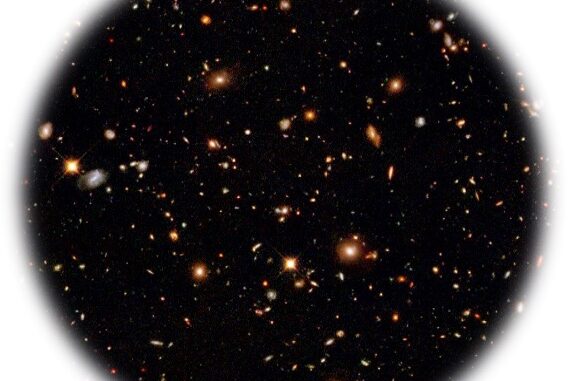
Try this:
Hold up your little finger to the night sky.
Now consider everything hidden behind just your fingernail.
If you had access to a world-class telescope and computer enhanced images, this is what would be hidden. And those aren’t stars!
Well, a few of them are, but the rest are galaxies, each with hundreds of billions of stars. Astrophysicists have calculated how many other planets there are, and there are more than you probably imagine.
Do the math, and you arrive at a staggering estimate:
- Aside from our Sun, there are an estimated 100-400 billion other stars in our Milky Way Galaxy.
- Our galaxy is not alone; there are maybe two trillion other galaxies.
- And while not every star has planets, many will, therefore, there are roughly 300 sextillion (300,000,000,000,000,000,000,000 or 3×10²³) other planets out there.
The argument appears almost irresistible: Even if life is extraordinarily rare, with that many chances, how could it not exist somewhere else?
3. Abundance of habitable planets
There are already thousands of known planets we have located, and many of these exoplanets (planets orbiting stars outside our solar system) are within the liquid water “habitable zone,” meaning within the right distance from a particular star so water can potentially exist on the planet. This makes some suggest that conditions suitable for life are common, not rare.
4. Life happened here
Aboigenesis (life arising from non-living matter) happened at least once (Earth), so it is reasonable to assume it can happen elsewhere, particularly because the chemical building blocks for life are common throughout the cosmos.
Some possible supportive evidence includes:
- Detection of Atmospheric Signatures:Spectroscopy allows scientists to analyze the atmospheres of exoplanets for biosignatures, such as the potential discovery of dimethyl sulfide (DMS).
- Organic Molecules in Space:Meteorites and cosmic dust frequently contain complex organic compounds, indicating that the building blocks of life are widespread.
- Potential Microbial Life in Solar System:Mars has shown evidence of methane, and moons like Europa and Enceladus have subsurface oceans, indicating potential habitats.
5. The Copernican principle – we are not special
There was a time when humanity followed Aristotle’s teaching that the Earth sat at the center of everything.
Copernicus shattered that illusion by determining the Earth and the other planets revolve around the Sun. Science furthers this idea as the Earth is not at the center of the galaxy or universe either, but is just like other planets.
So why assume we are special in another way? Why assume we are the only planet with life?
This principle—sometimes called the “principle of mediocrity”—suggests: What happened here… likely happens elsewhere.
And if Earth formed in the last third of the universe’s timeline, then other civilizations could be far older… and far more advanced.
Maybe there truly was an Empire a long time ago in a galaxy far, far away.
Howard Smith an astrophysicist at the Harvard and Smithsonian Center for Astrophysics observed[1] humans have long thought about other worlds, and do so today:
- Ancient Greek philosopher, Democratus, claimed there were innumerable worlds of different sizes and possibilities.
- A textbook by Goldsmith and Owen declare, “Nothing in our theories of the origin and evolution of the sun makes it seem unusual or different. The chances of life being hosted, we say one out of every two stars to be conservative.”[2]
- Astronomer Jerome Land: “Is it rational to suppose the existence of living and thinking beings is confined to Earth from what is such a privilege derived but graveling minds of people.”[3]
- Astronomer Persal Lel director of the Lel Observatory was convinced the “canals” he observed on Mars were evidence of an advanced civilization, and argued: “From all we have learned of its constitution on the one hand and its distribution on the other, we know life to be inevitable phase of planetary evolution like quartz or feltspar soil.”[4]
And Stephen Hawking stated that we are so insignificant he was unable to believe the whole universe exists for our benefit. Strong words. And the media picks it up.
6. Life is incredibly resilient – extremophiles
There are different organisms on Earth thriving in extreme environments, such as deep-sea hydrothermal vents, barren and freezing Arctic conditions, hyper-salinity (super salty) desert pools, and high-radiation areas. This suggests that life could survive on planets previously thought uninhabitable, such as Mars, or icy moons like Europa.
7. UFOs and testimony
Then there’s a very controversial category: Reports of unidentified flying objects.
Claims of:
- Advanced craft
- Military encounters
- Government investigations
- Even abduction testimonies
In recent years, some military video[5] has been officially released, showing aerial phenomena that defy easy explanation.
Congressional hearings have even addressed the possibility of non-human pilots.
While none of this constitutes definitive proof… It does need to be evaluated.
8. The benefits of the search itself
Even if aliens are never found, the pursuit has value.
The search drives:
- Technological innovation
- Scientific discovery
- A deeper understanding of the universe
Space exploration has already produced countless advancements that impact everyday life.
Fermi paradox
The reasons above have made many expect or hope for alien contact, including a group of physicists going to lunch.
Nobel physicist Enrico Fermi was on his the way to lunch at Los Alamos National Labs, and was talking about the possibility of flying saucers, faster-than-light travel, and extraterrestrial beings with some colleagues.
When the conversation continued into lunch, Fermi interjected the question, “Where is everybody?”[6]
To state the famous Fermi paradox more formally, it is the apparent contradiction between the seemingly high probability of extraterrestrial life existing and the lack of any strong evidence or contact with such civilizations. It essentially asks, “If the universe is vast and life is common, why haven’t we detected or been contacted by other civilizations?”
Since we are still looking at reasons to support the existence of aliens, what are the possible explanations to Fermi’s paradox?
- The Great Silence:Perhaps we haven’t looked hard enough, or our search methods are inadequate.
- Interstellar Travel is Difficult:The vast distances between stars might make interstellar travel and communication extremely challenging.
- The Great Filter:There might be a “filter” in the process of life evolution that prevents civilizations from reaching a certain technological level, or that they self-destruct before that point.
- Self-Destruction:Advanced civilizations might be prone to self-destruction, preventing them from reaching other stars or broadcasting signals.
- The Dark Forest Hypothesis:Advanced civilizations might be deliberately hiding or avoiding contact, perhaps due to the dangers of interstellar travel or the potential for conflict.
- The Rare Earth Hypothesis:The conditions for life, and especially intelligent life, might be unfathomably rare in the universe, making the existence of other civilizations unlikely.
The Bottom Line
These eight reasons are compelling. They make the search feel justified—even inevitable.
But it’s important to notice something: None of them are substantial evidence of alien life.
They are reasons to look. Reasons to hope.
But not reasons to conclude. And that distinction matters. This is why scientists have had to seek explanations for Fermi’s paradox. And all of those explanations above show the same lack of evidence to support the hypothesis of alien existence.
The only explanation having demonstrative evidence beyond all others is the last, Rare Earth Hypothesis, which strongly suggests there are no aliens.
Because before belief becomes confidence, it must be weighed against all the evidence—not just the possibilities.
[1] ReasonableFaithOrg, “Are There Aliens in the Universe and Why Do We Want to Know? | Ivy League Roundtable,” YouTube video, October 24, 2025, 30:39, https://www.youtube.com/watch?v=your_video_id.
[2] Donald Goldsmith and Tobias Owen, The Search for Life in the Universe, 3rd ed. (Sausalito, CA: University Science Books, 2001), 528.
[3] Bernard de Fontenelle, Conversations on the Plurality of Worlds, trans. Miss Elizabeth Gunning, with Additions by Jerome de La Lande (London: J. Cundee, 1803), viii, quoted in Zygon 51, no. 2 (June 2016): 331.
[4] Percival Lowell, Mars as the Abode of Life,(New York: The Macmillan Company, 1908), 12-13.
[5] Watch the Pentagon’s three declassified UFO videos taken by U.S. Navy pilots, YouTube video, 1:20, CNBC Television, Apr 28, 2020, https://www.youtube.com/watch?v=rO_M0hLlJ-Q. Also, https://www.bbc.com/news/videos/cj07rg34l62o.
[6] E. M Jones, “Where is everybody? an account of fermi’s question.” Technical Report LA-10311-MS, Los Alamos National Laboratory (1985), https://www.osti.gov/servlets/purl/5746675 (as of July 2022). Reprinted in Physics Today, August 1985, pp. 11-13.
[1] Sagan, Carl. “The Quest for Extraterrestrial Intelligence.” Cosmic Search, Vol. 1, No. 2 (March 1979), pp. 6–13.
[2] Vickers, Peter, et al. “Do aliens exist? We studied what scientists really think.” The Conversation (January 14, 2025). https://theconversation.com/do-aliens-exist-we-studied-what-scientists-really-think-241505.
Don’t hate the messenger
Seriously, people start acting funny, odd, even nasty towards others because their emotions or ego cannot handle being told something they do not like.
Myself, I would rather aliens did exist, my curiosity would have a blast, but I am intellectually honest enough to go where the evidence points, especially when it points as strongly as it does in this case. Could I be wrong, sure, then current science would be as well, and the Bible does not say anything either way, but if you are betting that aliens exist, you are making a bad bet.
The Fermi paradox isn’t just a puzzle—it’s a warning.
In fact, we can approach the skepticism towards alien existence like a “diss track” in rap music, by taking each of the supposed reasons to believe in aliens and systematically refuting each. We will attempt to do so without all the swearing and threats often accompanying a diss track.
What Are The Best Reasons To Believe Aliens Do Not Exist?
Science has already provided an answer to the Fermi paradox, but most people are unaware, or are not listening. News like this typically doesn’t make the textbooks or social media coverage, but it sings loudly to those who are drawn to evidence.
We will start by taking a shot at Drake.
1. A minoooooooor problem with the Drake equation
Scientists have discovered such a phenomenal series of factors throughout the universe, which all have to occur, and all in combination with each other, for any life to exist anywhere in the universe.
Those who sang out the Drake equation with such euphoria, are now being told by science discoveries and mathematics to: “Sit down, be humble.”[1]
Yet, what I still see, in books and talks, is the original, vastly over-simplified version of the Drake equation. And we noted the high percentage of scientists and astrobiologists who believe in aliens, with some giving estimates of millions of alien civilizations within our own galaxy. But did those scientists produce evidence to substantiate their belief and high estimates? Check for yourself.
While I understand the pressure for astrobiologists and some other scientists claiming belief, considering the serious pressure to publish, and the fact that claiming aliens do not exist would not sell either to the public, or to their employers, I still was disappointed to find so many scientists declare belief not only without the requisite scientific support, but also purposefully ignoring the clear scientific evidence staring back through every telescope and mathematic calculation.
Science has gained tremendous understanding of our universe, with loads of data to weigh in on the likelihood of extraterrestrial life, and possible visitations. Based on what science has discovered, the mathematical probability life exists anywhere in the universe, aside from Earth is so unlikely, it would be ridiculous (going against the better reasons, evidence, or logic) to believe in aliens.
While many scientists, on TV or magazine interviews, will say they hope, or even expect extraterrestrial life to exist, the actual scientific exploration and discoveries go directly against such hope or expectations.
Some scientists have not been abducted into the hype for aliens. Carl Sagan’s co-author, Shklovskii, noted previously for the estimate of millions of alien civilizations in our galaxy, revised his view and wrote another book titled We Are Alone, pointing out the complexity and requirements for life were too poorly understood when he and Sagan wrote their book, and recognizes the findings now show we will not find life anywhere else in the Universe.
As noted previously, 58.2% of astrobiologists believe in intelligent life elsewhere, that means 41.8% of those experts whose entire career depend upon life in space do not believe intelligent life is anywhere but Earth.
As more information has continually been amassed, the trend became clear, and the possibility of sentient life elsewhere became more and more remote. In 1976, Nobel Prize winning biochemist, Jacques Monod, wrote a book titled Chance and Necessity in which he said: “Man knows at last that he is alone in the indifferent immensity of the universe, whence he has emerged by chance.”[2]
[1] Kendrick Lamar, “Euphoria,” 2024, single, Interscope Records.
[2] Jacques Monod, Chance and Necessity: An Essay on the Natural Philosophy of Modern Biology, trans. Austryn Wainhouse (New York: Alfred A. Knopf, 1971), 180.
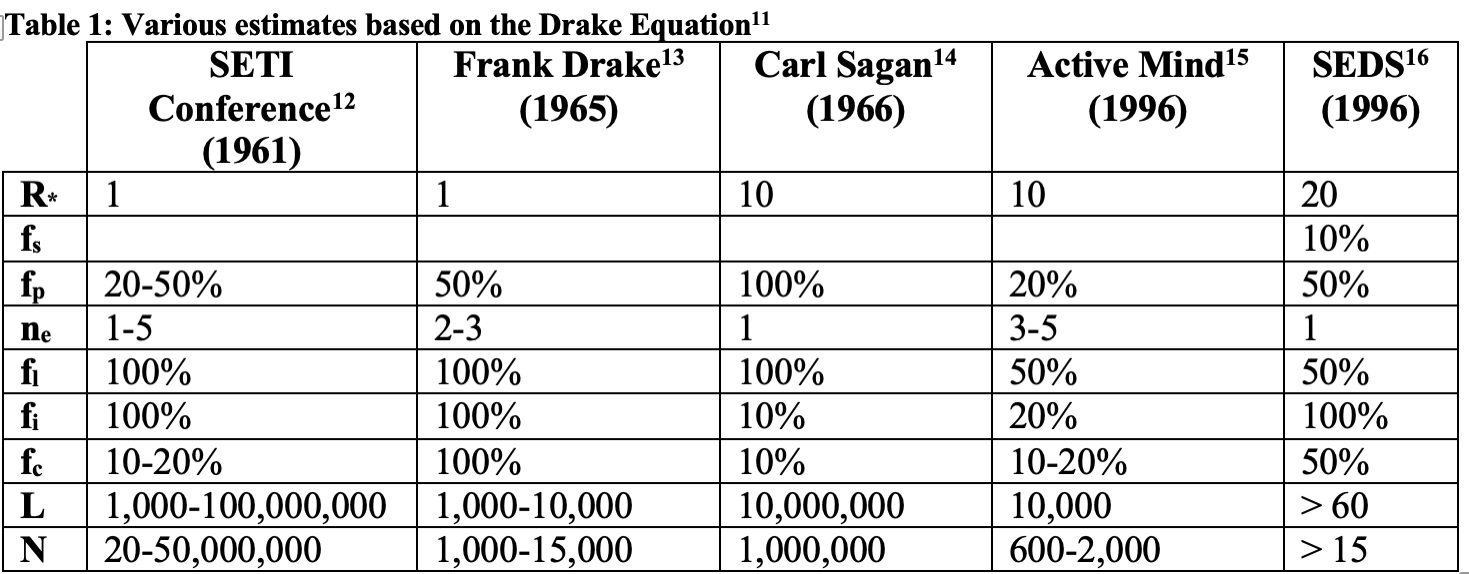
Yet, there are still the hopeful and expectant people in science and the general public, it’s just now they hope and expect against science and the evidence. Recently, I watched a talk by The Royal Institution,[1] which plugged values into the equation to come up with 100 likely alien civilizations in our galaxy. This is still absurdly optimistic, based on the evidence, but let’s be absurdly optimistic and say 150, as shown in the image. Also, in the image is a bit more realistic, but still much too generous, set of values obtained from a talk by physicist Mike Strauss (calculations and references given in “Aliens Appendix 1. The Drake Equation”).
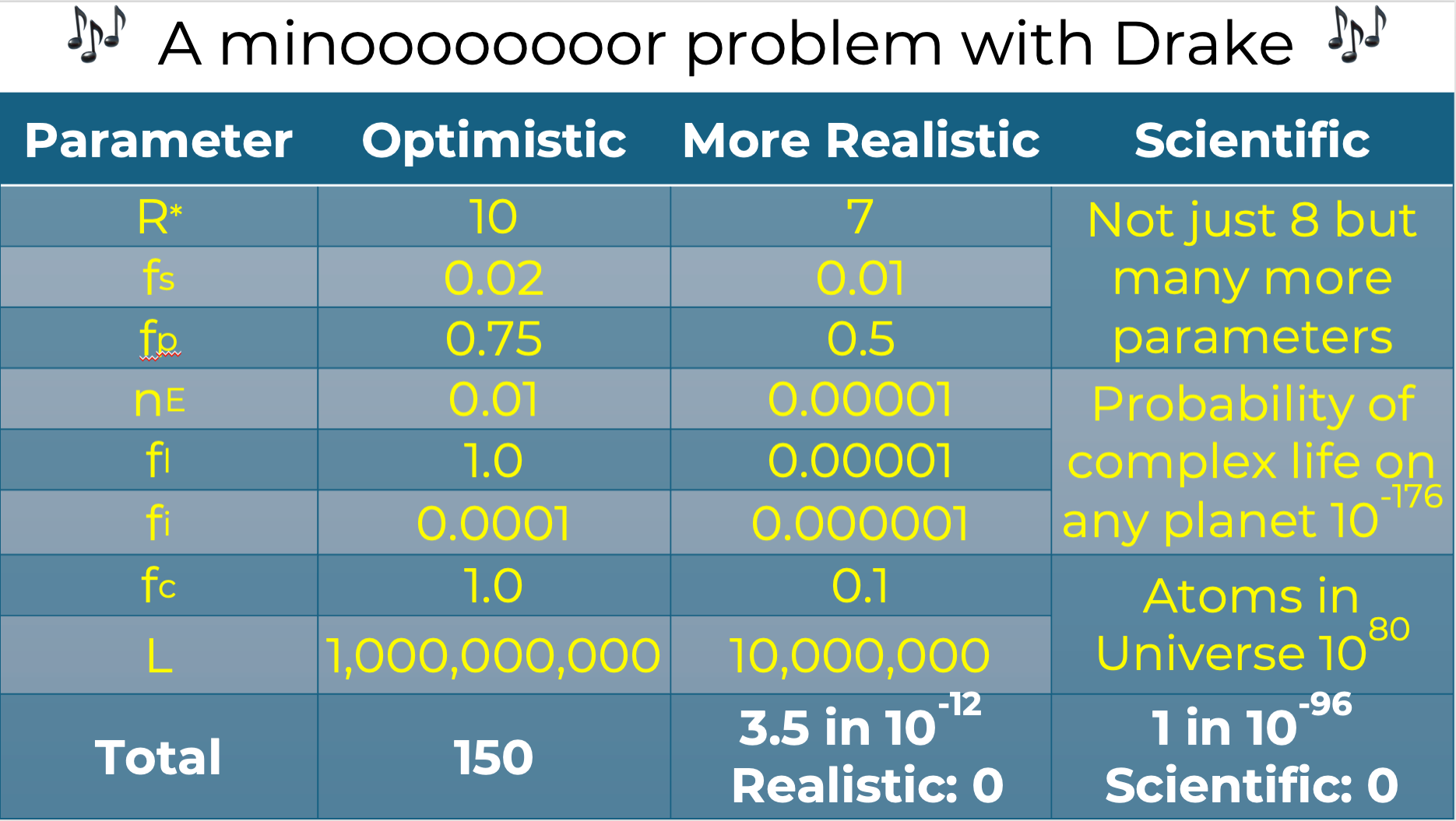
This equation is brought up to show how often people stop thinking before taking in all the evidence. This is an example of people making claims, some even basing their entire careers upon, with incomplete and likely inaccurate thinking.
Even taking the optimistic claim of 150 alien civilizations existing and able to contact within our galaxy, this still means, on average, the civilization will be 2,000 light-years away, which has dramatic impact on the likelihood of aliens ever visiting us, even if they existed. This will be discussed in the next section.
More important: Why are the people using the Drake Equation, but purposefully not telling us something? When reasonable values are placed into the equation, and when having not just eight factors in the equation, but the numerous other required factors many seem to ignore, the result of the Drake equation always comes up zero. Meaning, as far as likelihood of any of the thirty billion trillion other planets out there having life, “they not like us.”
This equation actually functions well to prioritize where we should look for alien life, which I think was Drake’s initial intention. But when Drake tries to get hard numbers, people have artificially inflated the numbers.
For example, consider the “L” term, which is the length of time an alien civilization is technologically active with radio communication. If you look for estimates of this value in the literature, you could get values that vary by 100 million. And considering the other factors in the equation may only vary by a factor of 10, that L value could dominate and change the answer of the entire equation, and either make aliens very probable or very improbable.
Further, the factors determining what fraction of stars are suitable to host a planet with life, fs and fp, are greatly overestimated. According to Guillermo Gonzalez, Assistant Professor of Astronomy at the University of Washington, our Sun is one of the few stars in the galaxy having necessary qualities to be capable of supporting complex life.
The Sun is a star that is stable, burns at constant rate, is not part of a binary system, does not burn too fast, not too big or small, too bright, not bright enough, is a good age, and so on.
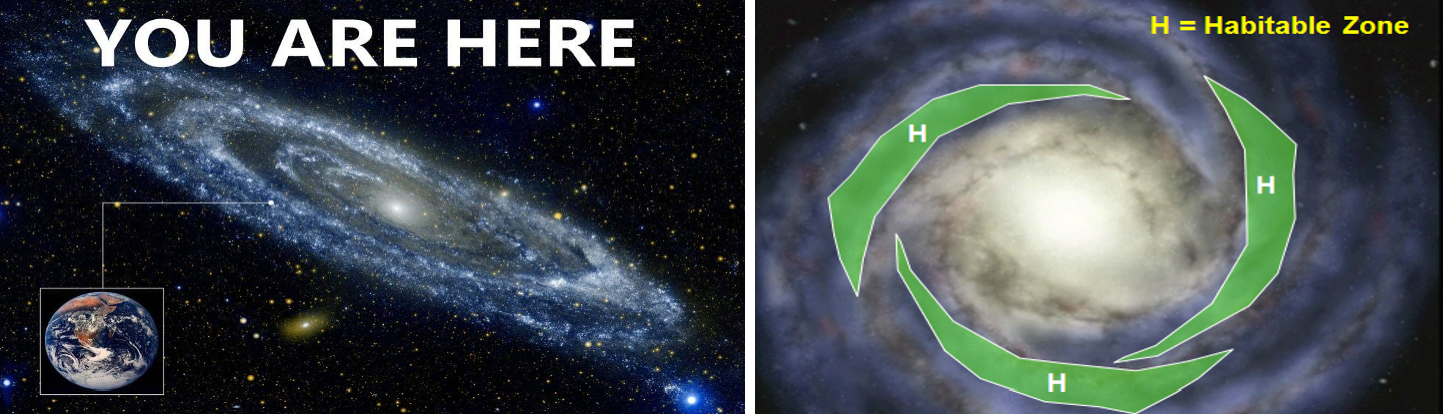
The Sun is composed of the right amount of “metals.” Astronomers label all elements heavier than hydrogen and helium as “metals.” Also, the Sun is locked in a circular orbit about the galactic center, in just the right way, through a combination of factors, to manage to keep from interacting with the galaxy’s dangerous spiral arms. Our Solar System is also far enough away from the galactic center to not have to worry about disruptive gravitational forces or too much radiation, yet, somehow was able to gather enough material, which usually comes from those dense areas from supernovas, to enable the formation of our planets.
A region of space that has all of these factors occurring together, Gonzalez calls a “Galactic Habitable Zone.” He observes every form of life on our planet, whether simplest bacteria or you and I, owe our existence to the balance of these unique conditions.[2] Guillermo Gonzalez has argued that the conditions required for complex life may be rare and that Earth occupies a uniquely favorable position for such life.[3]
You can find peer-reviewed example after example of scientists pointing out the uniqueness of Earth, and how poorly the Drake equation values are used.
- Naturalistic science believers, Ward and Brownlee, recognize in Rare Earth, “The physical events that led to the formation and evolution of the Earth required an intricate set of nearly irreproducible circumstances.”[4]
- A leading cosmologist, Allan Sandage, noted that through his reflections on science he came to believe in God, because “the world is too complicated in all its parts and interconnections to be due to chance alone.”[5]
- Astrophysicist John Gribbin and astronomer Martin Rees, atheist and “cultural Anglican” respectively, were led by their research to state to their book Cosmic Coincidences: “The physical events that led to the formation and evolution of the physical Earth also required an intricate set of nearly irreproducible circumstances.”[6] And, “The conditions in our universe really do seem to be uniquely suitable for life forms like ourselves…”[7]
- As far as the Earth itself, an article in Science, from a team led by NASA astrobiologist Edward Schwieterman concludes: as far as current research indicates, Earth remains the only known planet capable of supporting life, and understanding this uniqueness strengthens the case for protecting it.[8] Schwieterman goes further in another article: “As far as we know, Earth is the only planet in the universe that can sustain human life.”[9]
In their appropriately titled “Dissolving the Fermi Paradox,” Oxford scholars answer: “When the model is recast to represent realistic distributions of uncertainty, we find a substantial ex ante probability of there being no other intelligent life in our observable universe, and thus that there should be little surprise when we fail to detect any signs of it. This result dissolves the Fermi paradox.”[10]
Use of the Drake equation should not draw a stadium full of alien fans anymore, it only highlights an example of artificial hype.
[1] In Search of Giants: An Exploration of Intelligent Alien Life,” YouTube video, posted by The Royal Institution, accessed Month Day, Year, https://www.youtube.com/watch?v=BV_DkQCNfu4
[2] NASA Astrobiology Program, “Galactic Habitable Zones,” accessed April 25, 2026, https://astrobiology.nasa.gov/news/galactic-habitable-zones/.
[3] Gonzalez, Guillermo; Brownlee, Donald; Ward, Peter (July 2001). “The Galactic Habitable Zone: Galactic Chemical Evolution”. Icarus. 152 (1): 185–200. arXiv:astro-ph/0103165. Bibcode:2001Icar..152..185G. doi:10.1006/icar.2001.6617. S2CID 18179704. Guillermo Gonzalez and Jay W. Richards, The Privileged Planet: How Our Place in the Cosmos Is Designed for Discovery (Washington, DC: Regnery, 2004).
[4] Peter D. Ward and Donald Brownlee, Rare Earth: Why Complex Life Is Uncommon in the Universe (New York: Copernicus, 2000), 190.
[5] Allan Sandage, quoted in Newsweek, “Science Finds God,” July 20, 1998.
[6] Peter D. Ward and Donald Brownlee, Rare Earth: Why Complex Life Is Uncommon in the Universe (New York: Copernicus, 2000), 190.
[7] John Gribbin and Martin Rees, Cosmic Coincidences: Dark Matter, Mankind, and Anthropic Cosmology (New York: Bantam Books, 1989), 269.
[8] Edward W. Schwieterman, quoted in Doyle Rice, “New Study Dramatically Narrows the Search for Advanced Life in the Universe,” USA Today, June 10, 2019, https://www.usatoday.com/story/news/nation/2019/06/10/search-advanced-life-universe-narrowed-study/1409383001/
[9] Edward W. Schwieterman et al., “A Limited Habitable Zone for Complex Life,” The Astrophysical Journal 878, no. 1 (2019): 19, https://doi.org/10.3847/1538-4357/ab1d52 as cited in: University of California, Riverside, “New Study Dramatically Narrows the Search for Advanced Life in the Universe,” EurekAlert!, June 10, 2019, https://www.eurekalert.org/news-releases/469180
[10] Anders Sandberg, Eric Drexler, and Toby Ord, “Dissolving the Fermi Paradox,” Philosophical Transactions of the Royal Society A: Mathematical, Physical and Engineering Sciences 376, no. 2133 (2018): 20170406, https://doi.org/10.1098/rsta.2017.0406
2. The universe is not vast enough
Let’s make this clear: the odds of all the factors necessary for life to exist anywhere in space are so remote, even if every atom in the universe were a planet, each with a chance to match what is necessary to host life, the odds of life existing on even one of these planets are closer to absolute zero than you can imagine!
Can vast amounts of time come to the rescue against this grinch of probability? No. Even if every atom in the Universe were a planet, and if every second, since the beginning of time, another universe emerged with an equal number of other planets and chance for life—still chance has no chance—as the odds are so far beyond even that unfathomably generous scenario.
This is explained further in The FINE-TUNED Evidence_Part 3.
There are not just eight, or fifty, or even a hundred factors involved and needing to be accounted for in the equation, when considering the likelihood of life existing somewhere else in the Universe. There are many more essential factors, and the number has shown amazing growth, and equally amazing things to contemplate.
Professor and research scientist, Mike Strauss, and astronomer Hugh Ross, list a number of these parameters. Strauss noted 323 parameters were known by 2004 (double-clicking in the chart below opens the file and allows you to scroll through 300+ parameters), and astronomer Hugh Ross, has kept a running tab of these discoveries and displays 922 as of 2008[1].
The 922 are necessities for advanced life to exist anywhere in the universe, and aliens with the ability to reach us would fit in that category. However, the requirements and corresponding likelihood values for different levels of “life,” for example, simplest bacteria to advanced life capable of civilizations, are separated into categories for separate probability evaluations in the data provided by Ross.
While almost all the information I present was obtained from non-Christian sources, in order to avoid claims of bias, both Mike Strauss and Hugh Ross are Christians, although their data comes from peer-reviewed scientific studies and literature, the references are provided for you to check yourself.
After interviewing, questioning, and having discussions following a few conferences with Dr. Ross. I found his data most useful. Ross’ list of fine-tuned features and model have been presented to professors and scientists at top universities and organizations across the world, specifically to those who do not share the worldview of Dr. Ross, and they do accept the fine-tuning of the features. The only disagreement is over the mathematic probabilities assigned to some features. However, this disagreement is inconsequential as the disagreement typical only goes up to several dozen zeros, which is insignificant when we are talking about probabilities involving numbers raised to the power of over a thousand zeros[2].
Being generous, and simply using the 123 parameters research scientist Mike Strauss used in calculations, if you are betting life exists anywhere else in the entire universe, you are not simply betting against odds of, for example, one person buying one Mega Millions lottery ticket, and getting the exact matching numbers (1 chance in 100,000,000, or 1 x 10⁸ in scientific notation). Nor is the likelihood as doubtful as the same person, who won the lottery, buying one ticket and winning the next Mega Millions lottery, and doing this 10 times in a row (which would be 1 chance in 100,000,000,000,000,000,000,000,000,000,000,000,000,000,000,000,000, 000,000,000,000,000,000,000,000,000,000; 1 x 1080 in scientific notation)!
If you believe life exists on any other planet in the Universe, you are expecting the universe winning against the odds of 1 in 10176!
Actually, the odds are much worse than that, as new evidence consistently comes in, averaging a new example about once a month in peer-reviewed scientific literature, making the odds literally a million times less likely!
[1] Ross, Hugh. Why the Universe Is the Way It Is. Reasons to Believe, 2008. Appendix C: Part 3. Probability Estimates for the Features Required by Various Life Forms. https://d4bge0zxg5qba.cloudfront.net/files/compendium/compendium_Part3_ver2.pdf
3. No abundance of habitable planets
Do you know what it takes to support life in space?
Watch Apollo 13 (here’s a clip). It requires our best minds, resources, and almost flawless circumstances to keep just a few people alive traveling in space for a relatively short time. Very, very many things are required to function precisely, all in combination with each other, for the entire trip, or you get what we see in the video, or more likely, worse.
Now imagine we must create a space capsule able to support billions of people, non-stop, for millennia! Take a moment to think about that job.
This is what is required of the space capsule we call Earth, and on average, every month or so, scientists discover another parameter in our universe and/or Earth, which had to be precisely fine-tuned, or the capsule is lifeless.
A planet has to be exquisitely “fine-tuned” (not my phrase, this is the phrase astrophysicists have used when discovering what is necessary for life to exist anywhere in our universe) to be capable of hosting, much less sustaining life. In sections below, we will look at just a sample of these fine-tuning examples.
Many people seem to think planets operate like a Chia Pet, just add water and you get life. So, if a planet is within the most well-known “Habitable Zone (HZ)”: the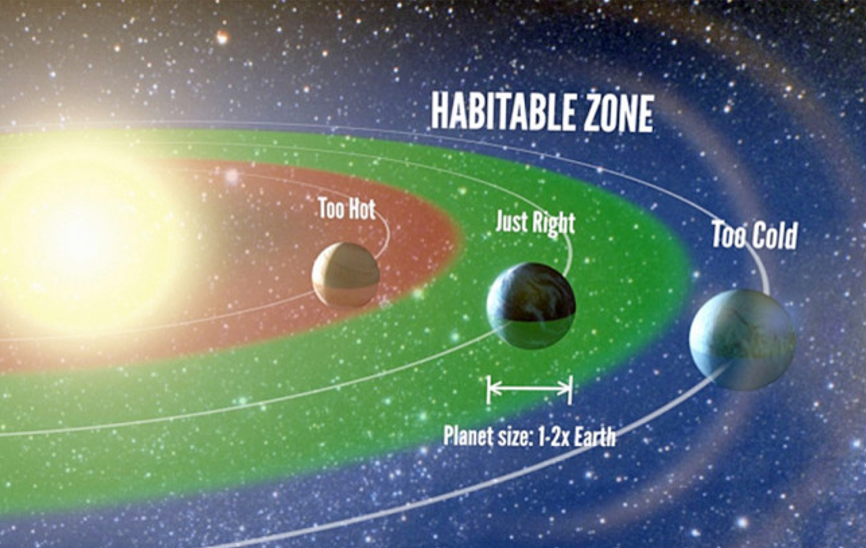
 range of distance from its host star within which it is conceivable for liquid water to exist, then life will arise. Earth is in this habitable zone for water, and many other planets would be, even with different types and ages of stars. Nevertheless, even people who should know better, often fail to mention liquid water must also exist on a large percentage of the planet’s surface over long time periods, and when considering other factors involved in discussions of the water HZ, such as the amount of oxygen and carbon dioxide and monoxide in the atmosphere, this habitable zone is way more restricted than most lead their audience to believe.[1]
In addition, many also fail to give proper voice to all the other habitable zones (locations relative to the distance from the host star where life could conceivably exist, due to factors other than water) a planet must fit within for life to have a chance of getting a foothold on a planet.
For example, a planet must also be within the proper ultraviolet radiation (the UV HZ); not too close to its star or the planet receives too much UV, which can breakup molecules required for life, or too far from the star and not getting enough UV energy for biochemical reactions.[2] And, being in both the water and UV habitable zones is not a simple thing. A study by Guo in 2010 showed how most often the water HZ and UV HZ do not match[3].
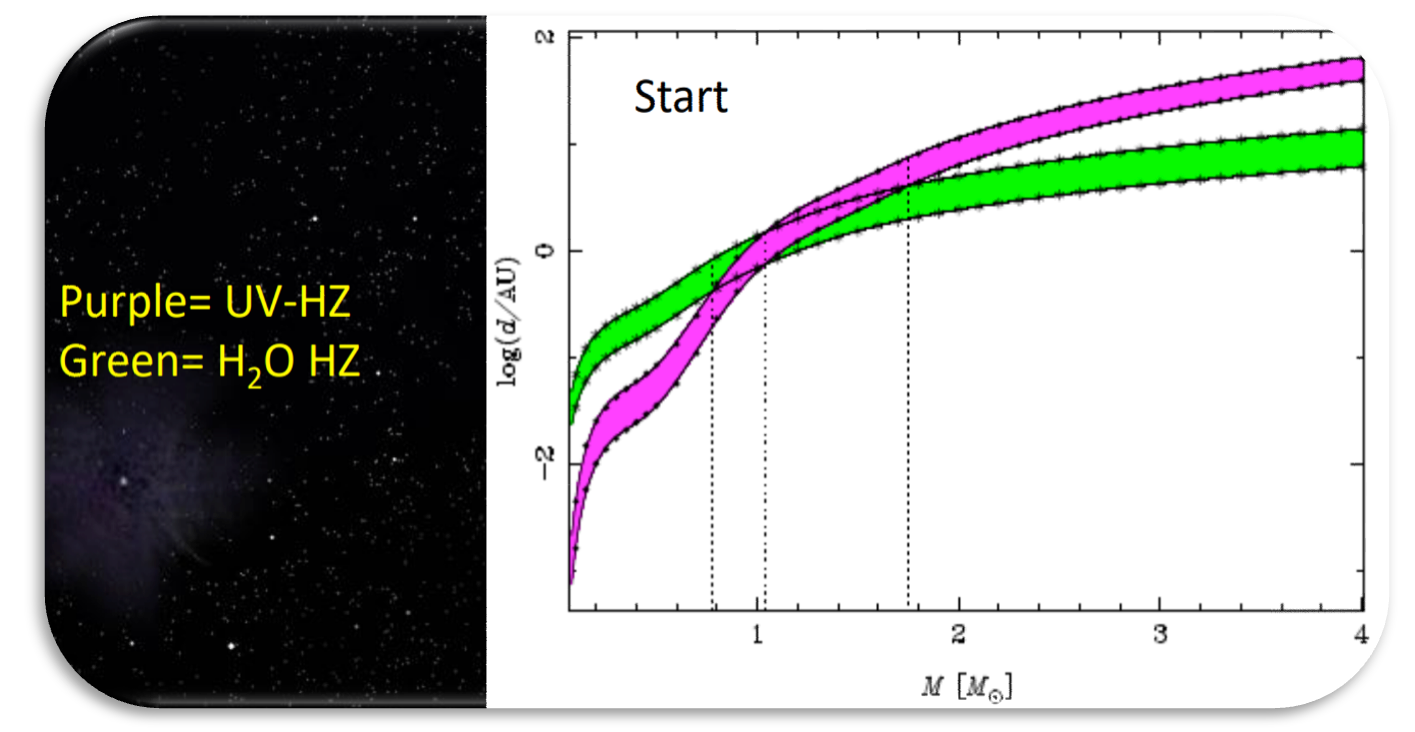
And it’s not just the water and ultraviolet habitable zones, there are fourteen known habitable zones for planets, Aliens Appendix 2 will show a table of the fourteen planet HZs with references, and a planet must simultaneously fit within all of them for advanced life. Out of the thousands of planets catalogued so far, I don’t think any fit in more than two habitable zones. If habitable zones were all that was needed for life, I would still expect life to be found on another planet, but even if a place stays within all fourteen HZs for long enough time, there are still many more, and even more amazing requirements a planet must meet before life is possible.
Even if planet(s) were found within all necessary habitable zones, the planet(s) would still require an extraordinary chain of events to maintain the precise balance for a long enough time for life like ours.
If you want to see a miracle (there are miraculous misunderstandings regarding miracles, which are covered here) there’s a good likelihood you’re looking at one whenever you look at the moon. The image below displays a computer simulation of the collision leading to the formation of the moon.
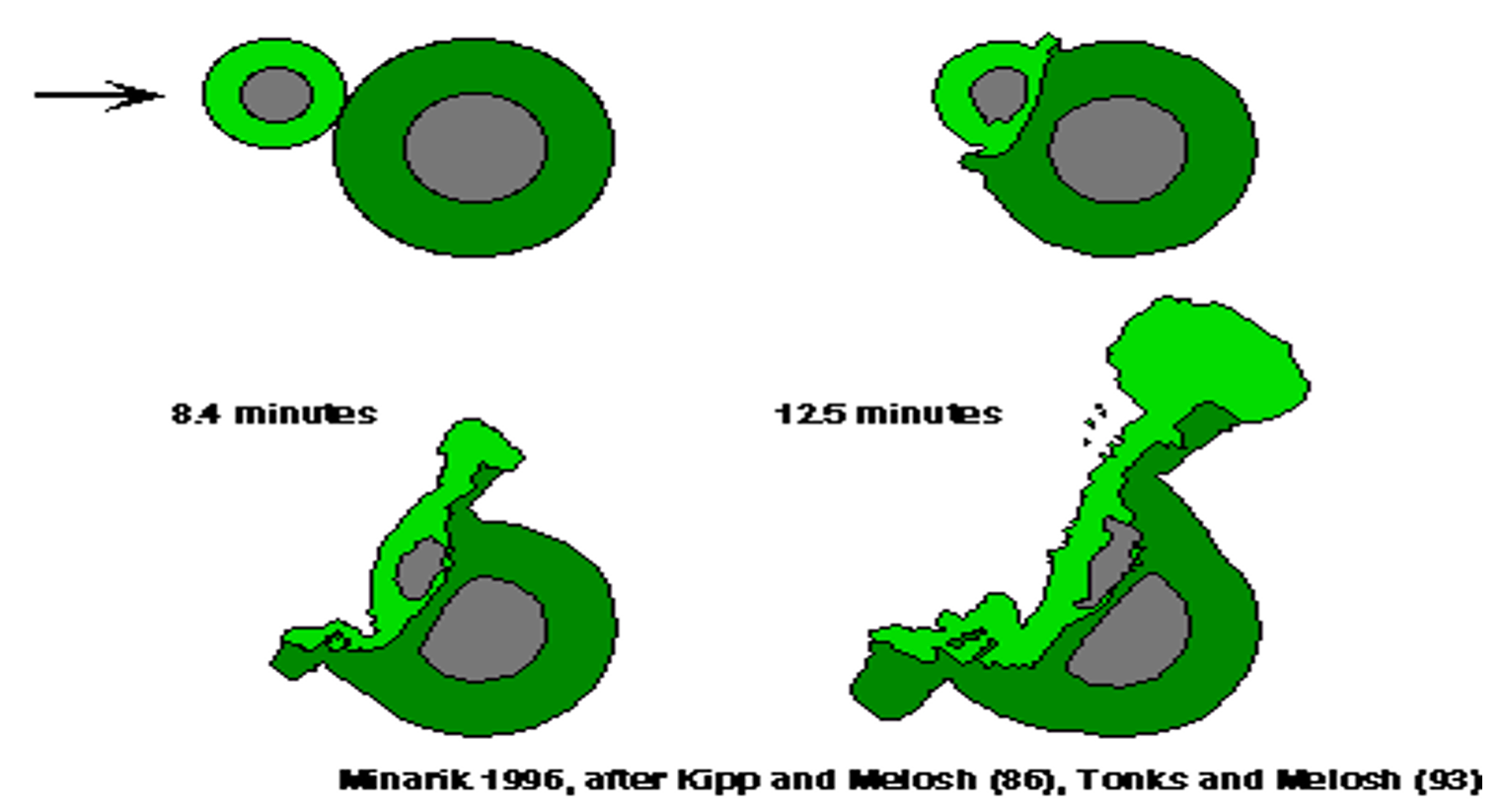
Based on all we know regarding planetary formation and solar systems, the Earth had too much water, not enough radioactive elements to bring requisite plate tectonics for continent formation and sustained land masses, had a suffocating, toxic atmosphere, no magnetic field to block deadly solar radiation, and vast climate issues due to an erratically changing rotation axis tilt and rotation speed.
Then, something about the size of Mars struck Earth, at just the right time, just the right angle, just the right speed, and with just the right components to push Earth into just the right stability for life.
- The atmosphere changed.
The suffocating atmosphere, which through greenhouse effect would have become what Venus has, was jettisoned into space by the collision. Further, the added mass made it so Earth’s gravity reduced to the point of allowing enough methane and ammonia to escape the atmosphere, yet strong enough not too lose too much water or oxygen.
- Massive resources of metals were added to the Earth’s core.
This kicked into operation plate tectonics, otherwise Earth would be a waterworld[4] (and the bad movie by that name would never have been made as we wouldn’t be here).
- Earth rotates about an axis tilted 23.5˚.
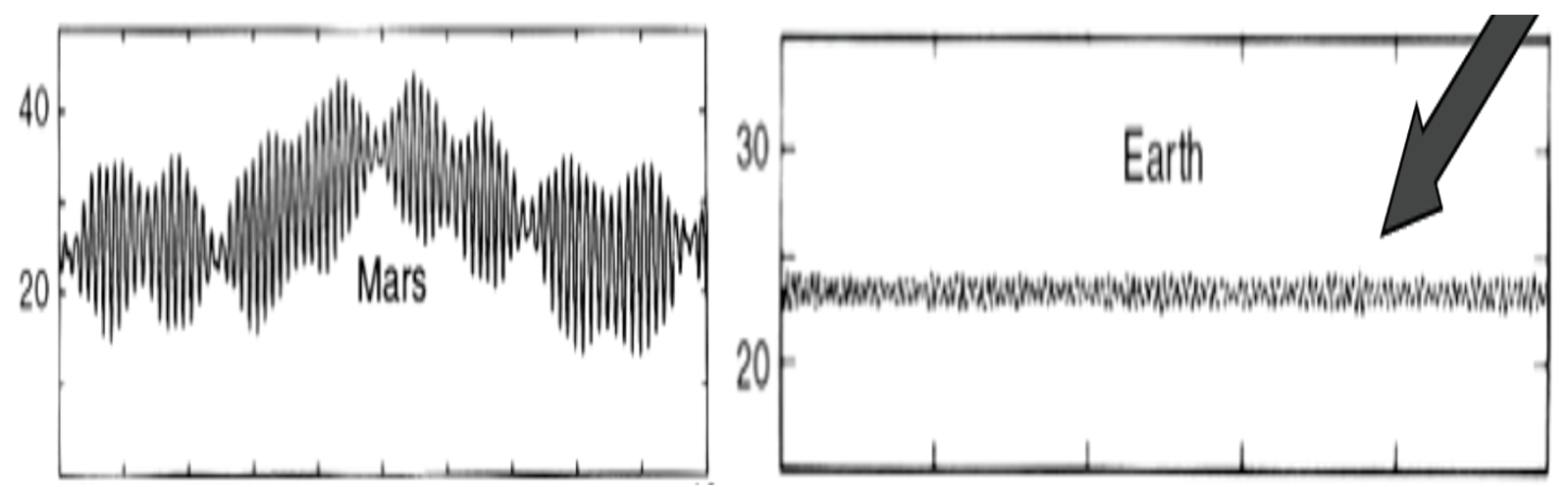
Before the collision, Earth’s axis wobbled as significantly as Mars’ (see image), which brings serious climate changes.
- Earth’s orbit was stabilized.
The Moon is large enough to stabilize our planet’s orbit, “minimizing catastrophic climate swings.”[5] Further, it generates tides large enough to stir the nutrients in the oceans, leading to abundant habitats, and tugs at the Earth through gravity to slow the rotation rate, so instead of rotating so fast a day would only last 4-6 hours, which comes with horrific winds and climate impact, we have the more stable 24-hour days.
- Earth was able to now generate a protective shield.
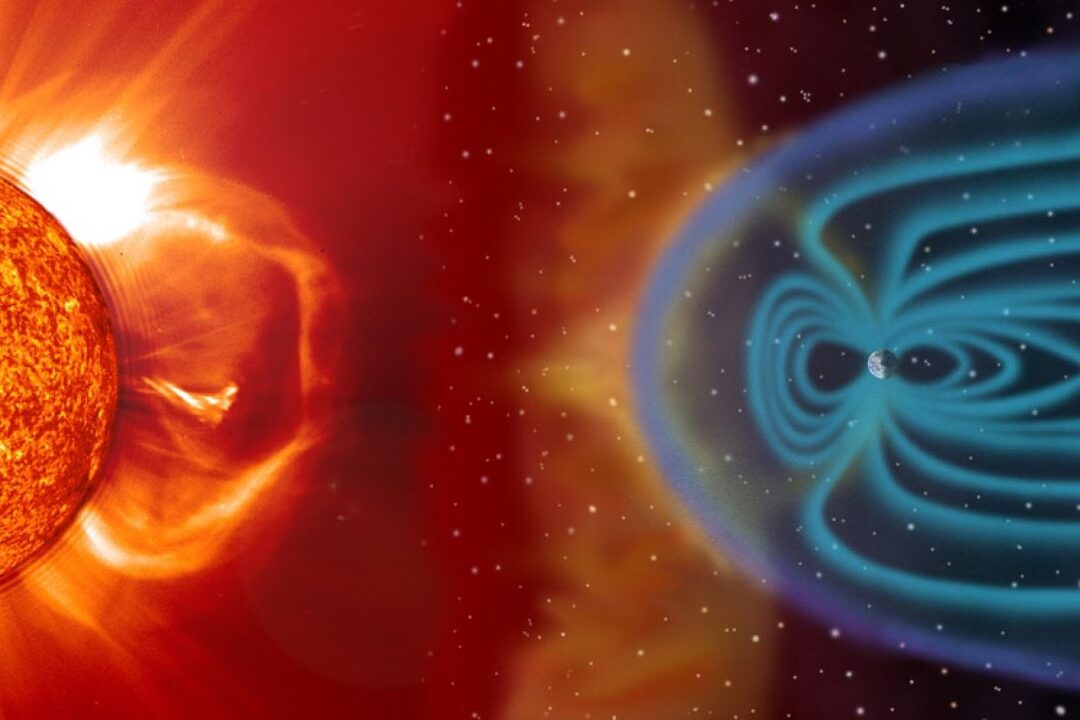
Just one more astonishing feature of the Earth, which ties both to the moon collision discussed previously, and to a later discussion on deadly radiation throughout space. We don’t worry about this radiation here on Earth because Earth is designed with two complimentary levels of shielding to handle this constant wave of radiation.
Earth’s magnetic field, which was enabled after the aforementioned collision added the much needed extra metal content to the Earth’s core, literally acts as a force field, curving the galactic cosmic rays away from the areas of the planet where people live, and the atmosphere handles the rest in beautiful fashion: the magnetosphere shield channels some charged particles towards the Earth’s poles, as noticed in the force lines in the image, but the atmosphere is there as the secondary shield which absorbs this remaining radiation and turns it into the Aurora Borealis.[6]
While on Earth you get to enjoy your protection in beautiful fashion, when you travel beyond Earth’s magnetic field, you lose these two shields.
The collision leading to our moon wasn’t the only one occurring to Earth. The Solar System had large amounts of comets and asteroids left over after the formation of the planets. When the gas giants of Jupiter and Saturn migrated to their current orbits, their significant gravitational pull, and/or whatever else also contributed, led to an early bombardment of the inner planets. In addition to clearing this early debris, the gas giants also protect against current potential impacts. Massive species extinction on Earth now occur 1000 times less often, which turns out to be a good time frame for humanity.[7]
If you want a list of specific parameters required by any planet to support life, with probability values taken from peer-reviewed literature, which you can check for yourself, astrophysicist Hugh Ross provided the list below in one of his books and in his presentations to top universities throughout the world.
Probabilities for Life on Earth[8]
This appendix presents an estimate for the probability of attaining the necessary parameters for life support on a planet. It includes 153 known parameters. (Reprinted from Lights in the Sky & Little Green Men, Appendix B, pp. 185-189. A list of scientific references supporting these design parameters is included at the end of the book.)
|
|
Probability that feature will fall in the required range for physical life | |
| Local abundance and distribution of dark matter | .1 | |
| Galaxy cluster size | .1 | |
| Galaxy cluster location | .1 | |
| Galaxy size | .1 | |
| Galaxy type | .1 | |
| Galaxy mass distribution | .2 | |
| Galaxy location | .1 | |
| Variability of local dwarf galaxy absorption rate | .1 | |
| Star location relative to galactic center | .2 | |
| Star distance from corotation circle of galaxy | .005 | |
| Star distance from closest spiral arm | .1 | |
| Z-axis extremes of star orbit | .02 | |
| Proximity of solar nebulae to a type I supernovae eruption | .01 | |
| Timing of solar nebula formation relative to type I supernova eruption | .01 | |
| Proximity of solar nebulae to a type II supernovae eruption | .01 | |
| Timing of solar nebula formation relative to type II supernova eruption | .01 | |
| Flux of cosmic ray protons | .1 | |
| Variability of cosmic ray proton flux | .1 | |
| Number of stars in birthing cluster | .01 | |
| Star formation history in parent star vicinity | .1 | |
| Birth date of the star-planetary system | .01 | |
| Number of stars in the system | .7 | |
| Number and timing of close encounters by nearby stars | .01 | |
| Proximity of close stellar encounters | .1 | |
| Masses of close stellar companion | .1 | |
| Star age | .4 | |
| Star metallicity | .05 | |
| Ratio of 40K, 235U, 238U, 232Th to iron in star-planetary system | .02 | |
| Star orbital eccentricity | .1 | |
| Star mass | .001 | |
| Star luminosity change relative to speciation types and rates | .00001 | |
| Star color | .4 | |
| Star magnetic field | .1 | |
| Star magnetic field variability | .1 | |
| Stellar wind strength and variability | .1 | |
| Short period variation in parent star diameter | .3 | |
| Star’s carbon-to-oxygen ratio | .01 | |
| Star’s space velocity relative to Local Standard of Rest | .05 | |
| Star’s short-term luminosity variability | .05 | |
| Star’s long-term luminosity variability | .05 | |
| Amplitude and duration of star spot cycle | .1 | |
| Number and timing of solar system encounters with interstellar gas clouds | .1 | |
| Galactic tidal forces on planetary system | .2 | |
| H3+ production | .1 | |
| Supernovae rates and locations | .01 | |
| White dwarf binary types, rates, and locations | .01 | |
| Structure of comet cloud surrounding planetary system | .3 | |
| Planetary distance from star | .001 | |
| Inclination of planetary orbit | .5 | |
| Axis tilt of planet | .3 | |
| Rate of change of axial tilt | .01 | |
| Period and size of axial tilt variation | .1 | |
| Planetary rotation period | .1 | |
| Rate of change in planetary rotation period | .05 | |
| Planetary rotation period | .2 | |
| Planetary orbit eccentricity | .3 | |
| Rate of change of planetary orbital eccentricity | .1 | |
| Rate of change of planetary inclination | .5 | |
| Period and size of eccentricity variation | .1 | |
| Period and size of inclination variation | .1 | |
| Number of moons | .2 | |
| Mass and distance of moon | .01 | |
| Surface gravity (escape velocity) | .001 | |
| Tidal force from sun and moon | .1 | |
| Magnetic field | .01 | |
| Rate of change and character of change in magnetic field | .1 | |
| Albedo (planet reflectivity) | .1 | |
| Density | .1 | |
| Reducing strength of planet’s primordial mantle | .3 | |
| Thickness of crust | .01 | |
| Timing of birth of continent formation | .1 | |
| Oceans-to-continents ratio | .2 | |
| Rate of change in oceans-to-continents ratio | .1 | |
| Global distribution of continents | .3 | |
| Frequency, timing, and extent of ice ages | .1 | |
| Frequency, timing, and extent of global snowball events | .1 | |
| Asteroidal and cometary collision rate | .1 | |
| Rate of change in asteroidal and cometary collision rate | .1 | |
| Mass of body colliding with primordial Earth | .002 | |
| Timing of body colliding with primordial Earth | .05 | |
| Location of body’s collision with primordial Earth | .05 | |
| Position and mass of Jupiter relative to Earth | .01 | |
| Major planet eccentricities | .1 | |
| Major planet orbital instabilities | .05 | |
| Drift and rate of drift in major planet distances | .05 | |
| Number and distribution of planets | .01 | |
| Distance of gas giant planets from mean motion resonances | .02 | |
| Atmospheric transparency | .01 | |
| Atmospheric pressure | .01 | |
| Atmospheric viscosity | .1 | |
| Atmospheric electric discharge rate | .01 | |
| Atmospheric temperature gradient | .01 | |
| Carbon dioxide level in atmosphere | .01 | |
| Rate of change in carbon dioxide level in atmosphere | .1 | |
| Rate of change in water vapor level in atmosphere | .01 | |
| Rate of change in methane level in early atmosphere | .01 | |
| Oxygen quantity in atmosphere | .01 | |
| Nitrogen quantity in atmosphere | .01 | |
| Chlorine quantity in atmosphere | .1 | |
| Carbon monoxide quantity in atmosphere | .1 | |
| Cobalt quantity in crust | .1 | |
| Arsenic quantity in crust | .1 | |
| Copper quantity in crust | .1 | |
| Boron quantity in crust | .1 | |
| Fluorine quantity in crust | .1 | |
| Iodine quantity in crust | .1 | |
| Manganese quantity in crust | .1 | |
| Nickel quantity in crust | .1 | |
| Phosphorus quantity in crust | .1 | |
| Tin quantity in crust | .1 | |
| Zinc quantity in crust | .1 | |
| Molybdenum quantity in crust | .05 | |
| Vanadium quantity in crust | .1 | |
| Chromium quantity in crust | .1 | |
| Selenium quantity in crust | .1 | |
| Iron quantity in oceans | .1 | |
| Tropospheric ozone quantity | .01 | |
| Stratospheric ozone quantity | .01 | |
| Mesospheric ozone quantity | .01 | |
| Water vapor level in atmosphere | .01 | |
| Oxygen-to-nitrogen ratio in atmosphere | .1 | |
| Quantity of greenhouse gases in atmosphere | .01 | |
| Rate of change in greenhouse gases in atmosphere | .01 | |
| Quantity of forest and grass fires | .01 | |
| Quantity of sea salt aerosols | .1 | |
| Soil mineralization | .1 | |
| Quantity of anaerobic bacteria in the oceans | .01 | |
| Quantity of aerobic bacteria in the oceans | .01 | |
| Quantity, variety, and timing of sulfate-reducing bacteria | .001 | |
| Quantity of decomposer bacteria in soil | .01 | |
| Quantity of mycorrhizal fungi in soil | .01 | |
| Quantity of nitrifying microbes in soil | .01 | |
| Quantity and timing of vascular plants introductions | .001 | |
| Quantity, timing, and placement of carbonate-producing animals | .00001 | |
| Quantity, timing, and placement of methanogens | .00001 | |
| Quantity of soil sulfur | .1 | |
| Rate of interior heat loss for planet | .01 | |
| Quantity of sulfur in the planet’s core | .1 | |
| Quantity of silicon in the planet’s core | .1 | |
| Quantity of water at subduction zones in the crust | .01 | |
| Quantity of high-pressure ice in subducting crustal slabs | .1 | |
| Hydration rate of subducted minerals | .1 | |
| Tectonic activity | .05 | |
| Rate of decline in tectonic activity | .1 | |
| Volcanic activity | .1 | |
| Rate of change of volcanic activity | .1 | |
| Continental relief | .1 | |
| Viscosity at Earth core boundaries | .01 | |
| Viscosity of lithosphere | .2 | |
| Biomass-to-comet infall ratio | .01 | |
| Regularity of cometary infall | .1 | |
| Number, intensity, and location of hurricanes | .02 | |
| Dependency factors estimate | 1030 | |
| Longevity requirements | 1013 | |
The probability of a planet anywhere in the universe fitting within all 153 parameters is approximately 10-194. The estimated maximum number of planets in the universe is 1023. This means there is less than 1 chance in 10171 (1 chance in 1 thousand trillion trillion trillion trillion trillion trillion trillion trillion trillion trillion trillion trillion trillion trillion) that even one such planet would occur anywhere in the universe.
Want to claim the estimate of planets is off, let’s be ridiculously generous and say every atom in the universe (~1080 atoms) is a planet, and every second since the beginning of time (~1017 seconds) another universe splits off with every atom in it being a planet. And all these planets have a chance to get all parameters the Earth did just right. Can we then bet on a planet being suitable for life?
We still only have a 1 in 1097 (1 chance in 10 trillion trillion trillion trillion trillion trillion trillion trillion) – essentially, chance has no chance.
Earth has life due to fantastically fine-tuned design features, which is why astrophysicist John Gribbin’s book, Alone in the Universe: Why Our Planet Is Unique, notes: “The reasons why we are here form a chain so improbable that the chance of any other technological civilization existing in the Milky Way Galaxy at the present time is vanishingly small. We are alone, and we better get used to the idea.”[9]
Even if science is pointing to the impossibility of life existing anywhere else in the universe, life exists on Earth, so if it happened here, shouldn’t we expect it elsewhere?
[1] Edward W. Schwieterman, et al. “A Limited Habitable Zone for Complex Life.” The Astrophysical Journal, 878:19(9pp), 2019 June 10https://arxiv.org/ftp/arxiv/papers/1902/1902.04720.pdf
[2] Andrea P. Buccino, Guillermo A. Lemarchand, and Pablo J. D. Mauas, “Ultraviolet Radiation Constraints around the Circumstellar Habitable Zones,” Icarus 183 (2006): 491-503. https://dx.doi.org/10.1016/j.icarus.2006.03.007
[3] J Guo, F Zhang, X Zhang, Z Han – Astrophysics and Space Science, 2010 – Springer. https://link.springer.com/article/10.1007/s10509-009-0173-9
[4] The Moon And Plate Tectonics: Why We Are Alone
[5] Nola Taylor Redd, “The Odds for Life on a Moonless Earth,” Astrobiology Magazine, August 4, 2011, http://astrobio.net/news-exclusive/the-odds-for-life-on-a-moonless-earth; per Jeff Zweerink, Is there Life Out There? Reasons to Believe: Covina, CA, 2017, p. 73.
[6] The magnetosphere allows life to exist on Earth’s surface. Without it, Earth would be exposed to cosmic and solar radiation from the sun. This is why we still have an atmosphere surrounded by an ozone layer, that shields from UV rays. Charged particles get through to poles stopped by atmosphere. Website: The Universe Today
[7] https://www.space.com/31577-earth-life-jupiter-saturn-giant-impacts.html; https://earthsky.org/space/is-it-true-that-jupiter-protects-earth
[8] Hugh Ross, Lights in the Sky & Little Green Men: A Rational Christian Look at UFOs and Extraterrestrials (Colorado Springs, CO: NavPress, 2002), Appendix B, 185–189.
[9] John Gribbin, Alone in the Universe: Why Our Planet Is Unique, (Hoboken, NJ: John Wiley & Sons, 2011), 205.
4. Life happened here? So what?
Earth has life, so why not other planets? But one occurrence does not establish a pattern.
This should make a person think further – What does this mean?
Somehow our planet has been able to win the lottery, against all mathematical hope, and provide a capsule able to sustain life abundantly for an incredibly long time. There are only four possibilities:
(a) Somehow evidence will arise in the future to support the belief nature + chance can create life.
(b) Some purposeful agent was involved in life arising on Earth, which would fit a transcendent God.
(c) An already existing and vastly intelligent alien race “seeded” the Earth.
(d) Some combination of the above.
Option (a) commits an error in thinking, or violation of logic known as the ad futuris fallacy. Think about it, this person is basically saying, “Despite all the massive evidence nature + chance is incapable of producing life elsewhere in the universe, I know evidence will one day come to support my belief in nature + chance.”
While this can be a hope, it would not be a good one for a reasonable person. If you feel believing in aliens is a reasonable position, what are your reasons? How are Strauss and Ross’ and hundreds of studies in the peer-reviewed literature wrong, and what evidence do you have to place your belief on a better supported position?
Option (b) not only has unparalleled evidence in diverse areas of study provided a comprehensive background of support for this option, unmatched by contrary belief systems, but also the lottery analogy is fitting here.
If someone (or the Universe), won the Mega-Millions lottery 10 times in a row, what are you thinking? How lucky? Or, are you thinking some purposeful agent is acting behind the scenes? This is the situation scientific discoveries place us in.
Out of all the phase space (all the possible situations our universe could have found itself in), the number of life-permitting situations is the smallest imaginable fraction compared to life-prohibiting possible universes, and somehow the universe won this lottery.
If you think a person winning the Mega Millions lottery 10 times in a row was unable to do it by coincidence, and required some purposeful agent acting behind the scenes, what makes you change from such obvious logic when applying it to your thoughts about life in the universe, which requires unfathomably greater luck?
The co-discoverer of DNA, who was a codebreaker in the war and recognized DNA is equivalent to language or code, Nobel Prize laureate Francis Crick, in his book Life Itself: Its Origin and Nature, came to the conclusion:
“An honest man, armed with all the knowledge available to us now, could only state that in some sense, the origin of life appears at the moment to be almost a miracle, so many are the conditions which would have had to have been satisfied to get it going.”[1]
The luminary discoveries release flares of quotes, and while quotes are not proof, consider the evidence causing the scientists involved to make statements, such as Arno Penzias’ (Nobel prize in physics):
Astronomy leads us to a unique event, a universe which was created out of nothing, one with the very delicate balance needed to provide exactly the conditions required to permit life, and one which has an underlying (one might say ‘supernatural’) plan.[2]
George Greenstein (astronomer):
As we survey all the evidence, the thought insistently arises that some supernatural agency – or, rather, Agency – must be involved. Is it possible that suddenly, without intending to, we have stumbled upon scientific proof of the existence of a Supreme Being? Was it God who stepped in and so providentially crafted the cosmos for our benefit?[3]
The Bible:
They know the truth about God because he has made it obvious to them. For ever since the world was created, people have seen the earth and sky. Through everything God made, they can clearly see his invisible qualities—his eternal power and divine nature. So they have no excuse for not knowing God. Romans 1:19-32
Option (c) gained a lot of attention, when the most renown atheist at the time, evolutionary biologist and author Richard Dawkins, was interviewed and asked how life could possibly have arisen from non-life by chance, given our knowledge in origin of life studies. Dawkins responded nobody knows, but added an idea of aliens seeding our planet to get the party started. Many have explored this idea, including Ridley Scott’s Prometheus, part of the sci-fi-horror Alien movie franchise. Good sci-fi, but weak sci-logic.
Can you see the problem? Don’t need a telescope to see this, only logic. Claiming advanced aliens seeded the Earth only pushes the problem backwards a step. If life on Earth is unexplainable without intelligent input from external aliens, then how did that advanced alien life get started? We are back at the same problem of trying to accomplish a feat beyond nature alone and any hope of chance.
Physicist and author Paul Davies, who was on a committee in 2009 to discuss what to do if aliens landed, made a statement regarding the very question this section covers:
Another common argument is that the universe is so vast there just has to be life out there somewhere. But what does that statement mean? If we restrict attention to the observable universe there are probably 1023 planets. Yes, that’s a big number. But it is dwarfed by the odds against forming even simple organic molecules by random chance alone.[4]
This applies to life arising on asteroids and cosmic dust as well.
What about microbes existing in space and “seeding” our planet, or our planet sending microbes through space to other planets?
This idea has been around, known as “panspermia,” no joke, and gained further attention when Richard Dawkins resorted to this idea when he had no other answers for the how life could have possibly arose from non-life. Further, scientists have studied microbes in ice on earth, and looked into the possibility of microbes surviving in comets or ice particles in space.
Among all the tens of thousands of meteors collected on earth, none contain any evidence that life exists outside of the earth.
The studies indicated “given the extremely high cosmic radiation flux in space, our results suggest it is highly unlikely that life on earth could have been seeded by genetic material external to this solar system.”[5] These findings are supplemented by others, which note the radiative pressure from stars in space would inevitably kill any microorganisms traveling through space.[6]
Origin-of-life researchers have made such interesting discoveries, yet still acknowledge it is seemingly impossible for life to have originated naturally on Earth, or any object in the solar system, or anywhere in interstellar space.[7] And why looking in space? If origin-of-life scenarios were as likely elsewhere in space, why aren’t such processes being observed, or at least figured out in the perfect environment, here on Earth?
There have been claims that “complex organic molecules” have been found in meteorites. First, you need to look into what was actually found as this is not as significant as it sounds. Second, we still do not have a natural explanation of how life arose from non-life. If it is simple enough to occur naturally, then why have the best minds, with massive funding, the best modern resources and controlled experiments, and voluminous instruction manuals on how to run the experiment fail to produce a natural formation of even RNA?
It was not surprising a co-discover of the DNA structure was a codebreaker, as DNA is mathematically equivalent to language or code. Language and code have properties making it only and always the result of a purposeful mind. So why, if every example of such coding only results from a purposeful mind, do people believe DNA is the one exception? Especially when DNA is vastly more complex and impressive than any computer coding by man—according to Bill Gates.
Origin of life research
Professor David Kipling’s entertaining lecture at Columbia University actually took the data into consideration. He provided a dark humor illustration.
He asked the audience to imagine an urn filled with colored balls. Everyone must pick a ball from the urn, and if not green, then he will have the student killed and disposed of. Kipling said he used to do this perverse experiment with undergrads, but was told it was not okay anymore. Then he would collect all the survivors together. And, of course, all the survivors must have picked a green ball.
He then made the point by adding:
And now, for all of those survivors, you don’t know anything except that you survived. That’s all you know. You don’t know about how many survivors there are. You just know that you picked a green ball. And I’m gonna now ask you how many green balls are in this urn that I’ve got down here.
Given that you know the following, you know that you’ve picked a green ball and you also know that, had you not picked a green ball, you wouldn’t be here to talk about it. And I don’t care how good you a at statistics, you’re not gonna be able to work that out. There’s not enough information to work that out.
And it’s really the same thing for the universe. So we call this a form of selection bias or observer bias.[8]
Life started relatively quickly once the Earth formed, and after extinction events, life arose quickly again and with complex new body forms. True. What does this mean? It either means life can easily arise from non-living matter, or there was an intelligent agent involved in this phenomena.
Philosopher William Lane Craig spoke at the previously noted Ivy League roundtable discussion on aliens. I will summarize Craig’s summary of the current origin of life research, and the options for both those who do and do not believe a God is involved.
There are two broad camps within the origin of life researchers, which Craig delineated as necessitism and contingentism.
- Necessitists hold the origin of life is caused by the laws of physics and chemistry and therefore happens necessarily (was determined to occur simply because the initial conditions and natural laws of the universe just happened to be right to necessarily lead to life).
- Contingentists hold the origin of life is due to the interplay of many independent causal factors and therefore is a highly improbable event.
Craig’s study of the naturalist researchers (those not believing in God) in the two opposing camps led to a funny realization: each of these two camps accuses the other of harboring theological motivations or assumptions, claiming God must somehow be involved.
Necessitists accuse contingentists of assuming a miracle is necessary to account for the origin of life. Indeed, as noted in the fine-tuning evidence, origin of life on earth is so fantastically improbable that you have to resort to postulating a miracle. Craig notes: “So necessitists are apt to think of contingentists as closet creationists.”
Similarly, contingentists claim that necessitists are assuming all the perfect initial conditions and natural law precision that would be forced to lead to life arising, would have to be built into the very structure of the universe, from the beginning. This is, in effect, postulating purposeful design. He quotes one origin of life researcher musing, “I can only explain it by assuming that these people hold in their heart that life is a gift given by some transcendent divinity.”[9] He sees the necessitists as closet creationists.
I understand why both sides feel this way, with naturalistic explanations for the origin of life showing the hallmarks of theories destined to die for lack of nourishment from evidence, both sides have turned to very questionable beliefs.
For example, Eugene Koonin called the natural emergence of a coupled system of replication and translation (meaning DNA and RNA emerging together) is “unlikely to the extent of being, effectively, impossible.”[10] Koonin understands the math, but then tries to evade it by claiming what is considered virtually impossible in a finite universe becomes not just possible but inevitable with a nearly infinite multiverse.
True, if he had the evidence to support the existence of his multiverse. But, of course, it would also mean there is a Eugene Koonin, who had the exact same life in every way as the Eugene Koonin on Earth, but this other Eugene Koonin becomes a Christian when recognizing his multiverse idea is massively flawed and the evidence supports a personal and purposeful God had to be involved.
The Christian Eugene Koonin must be equally real, out there somewhere, and in fact there will be an infinite number of Christian Eugene Koonin’s, and an infinite number of blue Eugene Koonin’s living on a planet called Pandora, if Earth’s Eugene Koonin is correct about his belief in the multiverse. In an infinite multiverse, anything that can happen will happen and does happen an infinite number of times.
Whether claiming the seeds of life came from space, which only pushes the explanation back one step, to the claim of nearly infinite other universes to make up for the mathematic impossibilities, these are ad hoc at extreme levels, showing desperation to avoid the biblical theory, which does come with significant evidence, as noted in The FINE-TUNED Evidence_Part 3 post.
In addition, as Craig observes, if anything that is possible will happen in such a multiverse, then his whole emergence of DNA and RNA is dispensable. Unnecessary, as would be Darwinism. Koonin impressively acknowledges some implications of this, calling out a nightmarish realization:
In the infinitely redundant world of MWO [Many-Worlds-in-One], why is biological evolution—and in particular, Darwinian selection—relevant at all? Is it not possible for any, even the highest degree of complexity, to emerge by chance?[11]
These problems only emerge when trying to explain the origin of life without the involvement of God. If one believes God is involved, then one can be a theistic necessitist or a theistic contingentist.
- Theistic Necessitists hold God chose and fine-tuned the initial conditions and physical laws of nature with his view in mind of producing life. God is the ultimate source of life on Earth, and anywhere else it may exist.
- Theistic Contingentists hold the origin of life is due to the interplay of many independent causal factors and therefore is a highly improbable event.
Theistic necessitism seems less likely due to the fact that we are not finding life elsewhere, and even seemingly exhaustive attempts of synthetic chemists to reproduce life from non-life strongly suggests that the universe is not set up to naturally produce life. If either of these two current facts reverses, then this theory gains in likelihood.
Theistic contingentism offers a couple possibilities, what Craig refers to as “creationism” and “supervisionism.”
If creationism is accurate, then the origin of life on earth is a miracle or possibly a series of miracles. God intervened in the series of natural causes to bring about outcomes that otherwise would have been impossible. This would explain getting beyond the mathematical impossibilities, and the fact that even the best minds and best resources on Earth cannot come close to abiogenesis.
If the search for extraterrestrial life discovers alien life, especially if life was abundant throughout the universe, then this theory loses plausibility.
The other contingentist perspective is supervisionism which claims the series of natural causes leading to abiogenesis did not require direct divine interventions, but occurred naturally through supervising providence of God, who set the system up to achieve life from non-life.
This view would gain credence if life naturally arose elsewhere, or scientists were able to replicate Earth’s conditions and life arose. Currently, we do not see purely natural causes leading remotely close to abiogenesis, leading plausibility away from supervisionism.
Of course, there could be a mixture of both creationism and supervisionism. Allowing contingent natural laws and conditions to do their work under God’s supervision, only requiring specific occasions of miraculous intervention.
In his book, The Search for Cell History, Franklin Herald concluded:
“For the present, we are in limbo. The natural path from simple cosmic molecules to cells, from chemistry to biology remains undiscovered. I have a hunch that there is more, much more to the origin of cells and of life than current philosophy knows. When or whether we solve that mother of all conundrums, it will change our perspective on life, the universe and all that. But where we should look for illumination, I cannot say.”[12]
Professor Herald recognizes naturalistic (no-God-involved) necessitism and contingentism are unable to illuminate how life came from non-life, therefore requiring a different source of illumination. And this new understanding will be on the level of a lifechanging perspective.
In another post, I explained how we have to use all the different methods of inquiry available (science, philosophy, theology, mathematics, etc.) to have the best understanding of the world and our place in it. Like a watchman keeping track of a large building using cameras.
Herald had been reliant on viewing abiogenesis through the science camera. A great source of knowledge, but limited. Herald knows a new perspective or camera view is needed, and the theology camera is precisely the illumination that would cover the same area of abiogenesis, but add a wider perspective by including intervention of a purposeful creator. Theistic necessitism or contingentism has explanatory power and scope sufficient for abiogenesis, and for pulling Herald from his “limbo” into solid, lifechanging perspective.
Instead, Herald stays in the dark. He cherishes a fantasy derived from science fiction of a Johnny Appleseed in space, who darts around the galaxy scattering life seeds, and we live on one of Johnny’s harvests. Herald made sure to add he doesn’t take that seriously. Ok, why bring it up? And if willing to bring up science fiction, why not seriously consider the theist option, which comes with significant evidence in the place where the science and theology cameras both illuminate?
[1] Francis Crick, Life Itself: Its Origin and Nature, (New York: Simon and Schuster, 1981), 88.
[2] Margenau, H and R.A. Varghese, ed. 1992. Cosmos, Bios, and Theos. La Salle, IL, Open Court, p. 83.
[3] Greenstein, G. 1988. The Symbiotic Universe. New York: William Morrow, p.27.
[4] Paul Davies, “Maybe Life in the Cosmos Is Rare After All,” Scientific American, May 23, 2016. https://blogs.scientificamerican.com/guest-blog/maybe-life-in-the-cosmos-is-rare-after-all/
[5] Kay D. Bidle et al., “Fossil Genes and Microbes in the Oldest Ice on Earth,” Proceedings of the National Academy of Sciences, USA 104 (August 2007): 13455-60, doi: 10.1073/pnas.0702196104, as cited in Zweerink, Are We Alone in the Universe, p. 38.
[6] Paul Parsons, “Dusting Off Panspermia,” Nature 383(1996), 221-22.
[7] Fazale Rana and Hugh Ross, “Life from the Heavens? Not This Way . . .” Facts for Faith 1 (Q1 2000), 11-15.
[8] David Kipping, “Why We Might Be Alone,” public lecture, Columbia University, November 18, 2022.
[9] Christian de Duve, Life Evolving: Molecules, Mind, and Meaning (New York: Oxford University Press, 2002), 284.
[10] Koonin, E.V. The cosmological model of eternal inflation and the transition from chance to biological evolution in the history of life, Biology Direct 2, 15 (2007). doi.org
[11] Koonin, Eugene V. 2011. The Logic of Chance: The Nature and Origin of Biological Evolution. Upper Saddle River, NJ: FT Press, 421.
[12] Franklin M. Harold, In Search of Cell History: The Negotiation of Genes and Membranes (Chicago: University of Chicago Press, 2014), 164.
5. The Copernican non-sequitur
When someone makes a claim that does not logically follow from what preceded it, then there is a gap in reasoning they failed to fill.
To claim other planets must also have life because we found the Earth is not the center of the universe, but revolves around a star as do the other planets, is an obvious non-sequitur. Yes, Earth is like other planets in some ways, but to assume this means Earth is mediocre and life must be on other planets is a leap to a much different claim that requires a lot of supportive evidence to keep it from falling.
When all the evidence is considered, it appears the Earth is not mediocre, but fantastically unique. In fact, likely the only planet in existence with intelligent life, as noted with the 14 Habitable Zones intersection and other features presented in this post and appendices.
Yes, Copernicus and Galileo did not think our planet had a special place in the universe, but both were Bible believers, and so did think we hold a special position, not in location, but in purpose.
Yes, our planet began in only the last 1/3 of the universe’s timeline, but that does not mean during the first 2/3 provide twice as many chances of life. In fact, it took two 1-2 billion years to even have the elements necessary for a rocky planet, and two generations of giant stars to live, die, and disperse the elements they cooked up to even be able to have Earth.
And then you have to have enough planets to get all the necessary properties right to allow any form of life, and mathematically, even if there were as many planets as there are atoms in the universe, it still would not be enough.
The only Empire a long time ago in a galaxy far, far away occurred in science fiction.
Howard Smith provided examples in the earlier section on the Copernican Theory. He had a lot more to say and a solid conclusion where he provided a balanced view. Below I respond to the examples he provided.
- Ancient Greek philosopher, Democratus, claimed there were innumerable worlds of different sizes and possibilities. Easy to claim, but a claim is only as good as the evidence supporting it versus evidence refuting it. Democratus had big ideas with little to no evidence.
- A textbook by Goldsmith and Owen declare, “Nothing in our theories of the origin and evolution of the sun makes it seem unusual or different. The chances of life being hosted, we say one out of every two stars to be conservative.” Someone writing a textbook should know better. What evidence is provided in the textbook to validate their claim?
- Astronomer Jerome Land: “Is it rational to suppose the existence of living and thinking beings is confined to Earth from what is such a privilege derived but graveling minds of people.” Land fails to rationally consider the evidence as he presupposes his belief that no God exists is true, to make his claim. If we find it is mathematically impossible (mathematic probability is just common sense put to numbers) for life to exist on any planet, yet we have significant evidence for a purposeful creator placing high value on humanity, then the most rational belief is “to suppose the existence of living and thinking beings is confined to Earth.”
- Astronomer Persal Lel director of the Lel Observatory was convinced the “canals” he observed on Mars were evidence of an advanced civilization, and argued: “From all we have learned of its constitution on the one hand and its distribution on the other, we know life to be inevitable phase of planetary evolution like quartz or feltspar soil.”
This one is interesting, and Smith addressed this himself. Astronomer Lel was so convinced he even mapped out the canal systems that was his proof advanced civilizations were on Mars. Turns out what he actually was seeing was blood vessels in the back of his own eye. We know have nice images of Mars, and there are no canals.
The late Stephen Hawking stated that we are so insignificant he was unable to believe the whole universe exists for our benefit. Strong words. And the media picks it up. But what evidence backs it up? Either Stephen Hawking has ceased to exist, or now understands our significance is greater than the universe, and understands the purpose he missed as he stood before the purposeful creator.
Howard Smith concludes with these sobering words:
The light from the closest galaxies takes millions of years to get to us. And the light from the more distant galaxies, the reddish ones in this image, has been traveling to us for most of the life of the universe over 10 billion years.
Moreover, because the universe is expanding and then moving away from us, if we were to send a signal to an alien civilization on one of those distant galaxies, if we waited forever, it would never get there. It can’t catch up because the universe is accelerating outward.
Carl Sagan and Stephen Hawking think we are insignificant because they assume we are insignificant. Their worldview presupposes that living and thinking beings in the words of Jerome Rand that they’re just an accidental product merely chemistry evolution and time.
Well, maybe, but maybe not.
So if to be alone is to have not to have anyone to talk to how long should we wait to have our conversation. So, let’s say a 100 human generations. 100 generations a long time. So that limits the the sphere of investigation to all the planets closer to us than 1,250 light years, which is the time for a signal to travel out to the edge and back in 100 generations. So this is a model of the our galaxy, the Milky Way galaxy made by John Lombberg. And the spot marks the position of the sun uh in our galaxy and the circle defines a sphere 1,250 light years across.
The Gaia satellite has recently completed the measurement of the distances and character of stars in the Milky Way. So, there are about 30 million stars in this neighborhood volume of ours and in it. Gaia found 327,000 G stars like the sun roughly stars let’s say they’re optimal for nurturing life. So even our perfect solar system has only one intelligent life form evolving intelligence and surviving on a suitable planet around a suitable star are less than say one in 327,000 then in our volume of space we are it. We are alone. And even after 100 generations of waiting, waiting for a signal, the time it takes light to travel in this volume.
The Royal Society held a conference on the detection of extraterrestrial life and consequences for science and society. And in its proceedings, it posed the question, what does the detection of extraterrestrial life mean for science and society?
I think a more sensible, relevant and urgent question is what the non-detection of extraterrestrial intelligence means for us and the growing evidence that we are probably alone.
The modern philosopher Thomas Nagel summarizes the significance of life on Earth this way: “We have not observed life anywhere but on earth. But no natural fact is cosmologically more significant. We are not insignificant or humdrum. The most rational approach and the honest approach is to set aside prejudices and re-evaluate our assumptions including the assumption that we must be ordinary and mediocre.”
The universe so far at least indicates that we are unique as far as we are likely to know for a long time, millennia or more. And even if it turns out that we’re not unique, we are unusual and we are precious, we should appreciate our blessings because the message from science is an imperative.[1]
6. Life needs to start, in order to have resilience
Yes, life can survive in extremely different and harsh environments. Maybe even different types of planets and on meteors. But first, life needs to arise from non-life before it can exist in these other environments.
Second, these other places need to be able to sustain life over long periods of time. All extremophiles are extremely complicated machines, and required 4 billion years of evolution and/or intelligent agency before they existed.
The studies indicated “given the extremely high cosmic radiation flux in space, our results suggest it is highly unlikely that life on earth could have been seeded by genetic material external to this solar system.”[2]
Among all the tens of thousands of meteors collected on Earth, none contain any evidence that life exists outside of the Earth.
Recent research has also challenged the idea of other type of planets. For example, super-Earths are a candidate, but more recent studies indicate these are actually mini-Neptunes and therefore very inhospitable. Large moons of Jupiter or rogue planets were proposed, but again chances of any of them being a place where any life beyond microbes could survive is very small.
Therefore, life forms being resilient is evidence life can thrive almost anywhere, but not evidence life can start anywhere.
[1] ReasonableFaith.org, “Are There Aliens in the Universe and Why Do We Want to Know? | Ivy League Roundtable,” YouTube video, October 24, 2025, 30:39, https://www.youtube.com/watch?v=your_video_id.
[2] Charles L. Limoli et al., “What Happens to the Brain in Space?” Scientific American, February 2017, 54–59.
7. Yes, UFOs exist, so what?
Once again, many jump to an unsupported assumption: if UFOs exist, then aliens exist. That is an error in thinking known as a non-sequitur, a faulty jump in logic.
Unidentified Flying Objects (UFOs) are only that: unidentified flying objects, or Unidentified Anomalous Phenomena (UAPs) as they are now called. The reason they are not called Alien Flying Objects (AFOs) is because that is a jump in logic without the bridge of supportive evidence.
Further, aliens are not the only option. We will discuss later in this section what other options there may be, but first, we will note why UFOs are probably not extraterrestrial vehicles.
It depends what you mean when you say UFOs. If you mean “Unidentified Flying Objects,” then sure, there are endless things observed or claimed through history, which are not entirely identified or understood.
A statement given by a U.S. military pilot regarding a UFO comes to mind as an example, which sounded credible to me. While many of these sightings have been investigated and became identified over time, there are accounts of UFOs without a good explanation, which is why they are “unidentified.” So what?
Does this mean aliens exist? That does not necessarily follow. It is a huge, unwarranted, and therefore fallacious leap of logic to think aliens exist because of unidentified flying objects.
You would need a background of evidence supporting advanced life existing beyond Earth, in order to make the connection to UFOs more reasonable – and that is exactly what we don’t have – in fact, the evidence goes the opposite way.
Further, you would have to multiply that fantastically low probability life came to be on other planets by the extremely low probability an advanced alien civilization could even reach us. The almost impossible multiplied by the hopeless—that is what you want to base your belief on?
Space X, NASA, and science fiction can make space travel seem easy to the public, but we can look at what they do not tell you in the section, “Do you know what it takes to travel in space?” Including the fact that your ship, if traveling near relativistic speeds and running into a particle of just a few grams, would not experience just a cracked windshield, the impact would be equivalent to a nuclear explosion!
There are also other alternative theories about what these UFOs can be. See the section “Funny notes about UFOs.”
8. The Cost of the Search Itself
The reason why this topic is important is two-fold:
- Global investment
Governments, with our tax money, as well as other organizations, have poured untold billions of dollars and untold mental and physical investment into the search for extraterrestrial life.
NASA planned to launch the James Webb Space Telescope into orbit by 2018, at a projected cost of $8.8 billion. The telescope finally launched just before 2022 at an estimated cost of $10 billion.
The expense of trying to reach serious space travel is absurd (see section below: “Do you know what it takes to travel in space?”)
There have been inventions from all the space effort to benefit mankind, we get great plot ideas for B-grade movies, and have amazing discoveries from space exploration, which have displayed the beginning and expanse of the universe, yet not a single blip suggesting the existence of alien life.
But don’t worry we are told, top scientists reassure us. Scientists or professors, who have invested their life work, and whose careers require funding from taxes, or publishing, or universities, have made claims, such as Seth Shostak, an astronomer with the SETI Institute. Years ago, he stated we need to just wait as we will get a signal from intelligent life by 2025. Many have made claims and given timeframes, but how many of these should we trust (against the evidence) as the other claimed dates come and go?
Further, what inventions in medicine, advancements or relief in world hunger and other areas of real and serious life need have we missed, due to the focus up in space instead of down on solid ground? The challenges we face here are tangible, as opposed to the wishful hope against hope of finding aliens.
As for me, I am not willing to bet my tax money on the unfathomably bad odds aliens may exist. I’d rather see it put to use helping those I know need help here and now. If you are the type to take that bet, please come to my place for some gambling. I don’t gamble, but I will in this case because it wouldn’t be gambling with someone who accepts odds as bad as you do. We will even play using ancient alien cards.
And, even if aliens were to visit, would we be proud to show our house, when clearly things need investment, focus, and straightening up here before inviting guests?
- Personal Investment
Where does your hope reside and abide?
Another post, What is the Purpose of My Life, discusses your hope and what makes it reliable. The idea of intelligent life elsewhere only comes into play as far as your hope for the world.
Not sure where it first came up, maybe Isaac Asimov’s Foundation series, but the term “Encyclopedia Galactica” has gained a lot of enthusiasm in science fiction and in some people’s hope.
Astronomer and author, Carl Sagan, for example, even brought it up through Jodie Foster’s character in Contact. Sagan taught a select class Hugh Ross attended, and noted he felt humanity would inevitably destroy itself, with the only hope being contact with an advanced alien race. This alien intelligence could provide us with such a text containing all knowledge of extraterrestrial civilizations. Such knowledge would allow us to escape the fate humans would otherwise fall into without accepting this alien wisdom and understanding.
While Sagan focused much on the potential of alien contact, he also provided a sober guide in an interview with Nova:
NOVA: Speculate for a moment on the parts of human nature, the commonality of believing in abductions, or aliens anyway, and the part of human nature that wants to search for other life forms in the universe.
SAGAN: I personally have been captured by the notion of extraterrestrial life, and especially extraterrestrial intelligence from childhood. It swept me up, and I’ve been involved in sending space craft to nearby planets to look for life and in the radio search for extraterrestrial intelligence.
It would be an absolutely transforming event in human history. But, the stakes are so high on whether it’s true or false, that we must demand the more rigorous standards of evidence. Precisely because it’s so exciting. That’s the circumstance in which our hopes may dominate our skeptical scrutiny of the data. So, we have to be very careful. There have been a few instances in the [past]. We thought we found something, and it always turned out to be explicable.[1]
Give Sagan credit for his proper approach. Although I do not know why he had so much faith that alien civilizations would not have the same inevitable self-destruction as humanity.
More ominously, the concise manual provided by a superior intelligence, with all the information and instructions one needs for the best possible life on Earth and beyond, may have already been available for Sagan, and the rest of us, in the Bible (Basic Instructions Before Leaving Earth).
And this source was provided by a Being beyond Earth, who actually comes with the comprehensive support of evidence, which was lacking in Sagan’s alien hope. As astrophysicist Ross concludes, this Bible was “corroborated with tangible evidences,” and then “To ensure humans understood and received it, the Creator Himself personally visited this planet two millennia ago, in human, not alien, form. He revealed—in Himself—the source of answers to life’s greatest questions and challenges.”[2]
In his article, “Nobody Here But Us Earthlings,” University of Washington astronomer Guillermo Gonzalez reflects:
“My answer to the question [‘Are we alone?’] almost always catches people off guard: Very likely yes, we are alone. When one looks at the astronomical data with an open mind, it becomes quite obvious why we have not found any evidence of extraterrestrial life.”[3]
And Gonzalez concludes his article stating:
“We should not be asking: ‘Are we alone?’ We should be asking instead: ‘Why are we here?’”[4]
This is the obvious, logical next step.
The question of our existence, and of life’s purpose was debated in theology, but science also adds its view to compare against the different theological claims.
Modern science, particularly astronomy, physics, and mathematics are testifying to the fact that our universe, galaxy, solar system, and our planet reflect the purposeful design of One in a position over and beyond the entire universe. Science continually adds pieces of the puzzle illustrating how and why we are here.
This was predicted, King David looked up at the heavens and concluded, “The heavens declare the glory of God; the skies proclaim the work of his hands. Day after day they pour forth speech; night after night they reveal knowledge.” (Psalm 19:1-2)
[1] Carl Sagan, interview by NOVA, “Are We Alone?” NOVA (PBS, 1985).
[2] Aliens From Another World? Getting Here From There (reasons.org)
[3] G. Gonzalez, “Nobody Here but Us Earthlings,” The Wall Street Journal, July 16, 1997, p. A22. This article along with three contrasting viewpoints and a follow-up response by G. Gonzalez can be found in Cosmic Pursuit, Spring 1999, 16-19, 63.
[4] G. Gonzalez, p. A22.
What Does This Mean For Me?
If this is accurate, then the beauty of this loving relationship is at the highest level, and involves care on an astronomical level.
While it would be so interesting learning new things from an alien species capable of traveling the vastness of space, wouldn’t learning from a relationship with the Creator of the vastness of space be unimaginably greater and more interesting?
If either the claim “Based on the evidence, aliens most likely do not exist,” or the claim “Based on the evidence, God probably does exist” bothers you, why? Do you already have evidence disproving the science presented here, and further evidence showing your contrary claims are the best supported? If not, it’s a solid sign you have emotional or volitional reasons driving your belief.
Why not try trusting this unequalled biblical text of this knowledgeable Creator, and explore adventures both on earth and even beyond this life. The Moon, Mars, Alpha Centauri, those are baby steps, you want the greatest leap, discover the relationship with the One who the evidence shows created it all purposefully for you.
What you believe will have no impact on me, but I invested effort into this study because your beliefs will impact you. If your beliefs (and therefore choices, actions, goals and direction in life) are not based on what is accurate (true), you will experience outcomes you did not want or expect.
On the other hand, if either you or I are incorrect in a belief, we have the opportunity to move onto a better, and more reliable, path and outcome; whether it be where we focus our tax dollars, or how we focus our life and potential never-ending existence with a purposeful Creator.
A Critical Distinction
There is a difference between:
- “It could be true”
And
- “There is good reason to believe it is true”
That gap—between possibility and evidence—is where careful thinking matters most.
You now have both sides:
- The strongest reasons to expect alien life
- The strongest reasons to question it
And now, the responsibility shifts.
Not to scientists.
Not to culture.
But to you.
Because your conclusion will shape more than an opinion, you beliefs shape your life journey and destination.
One small step for man, one greatest leap for mankind – either into wishful thinking or validated trust and relationship with the One responsible for all of space and beyond.
Do You Know What It Takes To Travel In Space?
I recently watched a captivating video of a SpaceX rocket launch—followed by part of that same rocket returning to a precise landing spot for reuse. With increasingly routine success from SpaceX and the National Aeronautics and Space Administration (NASA) in sending spacecraft to nearby planets, along with the constant stream of movies and shows depicting travel across the galaxy, it’s easy to lose sight of the reality of interstellar travel.
As research scientist Richard Deem noted, while popular media makes space travel appear routine, “(1) the laws and constants of physics set hard limits on any significant space travel by intelligent physical beings; and (2) no amount of technological capability can overcome such limits.”[1]
I personally want to buy into a good fantasy story, so don’t often question deeper, but with many people talking and investing tremendous resources based on the idea space travel will happen, and will open doors to escape a ruined planet, or culture, it’s important to let reality take its proper place again.
Start with Distance
First, set aside the idea of aliens traveling from another galaxy.
Even if we received a message today—from, say, the Mandalorian vacationing in our nearest neighboring galaxy, Andromeda—we would not expect to see him or baby Grogu.
Why?
That message would have been sent a long time ago, in a galaxy far, far away.
Even being our closest neighbor, the Andromeda galaxy is 2.5 million light years away. Therefore, the message we just received would have taken 2.5 million years to reach us, so having sent the message so long ago, the Mandalorian, and even baby Yoda, are long dead.
For an alien from Andromeda to reach us today, they would have needed to:
- Depart 2.5 million years ago
- Travel at the speed of light, which is not going to happen[2]
- Somehow carry enough toilet paper, nourishment, and commitment of countless descendants, to finish the trip
Although the radiation would have sterilized and killed them early on, but we’ll get into that later.
So, no aliens will be coming from outside our galaxy.
Even Within Our Galaxy…
Let’s bring it closer.[3] Consider the nearest star system: Alpha Centauri.
At the fastest speed humanity has achieved (Voyager 1), a one-way trip would take around 40,000 years.
Even if we imagine a breakthrough—traveling at one-third the speed of light (c/3, 100,000 km/s, 62,000 miles per second)—it would still take thirteen years and the challenges involved for the space travelers are far beyond what science-fiction or most scientists have dared to speak on. Thankfully, Deem’s calculations you can check for yourself:
- Going from zero to full speed in 10 seconds, or vice versa, is given by:
a = v/t = (100,000,000 m/s) / (10 s) = 10 million m/s2 = 1 million G! Remember, human limits for even short time intervals is 4-6 G, and you would need to explain how any organic being could survive 1 million G.
[Update: here is a g-Acceleration Calculator—Linear Motion (off-site), where you can input these numbers or any others.]
- Stopping distance is a problem.
d = vit + ½at2 = (100,000,000 m/s) × (400,000 s) – ½ × (250 m/s2) × (400,000 s)2 (the minus is because it is slowing down) = 2 × 10¹³ m
The distance the ship would need to stop from that speed is 12½ billion miles (20 billion km)!
- Turning radius is a problem.
The minimum turning radius is 25 billion miles (40 billion km OR 267 AU)!
These are not engineering problems, they are dealing with physical limits.
Pushing Toward Light Speed
What if we could travel near the speed of light?
Even if the wildly optimistic 150 alien civilizations in our galaxy were correct, one would still have had to left around the time of Christ’s birth to reach us today.
With realistic understandings of the limits involved, we’d be lucky to get to 1% the speed of light, still amazing and dangerous at almost 7 million miles per hour, and would still take 200,000 years to travel the 2,000 light years.
Let’s look at problems to even approach traveling at such a speed.
Collision Is Catastrophic
Here’s a problem rarely addressed by Hollywood.
Frank Drake noted:
“At relativistic speeds, even a collision with a particle of a few grams results in something close in energy to a nuclear bomb blast. Not good news for the space travelers.”[4]
You don’t see a crack on the windshield—you see a nuclear explosion.
The calculation is shown in the graph below for the energy released by collision with a pebble of 1 gram, while traveling at the speed of light. Even a grain of sand would drive nearly a billion joules of energy through the hull of the ship, and the hopes of the spacecraft.
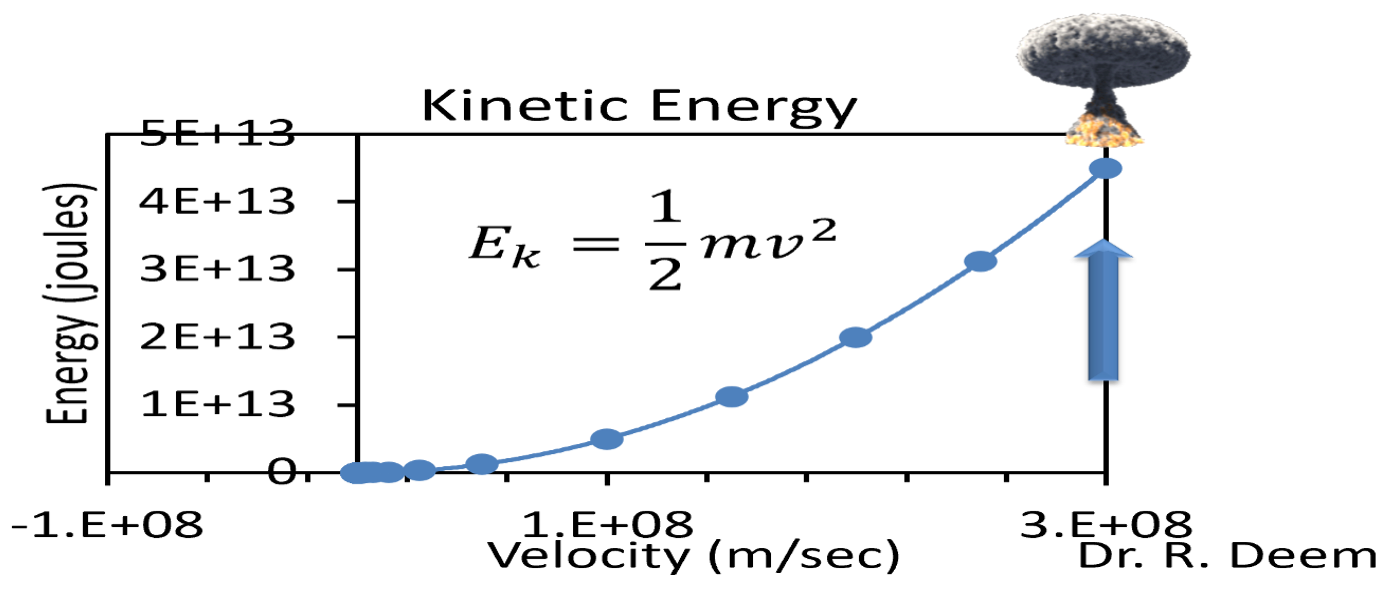
[1] Very useful summary of information was used for this article and can be found with several articles and video links that follow. Richard Deem, “UFO’s and Extraterrestrial Aliens: Why Earth Has Never Been Visited” http://godandscience.org/apologetics/ufo.html#n04. The site may still be getting reworked since I accessed the information.
The Energy Problem
Fuel requirements alone are sobering. I am too cheap to buy vehicles with bad fuel efficiency, but even a Hummer is nothing compared to a space shuttle. To accelerate a spacecraft roughly the size of the Space Shuttle to near light speed would require:
- Energy comparable to the entire world’s fossil fuel supply[1]
- Another equal amount just to decelerate
And this does not include:
- Additional fuel for the journey
- Increased mass from carrying that fuel
- The compounding effect of needing more fuel to move more fuel
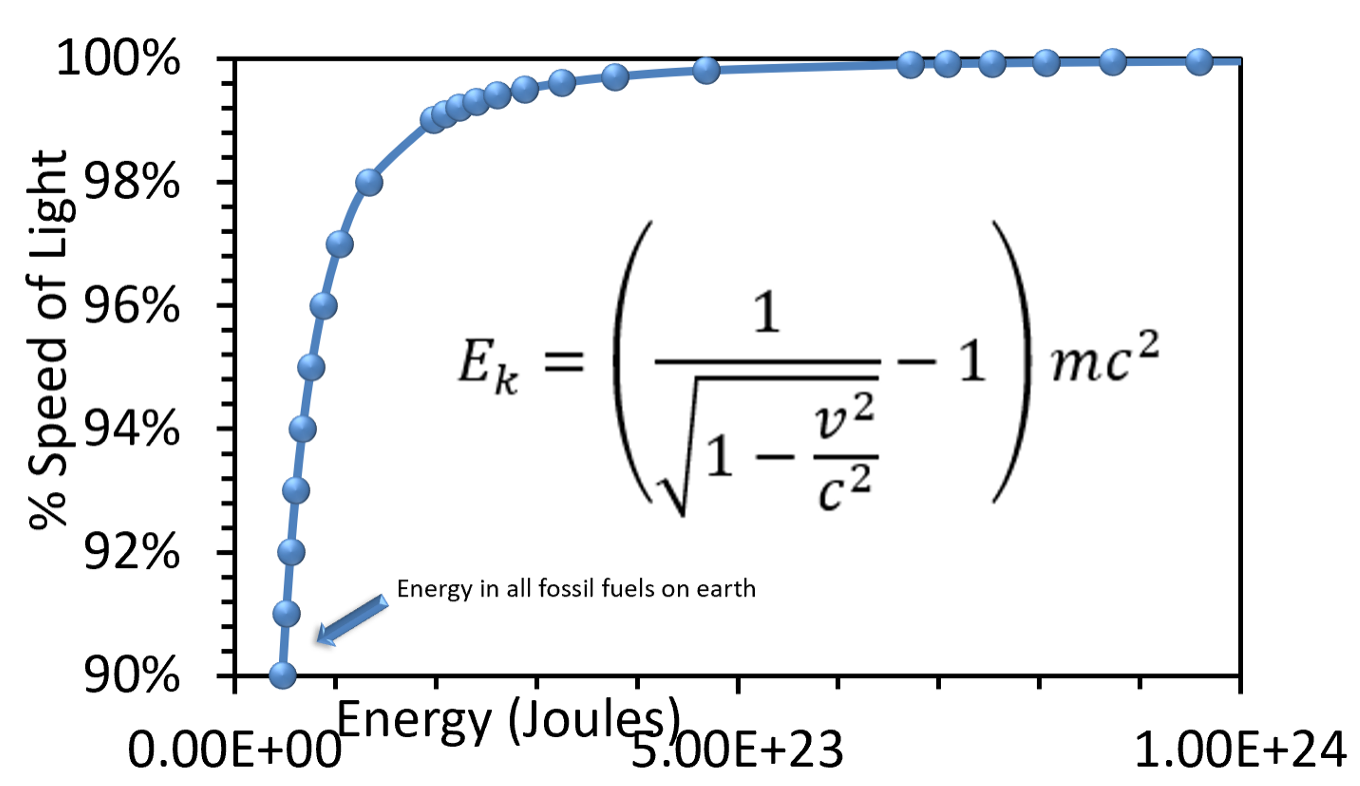
Alternative Energy?
Fusion power is not yet viable at this scale. Even if it were, Frank Drake estimated: “To send a spacecraft the size of a small airliner at one-tenth the speed of light requires as much energy as the US now produces in more than a hundred years.”[2]
In fact, the minimum amount of fuel required for such a spacecraft is 100 tons (assuming a fusion reactor converts mass into kinetic energy at 100% efficiency, which is can’t).[3]
This doesn’t even account for the food and water weight. Maybe you could recycle the water and carbon, aside from the weight and feasibility of recycling equipment, sounds nasty ingesting recycled waste, which would include dead bodies as long voyages, especially the unfathomably long ones needed in this case, would bring a lot of bodies.
You could use matter/anti-matter energy, but we have only produced this using particle accelerators, which are miles long. And our experience with these tremendous constructions is producing the tiniest amounts of antimatter, which only lasts the briefest of time before annihilating by coming into contact with everyday matter.
Warp Drives and Wormholes
Theoretical solutions like warp drives and wormholes exist mathematically.
But do they exist physically, in real life? Probably not, and every potential solution comes with its own set of problems:
- Requiring “negative energy density” (not currently controllable)
- Inability to steer or communicate within the system
- Potential destruction from radiation or particle buildup
- Catastrophic effects at the destination
Theoretical physicist Miguel Alcubierre presented a highly speculative, but theoretically valid solution to Einstein’s field equations in general relativity, that allows for space itself being warped in ways that could in principle move a ship faster than light without violating local causality.
This is where the often-used “warp drive” idea came from.
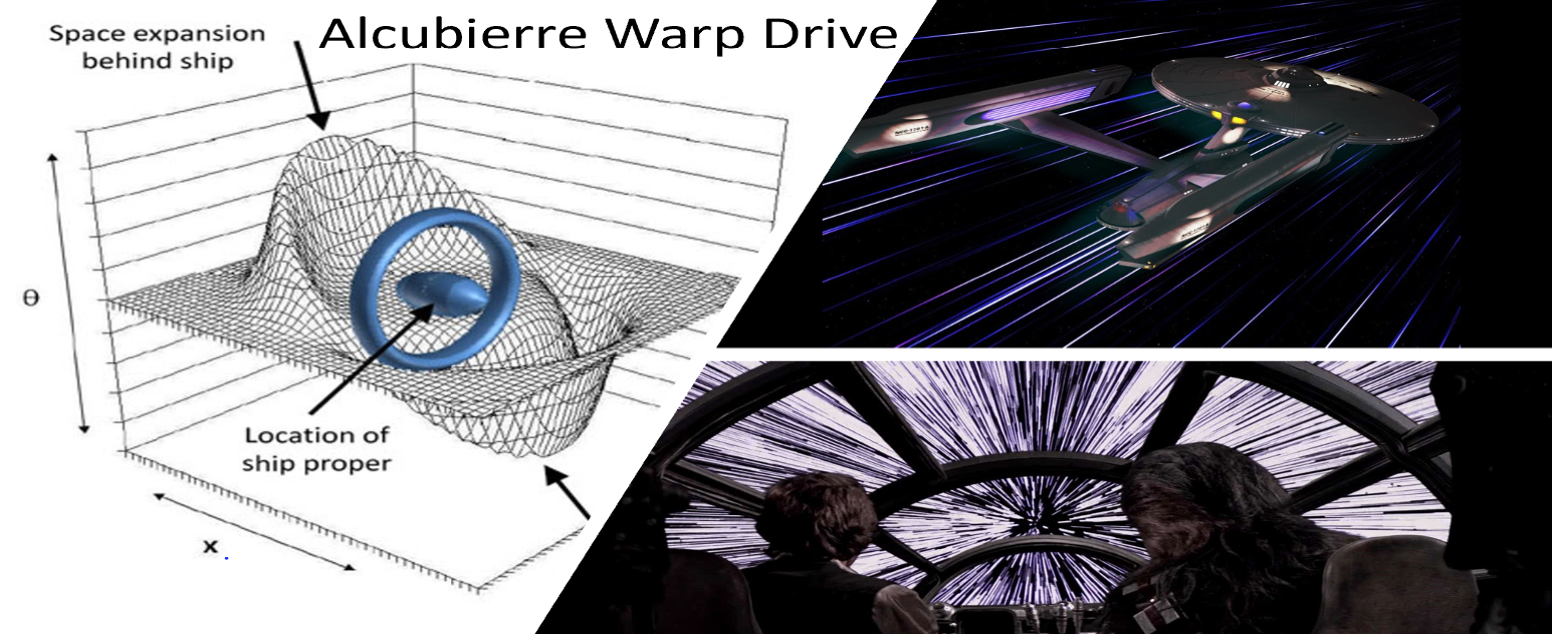
Even if we could avoid the crazy issues with engines using warp drives, we would then just run into the problem of needing to control material able to bend or warp space (“negative energy density”).
If warp drive were possible, again it is very speculative, think what you are doing. You would have to somehow harness something capable of warping the space-time fabric, creating a wave to warp space to expand behind the ship and contract ahead of the ship.
Even if this were able to be controlled without destroying everything near it, numerous articles point out other issues: crew members being unable to control, steer or stop the ship as they would be unable to send signals to the front of the bubble; Hawking radiation would destroy everything within the vessel; and when it stopped, a wave of energetic particles would destroy anything at the destination that is in front of the ship.[4] Better not invite your parents to welcome you home.
Not to mention, Warping space is a local thing. If you have something of massive mass, like a black hole, you can warp space, but it only does so locally, around that black hole, meaning you don’t go very far at all.
Picture a thin rubber sheet held by four people at the corners, who are standing on ladders. A fifth person goes under the sheet, pinches it in the center, and then pulls down so the sheet caves in the center. If the center gets pulled down far enough, then the downward “well” produced would bend the sheet so either side of the “well” come close to each other, and in the case of a gravity well produced by something of tremendous mass-density, a ship could theoretically travel from one side of the well to the other. If a spacecraft actually did this, it would only travel from one side of the space around the gravity well, to the other side, which is not very far.
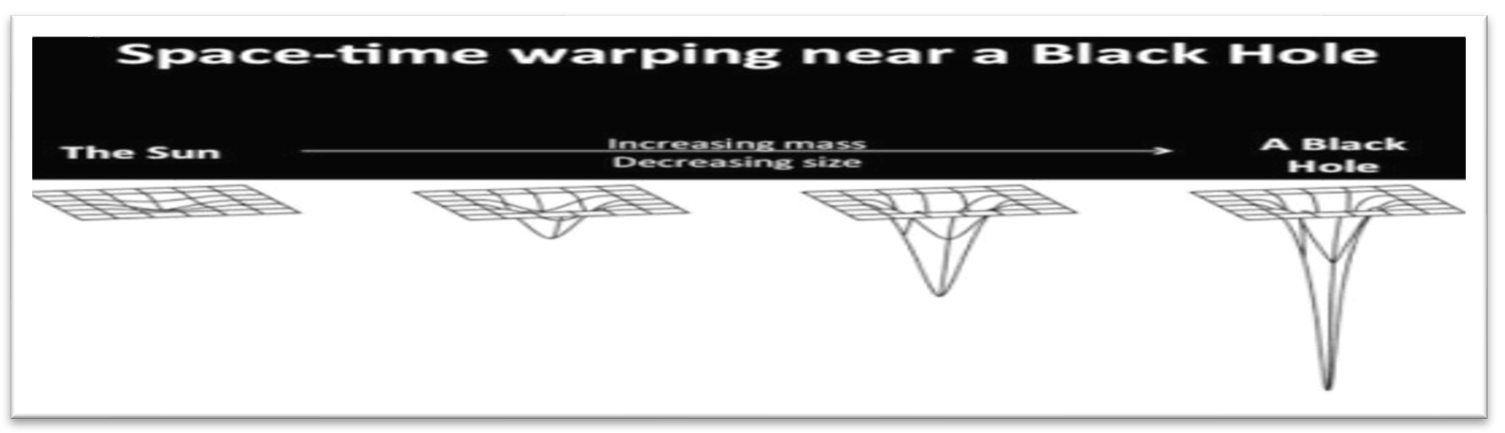
If you want to be very imaginative, you could conceive of a black hole on one sheet of the space-time fabric somehow contacting another black hole connected to a different sheet of space-time, and the supposed point of contact would be like a tunnel, the so-called “wormhole” to that other region. These wormholes can exist in mathematical computations, but can these things exist in the physical world, and be used by us?
They remain speculative, unsupported by physical evidence, and difficult to reconcile with what we observe about black holes. We already know what two black holes do when they are near enough to each other, they give off gravitational waves, which reduces each of the objects’ ability to keep spiraling around each other, and eventually they collide and merge.
Where does a wormhole fit into this process? And how would a traveler avoid the fate physics tells us would happen to a person too near a black hole – your body would be ripped apart in a very interesting process called “spaghettification.” (see post: What happens if you fall into a black hole?).
Distance and vast periods of time required for interstellar travel, of course, translate into increased risk, not only from space, but also mechanical failure of the craft, and even the crew failing.
Radiation: The Silent Threat
Travel near the speed of light introduces another overlooked danger: Pretty starlight becomes deadly radiation.
The Doppler effect you have experienced, when a fast-approaching car comes towards you, the pitch of its sound changes as it reaches and then moves away from you. The Doppler Effect describes how sound waves get compressed, and have a higher pitch when approaching you, and the sound waves get stretched and have lower pitch as the source of the sound moves away from you, as long the source is moving fast enough to make the change in pitch noticeable.
Unfortunately for travelers going near the speed of light, any visible light, like all the stars shown in the image of Star Wars’ iconic Millennium Falcon, would be blue shifted, or compressed all the way to the wavelength of gamma and x-rays. This radiation damages biological molecules.
This reality of the huge risk in space travel is finally getting some of the previously ignored recognition. In Scientific American (February 2017, page 54) Charles Limolihas wrote a very interesting discussion, noting galactic cosmic rays are charged atomic nuclei flying nearly at the speed of light. Limolihas and collaborating researchers demonstrated a much greater effect on brain tissue than anyone imagined.
Shielding against this would require massive protective structures, like something you’d find surrounding radiation oncology treatment vaults, thereby tremendously increasing weight and fuel demands.
We don’t worry about this radiation here on Earth because Earth is designed with two complimentary levels of shielding to handle this constant wave of radiation. Earth’s magnetic field literally acts as a force field, curving the galactic cosmic rays away from the areas of the planet where people live, and the atmosphere handles the rest in beautiful fashion: the magnetosphere shield channels some charged particles towards the Earth’s poles, but the atmosphere is there as the secondary shield which absorbs this remaining radiation and turns it into the Aurora Borealis. When you travel beyond Earth’s magnetic field, you lose these two shields.
On Earth, we are protected by:
- The planet’s magnetic field
- The atmosphere
Once outside that system, those protections are gone.
This is just touching the tip of the galaxy of problems in space travel.
Social Realities
Another issue is based on the effects of prolonged time of a group of people in the confines required for travel. Think about it.
Long-duration space travel would require:
- Multi-generational crews
- Sustained psychological stability
- Consistent mission alignment across generations
Lessons from history—and even controlled simulations—suggest extreme doubt.
The descendants of the original crew members, who volunteered for the trip, made no choice to be on the voyage forced onto them. If the travelers are like humans in any way, the confusion, altered goals or priorities and even relationships between the members would not necessarily have the same focus, dedication, harmonies, and priorities of the original crew.
Practice simulations of such confined living have been performed, with interesting results.[5] Regarding a potential manned mission to Mars, Discover magazine editors commented, “All the conditions for murder are met if you shut seven astronauts in a capsule together for nine months.”[6]
Basic Survival Problems
Even fundamental needs become obstacles:
- Weightlessness: Even more than a few years can be fatal
- Food and water: Storage and sustainability are major barriers
- Closed ecosystems: Difficult to maintain, even on Earth
- Suspended animation: Currently not feasible, except for Bobba Fett
Each “solution” introduces additional complexity, weight, and risk.
Can you hope for the possibility of interstellar travel in the future? Of course, science doesn’t say any conclusion is certain, but expecting a visitor from, or a visitation to alien life from another planet is wishful thinking against overwhelming evidence. Which can be okay, just do not use that same level of thinking in any significantly impactful choices in your own life.
[1] Graphs taken from presentation by Dr. Richard Deem. UFOs Part 1: Why Earth Has Never Been Visited – YouTube
[2] Relentless Evolution: Great Debates Part V
[3] The amount of energy the U.S.A. produces over 200 years is equal to 1.6 x 10²² joules. 1 kg of mass produces 9 x 10¹⁶ joules if all the mass is converted to energy (E=mc2), assuming nuclear fusion could be controlled. This means that the minimum amount of fuel required for such a trip is 180,000 kg (200 tons), which would be more than the weight of the spacecraft itself. This assumes 100% efficiency in converting mass to energy (which, of course is impossible). The amount of energy required to go even faster than 1/10 the speed of light goes up so that infinite energy would be required to travel at the speed of light. Obviously, infinite energy would require infinite mass to produce.
[4]Alcubierre drive – Wikipedia
An article by José Natário (2002) argues that crew members could not control, steer or stop the ship in its warp bubble because the ship could not send signals to the front of the bubble (the Horizon problem).[30]
A 2009 article by Carlos Barceló, Stefano Finazzi, and Stefano Liberati uses quantum theory to argue that the Alcubierre drive at faster-than-light velocities is impossible mostly because extremely high temperatures caused by Hawking radiation would destroy anything inside the bubble at superluminal velocities and destabilize the bubble itself; the article also argues that these problems are absent if the bubble velocity is subluminal, although the drive still requires exotic matter.
Brendan McMonigal, Geraint F. Lewis, and Philip O’Byrne have argued that were an Alcubierre-driven ship to decelerate from superluminal speed, the particles that its bubble had gathered in transit would be released in energetic outbursts akin to the infinitely-blueshifted radiation hypothesized to occur at the inner event horizon of a Kerr black hole; forward-facing particles would thereby be energetic enough to destroy anything at the destination directly in front of the ship.[35][36]
[5] Excerpt from: Aliens From Another World? Getting Here From There (reasons.org) For space travelers all these problems are compounded by limits on the size of their traveling party. Whereas six billion people living on a large planet can tolerate epidemics, natural disasters, ecological crises, and wars, a few (or few thousand) individuals on board a space ship or cluster of space ships would likely be wiped out by such catastrophes. Humanity holds the added advantage of having a large habitat with a wide variety of refuges where one can find temporary escape from a given problem or disaster.
Two tests of space travelers’ ability to support themselves independent of Earth have taken place in the Arizona desert (see www.bio2.edu). In 1991 a team of eight adults were sealed inside a 3.15-acre “capsule” for a two-year stint. In 1994 a team of seven entered for a half-year run. All the plants and animals needed for maintenance of food, water, and oxygen and for waste recycling were sealed inside with them. The challenge: maintain the quality and quantity of provisions and the quality of life in this confined habitat.
Alas, the challenge proved too great. Oxygen levels dropped so low and nitrous oxide levels rose so high that a controlled air mixture had to be pumped in. Nearly all the birds and animals died, as did most insects. Cockroaches and ants did survive, however. Forced to adopt a vegetarian diet, the biospherians discovered they could not raise enough crops. Ultimately, food had to be smuggled in.
The most unexpected problem of the biosphere experiment was the psychological one. A sense of adventure and dedication to the project’s goal held people together for the first few weeks. After that time, however, boredom, confinement, and isolation led to serious discontent and strife. Release came none too soon, especially for those who stayed two years.
Of course, the challenges of space travel would vastly exceed those of an Earth-based biosphere. Earth’s atmosphere and magnetic field protected the bubble from meteorites and radiation. Availability of Earth’s resources prevented total ecological catastrophe. Psychologically, biospherians had the advantage of knowing that if anything went terribly wrong, rescue was only a few feet and a few minutes away. The importance of this one advantage cannot be overestimated.
[6] William Speed Weed, “Can We Go To Mars Without Going Crazy?” Discover (May, 2001), 38, as cited by Richard Deem.
[2] It’s not physically possible to accelerate a ship up to the speed of light or faster. Even to get remotely near the speed of light for just a ship the size of the Space Shuttle, the amount of energy required would be more than the entire Earth’s sum of fossil fuels. And an equal amount of fuel to decelerate. Not to mention, the more energy required, the more mass is added to the ship, requiring much more energy. Maybe you could get to 20% the speed of light somehow, but then the trip would take at least 31 million years. Wonder if there would even be an inhabited Earth by then?
[3] A SETI research group scanned all 202 of the solar-type stars (roughly similar to the Sun) within 155 light-years of Earth. Not one intelligible signal was detected anywhere within the vicinity of each star.5 This finding translates to a minimum alien travel distance of 155 light-years plus hazard-avoidance maneuvers, a total of roughly 230 light-years (or 1.36 quadrillion miles). Christopher F. Chyba, “Life Beyond Mars,” Nature 382 (1996), 577, as cited in article at reasons.org.
[4] Frank Drake, Relentless Evolution: Great Debates Part V. 2002. Astrobiology Magazine.
Some Curious Notes About UFO Sightings
My first instinct when hearing claims of UFOs and “little green men” was simple:
Fraud… or foolishness. But that conclusion is too easy—and not fair.
It’s not reasonable to assume that every witness or reported abductee is lying or confused. I have a very intelligent friend who is convinced he saw a UFO, and I trust his testimony. There are also videos—some even released by the U.S. military—that deserve careful consideration.
Before diving into deeper explanations, it’s worth pausing to look at a curious and even funny bits of information, which hardly anyone talks about.
Where It All Began
Researcher/specialist at the Center at Cedars-Sinai Medical Center in Los Angeles, Richard Deem produced the best presentation I have found. Deem has taken a break from his website so I cannot provide the link to his presentation, but he was kind enough to let me use his presentation material, which I will share below. I made some adjustments and additions, but look forward to his update.
According to Deem, the modern UFO era has a surprisingly clear starting point. Although since ancient times people have contemplated life beyond d the earth, prior to the 20th century, there were very few recorded UFO sightings.
A pilot named Kenneth Arnold reported seeing a series of objects moving erratically—describing their motion as similar to a saucer skipping across water.
The media took that description and ran with it.
 The Chicago Sun labeled them: “Flying saucers.”
And just like that, a new cultural phenomenon was born.
Below is the unclassified report Arnold sent to the Air Force, including his drawing of what he saw. By the time his book came out in 1952, the picture had changed a bit.

The Roswell Story—And Its Timing
Just two weeks later, another story emerged—this time near Roswell, New Mexico.
A rancher reported discovering debris from what was described as a crashed “flying saucer.”
But there are some odd details:
- The debris was reportedly found before Arnold’s sighting
- Yet it wasn’t reported until after the “flying saucer” narrative spread
- The story then disappeared… only to resurface decades later in the 1970s
- And by then, it had evolved—now including claims of alien bodies (some alive, dependingon the version of the story)
Naturally, this raises simple but important skeptical questions.
The Explosion of Sightings
From that point forward, UFO sightings didn’t just increase—they skyrocketed.
Data collected over decades shows a dramatic rise, especially in the United States. You can download the data file of the UFO Sightings Reports of unidentified flying object reported in the last century.[1]
And when that data is analyzed, several curious patterns emerge:
- Why did sightings surge primarily after the 1950s?
- Why are reports disproportionately concentrated in certain regions—especially the U.S.?
- Why is it basically white men seeing and UFOs and being abducted? It has been called a “white man’s phenomena.” Are aliens racist?
- Why do sightings spike at particular times of day?
These are not dismissals—they are patterns that need explanation.
Deem provided the finished graphs and the formulas used to check his analyses.
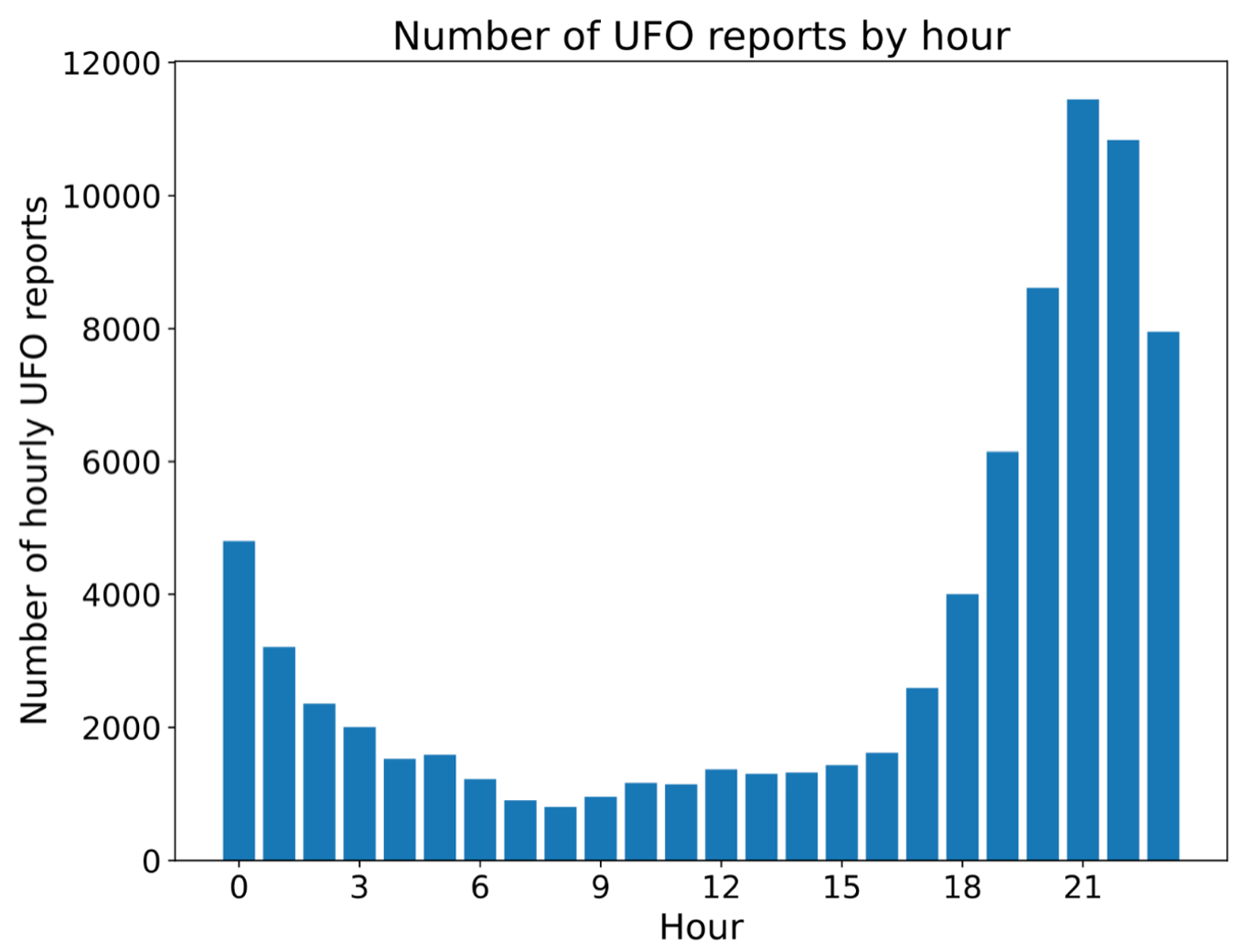
Here is an overlay:
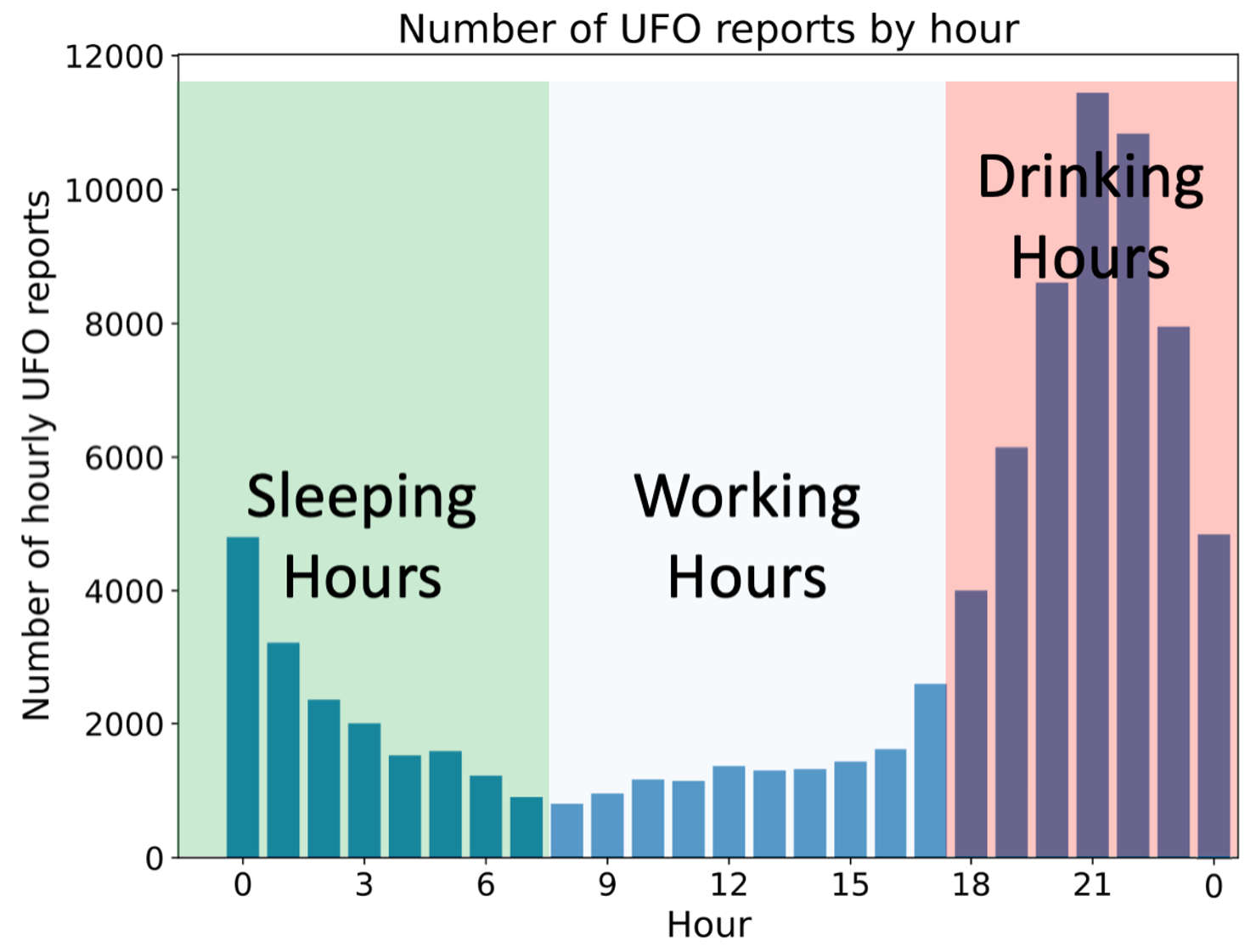
I do not use this graph to claim UFOs are the result of inebriation. Some may be, but I really do think reasonable people have seen unidentified flying objects, which do not fit natural explanations. It would be wrong to think everyone is lying or too foolish to know what is normal and what is not. It does seem there is something real and strange to consider.
The Strangeness Deepens
Over the past 70+ years, the U.S. government has investigated thousands of UFO reports through programs like:
- Project Sign
- Project Grudge
- Project Blue Book
Out of more than 12,000 cases, around 700 remain officially “unidentified.”
More recently, Department of Defense investigations have documented objects exhibiting extraordinary behavior.
Luis Elizondo, who led one such program, described objects showing:
- 1,000–3,000 Gs of instantaneous acceleration
- Movement patterns that appear to defy known physical laws[2]
G is a unit measuring acceleration by comparing to Earth’s gravity. We experience 1G from gravity, and this is equivalent to just over 32 ft/s2 acceleration (9.8 m/s2 in the much more sensible Metric system).
Taking off on a roller coaster you experience pressure from the acceleration reaching maybe 2-4 G. Humans can handle around 4-6 G, 5-6 G only briefly, and up to 9 G for a few seconds if a trained pilot wearing a G-suit.
There is a lot more that is strange. UFOs have appeared and disappeared. There were physics defying maneuvers, these violated natural laws and would be miraculous.
Official reports have not confirmed any extraterrestrial origin.
Possible Explanations
Despite the strangeness, official conclusions remain cautious.
No government report has confirmed extraterrestrial origin, but it is obviously one possible explanation.
Some researchers have proposed alternative interpretations based upon the data, including hypotheses that the phenomena may involve non-physical or interdimensional aspects. For example, the work of Jacques Vallée, John E. Mack, and the Interdimensional Hypothesis (IDH) point to behavior that appears purposeful yet not bound by known physical laws.
These ideas remain speculative and outside the scientific mainstream because they cannot be reproduced or tested in controlled ways.
Thus, mainstream explanations typically fall into categories like:
- Unknown
- Misidentified objects
- Sensor errors
- Classified technology
A Scientific Approach
Even with uncertainty, this topic can still be approached scientifically.
We can ask:
- What would we expect to observe if UFOs were extraterrestrial?
- What would we expect if they were misidentified natural phenomena?
- What patterns would emerge if they were something else entirely?
Then we compare those expectations with actual data.[3] And we can test each explanatory model much the same way we test other beliefs, theories, or models. We can predict what data we will find over time if UFOs are the result of aliens, IDH (which includes demons), or classified tech. We can also consider which alternative best explains the data we have. Consider the connections discovered below.
An Unexpected Correlation
One of the more interesting findings comes from analyzing UFO sighting data alongside cultural trends.
Using data from the National UFO Reporting Center and Gallup surveys, Richard Deem identified a strong statistical relationship, and provides the graphs and the formulas so you can check the data yourself:[4]
- As UFO sightings increased,
- So did the percentage of people identifying as having no religious affiliation
Using standard statistical tools:
- Pearson’s correlation (r) measures the strength of the relationship
- The p-value measures the likelihood that the result is due to chance
The result?
A highly significant positive correlation, with a p-value of:
1.89 × 10⁻¹⁰
Meaning the probability this relationship occurred by chance is less than:
1 in 20 billion.
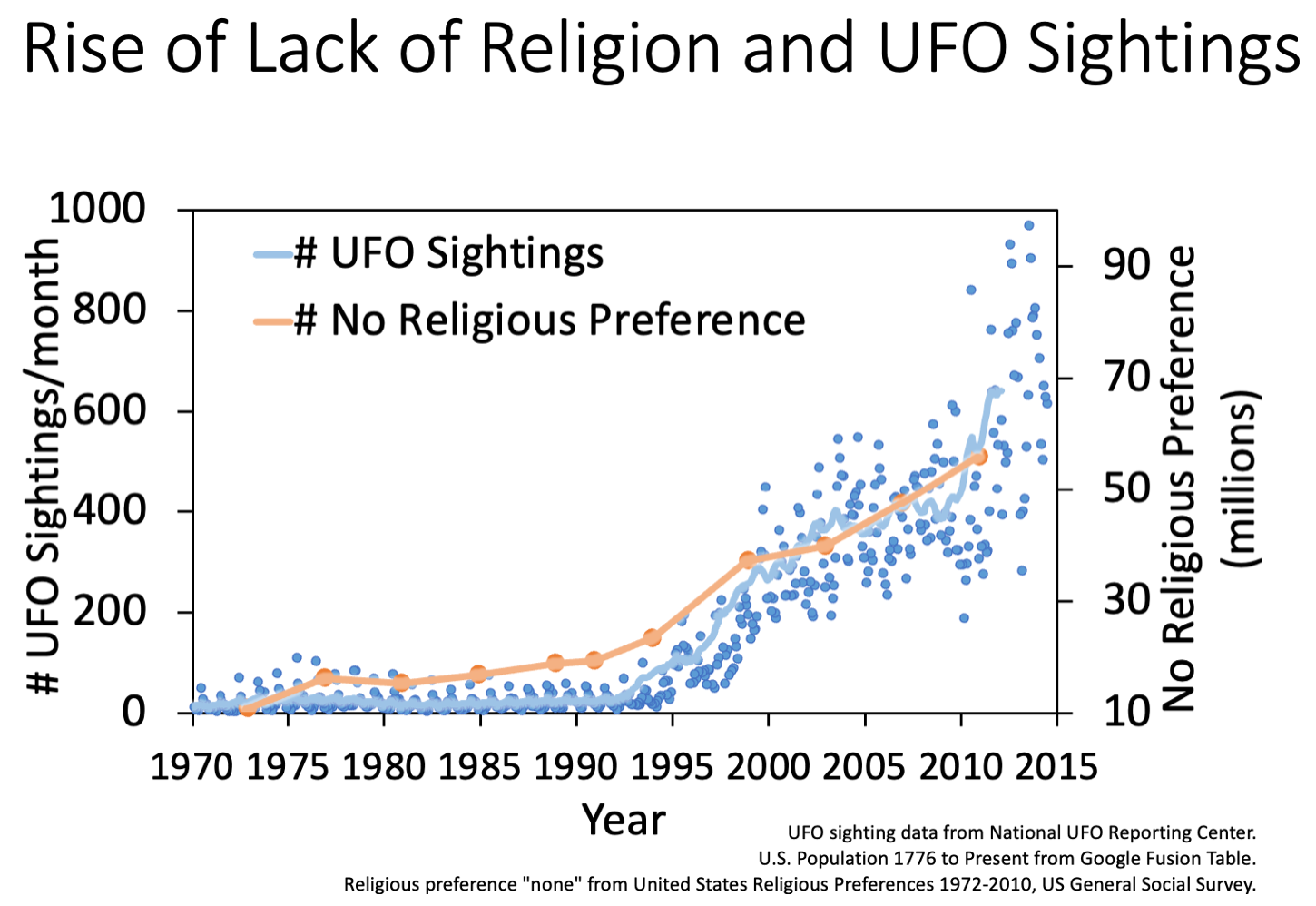
You can check the graph and results yourself. Here is how:
- The UFO sighting data by state can be found on the National UFO Reporting Center’s website. These numbers we use to plot the frequency of UFO sightings on the y-axis for each of the 50 states and the District of Columbia.
- The percentage of people with no religion by state is taken from Gallup survey and is on their website. These numbers we use to supply the x-axis values per state.
- Do a correlation analysis to quantify how strongly and in what direction two variables are linearly related. This is calculated by finding the Pearson’s Correlation (r) value.
- Determine how likely it is that this relationship happened by chance. This is calculated by finding the Probability (p) value.
How to find Pearson’s Correlation:
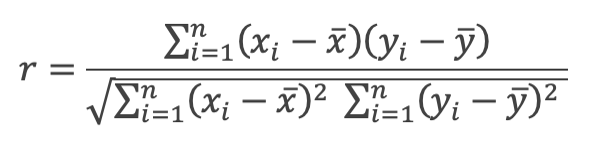
Here is the Excel command to plug into the spreadsheet to obtain a Pearson’s correlation (r) value =PEARSON(array1, array2)
This value puts a number on how strongly and in what direction two variables are linearly related. The number is always between -1 to 1, and translates to:
- +1 Perfect positive relationship, meaning the two are entirely related in that both rise or fall together.
- 0 No linear relationship
- -1 Perfect negative relationship, meaning the two are entirely related in that when one rises the other always falls and vice-versa.
How to find Probability (p) Value: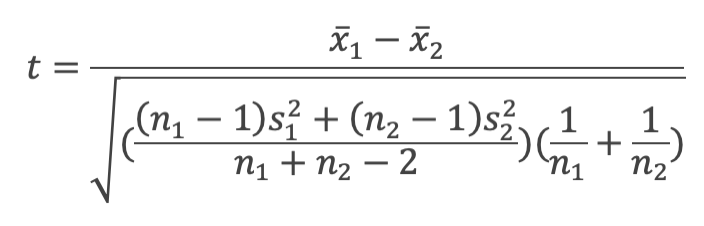
Excel command =TDIST(pearson*SQRT(n-2)/SQRT (1-(pearson^2)), n, 2)
This value puts a number on how likely it is that this relationship happened by chance:
- Small p (≤ 0.05) → unlikely due to chance → statistically significant
- Large p (> 0.05) → could easily happen by chance → not significant
It’s a common mistake to think if the p is small the relationship is strong, but p is not about relationship strength, r is not about relationship strength, p is about confidence the relationship is real and not by chance.
Here are the RESULTS
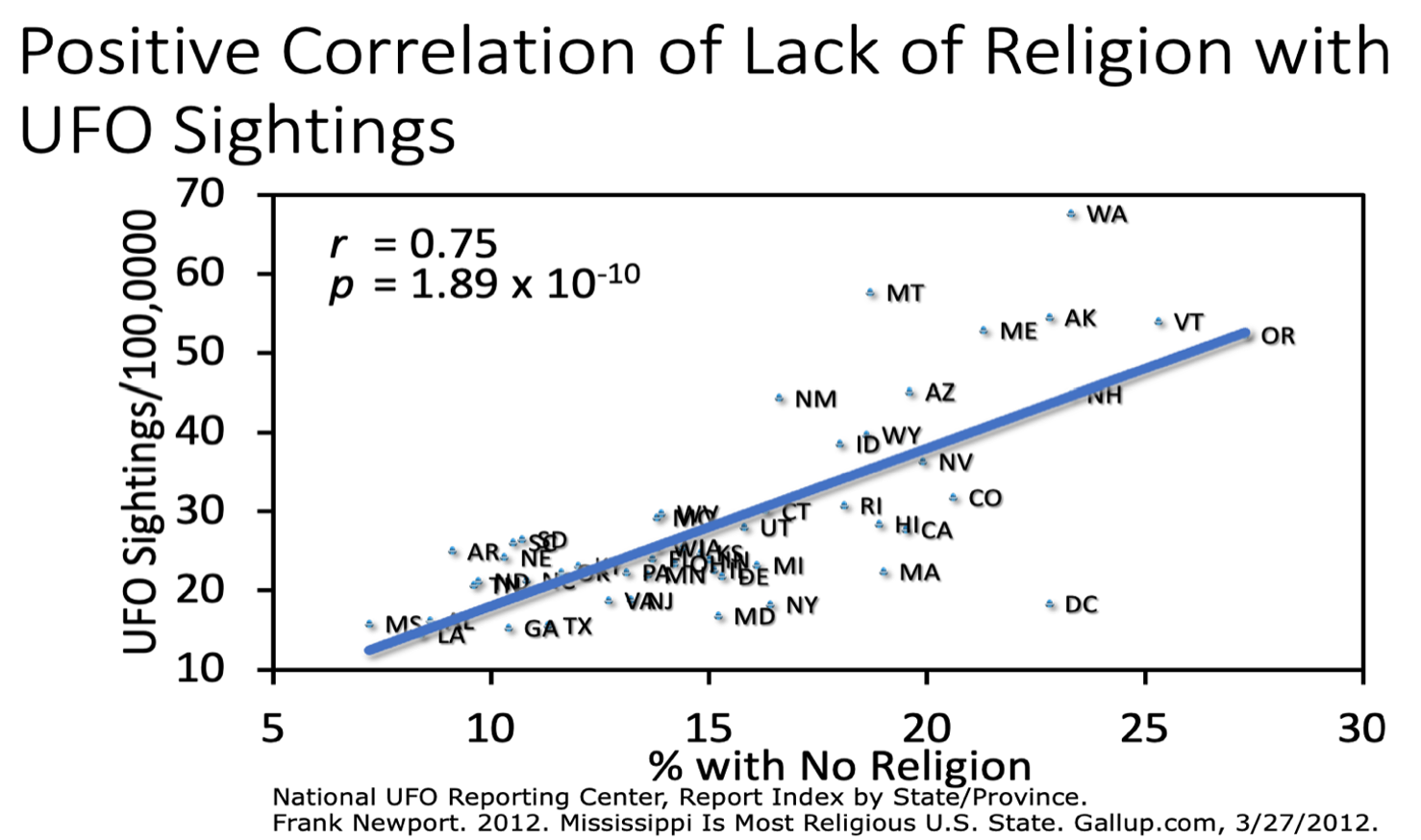
The data shows a highly significant positive correlation between the percentage of unbelievers and the frequency of UFO sightings. With a p value of 1.89 x 10⁻¹⁰, this means that the probability of the result occurring by chance is less than 1 in 20 billion!
[1] https://www.kaggle.com/datasets/NUFORC/ufo-sightings
[2] New Videos Shed Light on Pentagon’s Secretive UFO Program,” CBS News, December 18, 2017, https://www.cbsnews.com/news/ufo-videos-pentagon-program-luis-elizondo, accessed 26 April 2026.
[3] U.S. Department of Defense, Preliminary Assessment: Unidentified Aerial Phenomena (2021)
[4] Richard Deem, “UFOs and Extraterrestrial Aliens: What Are They?,” God and Science, awaiting the site to finish reconstruction to provide URL.
A Better Explanation Of UFOs
As a Bible believer, I do not see strong biblical reasons to conclude that alien life either does or does not exist.
I’m genuinely open to either possibility.
Alternatively, I have very good reasons supporting the unique accuracy of biblical claims, which include spiritual beings (we label as angels and demons, but these are also interdimensional beings included in IDH).
Such beings would be:
- Intelligent
- Purposeful
- Capable of operating beyond our three dimensions of space and one dimension of time
In other words, they would not be bound by the same physical laws that govern the natural world.
This provides a direct explanation for something important: The apparent violation of natural laws often reported in UFO phenomena, including appearing and disappearing.
It warns that deceptive spiritual beings exist—beings that oppose humanity and can manipulate human perception and belief.
That is why Scripture cautions:
“Do not believe every spirit, but test the spirits to see whether they are from God…” (1 John 4:1)
This is not a dismissal of experiences.
It is a call for discernment.
Building on this framework, Richard Deem proposed a specific hypothesis:
That UFO sightings and abduction experiences may not be extraterrestrial at all, but instead represent spiritual deception—attempts to convince people that intelligent life exists throughout the universe, thereby removing the perceived need or even existence of a Creator.
In this view, even the concept of “God” can be reframed:
Not as a Creator to be trusted, but as a highly advanced alien to be resisted.
Over two decades ago, a psychiatrist friend of mine, William Guy, made a striking prediction.
We were discussing the strength and breadth of evidence supporting Christianity when he suggested that even if people came to recognize that evidence, many would still resist its implications.
I found the prediction strange at the time, but it now seems remarkably perceptive. Invoking aliens is not so much a conclusion as it is an escape hatch.
You can already see this shift reflected in modern culture:
- The Engineers who seeded life on Earth in Ridley Scott’s films,
- God portrayed as a petulant and powerful bully in the Supernatural series,
- The “Jesus was an alien” theory floating on internet forums.
Fascinating ideas for science fiction, but faulty hypotheses for non-fiction.
Testing the Hypothesis
Deem approached this question the way any serious inquiry should be approached:
Can it be tested?
He pointed to data showing a strong correlation between:
- Increasing UFO sightings
- Increasing levels of secularization
There are even claims made thousands of years before these modern experiences began that apply. When combining the facts shown by the graphs with the biblical claim that those in relationship with God possess spiritual discernment (1 Corinthians 2:14), this creates a testable framework:
If spiritual deception is involved, those with greater discernment should be less susceptible than those without the interaction on a spiritual level with God, which brings understanding and discernment otherwise absent.
This means believers have added capacity to recognize spiritual level fraud. And remember, there is a strong correlation between lack of religion and sightings of UFOs, and the very low probability this correlation is by chance.
This explains the graphs very well.
As is true with some of the most straightforward and accepted science, there are also predictions and repeatable tests available. Which is not the case for alien UFOs. We will cover this shortly, but first a word of caution about gullibility.
It is often claimed that those who believe the Bible are gullible.
That is true for some. But where is the evidence to support this hasty generalization?
Further, gullibility is found across every belief system, including atheism.
The real question is not whether some individuals are gullible.
The question is: What does the evidence support? And who is going against the evidence and best reasons.
The case presented here is not based on blind faith, but on what is argued to be testable, evidence-based claims—claims that, if true, would make belief not only reasonable, but compelling.
Additionally, there is significant background evidence that must be taken into account. This website provides a comprehensive case of evidence, primarily taken from peer-reviewed research from those not accepting the Bible, supporting the conclusion the Bible provides accurate and testable knowledge on a level no human source has remotely approached.
This source is unparalleled, and therefore, extremely it is reasonable, even compelling to accept. And gullible to believe the Bible is just a product of humans like any other source.
If the Bible is accurate regarding spiritual beings, demons, and those in a relationship with God are better able to discern spiritual fraud, then this explains the graphs very well. Making those claiming aliens explain the UFO records as the ones being gullible.
Which one is the best explanation? It is testable. Are there other reasons from the records to add support to one explanation or another?
Yes, an eerie example comes next.
Abduction Experiences That Demand Explanation
Studies of abductees reveal something important. These accounts should not be dismissed outright as fraud or imagination.
They are:
- Voluminous
- Vivid
- Life-altering
- Psychologically impactful
Studies that have been done did not determine a specific characteristic in all abductees. However, researchers did record those claiming to be abducted by UFOs exhibited a fantasy-prone personality. Curiously, most of these experiences were only remembered while under hypnosis.
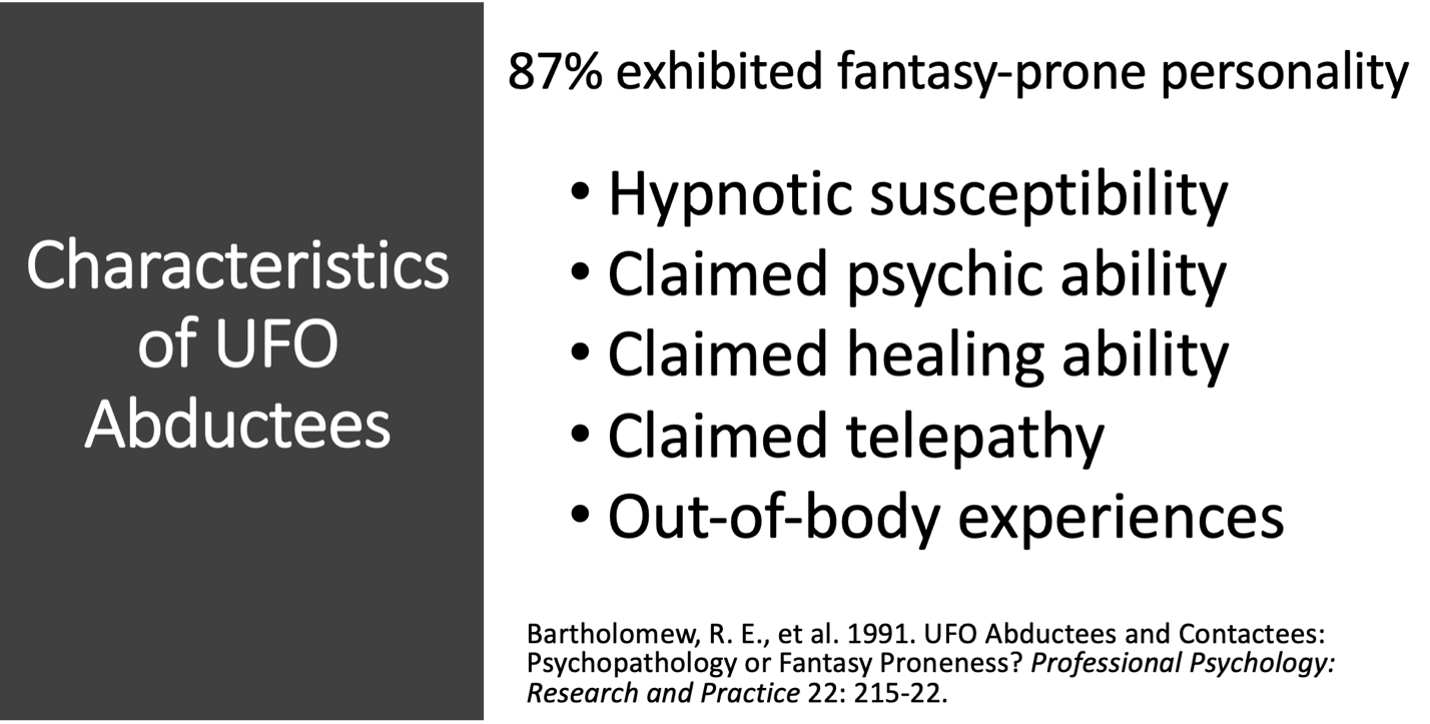
Over time, entire belief systems have formed around these experiences. New Age ET channeler, Barabara Marcinak stated in her book Bringers of the Dawn: Teachings from the Pleiadians:
The people who leave the planet during the time of Earth changes do not fit in here any longer, and they are stopping the harmony of Earth. When the time comes that perhaps 20 million people leave the planet at one time there will be a tremendous shift in consciousness for those who are remaining.[1]
The Heaven’s Gate cult engaged in mass suicide hoping to catch a ride on an alien spaceship they believed trailed behind the Hale-Bopp comet.
Raelianism copies and adjusts the same pattern used by other cults: claiming we all will be judged based entirely on our works, and in their belief it is by an advanced alien panel of judges.
Many include:
- Salvation by extraterrestrials
- Escape from Earth
- Transformation into higher beings
- Judgment by advanced alien intelligences
Look closely, and something becomes clear: These ideas often mirror biblical themes—but with key elements altered.
It’s not a random collection of beliefs. It’s a reframing.
A CNN/Time Magazine poll[2] in 1997 found:
~80% → Believe the government is not telling everything it knows about UFOs
~48% → Believe UFOs are real objects
~29% → Believe UFOs are alien spacecraft
~75% → Believe the government knows more about Roswell than it admits
These beliefs will only grow as belief in ETs grows. A more recent poll in 2025[3] found:
- 56% believe aliens definitely or probably exist
- 47% believe aliens have visited Earth
- 30% believe UFOs are probably alien spacecraft
The Bible noted those opening themselves to psychic, paranormal, or non-biblical spiritual experiences are opening a door to spiritual beings not of God.
Doctor John E. Mack, a Harvard psychiatrist, former professor of Harvard Medical School, and Pulitzer Prize-winning author, and Joseph Jordan, National Director in South Korea for the leading secular UFO research organization in the word, Mutual UFO Network (MUFON), are two of the most involved researchers of these claimed abductions. They have provided written records.
John Mack argued that reported abduction experiences may involve aspects of reality not adequately explained by current scientific frameworks, potentially challenging the boundary between the material and spiritual realms. In Abduction: Human Encounters with Aliens (1994), and Passport to the Cosmos (1999), Mack concludes:
- The phenomenon could not be fully explained by conventional psychiatry or simple physical models
- It might involve a non-ordinary reality (his phrase)
- The experiences often had spiritual or transformative effects on people
Joseph Jordan has a unique opportunity as a researcher in this area of study as he has approached the issue from three different perspectives—as an agnostic, then a new-ager, then finally, as a Christian. Nearing 30 years of research, over 600 cases he has personally investigated with abductees.
Both Jordan and Mack found that these abduction experiences were not benign. People were traumatized; lives were turned upside down.[4] Which is why it is very questionable the New Age channelers and other cults are claiming these ETs are benign.
Additionally, while MUFON is a data collection organization and official conclusions are not given, Jordan stated the understanding throughout MUFON and other research groups and conferences was that abductions, and the terrible experiences that followed were never able to be stopped. Budd Hopkins, David M. Jacobs, and others reported: subjects felt unable to prevent experiences, and attempts to resist were often described as ineffective.[5], [6]
During one recording of an abductee, Jordan was surprised to hear his abduction abruptly stopped when he started calling on Jesus to save him. Jordan thought the common knowledge was nothing was able to control or stop the experience.
Jordan reached out to other researchers worldwide, and, off the record, other researchers confided in discovering similar cases where victims either hummed a hymn or sang, or quoted scripture, or in some other way called to Jesus and not did it stop the experience, but also led to termination of the experiences as a life pattern.
Jordan responded saying he heard these same researchers saying these experiences could not be stopped, and they responded similarly, saying they didn’t know what to make of it and were afraid to go into it because it might affect their credibility in the UFO research Community. Jordan knew this was “a piece of the UFO puzzle that needed to be looked at” but it was an “unwanted conclusion.”
Unwanted because the hallmark of his own organization, MUFON, was to promote the idea of alien visitations. Of course, there is a significant group in the study of UFOs who want and expect these experiences to be real aliens. But Jordan goes on to observe:
Many in MUFON leadership have responded positively to hearing about people terminating this experience by invoking the name of Jesus Christ. I have had the opportunity to share the findings personally with the current and four past International Directors of MUFON. Many in MUFON have privately shared that they now believe it is spiritual and even demonic.[7]
Jordan himself became Christian, and now refers to abductees as “experiencers,” as they definitely have experiences, but he does not think they are alien abductions.
Even after his first 400 investigations and counseling of experiencers, he catalogued over 250 written and verbal testimonies from former experiencers stating after claiming the name and authority of Jesus Christ stops the experience, and accepting a personal relationship with Him terminates the pattern of these experiences.
The Bible described different forms of demonic activity, and provided warning:
For our struggle is not against flesh and blood, but against the rulers, against the authorities, against the powers of this dark world and against the spiritual forces of evil in the heavenly realms. (Ephesians 6:12)
Demonic activity utilizing the idea of aliens for a manipulative and harmful purpose fits the pattern. Further, unlike the extraterrestrial hypothesis (ETH), this hypothesis can make predictions and have tests that are repeatable.
For example, if the claimed use of Jesus and acceptance of the biblical relationship with God has the claimed effects, then it will be repeatable.
After posting the testimonies and making the claims public, Jordan and his team began receiving emails asking for help from the same experiences. They answered they predict they could help using the same involvement of Jesus alone.
The results were shown to be repeatable.
When time and opportunity allows, I will interview Joseph Jordan, and others that support or refute his claim. Currently, I am guardedly taking Jordan’s word as accurate, until proven otherwise, you have to do as you think best. As for me, Jordan’s claims fit the context of background evidence (not baseless faith, but well-established and evidence-backed biblical faith).
A Critical Difference
This creates a sharp contrast between explanations.
The extraterrestrial hypothesis:
- Does not provide consistent predictions
- Does not offer repeatable interventions
- Does not explain how the data shows violation of natural laws
- Does not explain other aspects of the data, such as the strong correlation with lack of religion and unique and repeatable stoppage of abductions
This alternative explanation:
- Provides testable predictions
- Validated by repeatable tests
- Strongly explains the violation of natural laws
- Strongly explains the graphs and abductions
Final Thought
The UFO phenomenon is real in the sense that something is being experienced. But the explanation we choose matters. Because it will shape how we understand:
- Reality
- Truth
- And ultimately… our place in the universe
So the goal isn’t to dismiss. And it isn’t to believe too quickly.
It is to do something harder—and far more valuable: Follow the evidence… wherever it leads.
[1] Barbara Marciniak, Bringers of the Dawn: Teachings from the Pleiadians (Santa Fe, NM: Bear & Company, 1992), 319.
[2] Poll: Americans Believe in UFOs, Government Coverups,” CNN/Time, June 1997.
[3] Jamie Ballard, “Half of Americans Believe Aliens Have Visited Earth,” YouGov, November 25, 2025, https://today.yougov.com/health/articles/53486-half-of-americans-believe-aliens-have-visited-earth
[4] Gary Bates, “UFO Change,” Creation Ministries International, accessed April 26, 2026, https://creation.com/ufo-change
[5] Budd Hopkins, Missing Time: A Documented Study of UFO Abductions (New York: Richard Marek Publishers, 1981).
[6] David M. Jacobs, Secret Life: Firsthand, Documented Accounts of UFO Abductions (New York: Simon & Schuster, 1992).
[7] Joseph Jordan as cited in “UFO Change,” and other interviews.
What to do when talking about aliens?
Three logical questions keep it simple—The Open Palm Slap (click on for link to post):
- What do you believe about aliens?
- Why do you believe that?
- Have you considered… bring up a significant piece of evidence to lead to further thoughtfulness on the topic.
The first question is useful to understand what exactly you, and/or the other person currently believe, as it helps when you must, out loud, state your belief:
- Aliens are abundant and already visit Earth
- Aliens are too rare or too far, and may or may not ever visit Earth
- Aliens do not exist
The second question is very significant, as both you and the other person can see what reasons, evidence, support, or lack thereof, supports each belief.
Finally, if your belief differs from another, provide something for them to think about, which will either challenge the support for their belief, or supports your differing belief. Or, if they provide you with better evidence than you have for your own belief, it’s in your best interest to consider it.
Shouldn’t have to keep repeating this, but you need to care more about the other person, than “winning” an argument.
If your emotions make you act negatively towards the other person, or towards truth, you have issues and need to fix yourself before trying to enter a productive discussion.
For some reason, people have behaved really odd and defensive regarding this topic. If the other person(s) shows unwarranted emotion or weak behavior or thinking, then point it out:
- I see you have some emotion tied into this, why is that?
- You’re the kind of person I’d like to talk to about this, since we disagree, but I need good reasons, not emotion.
- If you can’t support your point with good reasons, you are not capable of a reasonable discussion. Walk away.
If they can’t handle a good discussion, you can always find someone emotionally mature and intellectually honest enough who can.
If you are asking someone else who believes in aliens, here is what I advise:
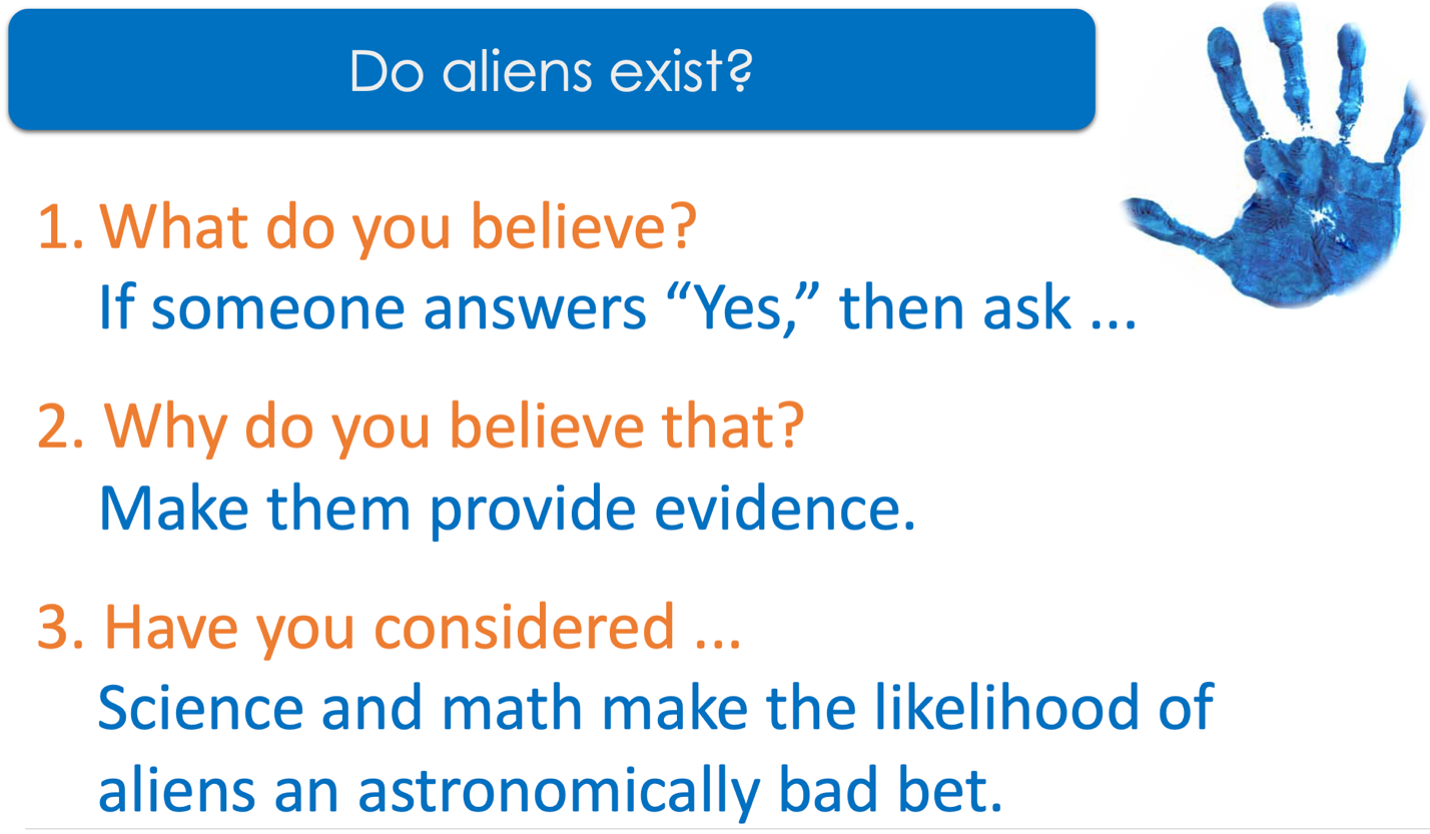
If someone asked me, here is how I would answer:
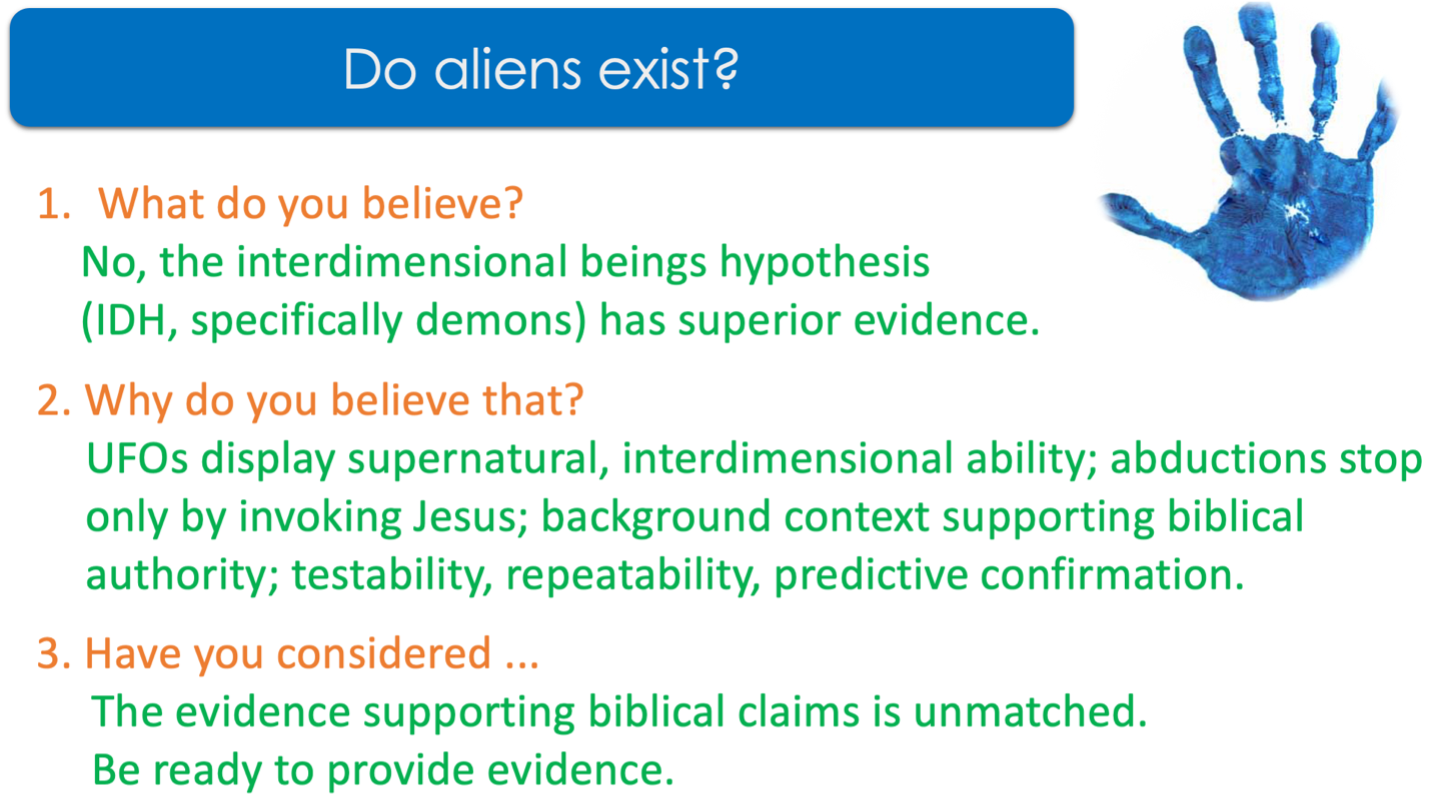
Could I be wrong, sure, but those betting on aliens existing are making a very bad bet, unless God purposed to have more than one place where life is able to operate.
Next, some common objections people bring against the claim that aliens do not exist.
Common Objections
Objection 1: It’s extremely arrogant for us to assume that we’re special.
During an interview for his then upcoming War of the Worlds movie, Tom Cruise said something similar when asked about life on other worlds. This is an annoying emotional appeal. No evidence, not a logical scientific argument, just calling you arrogant if you disagree.
Of course, Cruise has leanings towards this belief as Scientology teaches galactic ruler Xenu used DC-8-like spaceships to transport alien beings to Earth (called Teegeeack back then) to kill them, and then subjected their spirits to some kind of conditioning and implantation.
Can you see why I do not even invest time in trying to disprove this belief system? If you believe this, why? What evidence?
I am not saying anything about your intelligence, because very intelligent people have accepted these teachings. And no one can seriously claim to be free from believing something inaccurately before; we all make mistakes.
But the all-important difference is: Reasonable people, not being controlled by their emotions or wants, continually seek and move towards the most reasonable beliefs to base their lives upon. And to remain a reasonable belief, you must have better reasons than alternative beliefs, and I do not think this is possible for Scientology, or anyone claiming it is arrogant to think we are alone in the universe.
Objection 2: Absence of evidence is not evidence of absence
Okay, but we have evidence of absence too. Everything we know says we are alone. All scientific understanding of what it takes to have a habitable planet, combined with mathematical analysis leads to highest probability of a lonely universe.
Objection 3: Why such a huge universe if we are kept in just the playpen of Earth?
What is kept in playpens? Infants. Wise parents understand and keep too undeveloped and immature children within strict boundaries for their own protection. Maybe humanity is not able to handle themselves with anything further than life on this planet. Especially if the purposeful goals of a Creator do not fit what humanity may want.
Objection 4: There is a Government conspiracy to cover-up alien existence
Even I, someone who rejects almost all conspiracy theories out-of-hand, am tempted to give this idea a chance as the media and governments are firmly lodged in the dregs of my respect and trust, yet I cannot get around the history and facts about conspiracy theories.
A funny sidenote, Edward Snowden,[1] who did the snooping in the classified government files for all of us, did a podcast interview with Joe Rogan on October 23, 2019. He stated if there were any hidden information about aliens, it must be hidden really well, because he went looking.
Before buying into any conspiracy theory, it would be helpful to look into conspiracies, there are constant examples through history, in order to understand how conspiracies work, or do not work.
The conspiracy required to keep alien activity under wraps is most likely unobtainable.
History, and vast experience in criminal investigations have indicated properties required for successful conspiracies, for example, below is a list provided by the cold case detective I have spoken with regarding this issue. This detective holds the most appearances on Dateline for his impeccable record of solving cold cases:[2]
1. A small number of conspirators
Lies are difficult to keep a hold of, and when the number of conspirators is more than a very small and tight group, a number of factors arise making the conspiracy difficult, up to impossible, to maintain.
2. Thorough and immediate communication
All involved must immediately get their story straight, but not too straight, to survive investigation. If not, coconspirators simply are unable to separate lies from the truth and unsure where the others in their conspiracy stand.
3. A short time span
4. Significant relational connections
When each in the group is deeply and meaningfully connected to the others, there is motivation to keep the conspiracy and not break down. Yet, government workers are not known for this.
5. Little or no pressure
When concealing something as monumental, and assumed to be essential public knowledge as the existence of alien visitation, the pressure to provide the truth, especially when nearing the end of their lives, would be tremendous.
A huge conspiracy keeping away knowledge of aliens is at the wrong end of all these factors:
- This would require a massive and continuously growing number of conspirators
- With so many conspirators in so many areas of the world and society, immediate communication, deep connections, and short time span are not possible
This stretches the imagination too far to believe in such a conspiracy against aliens would be successful.
[1] Edward Snowden – Wikipedia : American whistleblower who copied and leaked highly classified information from the National Security Agency in 2013 when he was a Central Intelligence Agency employee and subcontractor. His disclosures revealed numerous global surveillance programs, many run by the NSA and the Five Eyes Intelligence Alliance with the cooperation of telecommunication companies and European governments, and prompted a cultural discussion about national security and individual privacy.
[2] Detective J. Warner Wallace, Cold-Case Christianity: A Homocide Detective Investigates the Claims of the Gospels (Colorado Springs: David C Cook, 2013), 111-112.
Aliens Appendix 1. The Drake Equation
Drake Equation parameters:
R* (average star formation rate)
The current rate of star formation is ~3 stars/year. However, in the past, the rate was higher. The average rate over the history of our galaxy was ~10 stars/year.7
fs (fraction of “suitable” stars capable of supporting a habitable planet)
95% of stars are smaller than the Sun.8 Small stars put out less energy, requiring potential life-containing planets to be closer to their star. The gravitational tidal effects result in synchronous rotation (where one side of the planet always faces the star), would affect atmospheric freeze-out due to the cold dark side.
Large stars (more than twice the size of the Sun) burn erratically and rapidly (burn out in less than 1 billion years – too short to develop advanced life).8 Variable stars, neutron stars, and white dwarf systems are too unstable to support life.
Only the area within 10,000 light years of the Sun are suitable stars (the galactic habitable zone).9 Radiation levels are too high near the center of our galaxy due to high densities. In addition, planetary orbits are likely to be less stable, due to stellar interactions. Stars in the outer region of our galaxy are unsuitable, since the rate of star formation is too low, resulting in low metallicity.
Only about 20% of stars fall within the galactic habitable zone. Not only is the Sun within this zone, but it is between spiral arms, which puts it in a low density area. The Sun is at the co-rotation radius of the galaxy, which means that the orbits of surrounding stars are stable – proceeding at the same rate.10 In other regions of the galaxy, stars rotate at different rates around the galactic center, going in and out of the spiral arms as the galaxy rotates. The co-rotation radius is the only radius in the galaxy where stellar orbits do not interact. (0.05 * 0.2 = 0.01)
fp (fraction of suitable stars with planets)
To date, about 10% of stars studied have planets orbiting them.11 Rocky planets cannot form unless the amount of metallicity is at least 60% of that of the Sun. The Sun is an unusually metal-rich star (richest out of 174 well-studied stars).8 The number of rocky planets is unknown, but hundreds to thousands have been discovered. Part of the problem is due to the limits of detection.11 Optimistic estimates claim that rocky planets are common (at least 75% of systems will have them). However, if the abundance of rocky planets is similar to the percentage of stars that have gas giants, the estimate could go as low as 10% (and possibly much lower).
nE (average number of “Earth-like” planets)
Not all rocky planets would be capable of supporting advanced life. Small rocky planets would lose their atmospheres (like Mars) shortly after formation. Large rocky planets would hold too much atmosphere, resulting in runaway greenhouse effect. Probably less than 10% of rocky planets would be right size to support advanced life.
The habitable zone for planets is relatively small, representing less than 10% of the area where rocky planets might form (actually vastly smaller, possibly zero, fit within the current fourteen known habitable zones).
The planet must be able to support plate tectonics. Without plate tectonics, planets would be water worlds (no dry land) and necessary nutrients would never be recycled. Intelligent life capable of communicating with us could not be exclusively aquatic, requiring the presence of land. Plate tectonics are a function of the thickness and composition of the crust and the presence of a large metallic core. None of the other rocky planets in our Solar System, other than earth, exhibit plate tectonics.
Venus, which is nearly the same size as earth, does not have plate tectonics. Although driven by radioactive decay that keeps the mantle liquid, the ability of plate tectonics to function seems to be due to the removal of ~70% of the primordial crust of the Earth to a position in orbit overhead (during the collision that formed the moon).12 If that crust were returned and replaced on Earth it would fill the ocean basins with wall-to-wall continent. This would choke plate tectonics, as on Venus, and displace the oceans to flood the land to a depth of several miles.
Nick Hoffman, Senior Research Scientist at La Trobe University, Melbourne Australia, claims that extraterrestrial “worlds will be, almost without exception, waterworlds.”13 Although collisions would have been common during the accretion phase of formation of the Solar System, a highly unlikely collision would be required to eject the earth’s crust into orbit and deposit the core of the collider into the earth’s core. The probability of such an event would likely be less than 1 in 10,000.
Other problems involve the presence of other gas planets in the stellar system. The current information on extrasolar planets indicate that a large percentage of the giant planets tend to migrate inward towards their star after formation, which would eject any Earth-sized planets from the habitable zone. A very optimistic estimate of this value would be 0.01. It is more likely that this value would be less than 0.00001.
fl (average fraction of Earth-like planets with life)
This value is quite disputable and subject to a wide latitude of possible values. Many scientists assume that since the earth developed life at a time when the conditions were inhospitable, that life emerges on virtually every planet that is capable of supporting it. There are some major flaws with this idea.
First, it is now known that the “prebiotic conditions” assumed to have been present soon after the earth’s formation never existed. Oxidation of zircons over 4 billion years ago demonstrate that free oxygen was present on the earth before life emerged.14 None of the prebiotic chemistry works in the presence of even small amounts of free oxygen.
Even with unrealistic “prebiotic conditions” the chemistry will not produce all the necessary biomolecules required for the first living system. In addition, hydrothermal sea vents, the current choice for the origin of life, would be unsuitable, since cell membranes cannot assemble in the presence of the salt of the oceans (See Is the Chemical Origin of Life (Abiogenesis) a Realistic Scenario?). Among all the 30,000 meteors collected on earth, none contain any evidence that life exists outside of the earth.
The assumption that fl is nearly 1 is based upon the rapid appearance of life early in the history of the earth, which many claim indicates that it is easily produced abiotically in this universe. However, the science indicates that the biological precursors of living systems cannot be produced naturalistically, nor can they be assembled under conditions that existed on earth. Realistically this value would be very small – probably even zero.
fi (average fraction of life-bearing planets evolving at least one intelligent species)
Intelligence is not something that would be expected to appear automatically. Taking the earth as an example, it took over 3 billion years for intelligent species to appear. Many worlds on which life might survive would be inhospitable to advanced life forms.
For example, the rotation of the earth at its creation was complete in a scant 8 hours. At such rotation rates, a calm day would be characterized by 1,000 mph winds. Needless to say, intelligent beings would find it difficult surviving such conditions. The only reason the earth’s rotation period is now 24 hours is because of our large moon. The gravitational braking of the moon has slowed the earth’s rotation to a reasonable rate, while the earth’s gravity has slowed the moon’s rotation period to be in synchrony with its rate of revolution.
Our large moon also provides extraordinary stability to the inclination of the earth’s orbit (23.5°).15 Most planets exhibit up to 90° flips over periods of millions of years. Flips in which one pole faces the star would result in temperature instabilities of major proportion. The side facing the star would get very hot, while the side facing away from the star would be extremely cold. The length of the planet’s day would be the equivalent of the planet’s year, with many months of scorching temperatures followed by many months of frozen winter. Plants would be unable to survive such conditions, resulting in the collapse of the entire planet’s ecosystems.
Our Solar System is unique in that it has large gas giants located only in its outer regions. Other systems discovered so far have gas giants located either near their star or in both inner and outer regions of their planetary system. The presence of gas giants near the star would eject any rocky planets from orbit. The presence of gas giants in the outer region of planetary systems is absolutely necessary for the survival of advanced life forms. Without Jupiter, the number of catastrophic collisions that the earth would experience would be at least 10,000 times greater. So instead of suffering massive species extinction events every 100 million years, the earth would experience these events every 10,000 years.5 Only bacteria and other simple life forms would be able to survive this kind of bombardment – no advanced life could ever form in the vast majority of planetary systems.
Maybe 10-15% of planetary systems have large gas giants in a location to protect an inner planet from devastating impacts, we must put these odds at less than 0.15. The odds of a rocky planet having a collision to form a large stabilizing moon would also be much less than 0.01. Therefore, a very optimistic estimate of fi would be 0.0001 (0.01 x 0.01). It is much more likely that the value would closer to one in a million.
fc (average fraction of planets with intelligent civilizations capable of interstellar communication)
It would seem that any intelligent civilization would eventually develop the ability to communicate through radio signals (unless they destroyed themselves with nuclear weapons). It would seem that this value would be close to one, although it would be difficult to estimate scientifically.
L (average lifetime that a civilization remains technologically active and will use radio communication)
The lifetime of civilization is difficult to estimate, but we can get an idea from our own planet. It took 4.5 billion years for advanced life to appear on the earth. The earth will be completely inhospitable to life within the next billion years due to increased solar luminosity (maybe sooner with human-caused global warming).16 According to Peter Ward, “The presence of complex life on the Earth will end in no more than a billion years (and perhaps much sooner), due to a sequentially predictable breakdown of habitable systems on our planet.”)
Therefore, we can expect an average advanced civilization to exist for about one billion years. However, it is likely that additional factors may make this time much shorter. We are currently releasing carbon dioxide into the atmosphere at a rate that could cause a runaway greenhouse effect in a period of a few hundred years, and there is always the possibility of extinction level meteor impact, or change in life-permitting properties of the Sun (a Project Hail Mary scenario is entertaining, but unlikely). Fortunately, it seems that the oceans have absorbed a large amount of that extra carbon, potentially saving us from our own self-induced doom.
Aliens Appendix 2. Known Planetary Habitable Zones
Habitable Zone for Complex Life (HZCL) is a range of distance from each specific type of star suitable for complex aerobic life. There are fourteen known HZCLs now.[1]
The eleven known HZs for planets of February 2019[2], with references for each, combined with the three additional discovered HZs. Explanations for each can be found on the Wikipedia page in the footnote.
- liquid water (temperature)[3]
- ultraviolet[4]
- photosynthetic[5]
- tropospheric ozone[6]
- planet rotation rate[7]
- planet rotation axis tilt[8]
- tidal[9]
- atmospheric electric field[10]
- Milankovitch cycles[11]
- stellar magnetic wind[12]
- astrosphere[13]
- Pressure-dependent[14]
- Galactic[15]
- Supergalactic[16]
Other Habitable Zone Classifications[17]
- Photosynthetic Habitable Zone:Defines the range where planets receive sufficient stellar radiation to support surface photosynthesis, which is crucial for forming the base of a food chain.
- Ultraviolet (UV) Habitable Zone:Focuses on the stellar UV flux. Planets around red dwarf stars, which are in the traditional water HZ, may be too close to their star and experience extreme UV radiation, making this zone a stricter constraint.
- Subsurface HZ (Tidal Heating):This refers to the ability of tidal forces, rather than stellar heat, to keep a planet’s or moon’s interior warm. This allows liquid oceans to exist beneath the surface, such as on Europa or Callisto.
- Atmospheric/Troposphere Zone:Evaluates if a planet possesses the necessary atmospheric pressure and composition (like an ozone layer) to protect against radiation, regardless of surface liquid water.
- Orbital Eccentricity Zone:Refers to how the circularity of an orbit affects long-term stability and temperature, defining a zone where a planet’s orbit allows for stable, life-fostering conditions rather than extreme temperature swings.
- Galactic HZ: Our solar system’s position in the galaxy had to have several features, such as: must have been near heavy element rich area to begin with enough of these elements to form necessary planet conditions, but contradicting this, also be far enough away from dense areas to avoid disruptive events from nearby stars, and other objects, and must orbit within the galaxy in a safe place.
- Conservative vs. Optimistic HZ:Researchers further refine the water HZ into “conservative” (the safe zone where water has historically been stable) and “optimistic” (a wider range that allows for potential atmospheric conditions like high greenhouse gases to keep water liquid).
[1] https://en.wikipedia.org/wiki/Habitable_zone_for_complex_life
[2] https://reasons.org/explore/blogs/todays-new-reason-to-believe/read/todays-new-reason-to-believe/2019/03/04/tiny-habitable-zones-for-complex-life
[3] Edward W. Schwieterman et al., “A Limited Habitable Zone for Complex Life,” eprint arXiv:1902.04720, submitted to AAS journals (February 13, 2019), https://arxiv.org/pdf/1902.04720.pdf; Kevin J. Zahnle, “Limits to Creation of Oxygen-Rich Atmospheres on Planets in the Outer Reaches of the Conventional Habitable Zone,” Habitable Worlds 2017: A System Science Workshop, held November 13–17, 2017 in Laramie, Wyoming, LPI Contribution No. 2042, id. 4078; Adiv Paradise and Kristen Menou, “GCM Simulations of Unstable Climates in the Habitable Zone,” Astrophysical Journal 848, no. 1 (October 10, 2017): id. 33, doi:10.3847/1538-4357/aa8b1c; I provide a review of the scientific literature up through 2016 on the liquid water habitable zone in Improbable Planet: How Earth Became Humanity’s Home (Grand Rapids, MI: Baker, 2016), 80–84.
[4] Midori Oishi and Hideyuki Kamaya, “A Simple Evolutional Model of the UV Habitable Zone and the Possibility of Persistent Life Existence: The Effects of Mass and Metallicity,” Astrophysical Journal 833, no. 2 (December 20, 2016): id. 293, doi:10.3847/1538-4357/833/2/293; I provide a review of the scientific literature up through 2016 on the ultraviolet habitable zone in Improbable Planet, 84–85.
[5] I provide a review of the scientific literature on the photosynthetic habitable zone in Improbable Planet, 85–86.
[6] I provide a review of the scientific literature on the photosynthetic habitable zone in Improbable Planet, 86–87.
[7] Jun Yang et al., “Strong Dependence of the Inner Edge of the Habitable Zone on Planetary Rotation Rate,” Astrophysical Journal Letters 787, no. 1 (May 20, 2014): id. L2, doi:10.1088/2041-8205/787/1/L2.
[8] Yutong Shan and Gongjie Li, “Obliquity Variations of Habitable Zone Planets Kepler-62f and Kepler-186f,” Astronomical Journal 155, no. 6 (May 17, 2018): doi:10.3847/1538-3881/aabfd1; Gregory S. Jenkins, “Global Climate Model High-Obliquity Solutions to the Ancient Climate Puzzles of the Faint-Young Sun Paradox and Low-Altitude Proterozoic Glaciation,” Journal of Geophysical Research: Atmospheres 105, no. D6 (March 27, 2000): 7357–70, doi:10.1029/1999JD901125.
[9] I provide a review of the scientific literature on the tidal habitable zone in Improbable Planet, 88–90.
[10] Vladimir S. Airapetian, “Space Weather Affected Habitable Zones around Active Stars,” AASTCS5 Radio Exploration of Planetary Habitability, Proceedings of the Conference, May 7–12, 2017 in Palm Springs, CA, published in the Bulletin of the American Astronomical Society 49, no. 3, id. 101.05; I provide a review of the scientific literature on the astrosphere habitable zone in Improbable Planet, 90–91.
[11] Glyn A. Collinson et al., “The Electric Wind of Venus: A Global and Persistent ‘Polar Wind’-Like Ambipolar Electric Field Sufficient for the Direct Escape of Heavy Ionospheric Ions,” Geophysical Research Letters 43, no. 12 (June 28, 2016): 5926–34, doi:10.1002/2016GL068327; Glyn Collinson et al., “Electric Mars: The First Direct Measurement of an Upper Limit for the Martian ‘Polar Wind’ Electric Potential,” Geophysical Research Letters 42, no. 21 (November 16, 2015): 9128–34, doi:10.1002/2015GL065084; Hugh Ross, “‘Electric Wind’ Becomes 9th Habitable Zone,” Today’s New Reason to Believe (blog), Reasons to Believe, July 4, 2016, https://www.reasons.org/explore/blogs/todays-new-reason-to-believe/read/todays-new-reason-to-believe/2016/07/04/electric-wind-becomes-9th-habitable-zone.
[12] Russell Deitrick et al., “Exo-Milankovitch Cycles. I. Orbits and Rotation States,” Astronomical Journal 155, no. 2 (January 16, 2018): id. 60, doi:10.3847/1538-3881/aaa301; Russell Deitrick et al., “Exo-Milankovitch Cycles. II. Climates of G-Dwarf Planets in Dynamically Hot Systems,” Astronomical Journal 155, no. 6 (June 4, 2018): id. 266, doi:10.3847/1538-3881/aac214; Hugh Ross, “Exoplanets’ Climate Instabilities Reveal Earth’s Fine-Tuning,” Today’s New Reason to Believe (blog), Reasons to Believe, July 30, 2018, https://www.reasons.org/explore/blogs/todays-new-reason-to-believe/read/todays-new-reason-to-believe/2018/07/30/exoplanets-climate-instabilities-reveal-earth-s-fine-tuning.
[13] Schwieterman et al, “A Limited Habitable Zone,” p. 1.
[14] “Planetary Habitability page of the Trieste Astrobiology Group”. wwwuser.oats.inaf.it.
Vladilo, Giovanni; Murante, Giuseppe; Silva, Laura; Provenzale, Antonello; Ferri, Gaia; Ragazzini, Gregorio (25 March 2013). “The Habitable Zone of Earth-Like Planets with Different Levels of Atmospheric Pressure”. The Astrophysical Journal. 767 (1): 65. arXiv:1302.4566. Bibcode:2013ApJ…767…65V. doi:10.1088/0004-637x/767/1/65.
[15] Cho, Adrian (24 November 2014). “Complex life may be possible in only 10% of all galaxies”. Science News.
[16] Mason, Paul (January 2018). The Supergalactic Habitable Zone. AAS Meeting #231, id. 401.04. American Astronomical Society. Bibcode:2018AAS…23140104M.
Mason, P. A.; Biermann, P. L. (November 2017). The Large-Scale Structure of Habitability in the Universe. Habitable Worlds 2017: A System Science Workshop. Bibcode:2017LPICo2042.4149M.
Mason, Paul (January 2019). The dawn of habitable conditions for complex life in the Universe. AAS Meeting #233, id.432.06. American Astronomical Society. Bibcode:2019AAS…23343206M.
“The Cosmic Blueprint | Paul Davies”. cosmos.asu.edu.
[17] Planetary Habitable Zones (Photosynthetic, Ultraviolet, Subsurface, Atmospheric, Orbital, Galactic, and Conservative vs. Optimistic),” adapted from astrobiology literature and NASA Astrobiology Institute materials; see also standard treatments in planetary habitability research.
Aliens Appendix 3. Planetary features for life of any kind to exist
Six distinct zones or regions in which life can exist. In order of the broadest to the narrowest they are as follows[1]:
- for unicellular, low metabolism life that persists for only a brief time period
2. for unicellular, low metabolism life that persists for a long time period
3. for unicellular, high metabolism life that persists for a brief time period
4. for unicellular, high metabolism life that persists for a long time period
5. for advanced life that survives for just a brief time period
6. for advanced life that survives for a long time period
The following parameters of a planet, its planetary companions, its moon, its star, and its galaxy must have values falling within narrowly defined ranges for physical life of any kind to exist. References follow the list on the website link in the footnote.
- galaxy cluster type
- if too rich: galaxy collisions and mergers would disrupt solar orbit
- if too sparse: insufficient infusion of gas to sustain star formation for a long enough time
- galaxy size
- if too large: infusion of gas and stars would disturb sun’s orbit and ignite too many galactic eruptions
- if too small: insufficient infusion of gas to sustain star formation for long enough time
- galaxy type
- if too elliptical: star formation would cease before sufficient heavy element build-up for life chemistry
- if too irregular: radiation exposure on occasion would be too severe and heavy elements for life chemistry would not be available
- galaxy mass distribution
- if too much in the central bulge: life-supportable planet will be exposed to too much radiation
- if too much in the spiral arms: life-supportable planet will be destabliized by the gravity and radiation from adjacent spiral arms
- galaxy location
- if too close to a rich galaxy cluster: galaxy would be gravitationally disrupted
- if too close to very large galaxy(ies): galaxy would be gravitationally disrupted
- if too far away from dwarf galaxies: insufficient infall of gas and dust to sustain ongoing star formation
- decay rate of cold dark matter particles
- if too small: too few dwarf spheroidal galaxies will form which prevents star formation from lasting long enough in large galaxies so that life-supportable planets become possible
- if too great: too many dwarf spheroidal galaxies will form which will make the orbits of solar-type stars unstable over long time periods and lead to the generation of deadly radiation episodes
- hypernovae eruptions
- if too few not enough heavy element ashes present for the formation of rocky planets
- if too many: relative abundances of heavy elements on rocky planets would be inappropriate for life; too many collision events in planetary system
- if too soon: leads to a galaxy evolution history that would disturb the possibility of advanced life; not enough heavy element ashes present for the formation of rocky planets
- if too late: leads to a galaxy evolution history that would disturb the possibility of advanced life; relative abundances of heavy elements on rocky planets would be inappropriate for life; too many collision events in planetary system
- supernovae eruptions
- if too close: life on the planet would be exterminated by radiation
- if too far: not enough heavy element ashes would exist for the formation of rocky planets
- if too infrequent: not enough heavy element ashes present for the formation of rocky planets
- if too frequent: life on the planet would be exterminated
- if too soon: heavy element ashes would be too dispersed for the formation of rocky planets at an early enough time in cosmic history
- if too late: life on the planet would be exterminated by radiation
- white dwarf binaries
- if too few: insufficient flourine would be produced for life chemistry to proceed
- if too many: planetary orbits disrupted by stellar density; life on planet would be exterminated
- if too soon: not enough heavy elements would be made for efficient flourine production
- if too late: flourine would be made too late for incorporation in protoplanet
- proximity of solar nebula to a supernova eruption
- if farther: insufficient heavy elements for life would be absorbed
- if closer: nebula would be blown apart
- timing of solar nebula formation relative to supernova eruption
- if earlier: nebula would be blown apart
- if later: nebula would not absorb enough heavy elements
- number of stars in parent star birth aggregate
- if too few: insufficient input of certain heavy elements into the solar nebula
- if too many: planetary orbits will be too radically disturbed
- star formation history in parent star vicinity
- if too much too soon: planetary orbits will be too radically disturbed
- birth date of the star-planetary system
- if too early: quantity of heavy elements will be too low for large rocky planets to form
- if too late: star would not yet have reached stable burning phase; ratio of potassium-40, uranium-235 & 238, and thorium-232 to iron will be too low for long-lived plate tectonics to be sustained on a rocky planet
- parent star distance from center of galaxy
- if farther: quantity of heavy elements would be insufficient to make rocky planets; wrong abundances of silicon, sulfur, and magnesium relative to iron for appropriate planet core characteristics
- if closer: galactic radiation would be too great; stellar density would disturb planetary orbits; wrong abundances of silicon, sulfur, and magnesium relative to iron for appropriate planet core characteristics
- parent star distance from closest spiral arm
- if too large: exposure to harmful radiation from galactic core would be too great
- z-axis heights of star’s orbit
- if more than one: tidal interactions would disrupt planetary orbit of life support planet
- if less than one: heat produced would be insufficient for life
- quantity of galactic dust
- if too small: star and planet formation rate is inadequate; star and planet formation occurs too late; too much exposure to stellar ultraviolet radiation
- if too large: blocked view of the Galaxy and of objects beyond the Galaxy; star and planet formation occurs too soon and at too high of a rate; too many collisions and orbit perturbations in the Galaxy and in the planetary system
- number of stars in the planetary system
- if more than one: tidal interactions would disrupt planetary orbit of life support planet
- if less than one: heat produced would be insufficient for life
- parent star age
- if older: luminosity of star would change too quickly
- if younger: luminosity of star would change too quickly
- parent star mass
- if greater: luminosity of star would change too quickly; star would burn too rapidly
- if less: range of planet distances for life would be too narrow; tidal forces would disrupt the life planet’s rotational period; uv radiation would be inadequate for plants to make sugars and oxygen
- parent star metallicity
- if too small: insufficient heavy elements for life chemistry would exist
- if too large: radioactivity would be too intense for life; life would be poisoned by heavy element concentrations
- parent star color
- if redder: photosynthetic response would be insufficient
- if bluer: photosynthetic response would be insufficient
- galactic tides
- if too weak: too low of a comet ejection rate from giant planet region
- if too strong too high of a comet ejection rate from giant planet region
- H3+production
- if too small: simple molecules essential to planet formation and life chemistry will not form
- if too large: planets will form at wrong time and place for life
- flux of cosmic ray protons
- if too small: inadequate cloud formation in planet’s troposphere
- if too large: too much cloud formation in planet’s troposphere
- solar wind
- if too weak: too many cosmic ray protons reach planet’s troposphere causing too much cloud formation
- if too strong: too few cosmic ray protons reach planet’s troposphere causing too little cloud formation
- parent star luminosity relative to speciation
- if increases too soon: runaway green house effect would develop
- if increases too late: runaway glaciation would develop
- surface gravity (escape velocity)
- if stronger: planet’s atmosphere would retain too much ammonia and methane
- if weaker: planet’s atmosphere would lose too much water
- distance from parent star
- if farther: planet would be too cool for a stable water cycle
- if closer: planet would be too warm for a stable water cycle
- inclination of orbit
- if too great: temperature differences on the planet would be too extreme
- orbital eccentricity
- if too great: seasonal temperature differences would be too extreme
- axial tilt
- if greater: surface temperature differences would be too great
- if less: surface temperature differences would be too great
- rate of change of axial tilt
- if greater: climatic changes would be too extreme; surface temperature differences would become too extreme
- rotation period
- if longer: diurnal temperature differences would be too great
- if shorter: atmospheric wind velocities would be too great
- rate of change in rotation period
- if longer:surface temperature range necessary for life would not be sustained
- if shorter:surface temperature range necessary for life would not be sustained
- planet age
- if too young: planet would rotate too rapidly
- if too old: planet would rotate too slowly
- magnetic field
- if stronger: electromagnetic storms would be too severe; too few cosmic ray protons would reach planet’s troposphere which would inhibit adequate cloud formation
- if weaker: ozone shield would be inadequately protected from hard stellar and solar radiation
- thickness of crust
- if thicker: too much oxygen would be transferred from the atmosphere to the crust
- if thinner: volcanic and tectonic activity would be too great
- albedo (ratio of reflected light to total amount falling on surface)
- if greater: runaway glaciation would develop
- if less: runaway greenhouse effect would develop
- asteroidal and cometary collision rate
- if greater: too many species would become extinct
- if less: crust would be too depleted of materials essential for life
- mass of body colliding with primordial Earth
- if smaller: Earth’s atmosphere would be too thick; moon would be too small
- if greater: Earth’s orbit and form would be too greatly disturbed
- timing of body colliding with primordial Earth
- if earlier: Earth’s atmosphere would be too thick; moon would be too small
- if later: sun would be too luminous at epoch for advanced life
- collision location of body colliding with primordial Earth
- if too close to grazing: insufficient debris to form large moon; inadequate annihilation of Earth’s primordial atmosphere; inadequate transfer of heavy elements to Earth
- If too close to dead center: damage from collision would be too destructive for future life to survive
- oxygen to nitrogen ratio in atmosphere
- if larger: advanced life functions would proceed too quickly
- if smaller: advanced life functions would proceed too slowly
- carbon dioxide level in atmosphere
- if greater: runaway greenhouse effect would develop
- if less: plants would be unable to maintain efficient photosynthesis
- water vapor level in atmosphere
- if greater: runaway greenhouse effect would develop
- if less: rainfall would be too meager for advanced life on the land
- atmospheric electric discharge rate
- if greater: too much fire destruction would occur
- if less: too little nitrogen would be fixed in the atmosphere
- ozone level in atmosphere
- if greater: surface temperatures would be too low
- if less: surface temperatures would be too high; there would be too much uv radiation at the surface
- oxygen quantity in atmosphere
- if greater: plants and hydrocarbons would burn up too easily
- if less: advanced animals would have too little to breathe
- nitrogen quantity in atmosphere
- if greater: too much buffering of oxygen for advanced animal respiration; too much nitrogen fixation for support of diverse plant species
- if less: too little buffering of oxygen for advanced animal respiration; too little nitrogen fixation for support of diverse plant species
- ratio of 40K, 235,238U, 232Th to iron for the planet
- if too low: inadequate levels of plate tectonic and volcanic activity
- if too high: radiation, earthquakes, and volcanoes at levels too high for advanced life
- rate of interior heat loss
- if too low: inadequate energy to drive the required levels of plate tectonic and volcanic activity
- if too high: plate tectonic and volcanic activity shuts down too quickly
- seismic activity
- if greater: too many life-forms would be destroyed
- if less: nutrients on ocean floors from river runoff would not be recycled to continents through tectonics; not enough carbon dioxide would be released from carbonates
- volcanic activity
- if lower: insufficient amounts of carbon dioxide and water vapor would be returned to the atmosphere; soil mineralization would become too degraded for life
- if higher: advanced life, at least, would be destroyed
- rate of decline in tectonic activity
- if slower: advanced life can never survive on the planet
- if faster: advanced life can never survive on the planet
- rate of decline in volcanic activity
- if slower: advanced life can never survive on the planet
- if faster: advanced life can never survive on the planet
- timing of birth of continent formation
- if too early: silicate-carbonate cycle would be destabilized
- if too late: silicate-carbonate cycle would be destabilized
- oceans-to-continents ratio
- if greater: diversity and complexity of life-forms would be limited
- if smaller: diversity and complexity of life-forms would be limited
- rate of change in oceans-to-continents ratio
- if smaller: advanced life will lack the needed land mass area
- if greater: advanced life would be destroyed by the radical changes
- global distribution of continents (for Earth)
- if too much in the southern hemisphere: seasonal differences would be too severe for advanced life
- frequency and extent of ice ages
- if smaller: insufficient fertile, wide, and well-watered valleys produced for diverse and advanced life forms; insufficient mineral concentrations occur for diverse and advanced life
- if greater: planet inevitably experiences runaway freezing
- soil mineralization
- if too nutrient poor: diversity and complexity of life-forms would be limited
- if too nutrient rich: diversity and complexity of life-forms would be limited
- gravitational interaction with a moon
- if greater: tidal effects on the oceans, atmosphere, and rotational period would be too severe
- if less: orbital obliquity changes would cause climatic instabilities; movement of nutrients and life from the oceans to the continents and vice versa would be insufficent; magnetic field would be too weak
- Jupiter distance
- if greater: too many asteroid and comet collisions would occur on Earth
- if less: Earth’s orbit would become unstable
- Jupiter mass
- if greater: Earth’s orbit would become unstable
- if less: too many asteroid and comet collisions would occur on Earth
- drift in major planet distances
- if greater: Earth’s orbit would become unstable
- if less: too many asteroid and comet collisions would occur on Earth
- major planet eccentricities
- if greater: orbit of life supportable planet would be pulled out of life support zone
- major planet orbital instabilities
- if greater: orbit of life supportable planet would be pulled out of life support zone
- mass of Neptune
- if too small: not enough Kuiper Belt Objects (asteroids beyond Neptune) would be scattered out of the solar system
- if too large: chaotic resonances among the gas giant planets would occur
- Kuiper Belt of asteroids (beyond Neptune)
- if not massive enough: Neptune’s orbit remains too eccentric which destabilizes the orbits of other solar system planets
- if too massive: too many chaotic resonances and collisions would occur in the solar system
- separation distances among inner terrestrial planets
- if too small: orbits of all inner planets will become unstable in less than 100,000,000 million years
- if too large: orbits of the most distant from star inner planets will become chaotic
- atmospheric pressure
- if too small: liquid water will evaporate too easily and condense too infrequently; weather and climate variation would be too extreme; lungs will not function
- if too large: liquid water will not evaporate easily enough for land life; insufficient sunlight reaches planetary surface; insufficient uv radiation reaches planetary surface; insufficient climate and weather variation; lungs will not function
- atmospheric transparency
- if smaller: insufficient range of wavelengths of solar radiation reaches planetary surface
- if greater: too broad a range of wavelengths of solar radiation reaches planetary surface
- magnitude and duration of sunspot cycle
- if smaller or shorter: insufficient variation in climate and weather
- if greater or longer: variation in climate and weather would be too much
- continental relief
- if smaller: insufficient variation in climate and weather
- if greater: variation in climate and weather would be too much
- chlorine quantity in atmosphere
- if smaller: erosion rates, acidity of rivers, lakes, and soils, and certain metabolic rates would be insufficient for most life forms
- if greater: erosion rates, acidity of rivers, lakes, and soils, and certain metabolic rates would be too high for most life forms
- iron quantity in oceans and soils
- if smaller: quantity and diversity of life would be too limited for support of advanced life; if very small, no life would be possible
- if larger: iron poisoning of at least advanced life would result
- tropospheric ozone quantity
- if smaller: insufficient cleansing of biochemical smogs would result
- if larger: respiratory failure of advanced animals, reduced crop yields, and destruction of ozone-sensitive species would result
- stratospheric ozone quantity
- if smaller: too much uv radiation reaches planet’s surface causing skin cancers and reduced plant growth
- if larger: too little uv radiation reaches planet’s surface causing reduced plant growth and insufficient vitamin production for animals
- mesospheric ozone quantity
- if smaller: circulation and chemistry of mesospheric gases so disturbed as to upset relative abundances of life essential gases in lowe atmosphere
- if greater: circulation and chemistry of mesospheric gases so disturbed as to upset relative abundances of life essential gases in lower atmosphere
- quantity and extent of forest and grass fires
- if smaller: growth inhibitors in the soils would accumulate; soil nitrification would be insufficient; insufficient charcoal production for adequate soil water retention and absorption of certain growth inhibitors
- if greater: too many plant and animal life forms would be destroyed
- quantity of soil sulfer
- if smaller: plants will become defieient in certain proteins and die
- if larger: plants will die from sulfur toxins; acidity of wate and soil will become too great for life; nitrogen cycles will be disturbed
- biomass to comet infall ratio
- if smaller: greenhouse gases accumulate, triggering runaway surface temperature increase
- if larger: greenhouse gases decline, triggering a runaway freezing
- density of quasars
- if smaller: insufficient production and ejection of cosmic dust into the intergalactic medium; ongoing star formation impeded; deadly radiation unblocked
- if larger: too much cosmic dust forms; too many stars form too late disrupting the formation of a solar-type star at the right time and under the right conditions for life
- density of giant galaxies in the early universe
- if smaller: insufficient metals ejected into the intergalactic medium depriving future generations of stars of the metal abundances necessary for a life-support planet at the right time in cosmic history
- if larger: too large a quantity of metals ejected into the intergalactic medium providing future stars with too high of a metallicity for a life-support planet at the right time in cosmic history
- giant star density in galaxy
- if smaller: insufficient production of galactic dust; ongoing star formation impeded; deadly radiation unblocked
- if larger: too much galactic dust forms; too many stars form too early disrupting the formation of a solar-type star at the right time and under the right conditions for life
- rate of sedimentary loading at crustal subduction zones
- if smaller: too few instabilities to trigger the movement of crustal plates into the mantle thereby disrupting carbonate-silicate cycle
- if larger: too many instabilities triggering too many crustal plates to move down into the mantle thereby disrupting carbonate-silicate cycle
- poleward heat transport in planet’s atmosphere
- if smaller: disruption of climates and ecosystems; lowered biomass and species diversity; decreased storm activity and precipitation
- if larger: disruption of climates and ecosystems; lowered biomass and species diversity; increased storm activity
- polycyclic aromatic hydrocarbon abundance in solar nebula
- if smaller: insufficient early production of asteroids which would prevent a planet like Earth from receiving adequate delivery of heavy elements and carbonaceous material for life, advanced life in particular
- if larger: early production of asteroids would be too great resulting in too many collision events striking a planet arising out of the nebula that could support life
- phosphorus and iron absorption by banded iron formations
- if smaller: overproduction of cyanobacteria would have consumed too much carbon dioxide and released too much oxygen into Earth’s atmosphere thereby overcompensating for the increase in the Sun’s luminosity (too much reduction in atmospheric greenhouse efficiency)
- if larger: underproduction of cyanobacteria would have consumed too little carbon dioxide and released too little oxygen into Earth’s atmosphere thereby undercomsating for the increase in the Sun’s luminosity (too little reduction in atmospheric greenhouse efficiency)
- silicate dust annealing by nebular shocks
- if too little: rocky planets with efficient plate tectonics cannot form
- if too much: too many collisions in planetary system.; too severe orbital instabilities in planetary system
- size of galactic central bulge
- if smaller: inadequate infusion of gas and dust into the spiral arms preventing solar type stars from forming at the right locations late enough in the galaxy’s history
- if larger: radiation from the bulge region would kill life on the life-support planet
- total mass of Kuiper Belt asteroids
- if smaller: Neptune’s orbit would not be adequately circularized
- if larger: too severe gravitational instabilities generated in outer solar system
- solar magnetic activity level
- if greater: solar luminosity fluctuations will be too large
- number of hypernovae
- if smaller: too little nitrogen is produced in the early universe, thus, cannot get the kinds of stars and planets later in the universe that are necessary for life
- if larger: too much nitrogen is produced in the early universe, thus, cannot get the kinds of stars and planets later in the universe that are necessary for life
- timing of hypernovae production
- if too early: galaxies become too metal rich too quickly to make stars and planets suitable for life support at the right time
- if too late: insufficient metals available to make quickly enough stars and planets suitable for life support
- masses of stars that become hypernovae
- if not massive enough: insufficient metals are ejected into the interstellar medium; that is, not enough metals are available for future star generations to make stars and planets suitable for the support of life
- if too massive: all the metals produced by the hypernova eruptions collapse into the black holes resulting from the eruptions; that is, none of the metals are available for future generations of stars
- quantity of geobacteraceae
- if smaller or non-existent: polycyclic aromatic hydrocarbons accumulate in the surface environment thereby contaminating the environment for other life forms
- density of brown dwarfs
- if too low: too many low mass stars are produced which will disrupt planetary orbits
- if too high: disruption of planetary orbits
- quantity of aerobic photoheterotrophic bacteria
- if smaller: inadequate recycling of both organic and inorganic carbon in the oceans
- average rainfall preciptiation
- if too small: inadequate water supplies for land-based life; inadequate erosion of land masses to sustain the carbonate-silicate cycle.; inadequate erosion to sustain certain species of ocean life that are vital for the existence of all life
- if too large: too much erosion of land masses which upsets the carbonate-silicate cycle and hastens the extinction of many species of life that are vital for the existence of all life
- variation and timing of average rainfall precipitation
- if too small or at the wrong time: erosion rates that upset the carbonate-silicate cycle and fail to adjust adequately the planet’s atmosphere for the increase in the sun’s luminosity
- if too large or at the wrong time: erosion rates that upset the carbonate-silicate cycle and fail to adjust the planet’s atmosphere for the increase in the sun’s luminosity
- average slope or relief of the continental land masses
- if too small: inadequate erosion
- if too large: too much erosion
- distance from nearest black hole
- if too close: radiation will prove deadly for life
- absorption rate of planets and planetismals by parent star
- if too low: disturbs sun’s luminosity and stability of sun’s long term luminosity
- if too high: disturbs orbits of inner solar system planets; disturbs sun’s luminosity and stability of sun’s long term luminosity
- water absorption capacity of planet’s lower mantle
- if too low: too much water on planet’s surface; no continental land masses; too little plate tectonic activity; carbonate-silicate cycle disrupted
- if too high: too little water on planet’s surface; too little plate tectonic activity; carbonate-silicate cycle disrupted
- gas dispersal rate by companion stars, shock waves, and molecular cloud expansion in the Sun’s birthing star cluster
- if too low: too many stars form in Sun’s vicinity which will disturb planetary orbits and pose a radiation problem; too much gas and dust in solar system’s vicinity
- if too high: not enough gas and dust condensation for the Sun and its planets to form; insufficient gas and dust in solar system’s vicinity
- decay rate of cold dark matter particles
- if too low: insufficient production of dwarf spheroidal galaxies which will limit the maintenance of long-lived large spiral galaxies
- if too high: too many dwarf spheroidal galaxies produced which will cause spiral galaxies to be too unstable
- ratio of inner dark halo mass to stellar mass for galaxy
- if too low: corotation distance is too close to the center of the galaxy which exposes the life-support planet to too much radiation and too many gravitational disturbances
- if too high: corotation distance is too far from the center of the galaxy where the abundance of heavy elements is too sparse to make rocky planets
- star rotation rate
- if too slow: too weak of a magnetic field resulting in not enough protection from cosmic rays for the life-support planet
- if too fast: too much chromospheric emission causing radiation problems for the life-support planet
- rate of nearby gamma ray bursts
- if too low: insufficient mass extinctions of life to create new habitats for more advanced species
- if too high: too many mass extinctions of life for the maintenance of long-lived species
- aerosol particle density emitted from forests
- if too low: too little cloud condensation which reduces rainfall, lowers the albedo (planetary reflectivity), and disturbs climates on a global scale
- if too high: too much cloud condensation which increases rainfall, raises the albedo (planetary reflectivity), and disturbs climate on a global scale; too much smog
- density of interstellar and interplanetary dust particles in vicinity of life-support planet
- if too low: inadequate delivery of life-essential materials
- if too high: disturbs climate too radically on life-support planet
- thickness of mid-mantle boundary
- if too thin: mantle convection eddies become too strong; tectonic activity and silicate production become too great
- if too thick: mantle convection eddies become too weak; tectonic activity and silicate production become too small
- galaxy cluster density
- if too low: insufficient infall of gas, dust, and dwarf galaxies into a large galaxy that eventually could form a life-supportable planet
- if too high: gravitational influences from nearby galaxies will disturb orbit of the star that has a life-supprtable planet thereby exposing that planet either to deadly radiation or to gravitational disturbances from other stars in that galaxy
- star formation rate in solar neighborhood during past 4 billion years
- if too high: life on Earth will be exposed to deadly radiation or orbit of Earth will be disturbed
- variation in star formation rate in solar neighborhood during past 4 billion years
- if too high: life on Earth will be exposed to deadly radiation or orbit of Earth will be disturbed
- gamma-ray burst events
- if too few: not enough production of copper, scandium, titanium, and zinc
- if too many: too many mass extinction events
- cosmic ray luminosity of Milky Way Galaxy:
- if too low: not enough production of boron
- if too high: life spans for advanced life too short; too much destruction of planet’s ozone layer
- air turbulence in troposphere
- if too low: inadequate formation of water droplets
- if too great: rainfall distribution will be too uneven
- primordial cosmic superwinds
- if too low of an intensity: inadequate star formation late in cosmic history
- if too great of an intensity: inadequate star formation early in cosmic history
- smoking quasars
- if too few: inadequate primordial dust production for stimulating future star formation
- if too many: early star formation will be too vigorous resulting in too few stars and planets being able to form late in cosmic history
- quantity of phytoplankton
- if too low; inadequate production of molecular oxygen and inadequate production of maritime sulfate aerosols (cloud condensation nuclei); inadequate consumption of carbon dioxide
- if too great: too much cooling of sea surface waters and possibly too much reduction of ozone quantity in lower stratosphere; too much consumption of carbon dioxide
- quantity of iodocarbon-emitting marine organisms
- if too low: inadequate marine cloud cover; inadequate water cycling
- if too great: too much marine cloud cover; too much cooling of Earth’s surface
- mantle plume production
- if too low: inadequate volcanic and island production rate
- if too great: too much destruction and atmospheric disturbance from volcanic eruptions
- quantity of magnetars (proto-neutron stars with very strong magnetic fields)
- if too few during galaxy’s history: inadequate quantities of r-process elements are synthesized
- if too many during galaxy’s history: too great a quantity of r-process elements are synthesized; too great of a high-energy cosmic ray production
- frequency of gamma ray bursts in galaxy
- if too low: inadequate production of copper, titanium, and zinc; insufficient hemisphere-wide mass extinction events
- if too great: too much production of copper and zinc; too many hemisphere-wide mass extinction events
- parent star magnetic field
- if too low: solar wind and solar magnetosphere will not be adequate to thwart a significant amount of cosmic rays
- if too great: too high of an x-ray flux will be generated
- amount of outward migration of Neptune
- if too low: total mass of Kuiper Belt objects will be too great; Kuiper Belt will be too close to the sun; Neptune’s orbit will not be circular enough and distant enough to guarantee long-term stability of inner solar system planets’ orbits
- if too great: Kuiper Belt will be too distant and contain too little mass to play any significant role in contributing volatiles to life-support planet or to contributing to mass extinction events; Neptune will be too distant to play a role in contributing to the long-term stability of inner solar system planets’ orbits
- Q-value (rigidity) of Earth during its early history
- if too low: final obliquity of Earth becomes too high; rotational braking of Earth too low
- if too great: final obliquity of Earth becomes too low; rotational braking of Earth is too great
- parent star distance from galaxy’s corotation circle
- if too close: a strong mean motion resonance will destabilize the parent star’s galactic orbit
- if too far: planetary system will experience too many crossings of the spiral arms
- average quantity of gas infused into the universe’s first star clusters
- if too small: wind form supergiant stars in the clusters will blow the clusters apart which in turn will prevent or seriously delay the formation of galaxies
- if too large: early star formation, black hole production, and galaxy formation will be too vigorous for spiral galaxies to persist long enough for the right kinds of stars and planets to form so that life will be possible
- frequency of late impacts by large asteroids and comets
- if too low: too few mass extinction events; inadequate rich ore deposits of ferrous and heavy metals
- if too many: too many mass extinction events; too radical of disturbances of planet’s crust
- level of supersonic turbulence in the infant universe
- if too low: first stars will be of the wrong type and quantity to produce the necessary mix of elements, gas, and dust so that a future star and planetary system capable of supporting life will appear at the right time in cosmic history
- if too high: first stars will be of the wrong type and quantity to produce the necessary mix of elements, gas, and dust so that a future star and planetary system capable of supporting life will appear at the right time in cosmic history
- number density of the first metal-free stars to form in the universe
- if too low: inadequate initial production of heavy elements and dust by these stars to foster the necessary future star formations that will lead to a possible life-support body
- if too many: super winds blown out by these stars will prevent or seriously delay the formation of the kinds of galaxies that could possibly produce a future life-support body
- size of the carbon sink in the deep mantle of the planet
- if too small: carbon dioxide level in planet’s atmosphere will be too high
- if too large: carbon dioxide level in planet’s atmosphere will be too low; biomass will be too small
- rate of growth of central spheroid for the galaxy
- if too small: inadequate flow of heavy elements into the spiral disk; inadequate outward drift of stars from the inner to the central portions of the spiral disk
- if too large: inadequate spiral disk of late-born stars
- amount of gas infalling into the central core of the galaxy
- if too little: galaxy’s nuclear bulge becomes too large
- if too much: galaxy’s nuclear bulge fails to become large enough
- level of cooling of gas infalling into the central core of the galaxy
- if too low: galaxy’s nuclear bulge becomes too large
- if too high: galaxy’s nuclear bulge fails to become large enough
- ratio of dual water molecules, (H2O)2, to single water molecules, H2O, in the troposphere
- if too low: inadequate raindrop formation; inadequate rainfall
- if too high: too uneven of a distribution of rainfall over planet’s surface
- heavy element abundance in the intracluster medium for the early universe
- if too low: too much star formation too early in cosmic history; no life-support body will ever form or it will form at the wrong tine and/or place
- if too high: inadequate star formation early in cosmic history; no life-support body will ever form or it will form at the wrong tine and/or place
- quantity of volatiles on and in Earth-sized planet in the habitable zone
- if too low: inadequate ingredients for the support of life
- if too high: no possibility for a means to compensate for luminosity changes in star
- pressure of the intra-galaxy-cluster medium
- if too low: inadequate star formation bursts in large galaxies
- if too high: star formation burst activity in large galaxies is too aggressive, too frequent, and too early in cosmic history
- level of spiral substructure in spiral galaxy
- if too low: galaxy will not be old enough to sustain advanced life
- if too high: gravitational chaos will disturb planetary system’s orbit about center of galaxy and thereby expose the planetary system to deadly radiation and/or disturbances by gas or dust clouds
- mass of outer gas giant planet relative to inner gas giant planet
- if greater than 50 percent: resonances will generate non-coplanar planetary orbits which will destabilize orbit of life-support planet
- if less than 25 percent: mass of the inner gas giant planet necessary to adequately protect life-support planet from asteroidal and cometary collisions would be large enough to gravitationally disturb the orbit of the life-support planet
- triggering of El Nino events by explosive volcanic eruptions
- if too seldom: uneven rainfall distribution over continental land masses
- if too frequent: uneven rainfall distribution over continental land masses; too much destruction by the volcanic events; drop in mean global surface temperature
- time window between the peak of kerogen production and the appearance of intelligent life
- if too short: inadequate time for geological and chemical processes to transform the kerogen into enough petroleum reserves to launch and sustain advanced civilization
- if too long: too much of the petroleum reserves will be broken down by bacterial activity into methane
- time window between the production of cisterns in the planet’s crust that can effectively collect and store petroleum and natural gas and the appearance of intelligent life
- if too short: inadequate time for collecting and storing significant amounts of petroleum and natural gas
- if too long: too many leaks form in the cisterns which lead to the dissipation of petroleum and gas
- efficiency of flows of silicate melt, hypersaline hydrothermal fluids, and hydrothermal vapors in the upper crust
- if too low: inadequate crystallization and precipitation of concentrated metal ores that can be exploited by intelligent life to launch civilization and technology
- if too high: crustal environment becomes too unstable for the maintenance of civilization
- quantity of dust formed in the ejecta of Population III supernovae
- if too low: number and mass range of Population II stars will not be great enough for a life-support planet to form at the right time and place in the cosmos; Population II stars will not form soon enough after the appearance of Population III stars
- if too high: Population II star formation will occur too soon and be too aggressive for a life-support planet to form at the right time and place in the cosmos
- quantity and proximity of gamma-ray burst events relative to emerging solar nebula
- if too few and too far: inadequate enrichment of solar nebula with copper, titanium, and zinc
- if too many and too close: too much enrichment of solar nebula with copper and zinc; too much destruction of solar nebula
- heat flow through the planet’s mantle from radiometric decay in planet’s core
- if too low: mantle will be too viscous and, thus, mantle convection will not be vigorous enough to drive plate tectonics at the precise level to compensate for changes in star’s luminosity
- if too high: mantle will not be viscous enough and, thus, mantle convection will be too vigorous resulting in too high of a level of plate tectonic activity to perfectly compensate for changes in star’s luminosity
- water absorption by planet’s mantle
- if too low: mantle will be too viscous and, thus, mantle convection will not be vigorous enough to drive plate tectonics at the precise level to compensate for changes in star’s luminosity
- if too high: mantle will not be viscous enough and, thus, mantle convection will be too vigorous resulting in too high of a level of plate tectonic activity to perfectly compensate for changes in star’s luminosity
[1] Hugh Ross, “Fine-Tuning for Life on Earth (Updated June 2004),” Reasons to Believe, June 7, 2004, https://reasons.org/explore/blogs/todays-new-reason-to-believe/read/tnrtb/2004/06/07/fine-tuning-for-life-on-earth-updated-june-2004.