Brief Answer:
Trying to determine if this or that event is a “miracle” is really just a secondary issue. The question of miracles is inherently tied to the primary issue: Does God exist or not? If God exists, then of course miracles are possible. If only nature and natural law exist, then of course miracles are not possible.
But if the questioner prefers, it is much simpler to just provide evidence:
The greatest miracle already occurred and is verified by science.
One of the best proven laws of nature is the conservation of matter/energy[i], put simply, matter and energy are neither created not destroyed. This description of reality fit every experiment, equation, and understanding before it was discovered the universe did not exist forever.
The scientific discovery of the universe having a beginning also demonstrated ALL of the matter/energy of the universe was created at the beginning. This is a glaring exception to the rule. All matter/energy was created “out of nothing” natural (not of any natural stuff of this universe or any potential multiverse). This goes against all uniform experience and well-established natural law, and necessarily required the intervention of something transcending the natural universe.
This is a miracle by definition.
And for a causal agent capable of supervening natural laws to the point of creating the entire natural order, other miracles, such as a virgin birth or raising from the dead are minor in comparison. It would be like asking a master chef to make a hamburger.
[i] YouTube. (2022, Date Unknown). The law of conservation of matter [Video]. YouTube. https://www.youtube.com/watch?v=5ZVYgqLE-Ek
Detailed Answer:
Here is a basic way to answer anyone challenging the existence of miracles, and below that The rest of this post will provide information to go as in-depth as your interest or needs in speaking to others carries you.
Question: How can you believe in miracles? I believe in science not fantasy. Where is your proof?
Answer: I accept miracles for the same reasons I accept other things as true—it best explains the evidence.
I have a question as well: How do you know miracles do not occur? Next, wait to hear the evidence they provide for their disbelief.
Then ask: Do you have comprehensive enough knowledge to know no miracles have ever occurred?
Believing you know enough to claim no miracle has ever occurred is a very questionable belief:
- There is no sound philosophical argument against miracles.
- Science is incapable of studying anything beyond the limits of nature and natural laws, which is precisely the area of knowledge needed for this issue.
- Since neither philosophy nor science can rule out the miraculous or supernatural, a person would have to have an in-depth knowledge of billions of miracle claims throughout all history to have an informed decision.
- Nearly two of every five American adults, that is around 94,792,000 adults in the U.S., are convinced God has performed at least one miracle for them personally. But you know better?
After giving reasons to doubt anyone could truly know enough to claim miracles never occur, then I ask if they have really looked into the Christian claims.
Next, I ask if they would like to hear some evidence, and provide an example, such as the one given in the brief answer at the beginning of this post.
Finally, I ask them to explain why my claim is not a better explanation of the evidence than their claim.
For more really interesting stuff found when digging deeper into this topic, the rest of this post will try to organize this topic in a logical manner:
- Defining what a “miracle” is, so we are clear what we are talking about
- Go over some specific examples of well-evidenced miracle claims
- Bring up the strongest criticisms against miracles and clear up the common misunderstandings about miracles
- If you want numbers, we use Bayes’ probability theorem to calculate the probability of a miracle claim given the evidence.
So what, exactly, is a miracle?
Clarity begins with definition. Conversations about extraordinary topics often dissolve into confusion not because the ideas are unclear, but because the terms are. While debate and clever rebuttals can be entertaining, I already have better entertainment in my life, and gotcha moments rarely lead to useful understanding. The goal here is not verbal sparring, but clarity.
Philosophers, scientists, and theologians have offered many definitions of miracles, yet most of us carry an intuitive sense of the word. Merriam-Webster captures this intuition with two common uses:
- An extraordinary event manifesting divine intervention in human affairs.
– the healing miracles described in the Gospels - An extremely outstanding or unusual event, thing, or accomplishment.
– The bridge is a miracle of engineering.
– It was a miracle that we won.
The second definition reflects the language of everyday amazement. We often call remarkable achievements “miraculous,” even when they are fully explainable through natural processes. The 1980 U.S. Olympic hockey victory over the Soviet Union, famously dubbed the “Miracle on Ice,” belongs in this category—astonishing, improbable, but not supernatural. These moments are interesting parts of life, but they are not our focus.
When discussing worldview beliefs, the first definition becomes the focus. If divine intervention in human affairs occurs, then miracle claims become more than inspiring stories; they become potential signposts pointing toward truth, validate a worldview and exposing others as inaccurate or false.
In fact, I like the definition atheist philosopher J. L. Mackie provides. The laws of nature, he argued, describe how the world operates when “left to itself.” A miracle occurs when the world is not left to itself—when something beyond the natural order intrudes into it.[i]
Mackie divides our options into two sides. On one side are all the worldviews tied into naturalism. If this side is true, then the world is “left to itself” in a closed system of only human and natural causes. Every event must be explainable through prior events and the natural laws that connect them.
On the other side, are theistic worldviews. If this side is true, then the natural world is not all that exists. A causal agent transcending, or beyond the limits of nature and natural laws, intervenes within the natural world to cause an effect not possible if only the natural world exists.
To make it simple:
A miracle is a special act of God in the natural world, which would not that would not occur if the natural world were all that exists.
This definition sets a high bar—and rightly so.
Evidence for miracles
Miracles are, by their very nature, not natural. This, of course, is what gives them significance. And this is also why we must rule out natural causes first before giving any significance to a miracle claim.
History is filled with false reports fueled by deception, coincidence, emotional suggestion, confirmation bias, psychosomatic effects, natural phenomena not yet understood, and so on. Any responsible evaluation of miracle claims must first consider these possibilities.
Yet the presence of false claims does not eliminate the possibility of true ones. If miracles exist, they should leave traces—evidence open to investigation. The task, then, is comparative: does the available evidence point more convincingly to a natural explanation, or to something beyond nature?
Demonstrating even a single genuine miracle would be sufficient to show that miracles are possible. Likewise, if independent evidence supports the existence of God, the plausibility of miracles rises accordingly. While the evidence for the existence of God is given throughout the website, what we will do in this post is present some examples of potential miracles for your thoughtful evaluation.
These examples of miracle claims you can look into yourself, or provide to someone who wonders about miracles. These are barely a tip of the iceberg of miracle claims that are so well-evidenced, the burden to prove the non-existence of miracles falls hard on the skeptic.
Again, here is the working definition we are using for a miracle:
A miracle is a special act of God in the natural world, which would not that would not occur if the natural world were all that exists.
a. The beginning of the universe and all of nature
The greatest miracle already occurred and has been verified by science.
The natural world is what came into existence when the universe began. The natural world consists of space, time, matter, and energy. Scientific discovery has established that these did not exist eternally but had a beginning. This insight raises a profound question: if nature began, what caused it? This clearly cannot occur through natural means—there was no nature.
The conservation of matter and energy—regarded as one of the most secure principles in science—holds that matter and energy are neither created nor destroyed within nature. Yet cosmology indicates that all matter and energy came into existence with all of nature itself. Whatever brought the universe into being was therefore not part of the natural order. By definition, it transcended it.
This goes against all uniform experience and well-established natural law, and necessarily required the intervention of something transcending the natural universe. This is a miracle by definition.
Transcending all natural things, as well as the demonstrative evidence showing this cause of the universe is also personal, posits a supernatural mind, and further understandings regarding the cause of the universe necessarily include having other properties listed in the Bible regarding God.
Making this beginning and development of the natural world a special act of God, none of which would not be able to occur if the natural world was all there was—a miracle by definition.
More detailed explanations are provided in the beginning, cause, and fine-tuning evidence posts.
And for a causal agent capable of supervening natural laws to the point of creating the entire natural order, other miracles, such as a virgin birth or raising from the dead are minor in comparison. It would be like asking a master chef to make a hamburger.
b. Accurate predictions in the Bible
The Bible indicates that miracles, signs, wonders, and fulfilled prophecy are used to authenticate, confirm, and validate that a message or messenger comes from God (Hebrews 2:4, Acts 2:22, 2 Corinthians 12:12, Deuteronomy 18:21-22, Exodus 4:1-9). And if you do a study of miracles in the Bible, you will find miracles are clustered around such messages and messengers as a stamp of authority God uses to establish his Word over all others.
There are many examples of either scientific knowledge or prophecies (predictions of future events) provided which are not explainable through natural means. The scientific knowledge often went contrary to all other belief systems, science or common sense, and both this knowledge and the prophecies have been established to have been given well before, up to millennia prior to the scientific discoveries of the knowledge or the foretold events.
Examples include:
- Facts about the beginning of the Universe (explained in The BIG Beginning post).
- Facts about the cause of the Universe (explained in The BIGGER Cause post).
- Facts about the development of Earth for life and miscellaneous facts in different fields of study (to be explained in a future post).
- Prophecies and symbols throughout the Old Testament specifically picking out only one person, who will ever live, that be the Messiah. Jesus is the only one who fits within all the prescriptions (explained in 1 in 100,000,000,000 Pick).
- Other prophecies about future people and events (to be explained in a future post).
The Bible is not a scientific text, if it were, then the book of Genesis would have included: “In the beginning God synthesized deoxyribonucleic acid, and the polymerization of complex proteins were enzymatically catalyzed by …”
While the Bible’s purpose is not to teach us science, but inform us about God, us, and our relationship with him, even so, covering the diverse topics of life, the Bible inevitably gives statements of knowledge that can be tested, have been tested, and the scientists involved even recognized the significance and absolute uniqueness of what the Bible provides.
Mathematical physicist Frank Tipler was an atheist, yet through his studies was brought to the conclusion: “From the perspective of the latest physical theories, Christianity is not a mere religion, but an experimentally testable science.”[ii]
And the tests are in, and establish biblical knowledge and accuracy beyond the capacity of humanity.
“Prophecy” is one of those religious sounding words that immediately bring skepticism to some. Even as a Christian I have observed a lot of supposed prophecy from speakers, who were at least Christian in name, but the prophecy was shown to be false.
Nevertheless, one cannot generalize and say prophecy is not possible or myth, especially when we have direct evidence of biblical prophecy, easily shown by standard historical dating methods to be sometimes hundreds of years prior to the events, and clearly, specifically, and over and over again accurately calling out future events as if seeing the events before their eyes.
This is not possible by natural means. Someone in an authoritative position beyond the limitations of the three dimensions of space and one dimension of time in which we operate, in other words, a supernatural God, is the best explanation of the evidence.
Sometimes skeptics go in another direction. They claim other sources, such as Nostradamus or psychics, can also see the future, and it is not a good test for truth when the same ability to know the future beyond human capacity is being accomplished by others.
It is true that a test able to be used to support any contradictory theories or beliefs is not a good test. Nevertheless, not all predictive ability of the future is the same. Thousands of years before modern day skeptics, the Bible already noted there are others who can know future events by being tapped into other spiritual beings with some predictive capacity beyond humanity.
Yet, the predictive capacity is significantly and demonstrably different between what the biblical God will use to validate his authority against any other. And the evidence supports this. See Did Nostradamus predict the future?
c. The resurrection miracle
A person can claim they do not believe Jesus rose from the dead, being a skeptic is easy. But does the skeptic do the hard work to ensure their skepticism is the most reasonable belief?
Some of the evidence involved is provided in a number of different posts found by clicking here. Even Jesus himself appealed to the evidence. When John the Baptist was going through his challenging time of imprisonment, he sent his followers to ask Jesus if he truly was the Messiah. Jesus told them just report back to John the authenticating miracles you will see me do.
Even Jesus’s enemies recognized he did wonders or miracles, a Greek philosopher, Celsus, and Jewish rabbinic leaders both provide the substantial evidence of enemy testimony confirming Jesus’ capability to work miracles. These critics just explained the power coming not from God but from magic or demons.
This evidence makes the inference to the best explanation to be that Jesus was resurrected and validated the biblical claims.
There is a very limited number of possibilities of what happened to Jesus after the crucifixion. And all the other alternatives have been refuted and discarded by the historical scholarship; most having been rejected over a century ago.
Scholars who know the evidence and still reject Jesus’ resurrection, even though all other alternative theories they have also rejected, when asked what do they believe happened to probably the most significant person in all history, often give an answer like, “Something happened, we just do not know yet.”
But this is an error in thinking known as the ad futuris fallacy. They are basically admitting we know all the alternative theories are invalid, and the only remaining theory being that Jesus was resurrected does have significant evidence, but we do not like that possibility—so we will wait until evidence comes along supporting a theory we prefer.
So now it comes to you, if you do not accept that Jesus rose from the grave as he and the Bible claimed he would, then three important questions:
- What alternative explanation do you believe in?
- What evidence supports your belief and explains all the evidence supporting the accuracy of the resurrection claims?
- If you do not have answers to the previous two questions, why?
This is probably the most impactful person in all history, who also had the glaring spotlight turned on due to claiming divinity and the ability to establish your future even beyond this life. To not have an answer as to what you believe about Jesus seems strange, and a self-imposed ignorance.
Doesn’t this kind of behavior occur when a person’s emotions and/or preferences seek a different answer and therefore overwhelm the thinking necessary to keep a person’s view accurate and safe?
That is the way it appears to this Christian after countless interactions with people of all diverse backgrounds, education levels, beliefs, etc. If you disagree with my impression, I would like to hear your thoughts so I can improve my understanding of skeptics who do not seem to be skeptical enough of their own skepticism.
d. Documented examples
You can do your own search in peer-reviewed literature. While one cannot be naïve to the restrictions placed on people wanting to publish accounts supporting miracles in scientific and academic journals, I was surprised by the examples found in peer-reviewed and renown journals. Of course, they use phrases like “spontaneous remission” or “medically inexplicable” instead of “miracle,” which is appropriate as the articles present the facts and do not want to make theological claims.
But we can make theological claims based on the evidence—we have to—if we want to be rational and ensure our life path is guided accurately and validated.
The first example is in the peer-reviewed journal Complementary Therapies in Medicine (Elsevier).[iii] The second study[iv] I added because it is in my field of radiation oncology, and the third because it contradicts the findings of another study discussed later in this post.
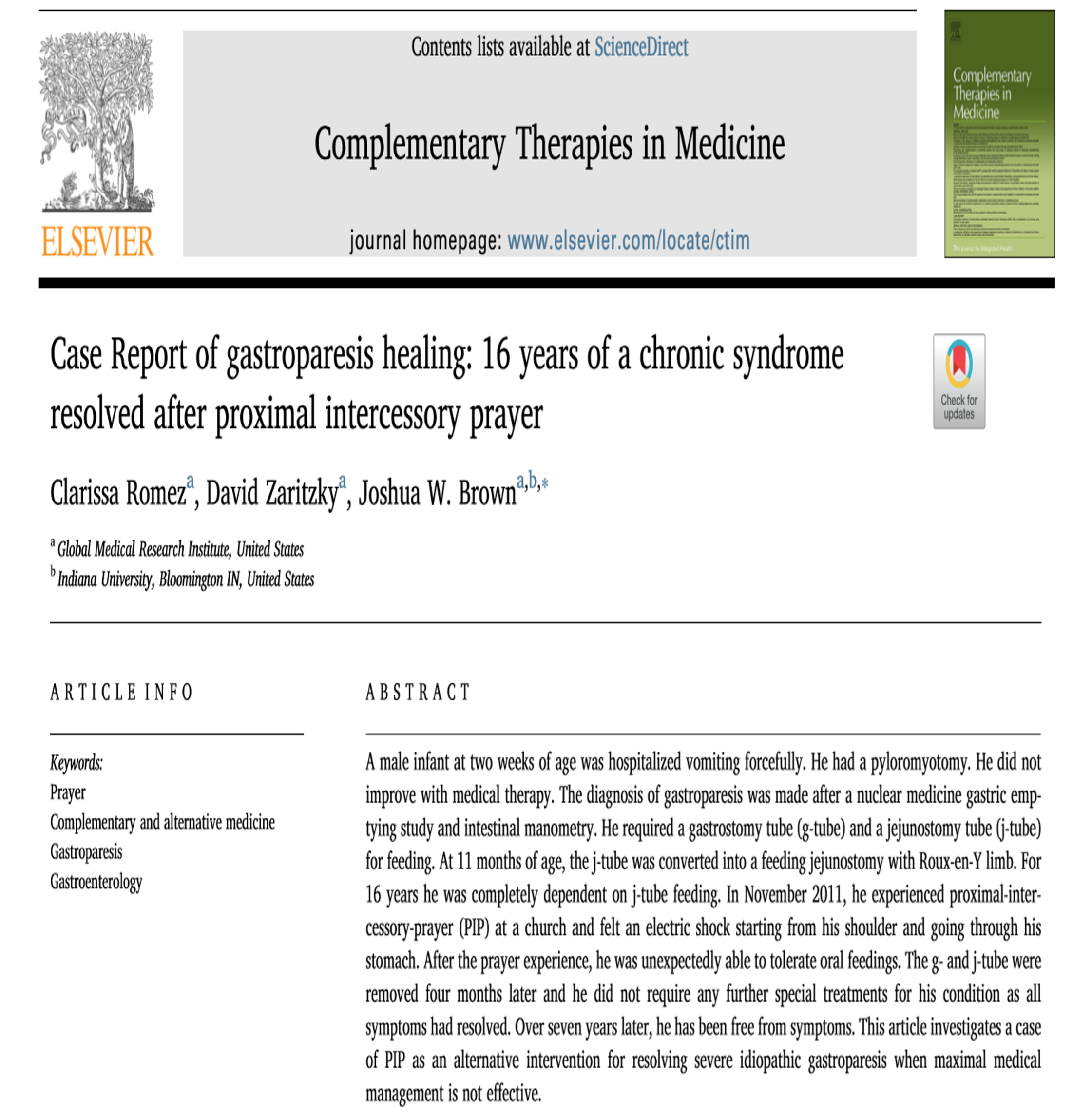
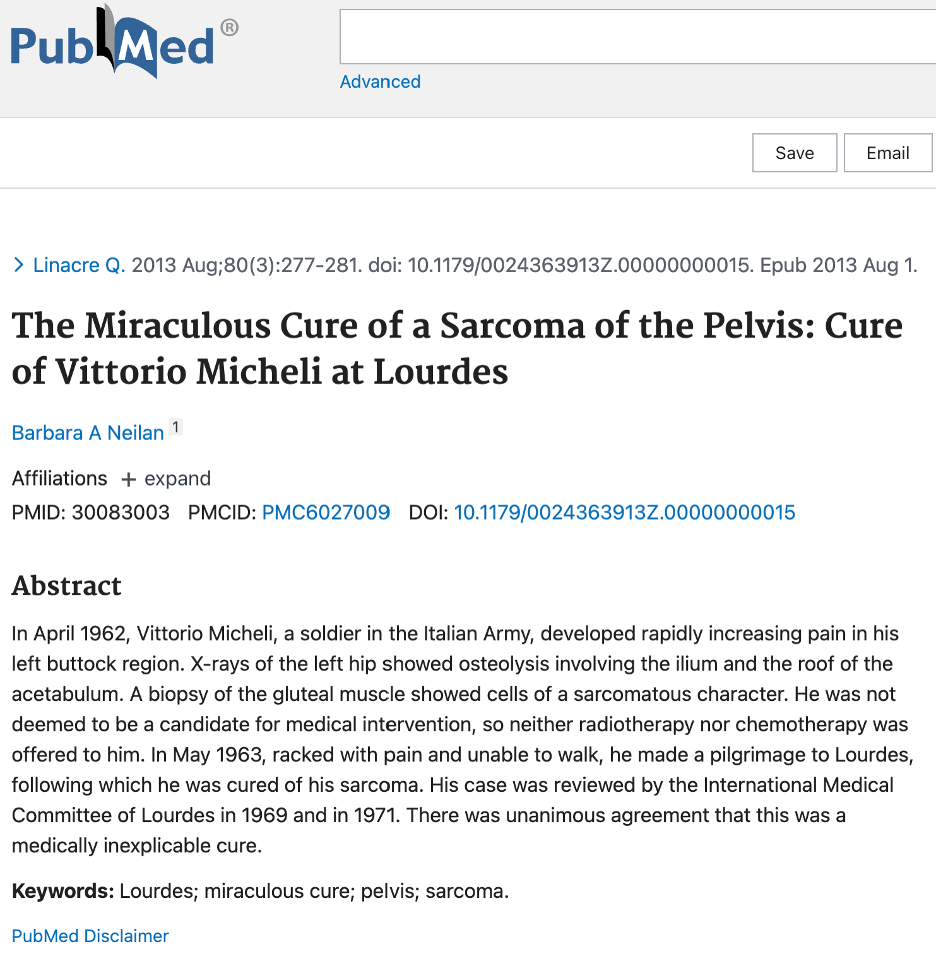
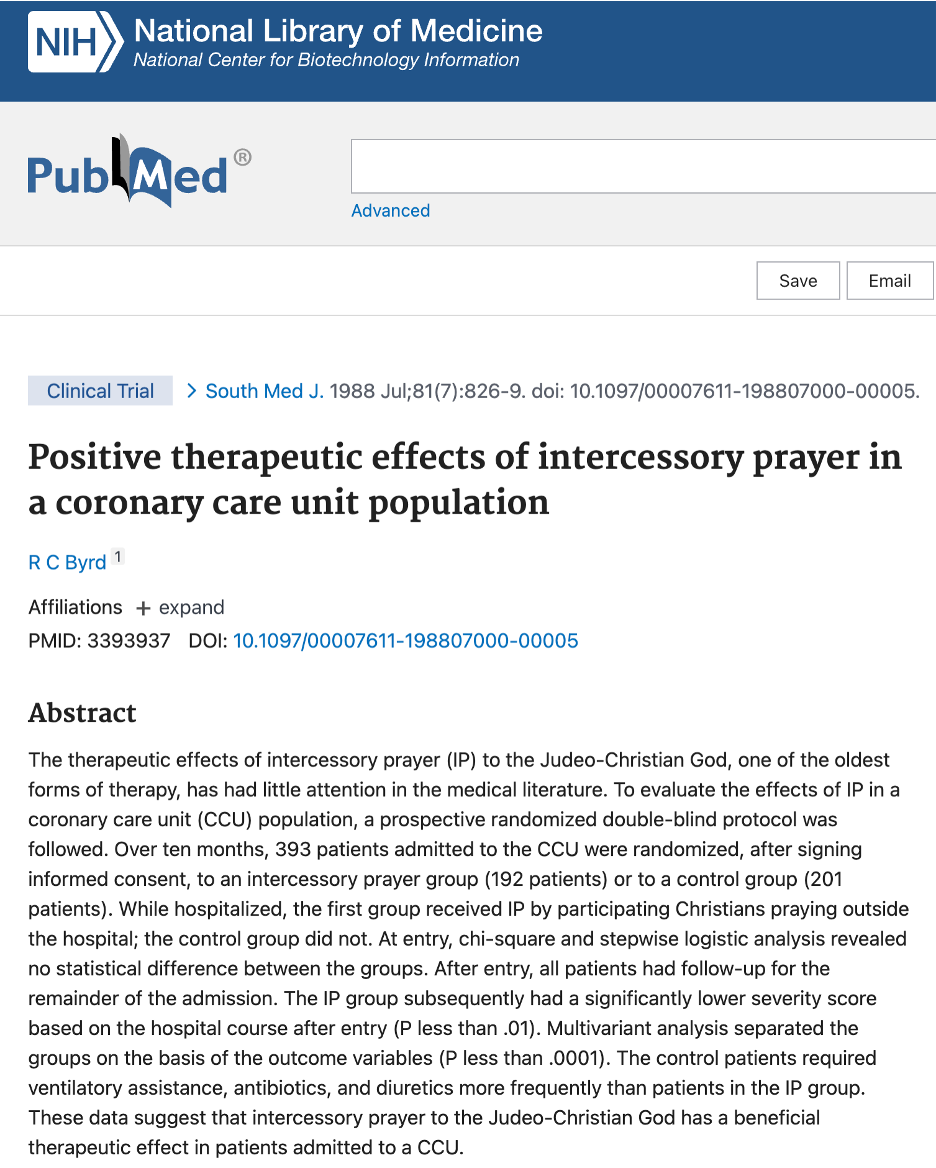
Here are a few more focusing on intercessory prayer, which just means out of a large group of patients with similar medical problems, some had people praying for them and some did not, and then outcomes of the patients were studied to determine if prayer made a significant difference.
- Randolph C. Byrd, “Positive Therapeutic Effects of Intercessory Prayer in a Coronary Care Unit Population,” Southern Medical Journal 81, no. 7 (1988): 826–829.
This study found patients in the CCU who received intercessory prayer had lower scores on a severity scale, required fewer antibiotics, and were less likely to develop pneumonia or need ventilators.
- Leonard Leibovici, “Effects of Remote, Retroactive Intercessory Prayer on Outcomes in Patients with Bloodstream Infection: Randomised Controlled Trial,” BMJ 323, no. 7327 (2001): 1450–1451.
Retroactive Prayer Study: A study on bloodstream infections showed that remote, retroactive intercessory prayer was associated with shorter hospital stays and faster reduction of fever.
- HIV+ Patient Study Ironson G, Ahmad SS. Praying for People You Know Predicts Survival over 17 Years Among People Living with HIV in the U.S. J Relig Health. 2022 Oct;61(5):4081-4095. doi: 10.1007/s10943-022-01622-5. Epub 2022 Aug 23. PMID: 35999335; PMCID: PMC9398051.
Research indicated that prayer for known individuals was associated with improved long-term survival rates (17 years later), even after adjusting for social support and medication.
- Dale A. Matthews et al., “Religious Commitment and Health Status: A Review of the Research and Implications for Family Medicine,” Archives of Family Medicine 7, no. 2 (1998): 118–124.
Often cited in discussions of prayer and long-term outcomes.
I usually like using researchers who reject God and the supernatural as it avoids people dismissing the evidence claiming bias. Of course, people who claim bias before genuinely dealing with the evidence are making their minds victims of their own bias. But currently the two sources I liked best were both by Christians who were dedicated enough to invest in sifting through the vast numbers of potential evidence.
Use whatever sources you find most useful, keep biases in mind, but be genuine yourself in allowing the evidence to lead where it leads without emotional or preferential steering.
Probably the most comprehensive academic treatment of the question of miracles I found is Craig Keener’s two volume set Miracles.[v]
Keener provides deeper explanations of the issues involved, full refutations of objections against miracles, and possibly hundreds of examples with differing levels of documentation and evidential verification.
If you want a quicker read and more tailored for the everyday person, Lee Strobel’s A Case for Miracles[vi] makes for an interesting read.
For now, just a couple more examples from Keener. Strobel actually interviewed Keener regarding a nine-year-old girl diagnosed with untreatable bilateral sensorineural deafness in 1982.[vii] Her British physician, Dr. R. F. R. Gardner, informed the girl’s parents there was no cure, and aside from hearing aides allowing for some hearing, there was nothing that could be done to repair the damaged nerves.
The young girl did not want to wearing hearing aides for the rest of her life, and felt what she explained as feeling prompted by God to pray for healing. She and her family began praying, and one evening in early 1983, the girl popped out of her bed without her hearing aides claiming she could hear again. Her amazed parents tested her and found she could even hear slight whispers.
They called the audiologist who said he didn’t believe them because it was not possible. But eventually relented by saying if some miracle happened, he would be happy, but just come in and get audiogram tests done.
The next day her audiogram and tympanogram results were fully normal. The audiologist’s response was he had absolutely no explanation and had never seen anything like it in his life.
It is unusual to get medical confirmation and documentation before and immediately after a claimed healing, and the medical report by the ear, nose, and throat (ENT) surgeon, stated the event was “inexplicable.” The surgeon recorded the audiogram confirmed her hearing was now completely normal and “I can think of no rational explanation.”[viii] Gardner compiled other cases studies like this into a book, which he concluded noting, “A belief in the occurrence of cases of miraculous healing today is intellectually acceptable.” And added people who are still skeptical should think about what evidence would convince them, and “If the answer proves to be, ‘None,’ then you had better face the fact that you have abandoned logical inquiry.”[ix]
Strobel’s next example I will simply reprint below as his interview with Keener summarized the situation well[x]:
One of the Most Hopelessly Ill Patients
Keener went on to discuss another case, not in his book, for which there is significant documentation. “I’ve personally interviewed Barbara, who was diagnosed at the Mayo Clinic with progressive multiple sclerosis,” Keener said. “I’ve confirmed the facts with two physicians who treated her. There are numerous independent witnesses to her condition and years of medical records. In fact, two of her doctors were so astounded by her case that they’ve written about it in books.”
One of those physicians, Dr. Harold P. Adolph, a board-certified surgeon who performed twenty-five thousand operations in his career, declared, “Barbara was one of the most hopelessly ill patients I ever saw.”
Another physician, Dr. Thomas Marshall, an internist for thirty years until his recent retirement, described Barbara as a budding gymnast in high school, playing flute in the orchestra. But symptoms began appearing: she would trip, bump into walls, and was unable to grasp the rings in gym class.
Eventually, after her condition worsened, the diagnosis of progressive multiple sclerosis was confirmed through spinal taps and other diagnostic tests. After thoroughly examining her case, doctors at the Mayo Clinic agreed with the dire diagnosis.
“The prognosis was not good,” Marshall said.
Over the next sixteen years, her condition continued to deteriorate. She spent months in hospitals, often for pneumonia after being unable to breathe. One diaphragm was paralyzed, rendering a lung nonfunctional; the other lung operated at less than 50 percent. A tracheostomy tube was inserted into her neck, with oxygen pumped from canisters in her garage.
She lost control of her urination and bowels; a catheter was inserted into her bladder, and an ileostomy was performed, with a bag attached for her bodily waste. She went legally blind, unable to read and only capable of seeing objects as gray shadows. A feeding tube was inserted into her stomach.
“Her abdomen was swollen grotesquely because the muscles of her intestine did not work,” Adolph said.
“She now needed continuous oxygen, and her muscles and joints were becoming contracted and deformed because she could not move or exercise them,” Marshall said. “Mayo [Clinic] was her last hope, but they had no recommendations to help stop this progressive wasting disease except to pray for a miracle.”
By 1981, she hadn’t been able to walk for seven years. She was confined to bed, her body twisted like a pretzel into a fetal position. Her hands were permanently flexed to the point that her fingers nearly touched her wrists. Her feet were locked in a downward position.
Marshall explained to her family that it was just a matter of time before she would die. They agreed not to do any heroics, including CPR or further hospitalization, to keep her alive; this would only prolong the inevitable.
Barbara entered hospice care in her home, with a life expectancy of less than six months.
One day someone called in Barbara’s story to the radio station of the Moody Bible Institute in Chicago. A request was broadcast for listeners to pray fervently for her. Some 450 Christians wrote letters to her church saying they were lifting up Barbara in prayer.
On Pentecost Sunday, 1981, her aunt came over to read her some of the letters in which people offered prayers for her healing. Two girlfriends joined them. Suddenly, during a lull in the conversation, Barbara heard a man’s voice speak from behind her—even though there was nobody else in the room.
“The words were clear and articulate and spoken with great authority, but also with great compassion,” Marshall wrote.
Said the voice, “My child, get up and walk!”
Seeing that Barbara had become agitated, one of her friends plugged the hole in her neck so she could speak. “I don’t know what you’re going to think about this,” Barbara told them, “but God just told me to get up and walk. I know he really did! Run and get my family. I want them here with us.”
Her friends ran out and yelled for her family. “Come quick, come quick!”
Marshall described what happened next: “Barb felt compelled to do immediately what she was divinely instructed, so she literally jumped out of bed and removed her oxygen. She was standing on legs that had not supported her for years. Her vision was back, and she was no longer short of breath, even without her oxygen. Her contractions were gone, and she could move her feet and hands freely.”
Her mother ran into the room and dropped to her knees, feeling Barbara’s calves. “You have muscles again!” she exclaimed. Her father came in, hugged her, “and whisked her off for a waltz around the family room,” Marshall said.
Everyone moved to the living room to offer a tearful prayer of thanksgiving—although Barbara found it hard to sit still. That evening, there was a worship service at Wheaton Wesleyan Church, where Barbara’s family attended. Most of the congregation knew about Barbara’s grave condition.
During the service, when the pastor asked if anyone had any announcements, Barbara stepped into the center aisle and casually strolled toward the front, her heart pounding.
“A cacophony of whispers came from all parts of the church,” Marshall said. “People started clapping, and then, as if led by a divine conductor, the entire congregation began to sing, ‘Amazing grace! How sweet the sound that saved a wretch like me! I once was lost, but now am found; was blind, but now I see!’”
The next day, Barbara came to Marshall’s office for an examination. Seeing her in the hallway, walking toward him, “I thought I was seeing an apparition!” he recalled. “No one had ever seen anything like this before.”
He told Barbara, “This is medically impossible. But you are now free to go out and live your life.”
A chest X-ray that afternoon showed her lungs were already “perfectly normal,” with the collapsed lung completely expanded.
“The intestine that had been vented to the abdominal wall was reconnected normally,” Adolph said. “She was eventually restored to complete health.”
Barbara has now lived for thirty-five years with no recurrence of her illness. “She subsequently married a minister and feels her calling in life is to serve others,” Marshall said.
Both physicians marvel at her extraordinary recovery. “I have never witnessed anything like this before or since and considered it a rare privilege to observe the hand of God performing a true miracle,” Marshall wrote.
Said Adolph, “Both Barbara and I knew who had healed her.”
Do these examples “prove” miracles. No.
As we will see later in the post, people misunderstand both God and science as related to miracles. We will not have forcible “proof” one way or the other. We will briefly analyze this last example from Keener, and later, analyze perhaps the most often used study against miracles, to show studies will never provide proof, only probabilities.
Barbara Snyder is one of the more frequently cited contemporary healing cases in discussions of miracles (especially in connection with Craig Keener and Lee Strobel). Critics generally don’t deny that something remarkable happened, but they challenge the evidential weight of the case.
The case does have remarkable features:
- The case includes modern medical testing with both pre and post-healing
- Physician testimony is included
- Documented and timely intercessory prayer for Barabara
- Long-term follow-up (decades)
- Multiple witnesses
- Severe documented disability
- Lack of relapse
And this case does not sit alone, but within a context of a comprehensive case for the existence of God, and while individual cases may be debatable, there is a large number of well-attested miracle claims, including prayers tied to healing.
Yet, this evidence can be argued against by critics.
One reason may be diagnosis uncertainty. Was the original diagnosis unquestionably correct?
Barbara was reportedly diagnosed with progressive multiple sclerosis (MS), but critics note:
- MS can be difficult to diagnose definitively, especially decades ago.
- Symptoms like paralysis, blindness, bowel dysfunction, and respiratory issues can overlap with:
- functional neurological disorders
- conversion disorder
- other autoimmune or neurological conditions
- rare metabolic or inflammatory disorders
If the diagnosis was mistaken, the recovery would be dramatic but not miraculous.
Another challenge could be that the case is not documented in peer-reviewed medical literature. Now, I have examples in my life, and many others I know as well, who had bigger concerns and did not bother with, or were unable to have documentation. Yet, for the case to be stronger, documentation subjected to peer-review would be nice to have.
While:
- There are physician testimonies
- Books describing the case
- Eyewitness accounts
Critics argue:
- No detailed medical chart publication
- No full diagnostic imaging record publicly analyzed
- No independent neurologist case review in journals
So, the case is evidentially weaker than documented spontaneous remission cases that appear in medical literature. Spontaneous remission is a possibility, as well as a functional disorder, or psychosomatic effect (intense religious experience could trigger a natural neurological reset). An extraordinary medical recovery is not necessarily a confirmed supernatural cause.
Bottom-line, critics will claim an unusual recovery does not necessarily prove a miracle. Keener acknowledges this, but responds some recoveries are so unlikely and well-attested that natural explanations strain credibility.
Therefore, the debate is not over whether something remarkable happened—it’s over explanatory inference—what does the comprehensive case of evidence make more probable: a miracle or a natural event.
How many of us are either just accepting a miracle claim, or placing all our focus on reasons to reject the examples? Doing either exposes a problem in a person’s approach to miracles, and why the question of miracles is really a secondary issue.
e. Our own examples
Having some geeky tendencies, I recorded and reviewed prayers over years and found almost all of my recurrent prayers had occurred, including some with crazy mathematical odds against what I had prayed for. There have been things I prayed for that did not occur or have yet to occur. And a few examples of the prayers, and a few experiences in my life I have analyzed, discussed with others, and determined were not explicable by natural means.
When these examples are placed in the context of the comprehensive case supporting the existence of a personal God, the best explanation of these examples is a miracle.
But these are just personal anecdotes, and are worthless to you because you do not know me, or the evidence well enough to make a reliable judgment for yourself. Some, who are really close to me and have experienced how I am as a person, may be able to consider my experiences as reliable, but only if they also have a background of other evidence supporting the existence of miracles or God.
Possibly you have your own personal examples. These may not have the documentation to be great evidence for others, but you are in the position to know, analyze and judge yourself.
The examples provided in this section are the briefest glimpse into the countless examples available. While the U.S. culture is not what may be called a “Power-oriented culture” or “Power worldview,” where the culture generally assumes a real and active supernatural world, aside from the examples noted above, claims of miraculous acts are prevalent even in America.
Evidence against miracles
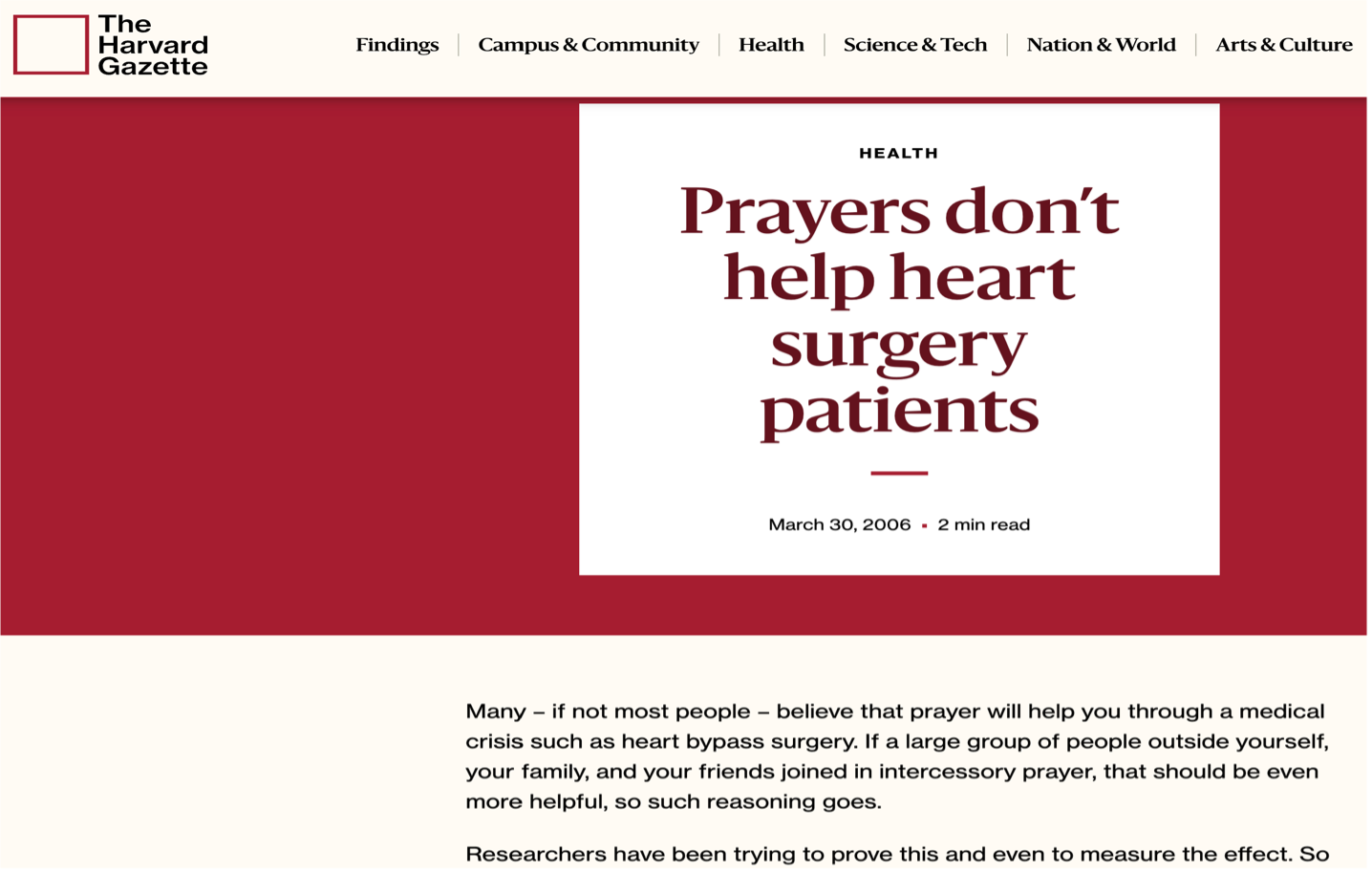
While I think miracles are a part of life, and cultivating a prayer life to an actual God will over time show the fruit of the practice, there is also evidence against miracles.
There are clear examples of fraudulent miracle claims. There are clear cases of people confusing something as miraculous, when the event had a natural cause. We have all had prayers not answered the way we wanted. Not all studies confirm miracles, some studies showed no significant difference between patients who were prayed for and those who were not prayed for, and probably the most well-known study even showed slightly worse outcomes for those prayed for! Let’s look at those studies now.
Although the United States does have an odd way of keeping the issue of God outside of academic and research pursuits (an issue to be discussed in another post), there have been studies on whether prayer has an impact on patients. We looked at some supporting the impact of prayers, and now we will look at some rejecting the impact of prayers.
- The STEP Study (2006): This is probably the most well-known or most cited study by critics. Involving 1,802 patients, this study found no significant difference in complications or recovery among those receiving prayer and those not.
- Systematic Reviews: A 2007 systematic review by D. R. Hodge found the evidence inconclusive, and research associated with the National Institutes of Health noted that overall, there was no significant difference in recovery.
- Historical Analysis: Francis Galton (1872) famously analyzed the lifespans of “prayed-for” groups (such as royalty) compared to others, concluding there was no statistical benefit.
As we did with the miracle example from Keener, it is instructive to do an analysis of the most often cited research study on prayer that I found skeptics using.
The Therapeutic Effects of Intercessory Prayer (the STEP study) was a ten-year clinical trial, backed by Harvard Medical School, on the effects of prayer on over 1,800 cardiac bypass patients.
The cardiac patients were divided into three groups: one group being prayed for and one group not prayed for, and neither of these groups were aware if they were prayed for or not, and the third group was prayed for and was aware. Then the research recorded who had complications following the surgeries.
Lee Strobel interviewed skeptic Michael Shermer for his book, and Shermer specifically called this study “the best one we have,” stating:
“The results were very revealing. There was no difference in the rate of complications for patients who were prayed for and those who were not. Nothing. Zero. In fact, those who knew they were being prayed for had more complications. So when you get beyond anecdotes and use the scientific method, there’s no evidence for the miraculous.”[xi]
Michael Shermer, a historian of science, the executive director of The Skeptics Society, and founding publisher of Skeptic Magazine—was not skeptical enough—he needed to be more skeptical of his skepticism.
Strobel went on to interview Candy Gunther Brown, whose doctoral degree is from Harvard, and who not only investigated the STEP study, but also published her own research of the measurable effects of prayer in Testing Prayer: Science and Healing, through Harvard University Press, and The Healing Gods: Complimentary and Alternative Medicine in Christian America, published by Oxford University Press, and other publications.
It turns out the researchers conducting the study had a serious lack of understanding of prayer. Brown correctly observed:
“If you’re going to study prayer wouldn’t it be important who was praying, who they were praying to, and how they were praying?”[xii]
Because different belief systems believe in contradictory Gods, then by the law of noncontradiction, only one of those, at most, can truly by God. Therefore, prayers to a non-existent God would be expected to have no impact, while prayers to a purposeful God that does exist would have impact.
Yet, when you look into the study, the people doing all the praying were members of a New Age cult: the Unity School of Christianity in Lee’s Summit, Missouri. This is a sect that denies biblical teachings on the divinity of Jesus, sin and salvation, the Trinity, the Bible, and almost every other fundamental Christian doctrine. Especially interesting is that leaders of this sect have long stated beliefs that prayers do not work miracles and intercessory prayers, as was being done for the cardiac patients, were useless.
This means what this study actually studied was what happens when people who do not believe in prayer, use prayer for cardiac patients. Goofy.
What would have greatly increased the veracity, reliability, and usefulness of the study would be to study prayer from different belief systems separately, and also ensuring the non-prayed for group did not include people who were actually be prayed for by themselves or others not known by the research group.
Actually, there is a lot needed to fix this study, some of which Brown describes in Strobel’s interview, and some of which was taken into account in other ‘gold standard’ studies showing the opposite conclusion of the STEP study: the group receiving prayer having statistically significant better outcomes, including a study attempting to replicate the STEP study by Dr. William S. Harris and colleagues published in the Archives of Internal Medicine.
Strobel ends on a fitting note:
“In the end,” I (Strobel) asked, “does this study tell us anything that’s helpful?”
“Well,” Brown replied, “it is instructive on how not to conduct a study of Christian prayer.”[xiii]
Either miracles exist, or they do not. Either prayers have an impact, or they do not. There is no middle ground. So, why do some studies find prayer does have a significant effect on patient outcome, and some studies do not?
There are a number of possible reasons, and likely a combination of reasons. For example, bias of researchers or poor research methods can exist both for and against miracles, also, natural mental and psychological impacts for those feeling prayed for can either facilitate healing or hurt healing through the placebo effect and performance anxiety respectively, and there are more reasons depending upon the specific study.
While I personally lean towards studies for evidence, I also understand how studies work, and recognize these are unlikely to provide a definitive answer, not only due to the factors noted above and already having studies on both sides of the argument, but also because of the misunderstanding of the biblical God.
Anyone who believes studies will provide the final answer on whether prayer impacts life in miraculous ways, which, of course, also answers the primary question of whether there is a personal supernatural agent involved, misunderstands the biblical God.
As will be explained in a later section of this post, the biblical God is not seeking to prove that he exists. If solving an equation or through study is how God wants us to be forced to conclude he exists, then Heaven would look like a cast meeting of the Big Bang Theory series, or a scientific convention. A bunch of techies, dorks, geeks. The biblical God is not after a person believing that he exists, but a relationship of love and trust, which requires something much deeper than proof.
Not only does the Bible make clear proof is not the goal, but science now rejects the idea of proof as well, instead recognizing theories, such as the existence of miracles or laws of nature, can only be more or less probable depending on the supportive evidence. Therefore, we will never have a scientifically proven answer as to whether miracles exist or not. In fact, in the misunderstanding of science section we demonstrate science is not capable of providing a definitive answer. But science can provide very good evidence.
The former investigative journalist, Lee Strobel, partnered with Barna for a custom national survey of US adults regarding miracles. While Barna has not yet published a standalone report, Strobel published some results:
- 51% believe the miracles as described in the Bible happened
- 67% reported “yes” when asked if miracles are possible today, 15% said “No”
- 44% do not believe in the supernatural
- 20% believe modern science has disproven the possibility of miracles
These results are close to what I expected based on my interactions, with younger people having even less belief in miracles. What was most surprising to me was this last statistic Strobel provided:
- 38% or nearly two out of five US adults said they had a miraculous experience
As Strobel writes, “which means that an eye-popping 94,792,000 Americans are convinced that God has performed at least one miracle for them personally.”[xiv]
Another Barna study reported:
- 66% of U.S. Adults believe people can be healed supernaturally by God and 27% say they have experienced such a miraculous healing.[xv]
Since many of the claims involve a healing, which are events that sometimes come with some background studies of people before and after the possible miracle, a national survey was given to physicians regarding miracles [xvi]:
This report states that:
- 74% of physicians believe miracles have occurred in the past
- 73% believe miracles can occur today
- 72% say religion provides a reliable and necessary guide to life
- 55% say they have seen treatment results they would consider miraculous
- 51% pray for patients as a group and 59% pray for individual patients
The Pew Research Center reports:
- 33% of AAAS scientists say they believe in God; 18% believe in a universal spirit/higher power (51% total for “God or higher power”).[xvii]
American Association for the Advancement of Science (AAAS) is the world’s largest general scientific society and the publisher of the journal Science. This statistic for scientists has been steady over time and repeated in other surveys.
This same report noted 83% of American adults say they believe in God and 12% believe in a universal spirit or higher power. This figure is much higher than the Barna study, and also shows a significant difference between scientists and the general public. This difference will be addressed in the later section on common objections to miracles.
What do you think? Have miracles occurred and are they still possible?
If you reject the possibility of miracles, then what evidence do you provide better explaining the specific examples through natural means, as opposed to a miracle?
If you believe in miracles and someone asks you why, do you have an example with evidence enough to be useful to the other person?
If those who reject or accept miracles do not have good answers to the above questions, they expose themselves as someone not approaching the issue with proper thinking.
It is important to be as open and genuine as possible when considering any topic touching on the big questions in life. Because your choice will not impact me, but it will certainly impact you and those close to you. The most common misunderstandings causing mistaken beliefs about miracles are covered in the next section.
Misunderstandings lead people to filter new evidence with what you want to believe rather than what the evidence supports. Such thinking can make smart people stupid.
These people only create a reality that does not extend beyond their skull.
But, this skewed reality does bring consequences impacting their life and those nearby.
Miraculous Misunderstandings of Miracles
Driving in Michigan winters brings a lot of beautiful and also scary experiences. After a particularly bad snowstorm, early the next morning my friends and I piled into my parent’s van heading to a ski resort. As we enjoyed the beautiful landscape, we noticed ahead of us were big grooves cut into the snow on the road, which swerved right off into the ditch, where a vehicle must have crashed and been recently removed.
When we came up to the grooves, our van got irreparably caught in the rut that forced us on the same path into the ditch. The rut controlled the next five hours of our lives. Annoying, but minor inconvenience.
Similar to those physical ruts, people can easily become caught in mental ruts, forcing thoughts, choices, behavior, and potentially much along life’s path into a restricted path leading to consequences we did not seek or expect. You can see people veer off from valid thinking on the issue of miracles, being caught in ruts of misunderstanding.
The misunderstandings surrounding miracles can be grouped into three categories:
- Misunderstanding the primary issue
- Misunderstandings about God
- Misunderstandings about science
Each of these categories will be explained, hopefully exposing the rut before being caught into its coercive path. And for those already stuck and needing to be towed out of the ditch, we will answer the objections the misunderstandings led unwary travelers to.
A. Misunderstanding the primary issue
A brief way to point this out: If God exists, do you think miracles are not possible? Why would you believe that?
Be ready to provide (or get back to them later with) evidence that God exists: The Beginning, Cause, or Fine-Tuning of the Universe, Morality, Resurrection, or other evidence.
Standing over the secondary question of miracles is the primary question: Does God exist? The answer to the primary question will answer the secondary question. Because if God exists, then the obvious answer is miracles are not only possible, but would likely be expected. If no God exists, then the obvious answer is miracles are not possible.
Therefore, the question about this or that event being an actual miracle is secondary, as the whole issue of miracles is part of a much larger comprehensive case supporting or refuting the existence of God.
The miracle claim reported above concerning Barbara is analyzed in a later section of this post because it illustrates how secondary the question of miracles is. Whether a person views the case favorably and accepts it as a verified miracle, or rejects it as too problematic to be considered evidence does not depend solely on the evidence.
Every person who considers that case comes to the report already with a personal answer to the primary question of whether God exists or not. And this answer predisposes the person to see any miracle claim as possible or impossible.
So, if you are looking for a definitive answer regarding miracles you must answer the primary question.
Here are some objections to miracles based on the critic’s misunderstanding of the primary issue.
Objections to Miracles Answered by Misunderstandings of the Primary Issue
Objection 1:
Miracles are impossible.
Answer 1:
Your claim assumes an answer to a bigger question without giving evidence. The bigger question is: Does God exist. If God exists, how can you claim miracles are not possible? As C.S. Lewis correctly noted: “But if we admit God, must we admit Miracle? Indeed, indeed, you have no security against it. That is the bargain.” [xviii]
Even critics recognize this. Evolutionary biologist, mathematician, geneticist, and social commentator Richard Lewontin candidly admits: “It is not that the methods and institutions of science somehow compel us to accept a material explanation of the phenomenal world, but, on the contrary, that we are forced by our a priori adherence to material causes… we cannot allow a Divine Foot in the door.” [xix]
Objection 2, 3, 4:
- Philosopher David Hume’s argument against miracles is one of the most common: A miracle is a violation of the laws of nature, which are supported by uniform experience. Since human testimony or report of a miracle is always weaker than the vast body of uniform experience, it is always more rational to reject miracle reports than accept them.[xx]
- Bart Ehrman argues historically: “Historians more or less rank past events on the basis of the relative probability that they occurred . . . Miracles, by our very definition of the term, are virtually impossible events.[xxi]
- Astronomer Carl Sagan mimicked and earlier statement from Pierre-Simon Laplace in stating: “Extraordinary claims require extraordinary evidence.”[xxii]
Answer 2:
Hume’s objection sounds reasonable until it is critically examined itself, then the logic errors are clear.
Read Hume’s argument again. Do you see his preconceived belief answering the question before he even considers the evidence.
Hume falls into a circular argument error
If the person using Hume’s objection is meaning to say:
- Laws of nature are exceptionless because miracles don’t occur
- Miracles don’t occur because laws are exceptionless
That is circular reasoning, an error in logic.
To have “uniform experience” you have to already know miracles never occur, but that is the very question we are trying to prove.
- He has not surveyed all experience
- He excludes miracle reports before evaluating them
- He assumes that only non-miraculous experiences count
That is methodological bias (a specific and exclusive method for approaching a question), not neutral empiricism.
Should all science stop because, based on our “uniform experience,” our current understanding must be correct? If Hume’s method is followed, a scientist discovering evidence contradicting past experiences or background knowledge must reject their findings, and we will progress no further.
You cannot claim experience is uniform while excluding contrary data from the outset. At some point, coordinated deception or mass error becomes less probable than the miracle itself.
If Hume or today’s objectors are not assuming there was never a miracle, then the objection should say our “general experience” shows us natural laws are not violated so a miracle would be extremely rare, if any occurred at all. In a debate, my atheist opponent tried to mockingly say in his experience dead people stay dead, and I answered: Yes, and that is the point, right?
We would not even recognize what a miracle is unless we have repeatable events, the ordinary way of things, to judge against when something miraculous happens. What do you think miracles are for? Jesus staying dead shows no unique authority, but someone rising from death as he and the bible predicted, and which our uniform experience tells us is not humanly possible, brings correspondingly unique credibility.
Jesus illustrated this even before the cross. He claimed the authority to forgive a person’s sins, and the religious leaders said anyone can falsely claim that authority, so Jesus, knowing their skepticism, asked them what is easier: to claim you can forgive sins, or to tell a known cripple to get up and walk? And then he healed the crippled man, demonstrating his unmatched authority. If Jesus just waded into the water, instead of walking on it, or stayed in his grave after the cross, he would not be the crux of history.
My opponent was trying to say his belief is supported by the sum of every person who died and stayed dead, and on my side of the equation is only a claim that this particular person did not stay in the grave. But his equation is mistaken, committing a misunderstanding known as a category error.
The sum of all people who stayed in their graves does indeed add up to show that rising from the grave is not naturally possible. The biblical claim is not that Jesus rose naturally from death, as that claim would be even more foolish to believe than in the mass hallucination or coma theories of skeptics.
The biblical claim is Jesus rose supernaturally after the cross, which is an entirely different equation. With all the evidence supporting a transcendent God, we are beyond the closed system of only natural causes.
Again, we find the question of miracles is a secondary issue, the primary issue is whether God exists or not.
Hume misunderstands key concepts in science
Hume did not even believe cause and effect was an objective feature of the universe. The consensus of scientists entirely disagrees, so Hume’s grasp of natural law and science is questionable.
If Hume believes we have uniform experience because a violation of natural laws is impossible, then again, he is assuming we already have the answer to the primary question of God existence in order to know violating natural laws is impossible.
If nature is left to itself, then yes, violation of natural law is impossible (if the natural law is accurate), but if nature is not a closed system, and something beyond nature and natural laws intervenes, then scientifically, natural laws do not apply and are not violated as it is not a closed system.
Modern philosophy of science treats laws of nature as:
- Descriptions of how nature ordinarily behaves
- Not inviolable rules that cannot admit exceptions
A miracle would not break a law of nature—it would be an exception caused by an additional agent (like human intervention doesn’t “violate” gravity).
Hume displays a faulty view of testimony
Hume relies heavily on testimony for:
- History
- Science
- Geography
- Law
- Everyday knowledge
Yet he treats testimony about miracles as uniquely weak by definition, not by evidence.
This is inconsistent.
Hume’s disregard of testimony is sometimes warranted, and sometimes not. Depends on the circumstances, which Hume disregards.
Miracles have a wide range of people and circumstances involved in testimonies, which cannot be flippantly dismissed. Some with no education, some of highest education, from ancient to modern times, all across the world, no documentation to thorough documentation, in remote areas and in places where the witnesses are well known and can be checked, and even examples where critics and enemies and those who would not gain but significantly suffer from the testimony, still provided the testimony.
And to assume people of biblical times were primitive and since not having modern science would easily fall for fake miracles—this is non-sense. What did the Bible record Joseph did when he saw his soon-to-be-bride Mary pregnant? He did not proclaim to all what a marvelous miracle, but instead wanted to divorce her quietly as he knew were babies come from based on normal laws of nature.
Testimony can range from false or extremely weak all the way to extremely strong evidence.
Summary rejection of Hume:
The strongest replies to Hume argue that his rejection of miracles is circular, misunderstands laws of nature, unfairly dismisses testimony, conflates rarity with impossibility, and relies on hidden naturalistic assumptions. Rather than showing that miracles cannot be rationally believed, Hume shows only that miracles are implausible given a worldview that already excludes divine action.
Answer 3:
Ehrman: “Because historians can only establish what probably happened, and a miracle of this nature is highly improbable, the historian cannot say it probably occurred.”
This is funny, he is penalizing a miracle for being miraculously rare. As a historian, Ehrman should understand rarity does not make something virtually impossible to accept. Anomalies have happened in history. Clearly, they are rare, but not impossible. Evidence, not rarity, is what determines the probability historians judge events by.
Historians fall into the same trap as philosophers and scientists. But the kind of trap differs based on whether the individual making the claim has a metaphysical bias or a methodological bias. If they disregard miracles because they believe the supernatural and miracles do not exist, then that is a philosophical claim to reality, a metaphysical bias. They assume an answer to the primary question is already known in order to answer the secondary question, and by this misunderstanding expose themselves to logic errors. If the hypothesis was that Jesus rose naturally from the dead, then based on our background knowledge this does not happen, and cannot happen naturally. But this is not the hypothesis being examined. The hypothesis is God supernaturally raised Jesus, bringing an entirely new set of background evidence, which includes all the evidence supporting the existence of a supernatural God.
If the person does not dismiss the possibility of the supernatural, but instead just has a method for approaching a topic using natural causes and natural laws, that is a methodological bias, and Bart Ehrman’s claim is an example of this.
While this biased method is narrow-sighted by excluding any non-natutral claims out-of-hand, it makes sense to me as well to initially look for a natural explanation for a miracle claim. Despite this, anyone coming to the question of miracles is ignoring a bundle of evidence supporting the existence of God—a factor that must be included to get a reliable probability of whether the claim is true or false. This factor is known as “prior odds” in Bayes’ probability formula. In fact, there are two necessary factors Ehrman entirely leaves out of his equation. Aside from prior odds, the factor that accounts for how probable is it that the evidence we have is explainable by natural means, is also ignored.
Ask a skeptic what they believed happened to Jesus, and what evidence supports their belief. There are a limited number of possibilities, and all natural alternatives have been rejected by scholarship based on evidence, science, logic, and common sense. Believing in any of those alternatives is unreasonable, so now critics often say, “Something happened, we just don’t know what.” Critics have had 2000 years with the most studied person and event in history, and the only one with a testable claim with and such unprecedented evidence. This belief is a failure in logic, and a more honest way to say it is, “All natural explanations are highly improbably, but the only option left that Jesus did rise as the Bible claimed we do not like, therefore, we will wait until evidence comes in we do like.”
And again, if a supernatural God is involved who transcends natural laws, AND if the miracle matches the purpose and pattern of this God, AND if the evidence does not support a natural cause better, then a miracle can be the most probable explanation.
And it is an interesting question to study, as even Ehrman notes, “Whatever you think about the philosophical possibility of miracles of healing, it’s clear that Jesus was widely reputed to have done them.” [xxiii]
Answer 4:
Challenge: “Extraordinary claim requires extraordinary evidence.”
Response: That’s an “extraordinary” claim, what is your evidence to support that claim? And, do you have requirements to make the evidence extraordinary? Maybe one amazingly unique piece of evidence, or maybe multiple sources of evidence all coming together in a comprehensive case to make the miracles the best explanation? Sagan was an astronomer and should understand science uses the latter requirement regularly, and that is not necessarily extraordinary evidence.
The claim sounds reasonable, but has problems. For example, if I went into a coma in 2008, then ten years later I wake up and am told by a nurse Donald Trump is the President of the United States—that would be an extraordinary claim. Mockingly, I would ask for clarification: “You mean the New York real estate guy who had the goofy line on The Apprentice?” However, all it would take is ordinary evidence to convince me of this extraordinary claim: a television newscast, Trump’s headshot hanging up in D.C. Government offices, someone I trust stating it was true, and so on.
And if you have the background context of the existence of a supernatural God purposefully acting, then that is already extraordinary evidence and miracles would be rare, but expected.
Even aside from the problems noted above, we already have “extraordinary” evidence, including: the science verifying the creation of all matter, energy, and nature, the fine-tuning throughout the universe, the resurrection, the foreknowledge of the beginning and development of the universe and earth and other events, including picking Jesus out of all people who have ever lived, and so on.
Objection 5:
People may sincerely believe a miracle occurred even when none did.
Humans are prone to cognitive bias, pattern recognition errors, emotional suggestion, group reinforcement, and other psychological factors. Also, there are natural explanations people may miss, such as: psychosomatic effects, natural but unknown phenomena, coincidence, or people engaging in fraud.
Answer 5:
Your claim assumes an answer to a bigger question without providing any evidence. You are assuming there is no God, so miracles are impossible, therefore, every claimed miracle must be one of those natural explanations.
This claim, depending on the specific thoughts of the critic, commits one of several errors in logic. Most likely it is an error known as a hasty generalization, or possibly the genetic fallacy.
You did not disprove the existence of miracles, you assumed them to be impossible and then assigned a cause, which is not valid reasoning. It is a hasty generalization to move from: “Many miracle claims can be explained by bias or error” to “All miracle claims are false.” That’s overextending the evidence beyond its logical reach.
That confuses:
- The possibility of error
with - The certainty of error
You cannot prove a miracle claim is inaccurate based on falsity of other claims, or even how you think the miracle claim originated.
The truth or falsity of the claim is judged by the evidence.
However, because there have been false claims, and people do have those propensities mentioned, these things can be accounted for when considering the evidence. For people who do not understand how to use Bayes’ theorem, ignore this section as it is tedious. But if you like this tool of reasoning, then we can show where this legitimate concern posed by the skeptics impacts the likelihood of the claim.
Bayes’ theorem (odds form):
For those who do not like the philosophical form of the equation, what this equation is saying is:
Posterior Odds = Prior Odds x Likelihood Factor (or Bayes Factor)
In other words, your posterior odds or new probability the miracle claim is true equals the odds of the claim being true based on the background knowledge we already have, multiplied by the impact of the new evidence, which is quantified by the Bayes Factor.
Where the Bayes factor is:
The Bayes factor quantifies the strength of the evidence (E) in favor of the hypothesis that the miracle claim is true (H) over the alternative hypothesis (what you see in the denominator) that the claim is false. It is the ratio of the likelihood of observing the evidence if the miracle claim is true versus the likelihood of observing the same evidence if the claim was false.
This multiplier factor updates the prior odds of the claim being true to the new odds after the evidence is taken into account.
The objection against miracles is: even if no miracle occurred, we would still expect to sometimes observe testimony, belief, reports, and conviction—because humans are prone to bias, suggestion, coincidence, fraud, etc. This psychological/bias of people claiming miracles affects the denominator in the Bayes factor: which makes the probability of observing the evidence if the miracle did not occur, not as small as it otherwise would be, which makes the overall Bayes factor not as large a value to multiply with the prior odds as it would have been otherwise.
Bottom-line: the skeptics claiming people have those tendencies is true, but it does not impact the answer to the existence of miracles the way the critics seem to think. We are not being told the miracle is therefore likely to be false, but only that Bayes’ theorem is showing we need to have caution when considering people’s testimony as though it were definitive evidence because there have been instances of people making such claims and were wrong.
At the end of this post, we will provide an example by applying Bayes’ theorem to the resurrection miracle. For those who like numbers, this will be fun for you. For those who don’t, it is at least interesting. Another post will explain Baye’s theorem deeper, and explain why even if an oncologist says you tested positive for cancer on a test that is 99% accurate, the probability that you actually have cancer can still be quite low!
Objection 6:
Some of those who recognize the weakness of Hume’s approach have turned to Bayes’ theorem, which avoids the claim of circular reasoning, and instead has the more modest claim that evidence for miracles may not be strong enough to change opinions about miracles.
To put it simply, the Bayesian skeptic argues:
- The prior probability of a miracle is astronomically low
- Testimony is fallible
- Therefore, posterior probability remains low
- Conclusion: belief in miracles is irrational
Bayesian skeptic claim:
“Miracles are irrational because their prior probability is so low that testimony almost never defeats it.”
Analysis of Bayesian skeptic claim:
This claim is more transparent and may avoid the circular reasoning of Hume, but still can have serious trouble with reliability for four reasons below.
- Arbitrary Priors
- Why assume miracles are near-impossible before examining evidence?
- Prior odds often reflect metaphysical commitments, not neutral reasoning
The prior odds encode assumptions upfront, and are in danger of smuggling in the assumption there is no God, which can inaccurately distort the values placed into the equation.
Prior odds depend upon the comprehensive case of evidence either supporting naturalism (there is only nature) or theism (a supernatural God exists). A simple way to look at it is:
Prior Odds = what are the odds of this miracle claim being true based on background knowledge of God existing and other miracles having occurred, or not.
For example, if the evidence supporting atheism was definitive over theism, then the prior odds for any miracle claim are warranted to be extremely low, let’s say 1 in 1 trillion = 0.000000000001 (this would be the population of all people to have ever lived on this planet and on a hypothetical 999 other planets).
On the contrary, if there were enough evidence to make a person think there was even a 80% chance God exists, then the prior odds could be 0.8, or less depending on the circumstances of the specific miracle claim.
Therefore, if the person inputting the prior odds believes the answer to the primary question is no God exists, then, of course, the prior odds of a miracle being possible are, for all intents and purposes, zero.
If the person has some doubt in naturalism, and there is some belief God exists and performs miracles, then the value for prior odds is not zero, but may still be so incredibly low in their mind that even with extraordinary evidence, evidence that should rationally change a person’s mind, it will still be multiplied by the near zero prior odds and result in a very low posterior odds of the miracle being true.
So, basically, no amount of evidence will convince such a person to change their mind because their prior assumptions about the primary question overwhelms any evidence.
- Testimony Undervalued
- Independent, early, hostile, or costly testimony can dramatically raise likelihoods, and we know this from our own experiences and in legal documentation and theory
- Bayesian models sometimes unrealistically discount human testimony
- Inappropriate practice to disregard testimony just because it goes against “normal” experience
- Testimony is not the only source of evidence
- Single-Event Blindness
- Bayesian methods excel at repeatable events
- Unique historical events (assassinations, discoveries, origins) are harder to model
- The big takeaway: check the skeptic’s input values
Bayes’ Theorem shows miracle debates hinge on two questions:
- Prior: How rare are miracles in your worldview?
- Likelihood ratio: How much more likely is the evidence if a miracle happened than if it didn’t?
What this shows (honestly)
- Bayes is more transparent in its preconceived bias than Hume, but it is still there and can be quantified.
- It makes the real dispute explicit: How low is your prior? and How often can non-miracle processes generate evidence like this?
Evaluate the values skeptics place into prior odds and for P(E|not-H) in the likelihood ratio, most often you will find very sketchy or faulty values, which is why their final probability value appears to be so low.
We will do calculations and show the real numbers at the end of this post, and do so on one of the most strongly denied miracles—the resurrection after the cross.
B. Misunderstandings about God
Three of the biggest misconceptions people carry about God are:
- God’s goal is for us to believe that he exists.
- Our responsibility is to earn a good life and salvation by being “good.”
- If we are trying to be good, then God should keep us comfortable and happy in life.
A person does not know the biblical God if this is what they believe about God. The biblical God makes clear there are much bigger purposes for us:
- God is not after us knowing that he exists. The Bible notes even the demons know that he exists. God is after something much deeper—a relationship of love and trust—requiring much more than just proof of existence.
- We cannot earn good by being “good,” God alone is capable of achieving the good necessary for salvation and provides it as a gift for those who choose to trust him. And living as God knows is best for us comes more and more natural to follow because we recognize and trust God’s way is best for us. And things not good, or against God’s nature (sin), we recognize more and more these are not in our best interest, so we fall into them less and less.
- God is not seeking goldfish, which should be well fed and kept in a comfortable environment, but instead wants relationship and purpose beyond just the events of life. While happiness is great, it is neither guaranteed, nor the goal in life. The goal is knowing God and gaining peace, purpose and possibilities for the best existence during and after this life.
When a person understands the bigger picture the Bible spreads out before us, the smaller picture is given much more context and begins to make much more sense.
Objections to Miracles Answered by Misunderstandings About God
Objection 7, 8, 9, 10, 11:
- Why doesn’t God heal amputees?
- God should put a glowing cross in the sky, and make stars align to spell out the Gospel.
- Prove a miracle to me.
- Why didn’t the resurrection happen today, so modern cameras could capture everything, and modern science and medicine could study Jesus afterward?
- Why so many miracles before, and not now?
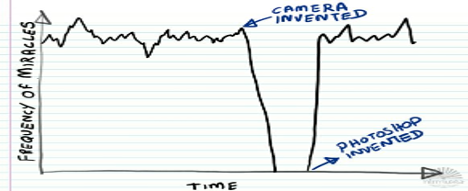
Answer 7-11:
As far as healing amputees, I am tempted to answer by asking how do you know God hasn’t healed amputees? I think he did (Luke 22:50-51). But aside from the biblical example, do have comprehensive knowledge enough to know this? I am skeptical of such claims to absolute knowledge.
Further, there is an assumption behind all these objections that needs to be dealt with.
What these objections seem to be implying is there are no miracles happening that fit what they would view as undeniable. Thus, miracles must be fake as there are no undeniable examples.
Can you see the misunderstandings or assumptions being made?
- These objections assume God’s purpose for miracles is to make sure we believe that he exists.
- These objections assume “undeniable” miracles would make people choose to accept God.
God’s purpose is not to compel acceptance of him. This means all these objections that misunderstand God’s purpose, correspondingly, will have mistaken expectations of how God should do things.
Just believing an almighty Creator exists, does not lead to a life-transforming, personal relationship with that Creator, which only occurs when we choose to buy into his plan and trust and love God for what he is to us. This much deeper goal requires deeper processes, and the shallow process of simply making one’s presence obvious can be irrevocably counterproductive.
Søren Kierkegaard provided a good comparison in his story of a king, who ruled a nation with absolute power, and while touring his kingdom observed and was instantly captivated by a peasant woman. The king, knowing if he approached her in all his royal coverings and surrounded with knights and other trappings of his immense power, would be unable to know whether the woman truly loved him.
So, he approached her as a commoner. Philosophers recognize this approach, and call it keeping an “epistemic distance.”
If miracles are not to prove God exists, then what purposes do they serve?
If you do a Bible study on miracles you will find them clustered around individuals who were unfolding further understanding from God at specific times. For example, Jesus’ ministry claimed to be fulfilling God’s message and purpose, and so was surrounded by miracles, including the resurrection.
Why didn’t the resurrection occur today, with modern cameras, medical examiners, and reporters? Former cold case detective, J. Warner Wallace and his son provide an interesting video explanation for the specific timing of Jesus’ ministry and resurrection. There were significant historical, societal, theological, and massive and diverse future impact reasons why Jesus’ ministry occurred precisely when it did. Further, just as people question the accuracy, capability, and integrity of both the followers of Jesus, and the Roman and Jewish leaders, soldiers, executioners, guards, and others involved, skeptics would still be skeptical of those involved if the crucifixion and resurrection happened today. Probably more so, as faked evidence (even worse today with deepfake videos), corrupt leaders and reporters, ineptitude, and other reasons critics will point to are still prevalent today. Undeniable confirmation is most likely never possible, but most importantly—undeniable confirmation was never the purpose.
Miracles did function to definitively set these individuals on a level that other competing people or claims could not reach. Even if not proving that God exists, the miracles did fulfill their purpose.
C.S. Lewis once observed about his study of miracles:
They come on great occasions: they are found at the great ganglions of history—not political or social history, but of that spiritual history which cannot be fully known by men.”[xxiv]
God uses diverse methods to reach and teach us, depending on the time, location, person involved, and so on. These approaches include prophets, miracles, visions, dreams, spiritual methods, personally with Jesus, the Bible, through nature, and likely other ways beyond our conscious awareness or understanding.
Prophets and miracles were especially important before we had the Bible in hand, and these prophets and miracles were used to establish and authenticate the Bible and Jesus’ claims. Our situation today is different and may alter the methods. For example, today we have access to a scholarly validated Bible, historical evidence for the phenomenon of Jesus and the resurrection, philosophical advancement to produce compelling arguments, physics, astronomy, and other sciences directing our thoughts and evidence towards the biblical God.
This is one reason why miracles seem to be, or maybe were relative to the population, more common in ancient times. Remember, the Bible is written across maybe 1,500 years, and there were specific reasons to record the miracles. Across 1,500 years in modern times, I wonder how many miracles have occurred? Maybe more, maybe less. If I had to guess, I would guess there are more personal and localized miracles as the population is greater.
Does God have other reasons to enact miracles today? I think so, but I cannot know God’s reasons that are not explicitly given through Jesus or the Bible. However, I do not think one of those reasons is forcing acceptance or belief in him. That is not the goal, the goal is a relationship of love and trust. Pascal put it this way:
God has given evidence sufficiently clear for those with an open heart, but sufficiently vague so as not to compel those whose hearts are closed.[xxv]
And regarding the assumption that “undeniable” miracles would make skeptics accept God:
- First, this isn’t Burger King, you cannot have it your way.
- Second, the biblical record already showed us “undeniable” miracles, and also recorded that these were able to be rejected or excused away.
- Third, there are already significant claims on the table, what is your answer to those.
Beggars cannot be choosers, and the arrogance to think God has to dance on stage to your whims and needs for “proof” is an absurd belief. Why would you believe an almighty Creator would do this? Especially when psychology and our own personal observations have taught us people have the greatest proclivity to believe what they want despite any evidence.
After a debate on the campus of U.C. Berkeley, one of the atheist debaters was asked what would make him accept the biblical God. He stated he would need to see a burning cross in the sky and the stars spelling out, “I exist and made all of this, signed God.”
He was then asked, “What if we step outside, right now, and see exactly that? Would you bend the knee and trust God?”
Credit to the atheist debater, he paused and thought about it, and responded genuinely: “No. I would probably check myself into a mental institution instead.” I have heard this same response more times than I can remember.
The Bible already forewarned us that some people will reject God despite any evidence or reason. Jesus came across this multiple times, and in an interesting foreshadowing of later events, remarked, “They will not be convinced even if someone rises from the dead” (Luke 16:31).
The critical Pharisees did recognize the miracles, or what they call “wonders,” and simply claimed Jesus was only able to accomplish those examples under the power of Satan. John 12:37 laments: “Though he had done so many signs before them, they still did not believe in him.”
God could find a way to make his presence undeniable, but that would likely lead to compulsion of belief through fear, which is not the goal.
It is presumptuous to say I know this is what God ought to do. As though meeting standards you expect is the only right way God could have handled the situation. Have you considered all the parameters?
And as far as those looking for “proof,” I do not think any examples of miracles will provide what you seek, for several demonstrable reasons:
- Science no longer accepts anything as “proven,” only given higher or lower likelihood of being accurate based on the evidence.
- God, at least the biblical God, does not seek us to simply believe that he exists (propositional knowledge), but wants a relationship of trust. Therefore, the purpose of miracles is not to prove his existence.
- Psychology, as well as the Bible and consistent discussions with skeptics, has shown miracles are not sufficient for proof.
And what do you want God to do?
Come to earth to model how to live, perform miracles and demonstrate his authority, sacrifice life for us to show the seriousness of sin, and his love for us, then do what has never been done, what would expose his claim if not true, by predicting, then rising from the dead and verifying for over a month to many, many witnesses (over 1000 at just one of the instances) providing “many convincing proofs,” incredible historical evidence (see website section on Jesus), then rise into the clouds right before the direct witnesses, leaving people, who knew for fact exactly who he was, who were willing to then hold that belief right through the point of execution, which is unparalleled in all history – Oh wait, he did do that.
Or maybe provide reasons to believe through science, history, philosophy and every applicable field of study, through some of the greatest discoveries ever made, showing knowledge capability far beyond any human in all history, consistently overturning critics objections through continuing research, trending of greater support as research continues and the opposite trend for opposing beliefs, and providing endless examples in creation to amaze the mind – this has been done too.
The critic of miracles or God’s existence is making a claim, and their claim is only worth considering if it can carry its burden of proof.
There is considerable evidence for miracles and a supernatural God, and it is not hidden, it has already been established by science and history as noted earlier. This evidence just appears to be absent from the minds of those who refuse to look at it. How does the critic explain the examples presented in just this brief post?
Now the critic has their own burden of proof.
Objection 12:
Other religions have miracle claims.
So, aren’t Christians being inconsistent believing in miracles from the biblical God, but not these other religions?
Answer 12:
The Bible agrees with the first part of the objection. The Bible recorded Egyptian magicians being able to mimic a limited number of the signs Moses and Aaron demonstrated before Pharaoh. The Bible also records others being able to know future events to a limited degree of accuracy beyond human capability.
However, it stands to reason if God exists, and if wanting us to know and trust him, will distinguish himself on a level competing sources are incapable of reaching. The biblical God demonstrated this level of exclusivity.
Therefore, here is how I would interact with the skeptic bringing this objection:
First, I would ask, “What non-biblical miracle claims are you referring to that rival the biblical miracle claims?”
Second, “What is your evidence validating your belief that these other claims are on the same level as the Bible’s?”
It is all about the evidence. The other miracles and miracle workers that are commonly alluded to like Apollonius of Tyana or Asclepius have nowhere near the historical credibility of the Resurrection. Nor does Nostradamus, or any other supposed prophet or future-teller provide any accurate foreknowledge remotely approaching the Bible’s (a comparison with Nostradamus is provided using this link).
Not until a skeptic provides as strong a historically validated argument comparable to the resurrection, or mathematically analyzed set of scientific or historical predictions comparable to the Bible’s will this objection carry any value.
Fourth, this directly answers the objection. Christians, in fact, are using correct reasoning when not equally considering the claims of other ancient miracle workers or holy books.
- If the Bible and Jesus claim exclusivity, and their claim of authority is true and reliably, then all competing claims are false.
- The law of noncontradiction, one of the most fundamental laws of logic, agrees. When competing claims contradict each other, only one, at most, can be correct. Truth is exclusive by its nature, and by common sense.
- The evidence confirms Jesus’ and the Bible’s authority on a level no other source remotely reaches.
If Jesus is who he says he is, the unique Son of God and the only way to be reconciled to God the Father, then the contradicting claims of other figures are necessarily false. Imagine that I am desperately searching all over my house for car keys. If I find them under the sofa, is it fair to accuse me of inconsistency and hypocrisy for not continuing to look for them in other areas of the house where they might have been lost?
If Christians have concluded that the resurrection is historically accurate, and the Bible establishes itself as the only source beyond the capacity of humanity to produce, then it follows that other mutually exclusive claims must be false.
Finally, I would ask if the skeptic wanted to hear evidence why the Bible stands absolutely alone—on a level no other source can reach.
This is covered in detail in other posts, here we will simply state no other source throughout all history can match what the biblical God provides in foreknowledge of numerous aspects of the creation of the universe and earth, which every other belief system and science got wrong. Until over three thousand years after the Bible’s claims, some of modern science’s greatest discoveries verified the Bible was right.
Or, the predictive symbols and direct statements concerning the coming Messiah. Or, predicting a miraculous validation of authority over even death in the resurrection, placing the Bible’s entire claim on the examination table and coming away with evidential support on a level none other can claim. And there is more, but the aforementioned absolutely unprecedented examples are more than enough to make the point, unless one can explain them away with better evidence.
Objection 13:
Why does God heal selectively? Healing one person but not another? Intervening sometimes but not always?
Answer 13:
This question is much tougher because anyone who has experienced serious pain will have emotions that can easily overwhelm logic when asking, “Why me?”
Let’s just take a very hard question posed to me after one of my programs, which really hits the question of selectivity of miracles.
After one of my presentations covering some evidence for the truth of the biblical God, an older woman stood up during the question-and-answer period, and said she could not challenge the evidence, but why would this God, if so loving and all powerful, would allow the young woman she adopted to suffer as she had.
She went on to explain how as a child this young woman had a wonderful family and life, but after her parents were killed in a drunk driver accident, she went into the care of a sexually abusive relative, and now was adopted by the woman questioning me, who has witnessed the necessary counseling and healing her new daughter has to endure.
Ugh. Worst question as the evidence I normally rely on will not satisfy her heart. So, I responded by saying, “I have two ways to answer you, depending on where you, or your daughter if she is here, are at with regards to the pain.”
If the pain is still raw, then logical answers will make you want to hit me and walk out. That’s how I would feel if my mental state was still raw, and some speaker comes at me explaining how I need to logically look at my pain. If this is where you are at, I wouldn’t say much of anything, but focus on just listening, hearing, and showing love the best that I am able. And, provide a contact if there comes a time where you are wanting an answer to why a loving God allows pain.
The longer answer to why pain and evil exist is covered in another post (click here if wanting the link). But here is a very brief part of the answer I gave at that time.
What I can’t do: I do not know enough to give a definitive answer. Why may God have intervened to stop some tragedies and not others? There are way too many factors involved for me to give a knowledgeable and reliable answer for your specific situation.
I know we have an enemy wanting to hurt us and separate us from God, I know why pain and suffering need a time to operate on earth, and I know things happen due to choices and natural occurrences. But, why did your specific loved ones die, instead of you, me, someone else, or no one else instead—I don’t know.
What I do know: Some people hurt because they think God let it happen. Maybe you think because your parents were allowed to die, then they must not have as much value to God, or his purpose, as other people. Or maybe you are not as loved, which is why bad things were allowed to reach you. I can show that those sad thoughts are not the reality of the situation. Here is where I can help because there are things, which, once understood, would answer a lot of the hurt.
- God values your parents infinitely, just as much as he values you and me.
- Where was God? God was with you, fully understands the pain as you go through it, and has the ultimate answer to pain.
How do we determine value, for example, of a painting, or a person? Value is determined by how much someone is willing to pay. And if the cross was the cost to redeem us, not to mention the investment of creating all creation and enduring human free will and all the evil that comes with it to allow free choice and the capacity to learn and love, then our value is as high as it gets.
We don’t need to wonder if God really knows our pain, it was demonstrated in history: Jesus suffered both during life as we do, and finally on the cross, probably more than we will ever know.
There are other sources responsible for pain and injustice in the world, unfortunately, many place the blame and angst not against the actual sources of the suffering, but on the one who is fully on our side, God.
When something entirely unfair, wrong or painful happens to us, we can trust God is there to comfort us, during the pain, and can work things out for good, as God already demonstrated this at the crux of history. God came to personally experience the unfair, wrong and painful, and had his arms spread at the cross to show us how expansive his love is for us, and then provided the greatest comfort for us by the verification of his ability to bring us beyond the pain and death of this world.
Pain is a personal problem and deserves a personal answer.
Every worldview belief system must answer the question of why pain and evil exist. Christianity is the only worldview providing a personal and validated answer.
Lee Strobel summarized this well:
God isn’t some distant, detached, and disinterested deity; He entered into our world and personally experienced our pain. Jesus is there in the lowest places of our lives. Are you broken? He was broken. Are you despised? He was despised … Your sufferings are his sufferings. If you accept his offer of redemption at the door, then his victory over it all is yours too. Jesus was even sent to suffer and die so that when this time on earth is over, evil and suffering could be eradicated without destroying us along with it. (Lee Strobel, Christianity Today, July 2012)
Christianity alone provides a personal answer, as well as unprecedented verification of its final answer.
Objection 14:
Do humans just have an artificial sense of being special, and have no better claim to miracles happening for our benefit than do the lobsters saved by the Titanic sinking?
Answer 14:
This image made me laugh out loud, but also saddened me to realize some people actually think this is a solid objection.
Do lobsters have the same claim to miracles as we do? It depends. If nature is all there is and no God exists, then lobsters, humans, trees, and all things have the same likelihood of expecting miracles—none—as miracles would not be possible.
On the other hand, if the biblical God exists, then humanity was created on an entirely distinct level of relational capability, and therefore created with specific purpose differing from the rest of the world. Lobsters would not have the same relational and free will purposes God has for humans.
Therefore, most, if not all, purposes served by miracles would be lost on lobsters, which have no capacity to even consider God anyway.
Objection 15:
Whether a miracle happens or not depends on a person’s belief in them.
“You just don’t have enough belief.”
Answer 15:
This answer is not “Thus sayeth the Lord,” but more of “thus thinketh Scott,” which has infinitely less authority.
What those statements imply about miracles is problematic. I think miracles do happen to those who trust God to do miracles in their life, but I do not think those who doubt miracles will entirely keep God from doing miracles in their life. This is a question better answered by a theologian or your pastor. As long as the theologian or pastor is biblically sound.
Yet, here are the basic points of my understanding based on patterns from biblical study:
- Miracles are relational signs, not mechanical responses to faith.
- There are connections to faith, but they are not withheld purely because of uncertainty.
- Miracles are often not given where there is entrenched rejection.
1. Miracles occur in a relational framework, not an experimental one to prove that God exists or that a person has faith.
That’s why in the episode in Nazareth (Mark 6:1-6, Matthew 13:58), where Jesus is dismissed as “just the carpenter,” miracles are sparse. It’s not that divine power is absent—it’s that signs are not imposed where they are despised. Miracles are invitations not coercive proofs or stage demonstrations.
2. Here are some examples demonstrating a connection between some miracles and faith:
- Mark 5:34 (woman with the issue of blood)
- Mark 10:52 (blind Bartimaeus)
- Luke 7:50 (sinful woman)
- Luke 17:19 (one grateful leper)
Faith isn’t presented as magic power, or mechanical cause and effect where you having faith ensures God will provide the miracle—it’s trust, openness, receptivity to a relational God, who has his own purposes.
Here are some examples showing miracles occur despite doubt, fear, ignorance, or outright hostility:
- Lazarus (John 11)
Lazarus didn’t show faith—he was dead. And of the primary people who were alive, even Martha expresses doubt in her chiding Jesus for not arriving sooner, and noting: “Lord, by this time there will be an odor…” (John 11:39)
Jesus raises him anyway. This miracle is explicitly performed before skeptics: “So that they may believe that you sent me.” (John 11:42) No prior faith required.
- The father says: “I believe; help my unbelief!” (Mark 9:24)
How often have we been in this situation? Wanting to believe but not sure of ourselves. Here is an exact example, and his child was healed.
- Widow’s son at Nain (Luke 7), or Feeding of the 5,000 (Matthew 14:13-21)
No record of faith being required or expressed. In fact, many of the crowd at the miraculous feeding later abandoned Jesus (John 6:66).
- Saul on the road to Damascus
Saul was persecuting Christians. Christ appears to him miraculously and provides follow-up miracles. This is not faith-based receptivity. It’s confrontation.
This fits with some experiences I have had. The occurrences I have experienced that are potential miracles, involved fervent prayer, but also sometimes significant doubt from me. Yet, the prayers were answered, and can only be best explained as miracles.
2. Miracles are often not given where there is entrenched rejection.
The pattern is not: No faith → no miracle → no evidence
It’s more like: Hardened rejection → fewer signs given
In the Gospel worldview:
- Faith = openness to God.
- Unbelief = resistant posture.
And repeated signs in hostile contexts often increase judgment rather than belief (see Matthew 11:20–24).
Objection 16:
Miracles are just magic.
Answer 16:
I would respond by asking: “What do you mean by that?” Do you believe there is no difference? Is the source of magic and miracles the same?
Next I would ask: “What evidence do you have for that?”
Let’s start by making sure we are talking about the same thing because “magic” has different denotations and connotations. Here is a definition given by the Merriam-Webster dictionary:
1a: the use of means (such as charms or spells) believed to have supernatural power over natural forces b: magic rites or incantations
2a: an extraordinary power or influence seemingly from a supernatural source b: something that seems to cast a spell : enchantment
3: the art of producing illusions by sleight of hand
The definition we are using for miracle is either Mackie’s, or this simple one:
A miracle is a special act of God in the natural world, which would not that would not occur if the natural world were all that exists.
Definitions one and three for magic claim the real source of the power is a person using special charms or spells to violate natural law, or simply a person using tricks to give the illusion of violating natural law. This entirely differs from biblical miracles, which state the source of capability to transcend natural laws is God, and these events are not illusion, but facts in our world. Further, while magic typically has a purpose of some type of gain for the user, or for entertainment of others, biblical miracles have other purposes, such as establishing the biblical God’s unique authority, and benefitting others.
The Bible does mention there are other beings (popularly known as demons) beyond the constraints of natural law, which may also exercise some limited power beyond natural laws.
The second definition for magic could possibly fit the definition of miracle. Here again is the simple definition we provided earlier:
A miracle is an intervention performed by God for a specific purpose, and is not about a person using a recipe of words or rituals that does it.
While that second definition may fit, I think when most people think of miracles, we mean definitions one or three, which do not fit as a miracle.
B. Misunderstandings about Science
Many people approach the question of miracles with a misplaced viewpoint, claiming “I believe in science, not in ancient myths.” Believing science, logic and other fields of study over time will expose miracles as nothing but superstition, false claims, and natural effects yet to be explained.
Anyone who believes this is much too limited in their understanding of the interaction between science and theology to be a credible source of information about such interaction. This is clear to demonstrate, with a full explanation being given by the Cameras of the Watcher post.
For now, we will examine science’s relationship with miracles through the following sections:
- How science and theology are actually related and interact
- Why science, by its very nature, is limited and incapable of disproving the existence of miracles
- How science already has verified the greatest miracle
- How objections to miracles are wiped away once these misunderstandings of science are properly understood
The relationship between science and theology
Since childhood, we naturally and efficiently integrate different sources of knowledge when facing a problem to solve, or decision to make.
On your next drive, you may find yourself fast approaching a traffic light that is “orange,” somewhere between a yellow and red light. Within just moments you naturally use viewpoints including physics (not actually doing a calculation, but considering momentum and road friction); history, you consider similar occurrences yourself or others have had; observation, check for any nearby police officers; and ethics, wondering if you may put others at risk of injury, to arrive at a conclusion to either stop or pass through.
Most choices in life are best visualized when multiple valid viewpoints, or sources of knowledge, are combined to provide a comprehensive view of the subject. The question then arises: what, if any, interplay occurs between differing sources of knowledge, particularly ones as influential as science and theology?
I do not use the phrase “science and religion” because “religion” concerns how people organize around different belief systems, while “theology,” being the study of the nature of God and corresponding beliefs, is much more comparable to science.
Science and theology are not friends or foes, but different fields of study using different methods or points of view to gain knowledge about reality. Much like different security cameras offering unique angles and fields of view of the same scene.
If both the science camera and theology camera turn to the same aspect of the universe, or reality, they together provide a wider field of vision, and more knowledge. And most significantly, where these two cameras’ fields of view overlap, is the best place to look to verify or discredit the accuracy each point of view provides. And we have many examples.
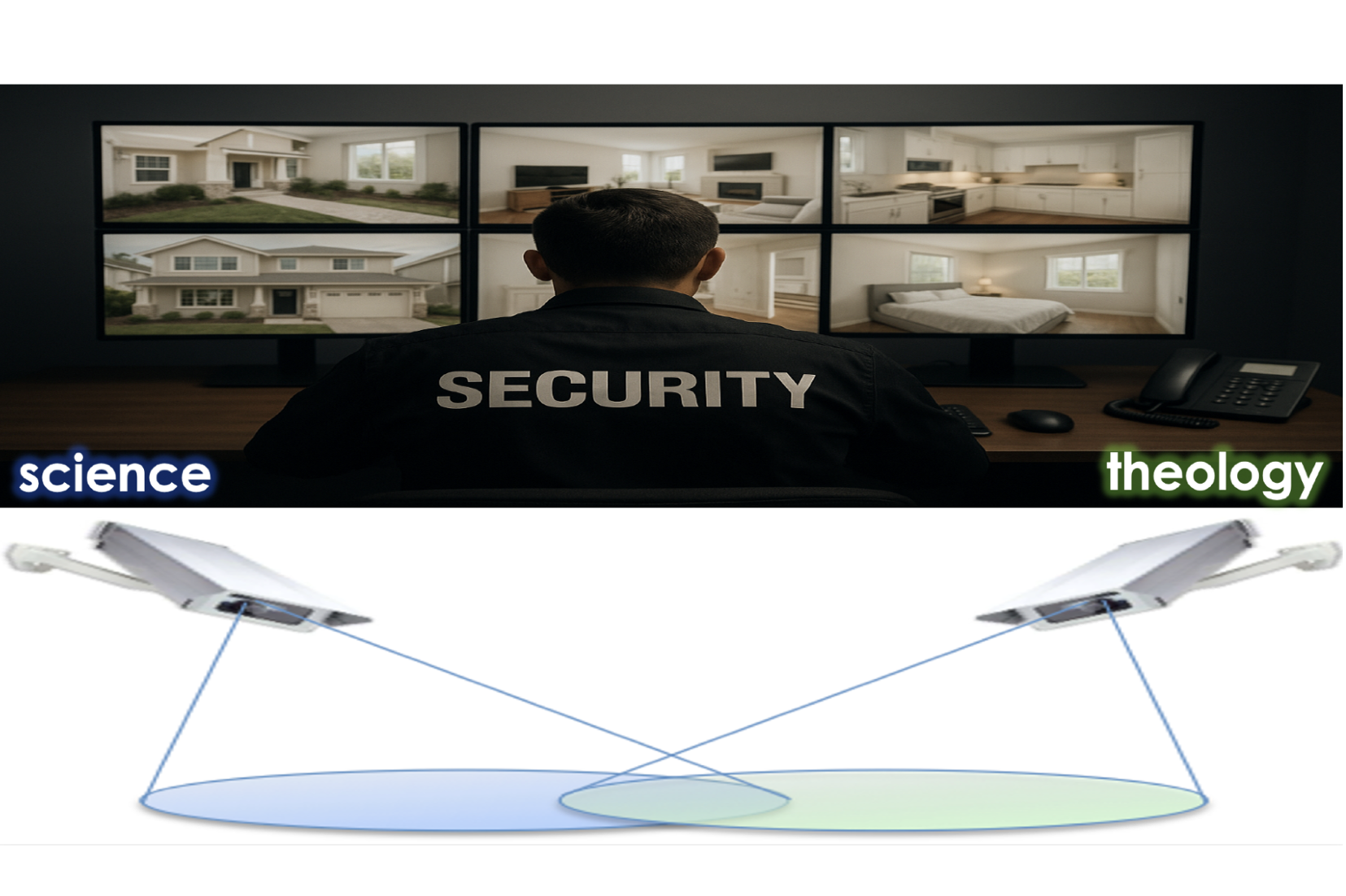
What science is capable of viewing
Science’s point of view and method of study allows us to “view” or explain natural events or things in nature by considering the initial state of nature (how a system started out) and the natural laws involved, which take a system from where it began to its current state.
For example, when some friends and I found a broken sled and blood at the foot of a large tree at the bottom of a sledding hill, we were able to describe what happened. The initials conditions:
- A person with their sled at the top of the wintery hill had a lot of potential energy.
And the picture is completed by describing how the natural laws involved took the system from where it began to its current state:
- The potential energy of the sledder was turned into high kinetic energy when deciding to start down the steep hill on a low friction ramp of snow and ice.
- And the significant force of the sledder (force = mass x acceleration) collided with the tree to impart an equal and opposite force to the young person’s sled and face.
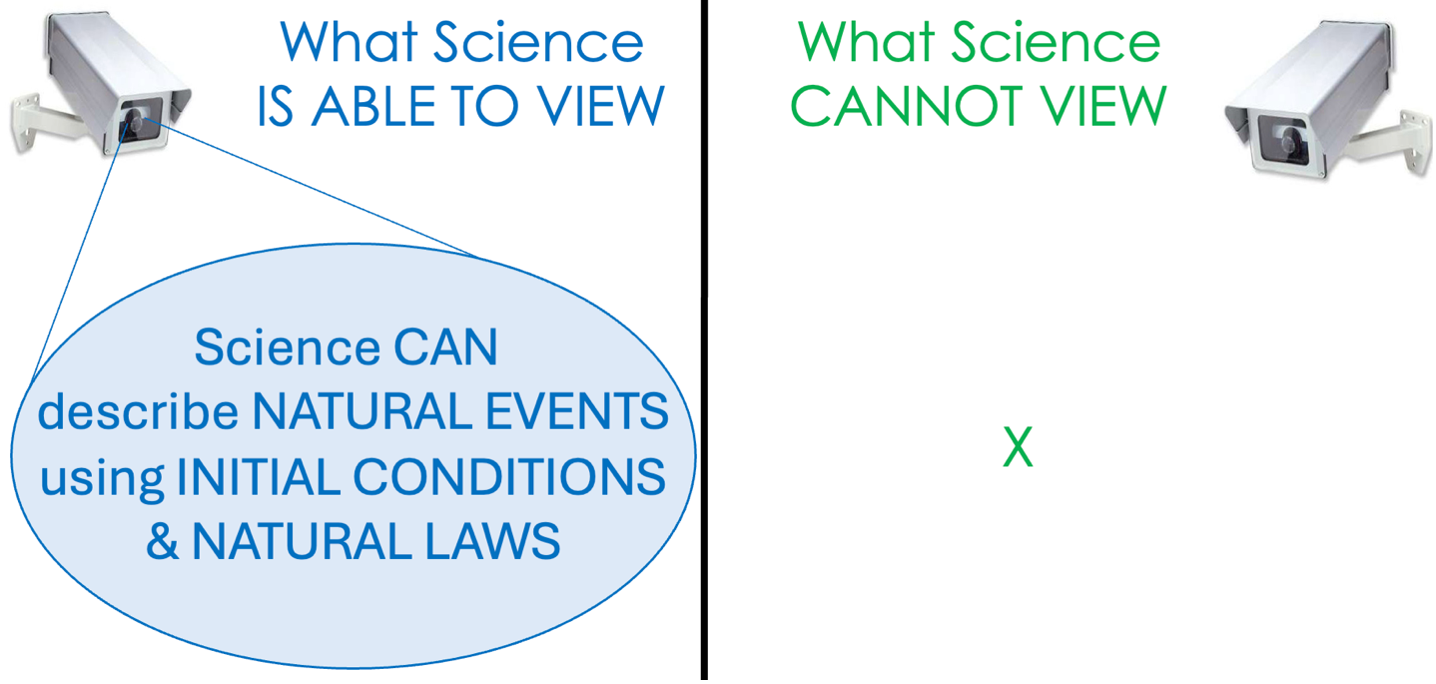
Science is limited and unable to disprove the miraculous
Science is a powerful tool to describe natural phenomena, but did you notice the limitations of science. Science’s area of view is not infinite, and even ignoring constraints caused by human limitations, the view is always inherently restricted to:
- A closed system, meaning no input from anything beyond the limits of nature.
- Only natural things and events involving matter, energy, space, and time of nature and the natural laws these things follow are able to be viewed and explained.
Therefore, if there is anything beyond nature, or actions beyond natural laws, then science is incapable of providing the necessary view. You need other tools and corresponding viewpoints.
What does this mean?
Science is incapable of viewing, much less providing a comprehensive claim about a causal agent beyond nature, or activity beyond the explanation of natural laws. The only things science can comment upon is if an event is best explained by natural causes or not, and is beyond natural explanation.
Science is capable of disproving specific miracle claims, but this falls far short of being able to reliably state miracles do not occur.
Furthermore, what science is capable of viewing is natural events that are not explicable by anything in nature or natural laws—and science has confirmed just that.
Science has already verified the greatest miracle
We have scientific confirmation of not only a causal agent transcending or beyond all nature, but also an event beyond or seeming to violate the natural laws that science is dependent upon for explanation.
This is all discussed in detail in The Bigger Cause post.
Possibly the greatest discoveries of science have shown us that reality exceeds the natural bounds of science. Because all of nature has a beginning and is contingent upon a cause outside of, or beyond, all nature and natural laws, reality includes an area beyond the constricted field of view of science.
This causal agent beyond all nature demonstrated the ability to bring all matter and energy into existence, which violates one of the most fundamental laws of nature, the conservation of matter/energy. This matches our definition, and likely any definition, of a miracle. Here again is atheist philosopher J. L. Mackie’s definition:
The laws of nature … describe the ways in which the world—including, of course, human beings—works when left to itself, when not interfered with. A miracle occurs when the world is not left to itself, when something distinct from the natural order as a whole intrudes into it.
And here is our simpler definition:
A miracle is a special act of God in the natural world, which would not be able to occur if the natural world was all there is.
A back-peddling critic may try to argue this special act was not necessarily by God. Okay, what do they suggest, an alien? Aliens, if they exist, would be part of the created order, and we still require a creative agent beyond all nature.
In fact, the argument only has weight if the person fails to consider the astronomical weight of the comprehensive case of evidence for the biblical God. In fact, the discoveries of the universe having a beginning spotlighted a number of necessary properties of the causal agent, which include: transcending nature, transcending time and being eternal, more powerful than the sum of all power in the universe, able to work miracles, and capable of choice.
This is not forcing modern discoveries to fit in the ancient Bible, these exact properties were given only by the Bible, against all other beliefs, science and common sense of the time, thousands of years before modern science confirmed the numerous pieces of foreknowledge of the Bible.
Astronomer Hugh Ross described an interesting interaction before his talk to a group of scientists at NASA. Before he was about to give his presentation, the group leader, having read Ross’ lecture, said he didn’t want him using the word “God” at all. Knowing the NASA leader recognized the evidence and what it meant, Ross responded by asking if when referring to the cause of the universe he could instead use the phrase “causal agent transcending space and time” created the natural universe. The leader said, ‘Yes, you can use that.”
And for a causal agent capable of supervening natural laws to the point of creating the entire natural order, other miracles, such as a virgin birth or raising from the dead are minor in comparison. It would be like asking a master chef to make a hamburger.
Objections to Miracles Answered by Misunderstandings of Science
Objection 17, 18, 19, 20:
“I believe in science, not ancient myths like miracles.”
Another version of this objection is given by skeptic Michael Shermer and others: “There is no such thing as the paranormal or the supernatural; there is just the normal, the natural, and mysteries as yet unexplained by natural law and chance/contingency.”[xxvi] Science will continue to expand to supply all truth.
Science has already refuted miracles, and eventually will explain all of reality to the point of not needing religion.
There must be some unknown natural law that explains this miracle.
Answer 17 – 20:
If you truly believed in science, then you would believe in the scientific demonstration that the greatest miracle already occurred.
Further, miracles are part of a theological context. And science and theology are just different fields of study, with different fields of view, but both can be turned on a miracle claim to more comprehensively view and evaluate.
Shermer, or anyone making such objections, has a serious misunderstanding of science. This is especially odd in Shermer’s case, being a historian of science. This belief that scientific descriptions using natural law is the way to explain all things, known as scientism, has been refuted and largely rejected since the mid-20th century.
The tool of science used by humanity will never expand to supply all truth, or remove the need for theology or other fields of study—science is incapable of this. Science has definite limits by its very nature, and cannot view or provide necessary knowledge beyond nature and natural laws, which is exactly the area we need to view to answer the question of miracles.
In addition to falling into a nearly century-dead belief in scientism, Shermer adds further established inaccuracy to his beliefs by stating there is nothing beyond nature and natural law.
I am sure science has refuted a lot of miracles. However, since different belief systems contradict each other, then we expect many miracle claims to be false and able to be refuted. This is not surprising at all, but what is mind-blowing is the fact that science and mathematics have already verified miraculous events and claims.
As far as a possible unknown natural law:
First, rather than believe the event is a miracle, the person assumes it must be some unknown natural phenomenon. This is just rejecting the possibility of miracles even before considering the evidence. This is the ad futuris fallacy in logical thinking. Notice what this person is saying: if we just wait long enough, eventually science find the evidence to show us I was right and miracles don’t exist.
Second, what evidence do you base this belief on? Science has a sufficiently clear grasp of natural laws to know when something is naturally impossible. And only if the event happened repeatedly, then we would know the natural law was falsified and need a new one.
Third, when miracle claims are so numerous, diverse, unique, and tied to specific theological context (background and purposes of a specific theological claim), then appeal to an unknown natural law stretches far beyond possible application and becomes absurd.
Objection 21:
Claiming a miracle stops scientific pursuit.
Answer 21:
Your challenge is only correct if you already know God does not exist, and science is the only source of knowledge and can reach all knowledge. But assuming their is no God before answering whether a miracle occurred is circular reasoning, and the latter belief in science has been disproven a long time ago.
When someone proposes the hypothesis of a supernatural event, a miracle, to explain some occurrence, then that person should delineate ways to test and falsify the hypothesis. Therefore, of course, natural explanations should be sought by first, thereby bringing science in as a partner.
Science only stops at its natural limits: explaining events in nature using antecedent conditions and natural laws. If scientifically it can be shown that a natural explanation is incapable of explaining the evidence, then the supernatural hypothesis can be the best inference from the evidence.
Objection 22:
Miracles are impossible as nothing can violate natural law.
Answer 22:
You are missing the context science always applies.
Natural laws are defined to be operating within a “closed system;” a system isolated from anything beyond nature. Picture a container containing all of nature, and no natural thing (matter, energy, space, time) of nature can enter or leave the container, or be impacted by anything beyond the container. And inside that container is all that science is able to view.
Now, if there is anything beyond that container, then nature does not exist in an entirely closed system, and something beyond nature is potentially able to impact nature and the normal expectations science has based on natural law.
Science describes what happens when nature is left to itself, but miracles occur when nature is not left to itself.
A miracle can occur even without violating natural law when something beyond natural laws is able to act.
C.S. Lewis described a situation we are more familiar with when a closed system is not really a closed system:
If I put six pennies into a drawer on Monday and six more on Tuesday, the laws decree that – other things being equal – I shall find twelve pennies there on Wednesday. But if the drawer has been robbed I may in fact find only two. Something will have been broken (the lock of the drawer or the laws of England) but the laws of arithmetic will not have been broken. The new situation created by the thief will illustrate the laws of arithmetic just as well as the original situation.[xxvii]
Additionally, science has found very interesting realities at the quantum level. The quantum level means operating at the subatomic scale (smaller than 100 nanometers), where physical reality behaves differently than the familiar macroscopic world in which you and I operate. The world at the quantum level is governed by probabilities and discrete, rather than continuous, energy values.
This means if a God understood and could manipulate and stack these probabilities in nature at the quantum level, then seemingly impossible things, at least impossible for humans to initiate, become possible.
One able to know and manipulate nature at the quantum level could theoretically cause a person to instantly freeze, or could walk through a wall, literally.
A physics lecture (I forgot from whom) discussed how quantum mechanics says that it is possible to run into a wall and pass through it without any harm coming to yourself or the wall. He went on to say he could actually demonstrate it in the lab on an atomic level.
On the much larger level of me and the wall, it becomes ridiculously improbable, but not impossible. And while the professor did not move from theoretical to theological, one could manage such an act if one was in a position of knowledge, power and existence beyond natural limitations to enact.
Not to mention, a transdimensional agent (outside the three dimensions of space and one dimension of time within which we operate) would have even more capabilities—beyond what we could even imagine.
Objection 23:
Occam’s Razor instructs us to go for the simplest explanation of an event, and a miracle is not it.
Answer 23:
You misunderstand Occam’s Razor.
This is a problem-solving principle that recommends searching for an explanation that has the smallest possible set of elements.
This, of course, does not mean the simplest explanation is best. Part of using the principle is to also recognize if more elements are necessary to accurately explain the problem, then that is the explanation you go with. The explanation with the best evidence wins—of course.
How does this apply to the issue of miracles?
When considering a miracle claim, look first for a natural cause, there is no need to bring in the supernatural if not necessary. However, if the best explanation of the evidence most likely is not a natural cause, and instead requires a supernatural cause, then that extra element is necessary, reasonable, and the best explanation.
How to approach “miracles”
People need to approach this topic methodically because so many lose a firm grasp of this topic when bypassing steps.
- What is a miracle?
- Recognize the significance.
- What is your background concerning miracles?
- Look for natural explanations first.
- Normal scientific method or common-sense problem-solving steps
- Infer the best explanation based on the evidence.
- Apply the answer to your life.
After a brief explanation of each of these steps, we will focus on the fifth step for a brief look at a significant example: the resurrection.
- Recognize the significance.
The question of do “miracles” occur may not seem relevant to you right now, but the significance will inevitably and dramatically impact you at some point.
Why? Because standing above the secondary question of miracles is the primary question: Does God exist? If miracles occur, then we need to account for the existence of a supernatural entity active within our world.
Do you really believe it will not impact your life whether or not there is a Creator, who demonstrated the capability of purposefully creating the entire universe and personally coming to earth to demonstrate what he is like, how serious our situation is, and how much we are valued? If so, why do you believe this? Please explain your logic as I am very skeptical of such a belief. Please send in your argument and evidence to the website.
- What is your background concerning miracles?
This is where the miraculous misunderstandings come into play. We all have background knowledge, feelings, biases, comfort levels with new information, and so on. These need to be recognized and kept in check, or, without exception, you will step into negative consequences when you allow poor thinking habits to narrow the view that evidence opens up.
Some people too easily accept an event as miraculous—to their detriment—if the evidence rejects the reality of miracles. Some people too easily reject an event as miraculous—to their detriment—if the evidence verifies the reality of miracles.
Typically, these mistakes come from the misunderstandings people have about miracles, which will be discussed in a later section.
Filtering new evidence with what you want to believe rather than what the evidence supports can make smart people stupid. You are only creating a reality that does not extend beyond your skull, but with consequences impacting your life and those around you.
Therefore, try to be as open and genuine as you can. Check the misunderstandings section below to avoid improper filtering of information or allow biases to make decisions before you even consider the evidence. Because your choice will not impact me, but it will certainly impact you and those close to you.
- Look for natural explanations first.
Because miracles are rare, that is what makes them special and significant. Therefore, we have to test and examine claims.
Also, there have been examples of fraudulent miracle claims, possible natural explanations such as psychosomatic effects, and so on.
- Normal scientific method or common-sense problem-solving steps
We naturally know how to approach a question we need an answer to (see discussion in How Can I Know: As the Boy Sticks His Hand Into An Electrical Socket post.
- We have a question to answer: Do miracles exist?
- We have defined what would constitute a genuine miracle.
- Each of us has our own hypothesis right now, based on what we currently think we know. Maybe you believe in miracles, maybe you don’t, maybe you could go either way.
But this is one of the most significant steps, not only because of confirmation bias, but also because most people misunderstand what the primary issue is—and the corresponding evidence involved.
The primary issue (whether a supernatural God exists or not) is the primary factor of your background expectations of hypothesis (your prior odds on whether miracles are possible). And the evidence for theism over naturalism is substantial, and must be applied when answering this secondary question of miracles.
- Tests and data have to be gathered to either confirm or refute our hypothesis. This has already been largely done as there are countless miracle claims, and scientists, philosophers, theologians, historians, mathematicians, and more have done the research and provide the data. Possibly you have your own personal examples, which may not have the documentation to be great evidence for others, but you are in the position to know, analyze and judge.
- Analysis of this data has to be done with extra care. Whenever worldview beliefs are involved, emotions and preferences are known to invade and often have much more of an impact on the analysis than is rationally warranted.
I have observed Christians who believed in a miracle claim without proper thought, and were burned by the inaccuracy.
On the other hand, skeptics also fall into allowing their wants and emotion to overwhelm proper thought. Thomas Nagel famously expressed his “Cosmic Authority Problem.” Nagel confessed that his own atheism was rooted not just in a lack of evidence for God, but in a psychological desire for there to be no such “cosmic authority,” stating:
I want atheism to be true and am made uneasy by the fact that some of the most intelligent and well-informed people I know are religious believers. It isn’t just that I don’t believe in God and, naturally, hope that I’m right in my belief. It’s that I hope there is no God! I don’t want there to be a God; I don’t want the universe to be like that.[xxviii]
Poor analysis just makes you look bad, and sets you on a careless path of consequences. And there may be tremendous benefits to add reliable meaning to your life if you are open to and come into reliable conclusions.
- Repeat the process as needed to reach a trustworthy conclusion, and to evaluate new information if warranted.
All we need to demonstrate is a single example of a miracle, and then miracles do exist. Or, if the evidence best supports the existence of God, the likelihood of miracles is again established.
While the evidence for the existence of God is given throughout the website, what we will do in this post is present some examples of potential miracles for you to evaluate.
- Infer the best explanation based on the evidence.
We naturally do this as well, which is also explained in the post noted above.
But if you like numbers, and a formal way to test the likelihood your belief after seeing the evidence is reasonable, then we will use a fundamental formula in probability theory, Bayes’ theorem, and apply it to a specific miracle—the resurrection.
- Apply the answer to your life.
If miracles do not exist, then the application is easy: there is no God or miracles to look to in life. Most likely a naturalist worldview like materialist atheism is true, and all the corresponding truths that follow materialist atheism is the reality of your life (see a list by clicking here).
If miracles do exist, then the application is a bit more complicated, but comes with massive possible benefits to add to your life. There is a supernatural source of miracles that can be applied to your life and beyond. But first you must:
- Determine what is the supernatural source of the miracles
- Determine if you want to trust your life and possible existence beyond life to this source
- Learn the best way to have relationship with this source, and how miracles apply to your life
Bayes’ probability theorem applied to Jesus’ resurrection
a. What Bayes’ theorem is (in plain language)
Bayes’ Theorem is a rule for updating what you believe when you get new evidence. It tells you how confident you should be in a hypothesis after seeing new evidence, or what is the probability the hypothesis or claim or belief is true, based on:
- how plausible the hypothesis was before the evidence (known as Prior Probability), and
- how well the evidence fits that hypothesis versus other alternative hypotheses (known as the Likelihood Ratio).
b. The equation
Bayes’ theorem: 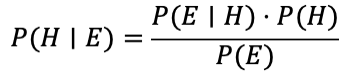
Posterior Probability P(H|E):
- The probability that the hypothesis (H) is true after considering the evidence (E).
- This is what you’re trying to calculate.
Prior P(H):
- How likely the hypothesis was before you looked at the evidence.
- This represents background knowledge or baseline expectations.
Likelihood P(E|H):
- How well the hypothesis predicts the evidence
- This will be changed to the likelihood ratio in the Bayes’ theorem (odds form), which makes the equation easier to understand
Evidence P(E):
- The overall probability of observing the evidence under all possible explanations.
- This acts as a normalizing factor so probabilities add up correctly.
- This also will be changed when moving to the likelihood ratio
The equation can be rearranged and written in the Bayes’ theorem (odds form), which is easier to use for our application: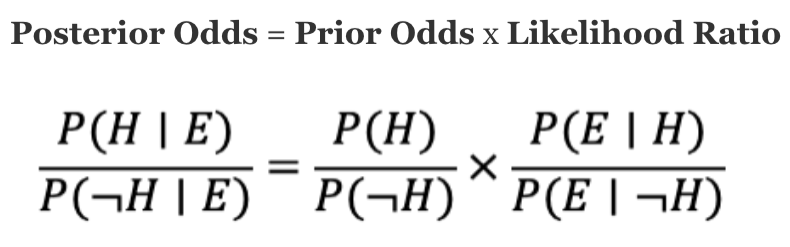
For those who do not like the philosophical terms in the equation, focus just on what this equation is saying is:
Posterior Odds = Prior Odds x Likelihood Ratio (or Bayes Factor)
In other words, your posterior odds or new probability the miracle claim is true equals the odds of the claim being true based on the background knowledge we already have, multiplied by the impact of the new evidence, which is quantified by the Bayes factor.
Likelihood Ratio (Bayes Factor): 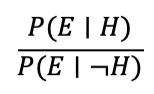
- The numerator is the likelihood we would have the evidence we do if the resurrection did occur.
- The denominator is the likelihood we would have the evidence we do if the resurrection did not occur.
The likelihood ratio quantifies the strength of the evidence in favor of the hypothesis that the miracle claim is true over how likely it would be to have the evidence we have if the hypothesis were false. This multiplier factor updates the prior odds of the claim being true to the new odds after the evidence is taken into account.
c. Sample calculations applied to the resurrection miracle
- Start with choosing your values for the Prior Odds & Likelihood Ratio
Based on all you know so far, what odds would you place on God performing the resurrection miracle?
Be careful. Many just say it is basically impossible and assign an extremely low value. If you are 99.9999999999% certain there is no God performing that miracle, then the prior odds you would input into the equation would be 0.000000000001 or 10-12.
BUT, this would only be valid if the hypothesis was asking if Jesus was raised from the dead naturally. HOWEVER, the hypothesis is not asking that, but instead asks if Jesus was raised from the dead supernaturally. This changes everything. If the biblical God exists, then what reason do you provide to make it improbable that God performed the miracle? Surely, God would be capable of a miracle. So, if you had to bet all you have, how certain are you God does not exist?
Your prior odds have to also account for the evidence for the existence of the supernatural biblical God.
Based on all the evidence you currently have regarding the biblical God, how certain are you no such God exists to perform the miracle?
- If you are absolutely certain there is no God …
That would make your prior odds value 0.0, the result of the equation could never be anything but 0.0 for your posterior belief odds. This means absolutely no evidence will ever be able to change your mind. You are exposed as an unreasonable person, whose thinking violates science and logic.
- If you are a bit more reasonable about your belief …
Let’s say you are 70% certain there is no God? Then your prior odds that the resurrection did occur would be 0.3. If you were only 55% certain no God performed the resurrection, then your prior odds would be 0.45.
- If you are a Bible believer, how strong do you believe your evidence is supporting God’s existence and authentication in the resurrection miracle?
If you are 98% sure the resurrection occurred, then your prior odds would be 0.98. If only 55% certain, then your prior odds value is 0.55.
We will begin our first calculation with the skeptic’s extremely low prior odds:
Prior odds: 0.000000000001 or 10-12
This means you are 99.9999999999% certain there is no God performing that miracle. I think we can show this value is extremely and demonstrably inaccurate, but will use it now to show the power of evidence.
Key concept: This is one place where skeptics input a faulty value leading to a faulty belief about miracles.
Likelihood Ratio:
- P(E|H) = 0.7 = likelihood we would have the evidence we do if the resurrection did occur.
Considering the pattern of the biblical God was to establish authority by miracles unable to be matched by others, and we have a prior expectation that God would raise Jesus from the dead in order to vindicate his self-claims to Messiah and Savior, and the Bible even predicted the resurrection hundreds of years prior to Jesus’ birth. Therefore, it would be more likely than not that we would have such evidence. The evidence fits the resurrection very well, and should likely be higher than the 0.7 value.
Look again at just some of the evidence and decide how likely this evidence fits if the resurrection miracle did occur:
- prophecies and symbols throughout the Old Testament specifically picking out only one person, who will ever live, that be the Messiah. Jesus is the only one who fits within all the prescriptions (explained in 1 in 100,000,000,000 Pick).
- an empty tomb admitted by even enemies of Jesus
- evidence of close followers, like the disciples or Paul, willing to sacrifice everything for a God they knew for fact had power over death or not
- immediate changes in skeptics, like Paul and James
- sudden changes in millennia-old sacred traditions because Jesus validated his place in the traditions,
- historical scholarship recognizing all of the above, and that the disciples sincerely believed their claim in Jesus being risen and making numerous post-crucifixion appearances, as fact
- all natural cause options have been thoroughly refuted and rejected by the scholarship
- plus, much more evidence in the comprehensive case
Here are some reasons why the evidence fits the miracle. God would ensure the Messiah would be able to be predicted, or picked out from every other person who would ever live, to provide grounds to establish Jesus. The people who knew the facts of the situation, the disciples and others like James and Paul, would show sudden and dramatic life change. The evidence, if available, would survive the finest scrutiny through history if God used it for validation.
Therefore, it is reasonable to assume a high likelihood for the evidence matching the event, and 70% likelihood or 0.7 is conservative.
- P(E|not-H) = 0.0000000000001 = 10-13 = likelihood we would have the evidence we do if the resurrection did not occur.
Key concept: This is another value skeptics do not do due diligence upon and arrive at a reasonable value.
Think about it, if prior odds in the numerator is really low, say 1 in a million, and the likelihood an alternative theory can explain the evidence we have is really low, say 1 in a million, then these cancel out to 1.0. Therefore, all natural explanations for the resurrection can be so unlikely in explaining the evidence we have, the prior unlikeliness of the miracle claim can become the only rational belief.
The value I chose is still conservative, let me explain why I think so below, and maybe you can refute the logic and let me know what better value you came up with. But the skeptics expose themselves if assuming the intellectually lazy position of sitting back and only casting skepticism on the hypothesis they do not like, they have to be equally skeptical of their own skepticism. It is now the skeptic’s responsibility to pick the naturalistic (no God involved) theory or theories that explain the bundle of evidence surrounding Jesus’ resurrection. And how probable do you think this theory is? Remember, the naturalistic theories have been rejected by skeptics long ago due to lack of evidence, fatal flaws, significant evidence for resurrection refuting these theories, and a background of evidence supporting an active, supernatural, purposeful, biblical God.
Consider just the brief list of evidence provided earlier surrounding the biblical God and the resurrection:
- The symbols, tradition, and prophecies, all of which have been established as being written typically hundreds of years before Jesus’ birth, eliminate as a possibility for the Messiah every single person who have ever lived on earth—except one—Jesus.
This is impossible without a miracle, but if you want a conservative estimate: there have been around 100 billion people who have ever lived, and the odds of picking out one specific person would be 1 in 100,000,000 = 0.00000000001 = 10-11
- Having evidence of multiple eyewitnesses, who knew for fact if their claims about Jesus’ resurrection and following appearances were true or not, sincerely believe in the resurrection to the point of willingness to sacrifice all they had. And further, for the evidence supporting this to survive through history to the point the scholarship accepts this as fact.
There is no other belief system or acclaimed God or prophet—none—that make a testable claim like being able to rise from death to verify their authority, place this claim on the examination table, and come away with the evidential validation of the claim.
In addition, critics routinely complain there are thousands of religions, and if this is true, then considering the resurrection is on a level of evidential support no other religious claim can reach, then conservatively, we could place the odds of having such evidence of the eyewitnesses, which also included skeptics, to be 1 in 1000 = 10-3.
- Having millennia old traditions change suddenly, timed with the same resurrection event. This occurred with the Jewish followers of Jesus, including: changing the Sabbath focus from legalistic work restriction to a day of spiritual rest, with some even observing it on Sunday (“The Lords Day”), shift from sacrificial system to Jesus being the completed sacrifice for sin, and inclusion of Gentiles in worship and in the family of God.
I do not know how many times or chances this had to occur in history, so 1 in 100 (10-2) odds seems conservative.
We could go on, but this is more than enough to make the point. These separate supportive evidences have to be multiplied together to get the final likelihood that you would see this evidence bundle if the resurrection had not occurred.
10-11 x 10-3 x 10-3 = 10-17, but instead I used a much more conservative 10-13 in the equation, which is 1000x more favorable to those who do not want to believe in the resurrection.
Therefore, the likelihood ratio or Bayes factor = P(E|H) divided by P(E|not-H) = 0.7 / 0.0000000000001 = 7,000,000,000,000
Interpretation: The evidence is 7 trillion times more expected if the miracle occurred than if it did not occur.
d. Conclusion:
Posterior Odds is the new probability the resurrection occurred based on your Prior Odds being updated by the evidence for the resurrection, which is evaluated using the Likelihood Ratio (Bayes Factor).
Posterior Odds = 0.000000000001 x 7,000,000,000,000 = 7
Posterior Odds of 7 means: 7:1 or it is seven times more likely the resurrection occurred than not.
Posterior Probability:
Therefore, the probability the resurrection miracle occurred P(H|E) = 7 / (1+7) = 0.875 = 87.5%
This means your new probability that the resurrection did occur has now changed from your prior odds based on the evidence, and being at such a high value near 90%, if you want to bet your life against the God who accomplished the resurrection, the odds are 7 to 1 against you. And luck will not save you from the consequences.
Key insight:
Even with an extremely skeptical prior odds, if the evidence is vastly more expected under the miracle hypothesis than under the natural explanations, the posterior probability can become very high and make it unreasonable not to believe in the resurrection.
What If
- What if we replaced the unreasonable Prior Odds of being 99.99999999% certain God does not exist or did not bring about the resurrection, to being 70% certain. Then we recalculate to find …
Posterior Probability = 99.999999999952% In other words, you’d be a fool not to believe in the resurrection, based on the evidence.
Can you see what a difference prior odds make, which are impacted by your background assumptions, confirmation bias, or awareness of the evidence available.
What If
- What if we replaced the value I selected for the denominator of the likelihood ration which tells us the likelihood of seeing the bundle of evidence for the resurrection if the resurrection did not occur?
I showed how I got the number, and made it very much less powerful for the sake of being conservative. But let’s say a skeptic, decide to input a value without much thought. They failed to consider how vastly low the likelihood of a natural explanation is to explain the evidence we have. Critics have already abandoned these failed alternative explanations, and have had the most study and over 2000 years to find even a reasonable explanation.
Ignoring all that, these skeptics hold to the examples we have of testimonies or miracles even when no miracle occurred, and examples of fraud fooling people. This is true, but failing to take into account the vast unlikelihood of natural explanations for the bundle of resurrection evidence, the value they may input is fatally flawed. They may end up claiming a 20% chance of seeing such evidence even if the resurrection never occurred.
The result, the same skeptic having prior odds of being 99% sure the resurrection never happened, after seeing the exact same evidence, would now calculate the following …
Posterior Probability = 3.38% And if this was the value you calculated, then it would be unreasonable to believe in the resurrection as the likelihood is under 4%. Unfortunately, the values input into the equation by the skeptic to get 4% are unreasonable and lead to a faulty answer.
Therefore, the debate about miracles always comes down to: (1) priors and (2) how expected the evidence is under each hypothesis.
Which leads to the obvious question: What evidence is brought to the table to back up the values input into the equation?
Endnotes
[i] Mackie, J. L. The Miracle of Theism, Oxford: Oxford University Press, 1982, 19-20.
[ii] Tipler, F.J. 2007. The Physics Of Christianity. New York, Doubleday.
[iii] Romez, C., Zaritzky, D., & Brown, J. W. (2019). Case report of gastroparesis healing: 16 years of a chronic syndrome resolved after proximal intercessory prayer. Complementary Therapies in Medicine, 43, 289–294.
https://doi.org/10.1016/j.ctim.2019.03.012
[iv] Neilan, B. A. (2013). The miraculous cure of a sarcoma of the pelvis: Cure of Vittorio Micheli at Lourdes. The Linacre Quarterly, 80(3), 277–281. https://pubmed.ncbi.nlm.nih.gov/30083003/
[v] Keener, C. S. (2011). Miracles: The credibility of the New Testament accounts (Vols. 1–2). Grand Rapids, MI: Baker Academic.
[vi] Strobel, L. (2018). The case for miracles: A journalist investigates evidence for the supernatural. Grand Rapids, MI: Zondervan.
[vii] Strobel, The Case for Miracles, 99-101.
[viii] Rex Gardner, Healing Miracles: A Doctor Investigates (London: Darton, Longman & Todd, 1986), 202–6. As cited in The Case for Miracles, 101.
[ix] Gardner, Healing Miracles, 165. As cited in The Case for Miracles, 101.
[x] See Harold P. Adolph, Today’s Decisions, Tomorrow’s Destiny (Spooner, WI: White Birch, 2006), 48–49; Scott J. Kolbaba, MD, Physicians’ Untold Stories (North Charleston, SC: CreateSpace, 2016), 115–22. As cited in The Case for Miracles, 101-105.
[xi] Lee Strobel, The Case for Miracles: A Journalist Investigates Evidence for the Supernatural (Grand Rapids, MI: Zondervan, 2018), 51.
[xii] Lee Strobel, The Case for Miracles: A Journalist Investigates Evidence for the Supernatural (Grand Rapids, MI: Zondervan, 2018), 128.
[xiii] Lee Strobel, The Case for Miracles: A Journalist Investigates Evidence for the Supernatural (Grand Rapids, MI: Zondervan, 2018), 131.
[xiv] Strobel, L. (2018). The case for miracles: A journalist investigates evidence for the supernatural. Zondervan, 30.
[xv] Barna Group. (2016, September 29). Most Americans believe in supernatural healing. Barna.
[xvi] HCD Research & Louis Finkelstein Institute for Religious and Social Studies. Science or Miracle? Holiday Season Survey Reveals Physicians’ Views of Faith, Prayer and Miracles. National survey of 1,100 U.S. physicians, December 2004. You can read a report summarizing the survey here: Science or Miracle? Holiday Season Survey Reveals Physicians’ Views of Faith, Prayer and Miracles
[xvii] Pew Research Center. (2009, November 5). Scientists and Belief. Pew Research Center.
[xviii] C.S. Lewis, Miracles(San Francisco: Harper Collins, 1974), 169.
[xix] Lewontin, Richard. “Billions and Billions of Demons.” The New York Review of Books, January 9, 1997, 31.
[xx] David Hume, An Enquiry Concerning Human Understanding, ed. Tom L. Beauchamp (Oxford: Oxford University Press, 1999), Section X, “Of Miracles.”
[xxi] Bart D. Ehrman, Jesus: Apocalyptic Prophet of the New Millennium (Oxford: Oxford University Press, 1999), 229.
[xxii] Sagan, Carl. Broca’s Brain: Reflections on the Romance of Science. New York: Random House, 1979.
[xxiii] Bart D. Ehrman, The New Testament: A Historical Introduction to the Early Christian Writings, 6th ed. (New York: Oxford University Press, 2016), 147.
[xxiv] C. S. Lewis, Miracles: A Preliminary Study (London: Geoffrey Bles, 1947), 113.
[xxv] Blaise Pascal, Pensees, trans. A. J. Kraillsheimer (London: Penguin Books, 1966), 167.
[xxvi] Shermer, Michael. “What I Believe But Cannot Prove.” MichaelShermer.com (blog), June 1, 2005. https://michaelshermer.com/articles/what-i-believe-but-cannot-prove/
[xxvii] C. S. Lewis, Miracles: A Preliminary Study, rev. ed. (New York: Macmillan, 1960), 6.
[xxviii] Nagel, Thomas. The Last Word. New York: Oxford University Press, 1997, 130.