
Brief Answer: This is a secondary question, what is the primary or first question you need to answer?
Primary question: Is there a Creator of the Universe behind the Bible? If no, then the Bible is just another ancient book, and may have similar ideas to other ancient wisdom, but will be exposed constantly as inaccurate when making testable scientific claims.
If yes, then such a source will always be a greater, more reliable, and more important source of knowledge than science. We have evidence of this, are you open to hear some? If so, read the blogs about the beginning of the Universe and the cause of the Universe.
Detailed Answer:
Is the Bible just a bunch of ancient ideas?
This statement includes the critical assumption these ideas are only the product of people. And these ideas do come from ancient times, therefore, if they are just from people, then these ideas are not worth anything more than any other ancient idea. In addition, so many ancient ideas, including all kinds of ancient religious claims, have been entirely falsified and appear foolish due to modern understandings.
HOWEVER, if this assumption is wrong, and there is a God involved in the Bible, then these ancient ideas become likely the most unique, important and reliable knowledge we could possibly have.
So the primary question is: Is God involved in the Bible and how would we know? One answer could be the source in question would have to provide something beyond the capability of any human – and we have evidence of that. This information is explained in a number of blogs, including: Five Smooth Stones, The BIG BEGINNING, The BIGGER CAUSE, 1 in 100,000,000,000 Pick, etc.
To derogatorily write-off the Bible as just a bunch of ancient ideas displays serious ignorance, unless the person can demonstrate many other man-made examples matching what the Bible provided: for example, clearly and specifically predicting dozens of facts about the beginning and cause of the Universe, against every other belief system and science, only to be proved exactly correct thousands of years late by modern science discoveries. If the Bible was just something only produced by ancient people, then throughout all of time, there will be many, many other times when people matched what the Bible provided – what are your examples?
Maybe if you turned on your theology camera, you would see a much bigger picture of our existence.
The real relationship between science and theology
This will cover the same information as noted in the brief answer, but you can also ask them what they believe about the relationship between science and theology. This is explained in detail in the booklet: “The Cameras of the Watcher: The Relationship Between any Field of Study and Theology.”
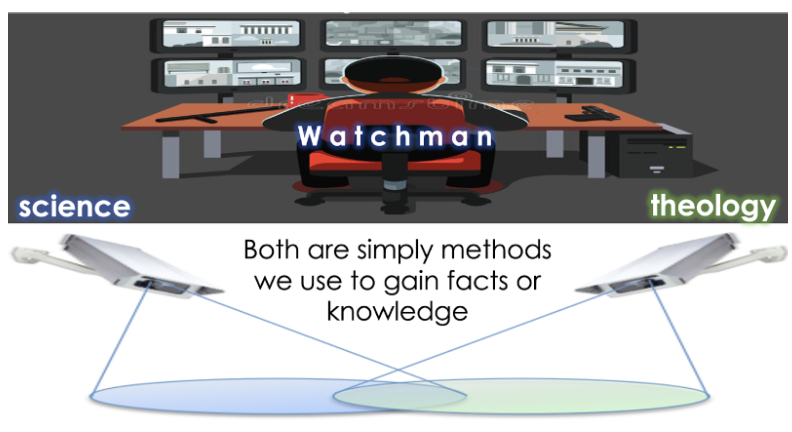
Imagine yourself as the night watchman of a huge house, and you must stay only in an office, which provides only a marginal view of the rest of the house. But you have cameras, labeled: physics, philosophy, mathematics, theology, history, and others, which monitor different areas of the house through their respective unique points of view. While each camera sends back its own view and information (what that field of study is capable of studying and providing knowledge about), you can combine all the views at your terminal in the office, in order to have the most comprehensive possible coverage of the house.
Now and then you notice some important large areas, and some difficult corners cannot be fully illuminated by a camera. Therefore, you simply turn other cameras towards the same area. Even though the cameras will view the area from different points of view, they each still view the same thing and together cooperatively illuminate difficult areas. That is a good system, and the watchman can feel secure of being aware of as much as is possible.
Science and theology are not friends or foes, but different fields of study, or methods to gain knowledge about reality. If both the science camera and theology camera turn to the same aspect of the universe, or reality, they together provide a wider field of vision, and not only more knowledge, but also a very productive way to verify or discredit the accuracy each of the points of view provide. There are times when science helped expose some theological beliefs which were inaccurate, and there are times when theology helped expose some science beliefs which were inaccurate. Accurate science and accurate theology (since different theologies or worldviews contradict each other, only one, at most, will provide an accurate view) will inevitably trend towards mutually benefitting and supporting each other.
Here is an example using the field of view provided by physics on the bloody snow we discovered around a tree. Walking in a park at the edge of the University of Michigan campus, after the first big snowfall, we saw a broken food tray at the base of a tree with blood drippings all around it, and knew there was a scientific explanation for it. We knew excited students often gathered at the top of the adjacent hill, usually with big tubes or sleds, although some enthusiastic kids would use food trays stolen from the nearby dorm cafeteria. Science’s field of view includes anything able to be explained through initial conditions and natural laws. Observing a very steep slope of the hill, with the large tree standing at the base of the hill, we hypothesized the over-enthusiastic student (initial conditions: excited kid at top of hill with food tray) slid down the hill, with significant momentum on the steep slope (natural laws at work), leading to control of the ride being lost and the momentum led the ill-fated student to hit the tree. Natural laws dictate the tree giving back an equal and opposite force to the student’s face, leaving the evidence of a nasty crash.
When you know how something started (initial conditions) and how things behave in nature (natural laws), then you can explain the cause and effect we see in nature. This explanation was almost entirely within the specific view of physics, but maybe the view of physics isn’t the only viewpoint involved to correctly understand what we were seeing.
After unsympathetically laughing at the story physics had provided us, I started wondering how this student could be so unlucky, or stupid, to slam into the one tree, when 95% of the base of the hill was tree-free. Further, it was very unlikely the tray would have broken as it did, the blood looked a little suspect, a group of footprints were at the top of the hill with only one set of footprints back up the hill (meaning no one rushed down to help the supposed victim), and following the path of the tray down the hill showed unnatural turns, unless someone was purposefully trying to guide the tray toward the tree. At this point, we turned on our psychology camera also, and, using the combined view provided by both the physics and psychology cameras, had a new hypothesis: the broken tray and fake blood scene was set up to capture the sick fascination of people who love a good train wreck.
While physics gave a somewhat adequate explanation, if there is something outside the area physics can view, then physics cannot see it and has nothing to say about it. You would have to use another camera, psychology or sociology in this case, which has a different view maybe covering the area outside the physics-limited view.
The same is true when studying other aspects of your life and place in this world, and if you don’t think science’s view is limited, you do not understand science and are not using all your cameras well.
